Amazon S3 Durability: Why AWS Expects Hardware to Fail
The engineering philosophy behind Amazon S3’s famous 99.999999999% durability.
Amazon S3 Durability: Why AWS Expects Hardware to Fail
The engineering philosophy behind Amazon S3’s famous 99.999999999% durability.
One Question Started This Investigation
When I finished writing about Amazon S3 Strong Consistency, I thought I finally understood why Amazon S3 feels so effortless to use.
Uploads complete successfully. Objects are immediately readable. Applications no longer need to build workarounds for eventual consistency. From a developer’s perspective, everything appears remarkably straightforward. Yet one question continued bothering me.
If Amazon S3 can immediately return the latest version of an object after a successful write, how does AWS ensure that object still exists years later?
For Non-Members to read the article, click here.
At first, I assumed the answer must be simple. Amazon S3 probably runs on exceptionally reliable hardware.
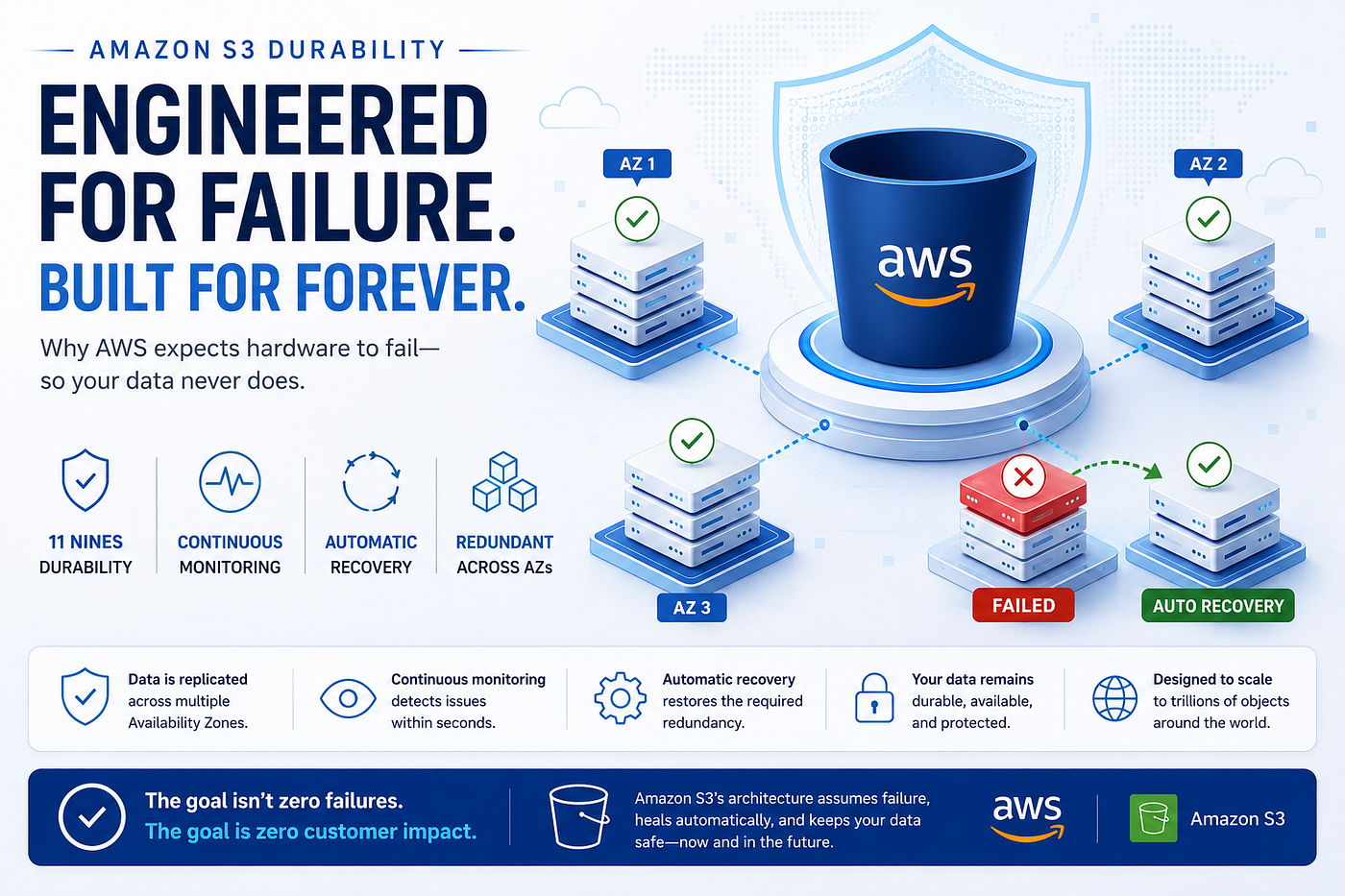
After all, AWS publicly advertises 99.999999999% durability. That number appears so frequently in documentation, conference presentations, certification courses, and architecture discussions that many of us simply accept it as evidence that Amazon S3 rarely loses data.
For years, I interpreted that number in exactly the same way. As I questioned that assumption, it became increasingly difficult to believe that exceptionally reliable hardware alone could explain Amazon S3’s durability guarantees.
Every storage device eventually reaches the end of its operational life. Hard drives fail. Solid-state drives wear out. Power supplies stop working. Network switches develop faults. Servers are routinely replaced as infrastructure evolves. None of those events are particularly surprising on their own.
What surprised me was realizing what they imply at Amazon S3’s scale.
AWS publicly describes Amazon S3 as a storage platform capable of storing virtually unlimited numbers of objects while serving millions of customers across the world. Even without knowing anything about the specific hardware AWS uses internally, one conclusion becomes unavoidable.
At that scale, infrastructure failures cannot possibly be unusual events. They must be happening constantly. That realization quietly changed the direction of my investigation. Instead of asking how Amazon S3 prevents failures, I found myself asking something entirely different.
How do you build a storage platform where hardware failures are expected, yet customers continue trusting it with their most important data?
The answer turned out to be very different from the one I had expected.
My First Assumption Didn’t Survive Very Long
Looking back, I realized my original assumption wasn’t unreasonable.
Most of my experience had come from building enterprise applications where infrastructure reliability and application reliability often felt closely connected.
- When storage systems became unreliable: disks were replaced.
- When servers started showing signs of failure: workloads were migrated elsewhere.
- When hardware reached the end of its operational life: it was upgraded.
Without consciously thinking about it, I had developed a simple mental model. Reliable hardware creates reliable systems.
As I dug deeper into Amazon S3’s architecture, that mental model became harder to defend.
One of the things I appreciate about AWS documentation is that it rarely describes cloud services in terms of perfect infrastructure. Instead, it consistently describes systems that continue operating despite failures. Hardware is expected to fail. Storage devices eventually become unreliable. Individual components are replaced continuously. Those realities are treated almost as ordinary background conditions rather than exceptional incidents.
That was a subtle but important shift in perspective. I had been focusing on the reliability of individual components, but AWS was focusing on the reliability of the entire system. Those are not the same engineering problem.
A storage device can fail without customers losing data; a server can disappear without applications noticing. Even significant infrastructure events don’t necessarily violate the durability guarantees Amazon S3 makes to its customers.
Eventually, it became clear that durability wasn’t really about building hardware that never failed. It was about designing software that never depended on hardware lasting forever.
The Real Problem Is not Preventing Failure
One lesson I’ve learned repeatedly while studying distributed systems is that the obvious problem is often not the real one.
In my previous investigation into Amazon S3 Partitioning, I initially assumed the biggest challenge was storing enormous amounts of data. Eventually, I realized the harder problem was locating one object among trillions without creating a central bottleneck.
Durability led me through a similar journey. Initially, I thought the engineering challenge was preventing component failures. As the investigation progressed, I realized that preventing failures at Amazon S3’s scale isn’t a realistic objective.
Hardware will fail - not occasionally or unexpectedly, but continuously.
Imagine operating a storage platform with ten hard drives. A failed disk every few years wouldn’t seem unusual.
Now imagine operating hundreds of thousands or perhaps millions of storage devices distributed across multiple facilities around the world.
Without knowing anything about annual failure rates, probability alone tells us something important. As failures stop being exceptional events. They become part of everyday operations.
Once I accepted that idea, another question naturally followed. If failures are inevitable, then durability can’t simply be about avoiding them.
It has to be about something else. That “something else” became the real subject of this investigation.
Instead of asking how Amazon S3 prevents failures, I started asking how it detects them, limits their impact, and restores redundancy before customers ever realize anything happened.
That change in thinking reminded me of something I’ve noticed across many AWS services. The platform rarely promises perfect infrastructure.
Instead, it promises carefully engineered outcomes despite imperfect infrastructure. To me, that’s a far more interesting engineering achievement.
Why This Investigation Became More Interesting
At this point, I realized I was making exactly the same mistake I had made in my earlier investigations.
When studying partitioning, I had focused on storage instead of coordination.
When studying strong consistency, I had focused on API behavior instead of distributed consensus.
Now, while studying durability, I was focusing on hardware instead of resilience.
Each investigation was quietly teaching the same lesson from a different angle.
The visible feature is rarely the real engineering story. The real story is almost always the invisible system working behind it.
Durability, I realized, was not a property of hard drives. It wasn’t even a property of storage. It was a property of the architecture itself. And this completely changed the rest of the investigation.
Why Replication Alone Is not Enough
By this point, I felt I was finally asking the right question.
Infrastructure failures were inevitable. The real challenge was understanding how Amazon S3 continues protecting data while those failures are taking place.
Initially, the answer seemed obvious.
Amazon S3 stores multiple copies of every object.
Case closed.
Except it wasn’t.
That explanation still felt incomplete.
Imagine storing three copies of an important document on three different storage devices.
At first glance, the problem appears solved. If one device fails, two copies remain. If another eventually fails, there is still one surviving copy. Replication certainly improves durability.
But replication alone doesn’t guarantee it.
What if one copy becomes corrupted without anyone noticing?
What if a storage device begins silently returning incorrect data?
What happens if redundancy is reduced because hardware has failed, but the platform doesn’t immediately recognize that additional copies need to be created?
Simply creating multiple copies is only the beginning. Keeping those copies healthy over time is a much harder engineering problem. This observation completely changed the direction of my investigation once again.
The question was no longer “How many copies does Amazon S3 store?”
It became:
“How does Amazon S3 continuously know that those copies are still healthy?”
That is a much more interesting question.
Durability Is not a Snapshot
One idea kept appearing throughout AWS documentation. Durability isn’t something that happens once when an object is uploaded.
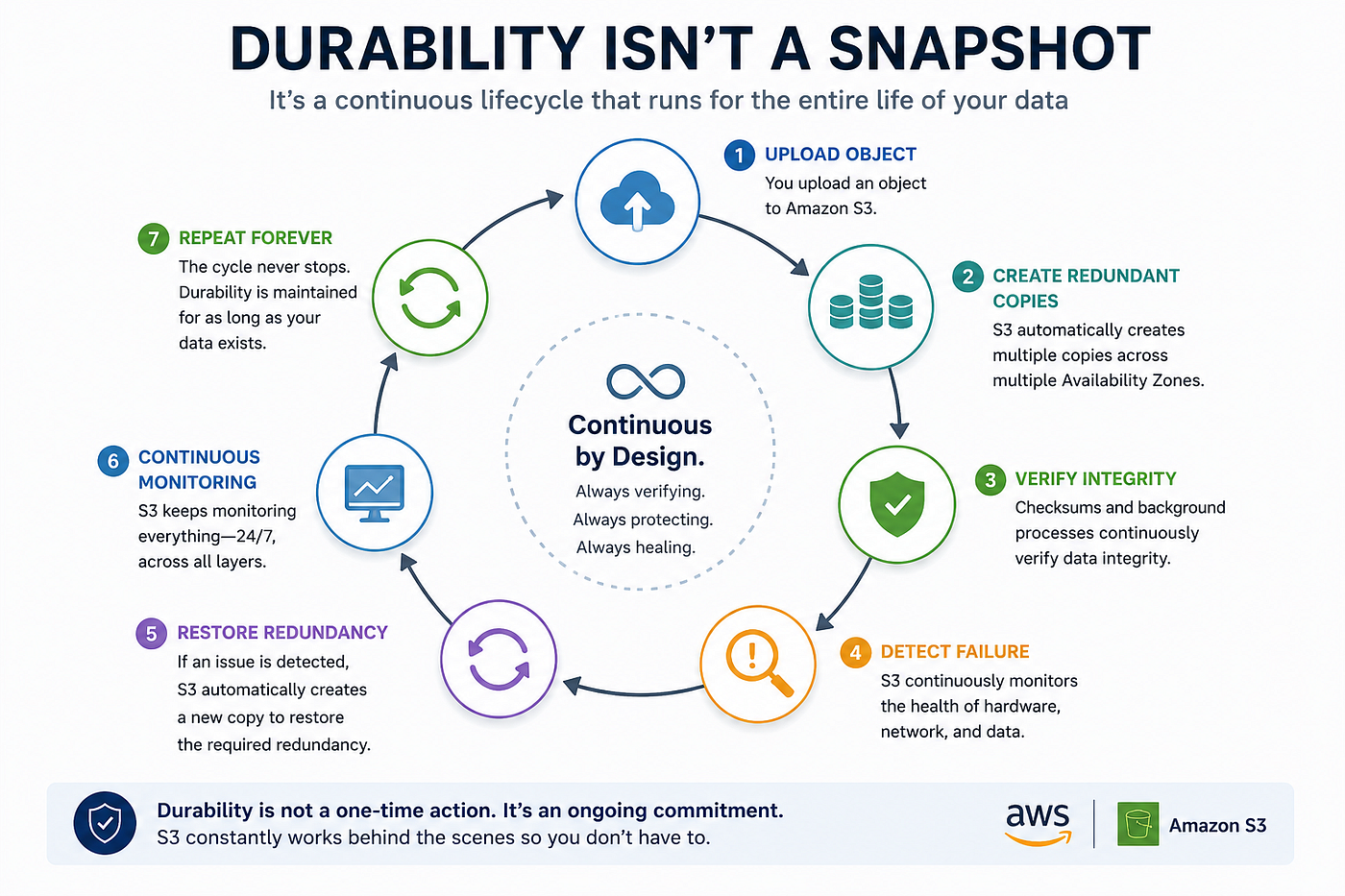
It’s something the platform continuously maintains. Initially, I imagined durability as a single event. I felt I had been thinking about durability as a storage problem.
It wasn’t. It was a maintenance problem.
A client uploads an object. Amazon S3 stores redundant copies. The work is finished. This is only accounts for the first few seconds of an object’s life. Everything that happened afterwards was an entirely different engineering challenge.
Many objects remain in Amazon S3 for years. Some remain for decades. During that time, the infrastructure beneath them is constantly changing. Servers are retired. Storage devices are replaced. Components fail. New hardware is introduced. Entire systems evolve without customers ever moving their own data.
That means durability cannot simply describe how data is stored. It must also describe how data is continuously protected throughout its lifetime.
The engineering challenge therefore extends far beyond the initial upload. Every object must continue surviving an infrastructure that never stops changing.
The Hidden Challenge Is Confidence
One question kept bothering me. Imagine a storage device develops an unrecoverable error.
How does Amazon S3 even know that something has gone wrong? A customer may not access that particular object for months. There may be no read request that naturally exposes the problem. Waiting until someone downloads the object would clearly be unacceptable.
The platform needs confidence that stored data remains correct even when nobody is actively using it. That led me toward one of the least discussed aspects of durability.
Data integrity.
AWS publicly documents that Amazon S3 performs integrity verification using checksums and continuously monitors stored data to ensure objects remain intact. If the platform detects corruption or reduced redundancy, it automatically initiates repair processes to restore the desired level of protection before customers are affected.
At first, I dismissed that sentence as a maintenance detail. Only later did I realize how much engineering was hidden behind it.
Amazon S3 isn’t simply storing data. It’s continuously validating its own assumptions about that data. That is a very different engineering mindset.
Self-Healing Is More Important Than Redundancy
Earlier in this investigation, I assumed replication explained durability.
Now I was beginning to see that replication without recovery eventually becomes fragile.
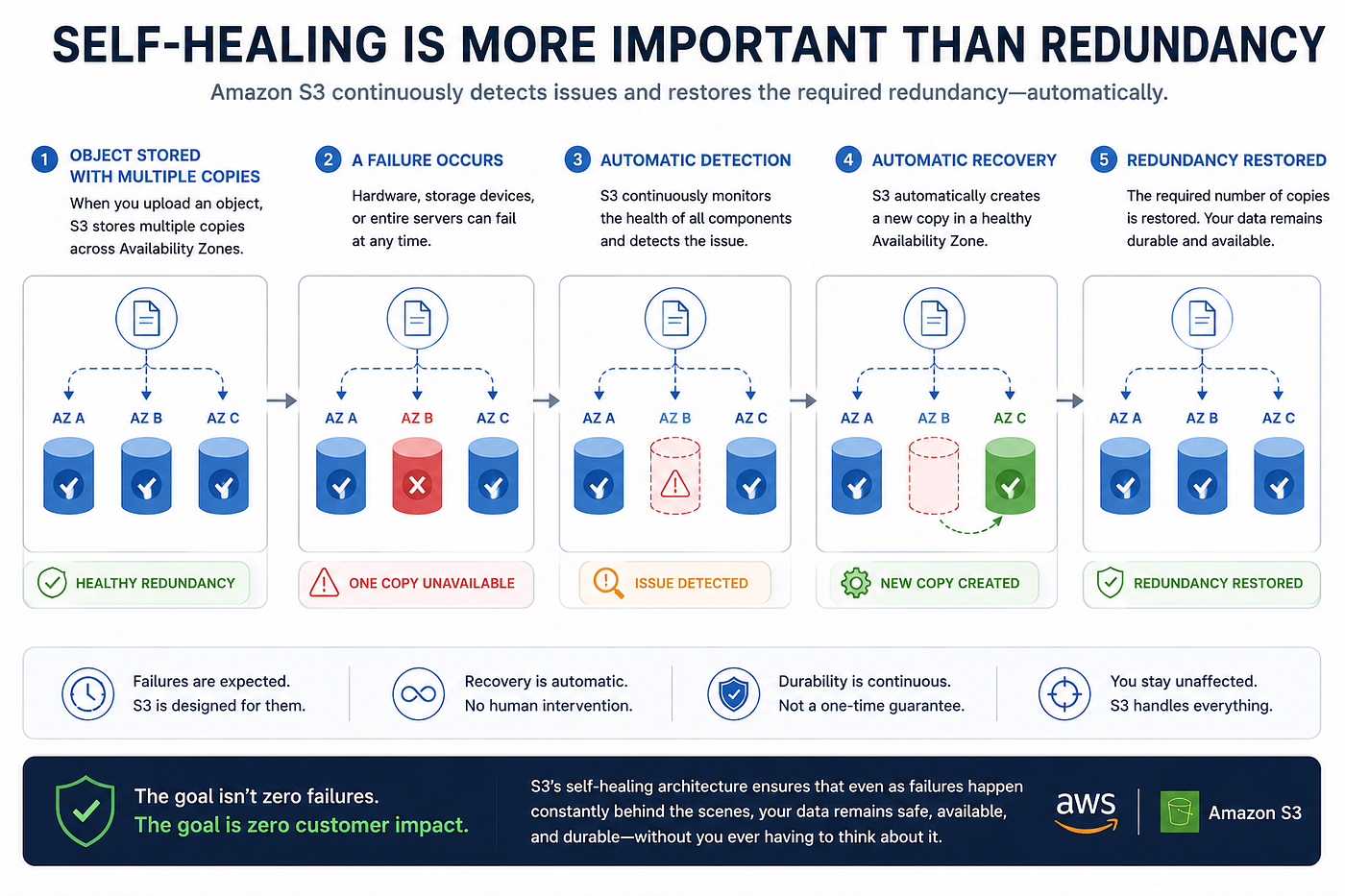
Imagine making three photocopies of an important contract. You place each copy in a different filing cabinet. For years, everything appears safe. Then one cabinet is damaged. You still have two copies. Nothing feels urgent. Months later, another copy becomes unreadable because of water damage. You now have only one surviving copy.
The real danger wasn’t the first failure. It was allowing redundancy to quietly disappear without restoring it.
Distributed storage systems face exactly the same challenge. Redundancy naturally decreases whenever hardware fails. If the platform simply accepted that reduction, durability would gradually erode over time.
Instead, Amazon S3 continuously detects when redundancy has been reduced and automatically rebuilds it. That process is why I now think the phrase self-healing storage is more meaningful than redundant storage.
Redundancy describes a state. Self-healing describes an ongoing capability.
One protects data today. The other protects data for years.
Invisible Engineering at Work
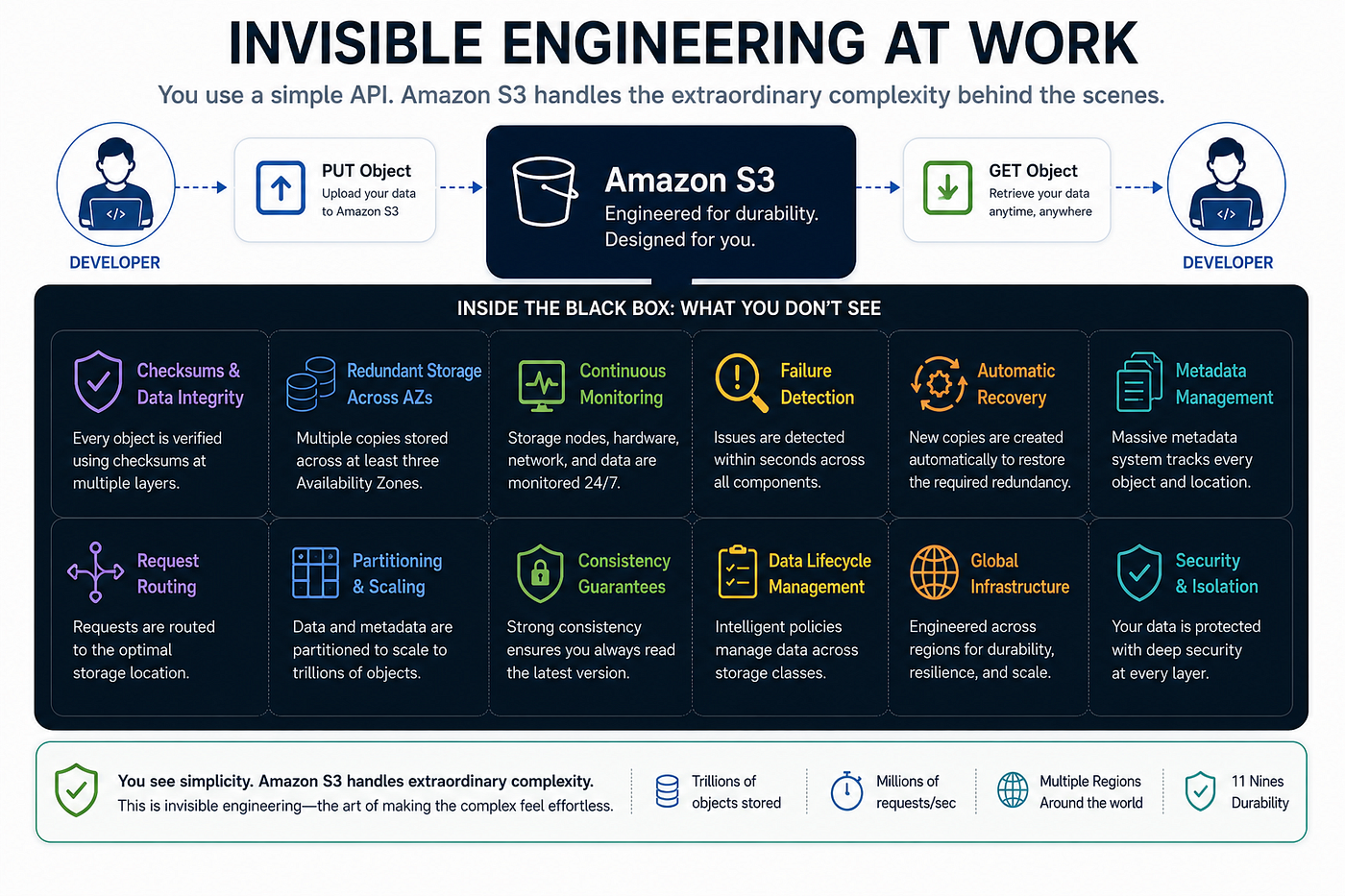
One pattern has quietly emerged throughout every investigation in this series. As the platform becomes more sophisticated, the experience presented to developers becomes simpler. Durability may be the clearest example yet.
Durability follows exactly the same pattern.
Customers don’t upload an object and then wonder whether background integrity verification has completed.
They don’t think about redundancy being restored after hardware replacement. They don’t monitor silent corruption detection processes.
Nor should they.
Those responsibilities belong to the platform.
Good engineering isn’t measured by how much complexity it exposes. It’s measured by how much complexity it quietly absorbs.
The customer’s experience remains remarkably simple.
Upload an object. Trust that it remains safe.
Behind that simplicity is a continuous process of monitoring, verification, redundancy management, and automated repair operating every hour of every day.
The Investigation Changes Once More
By this stage, I realized I had been thinking about durability in completely the wrong way.
I had imagined it as a storage feature. Instead, it looked much more like a continuous operational process.
Objects aren’t uploaded and forgotten. They’re continually protected.
The infrastructure beneath them changes.
The platform adapts.
Hardware fails.
Redundancy is restored.
Integrity is verified.
Customers continue storing and retrieving data without noticing any of it.
That, more than the famous eleven nines, became the most interesting discovery of this investigation.
Durability isn’t achieved by preventing change. It’s achieved by continuously responding to change.
And that philosophy extends far beyond Amazon S3.
Failure Isn’t an Incident — It’s Background Activity
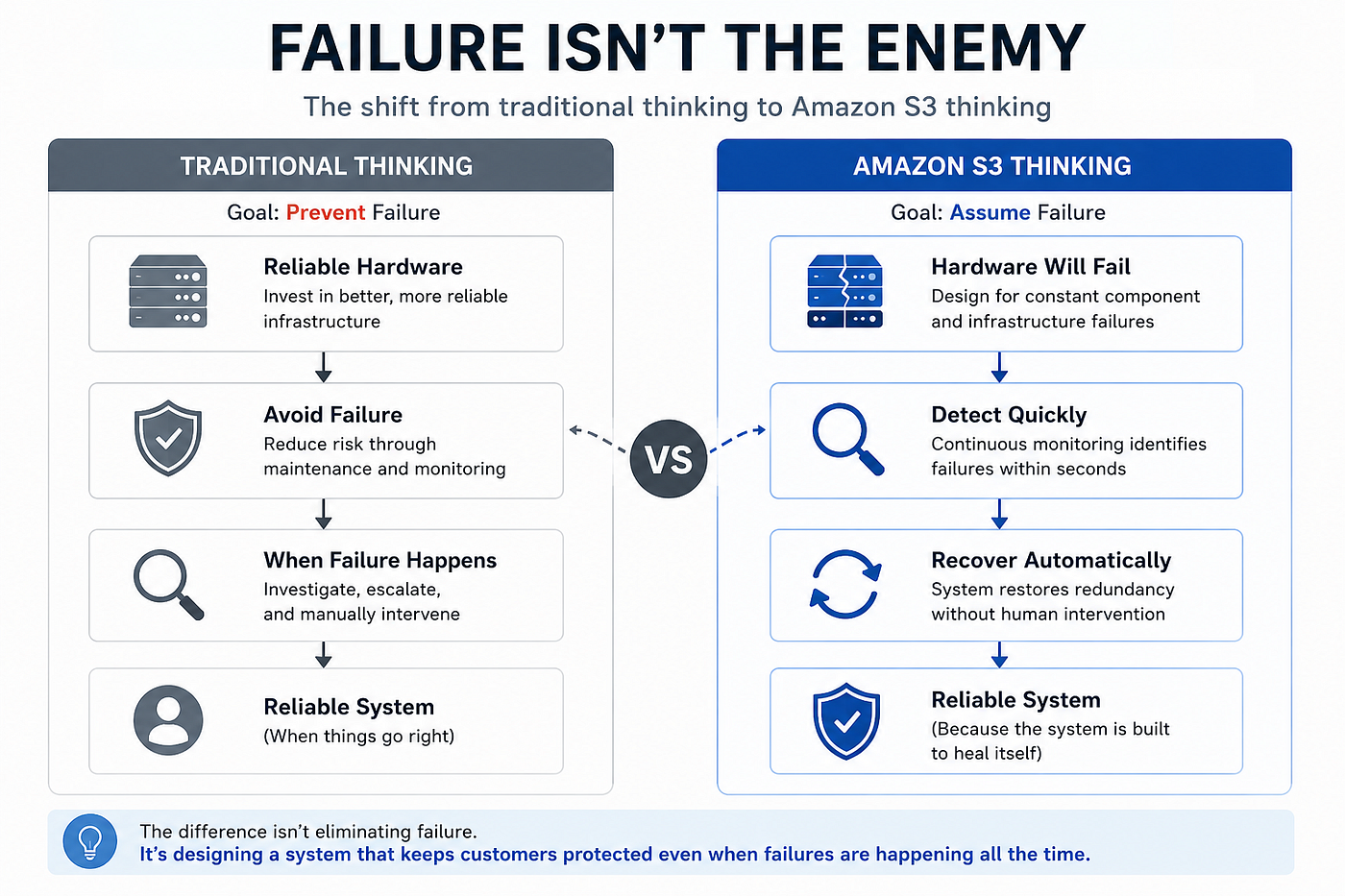
One of the biggest differences between traditional infrastructure and cloud-scale platforms is how they respond to failure. In many enterprise environments, a failed storage device immediately triggers investigation, escalation, and manual intervention. Amazon S3 follows a very different philosophy. Failures are expected, monitored continuously, and handled automatically wherever possible. Instead of treating failure as an exceptional event, the platform treats it as routine background activity. That subtle shift explains why cloud architecture often feels fundamentally different from traditional infrastructure.
The Trade-Off Most Developers Never Notice
One idea kept resurfacing as I worked through this investigation.
Every engineering decision that makes Amazon S3 easier for developers almost certainly makes the platform itself more difficult to build.
That isn’t unique to durability.
We saw the same pattern while exploring partitioning. Developers simply provide an object key, while Amazon S3 manages partitioning, routing, metadata organization, and request distribution behind the scenes.
We saw it again with strong consistency. Applications can immediately read newly written objects without implementing the workarounds that were once common. The complexity didn’t disappear, it moved into the platform.
Durability follows exactly the same philosophy.
From a developer’s perspective, storing an object requires a single API call. After that, the object simply exists. There is no need to think about storage device failures, integrity verification, redundancy restoration, or hardware replacement. Amazon S3 quietly assumes responsibility for those concerns.
That simplicity is easy to underestimate because it feels ordinary. In reality, it represents an enormous amount of engineering.
One idea had become impossible to ignore: cloud platforms don’t eliminate complexity. They decide where that complexity belongs.
AWS consistently chooses to absorb it within the platform so that developers can focus on building applications instead of managing infrastructure. I think that’s one of the defining characteristics of mature platform engineering.
Why This Matters Beyond Amazon S3
One of the reasons I enjoy researching distributed systems is that the lessons rarely stay confined to a single technology.
When I started this investigation, I expected to learn more about object storage. Instead, I found myself thinking about reliability in a completely different way.
For years, I associated reliable systems with reliable components. If storage became unreliable, I looked at the hardware. If applications became unstable, I looked for the failing server. Reliability felt closely connected to the health of individual machines.
Modern distributed systems challenge that assumption.
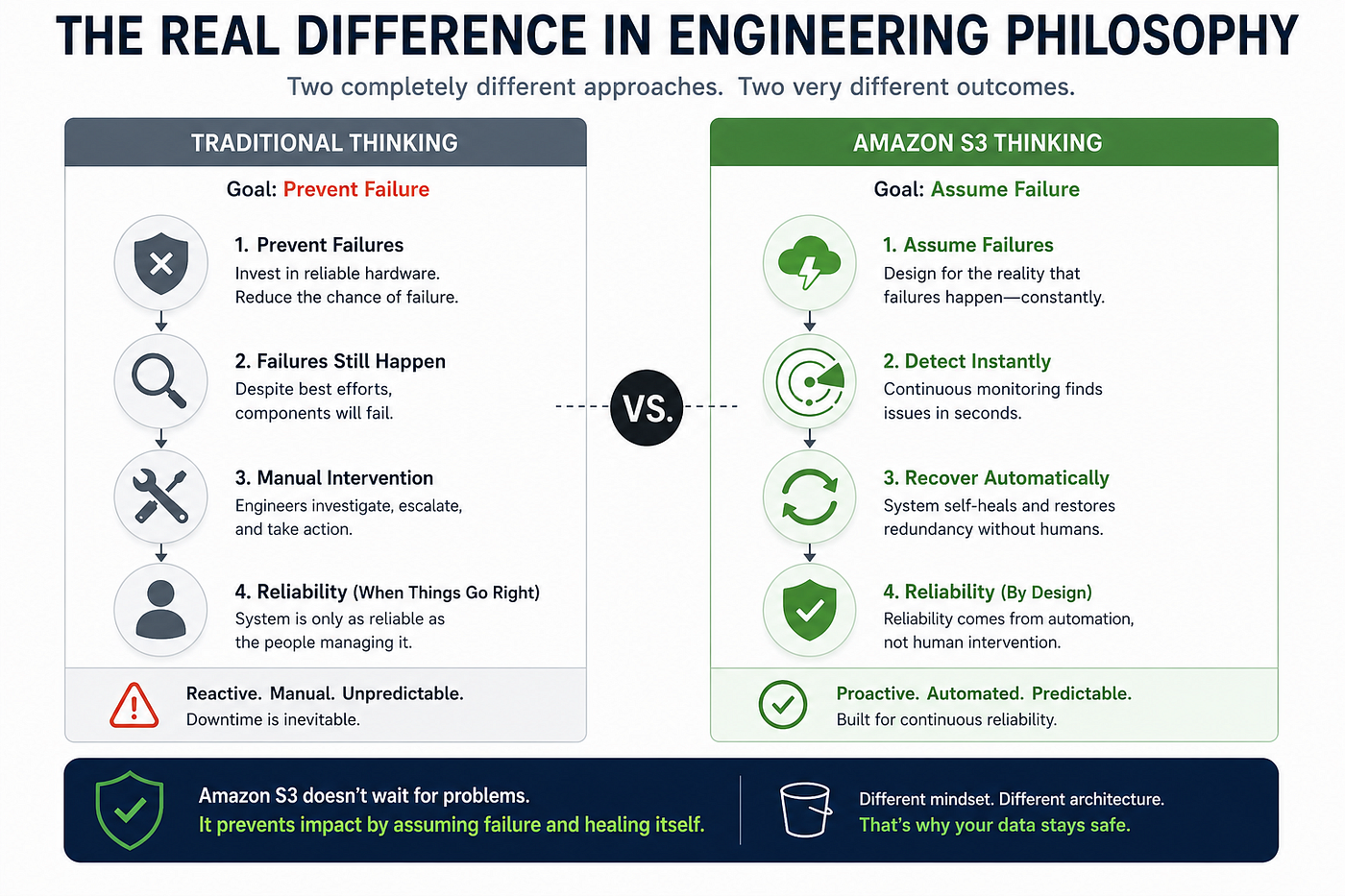
Amazon S3 demonstrates that highly reliable systems don’t require perfect components. They require architectures that continue delivering reliable outcomes even while individual components are constantly changing, failing, or being replaced.
The same philosophy appears throughout modern software engineering.
- Container orchestration platforms assume that containers will terminate unexpectedly and automatically recreate them.
- Distributed databases expect nodes to leave and rejoin the cluster.
- Load balancers continuously redirect traffic away from unhealthy instances.
- Message queues acknowledge that consumers can fail while processing messages and are designed to recover safely.
Although these technologies solve different problems, they all share a common mindset.
Failure isn’t treated as an exception. It’s treated as an expected operating condition.
That may be the most valuable lesson I have taken from studying Amazon S3.
Three Engineering Lessons I Didn’t Expect to Learn
Every investigation in this series has challenged one of my assumptions about cloud architecture.
This one was no different.
1. Durable systems are built around inevitable failure, not perfect hardware.
Before researching Amazon S3, I unconsciously linked durability to the quality of storage devices. The deeper I explored the architecture, the clearer it became that hardware quality alone can never explain eleven nines of durability. At cloud scale, failures are unavoidable. The real engineering achievement lies in designing systems that detect those failures quickly, restore redundancy automatically, and continue protecting data without interrupting customers.
2. Durability is a continuous process rather than a one-time event.
Initially, I thought durability was established when an object was written successfully. I now think of it very differently. Uploading an object is only the beginning. The more significant engineering happens afterwards through integrity verification, automated monitoring, redundancy management, and continuous repair. Durability isn’t something Amazon S3 provides once. It’s something the platform continually maintains throughout the lifetime of every object.
3. Great cloud platforms make resilience invisible.
One theme has emerged repeatedly across every article in this series.
Customers experience simple APIs. Engineers build extraordinarily sophisticated systems to make those APIs feel simple.
Partitioning, strong consistency, and durability all follow the same philosophy. The platform absorbs complexity so that developers don’t have to.
Perhaps the biggest lesson I took away from studying Amazon S3 is that simplicity is rarely the absence of complexity. More often, it’s evidence that complexity has been engineered so well that users never have to think about it.
Questions I’m Still Curious About
One of the things I’ve enjoyed most about writing this series is that every investigation answers one question while uncovering several more.
After exploring durability, these are the questions that I now find myself returning to.
- If Amazon S3 automatically repairs redundancy, how does it detect silent data corruption before customers ever notice?
- What happens internally when an entire Availability Zone becomes unavailable?
- Why isn’t Cross-Region Replication the same thing as durability?
- How do other large-scale distributed storage systems approach the same problem?
- Which architectural ideas pioneered by Amazon S3 have influenced newer AWS storage services?
Each of those questions feels like its own engineering investigation, and I suspect they’ll shape the next chapters of this series.
Final Thoughts
When I began researching Amazon S3 durability, I expected to learn more about storage.
Instead, I ended up learning more about resilience. That distinction may seem minor, but I think it changes the way we think about distributed systems.
Storage is ultimately about where data lives.
Resilience is about ensuring that data continues to exist despite everything happening around it.
Those are very different engineering challenges.
Looking back across the first four investigations in this series, I find it interesting that each one has quietly challenged a different assumption I held about Amazon S3.
Looking back across this series, what strikes me most is that every investigation challenged a different assumption I held about Amazon S3. Each answer revealed that the real engineering story lay somewhere beneath the feature itself.
Reliable systems are not built because components never fail.
They’re built because the architecture assumes components will fail and is engineered to recover long before customers ever notice.
That idea extends well beyond Amazon S3.
It’s a design philosophy that appears throughout modern distributed systems, from databases and messaging platforms to container orchestration and cloud-native infrastructure.
After studying systems like Amazon S3, I’m increasingly convinced that the most sophisticated engineering is rarely the engineering users can see.
It’s the engineering that quietly disappears behind a remarkably simple experience.
Amazon S3’s famous 99.999999999% durability isn’t simply a statistic.
It’s the outcome of an architectural philosophy that accepts failure as inevitable, continuously adapts to it, and quietly transforms what could have been customer-facing incidents into ordinary background operations.
To me, that’s one of the most elegant examples of engineering at cloud scale.
Coming Next in the Amazon S3 Engineering Investigation Series
Every article in this series has answered one question while naturally leading to another.
The next investigation explores one of those questions in greater depth:
If Amazon S3 is designed to survive hardware failures within a Region, why does AWS also provide Cross-Region Replication, and what problems does it solve that durability alone does not?
We’ll examine the difference between durability, availability, disaster recovery, and geographic resilience — and why those concepts are often confused, even though they solve very different engineering problems.
메타데이터
- post_id
- b3738827b83c
- slug
- amazon-s3-durability-why-aws-expects-hardware-to-fail-b3738827b83c
- url
- https://medium.com/illumination/amazon-s3-durability-why-aws-expects-hardware-to-fail-b3738827b83c
- canonical_url
- https://medium.com/illumination/amazon-s3-durability-why-aws-expects-hardware-to-fail-b3738827b83c
- author_url
- https://medium.com/@TechContentTech
- status
- ok
- fetched_at
- 2026-07-08 23:08:13