Why Puppetry?
Musings on puppetry after watching Papet Pasyon 2026
Why Puppetry? Musings on puppetry after watching Papet Pasyon 2026

Photo from Teatrong Mulat ng Pilipinas (Mulat Theater) Facebook page
After watching the preview of Papet Pasyon last March 28, 2026 at Teatrong Mulat ng Pilipinas, I found myself confiding to a friend with whom I had shared the experience, that I have this lingering feeling after watching the play, something that seemed to emerge precisely from the medium of puppetry to which the pasyon story was told. Given that the Passion of Christ narrative has long been embedded within the commemoration of Holy Week each year, from numerous movies televised on local channels to reenactments and eucharistic celebrations, encountering it through a puppet performance opened a reflective space from which I pose the question: Why puppetry?
The 2026 staging of Papet Pasyon by Teatrong Mulat ng Pilipinas (Mulat Theater), founded by National Artist for Theater Amelia Lapeña Bonifacio, offers a compelling site through which this question may be more rigorously pursued. Originally written and staged in 1985, Papet Pasyon has since evolved into a sustained Lenten tradition, performed and reinterpreted annually by the theater company for over four decades. Its endurance signals institutional continuity while registering an ongoing commitment to puppetry as a form that exceeds mere craft and operates as a mode of critical and aesthetic exploration.
Under the direction of Professor Amihan Bonifacio-Ramolete, Papet Pasyon 2026 unfolds as an iterative rearticulation of the pasyon narrative rather than a static reproduction of tradition long held by the theater company. Teatrong Mulat’s long-standing advocacy must be situated against the marginal positioning of this form within theatrical hierarchies. Puppetry, often relegated to the domain of children’s entertainment as genre of its own, with all its struggle of place in the industry, has been persistently misrecognized, as its capacities for formal rigor and theatrical possibilities are obscured. What emerges in Papet Pasyon is a performative language that unsettles actor-centered paradigms that draw attention to the dynamic interplay among object, performer, and spectator that allows meaning to arise within this triangulated field, where agency circulates rather than consolidates.
This circulation becomes palpable in the collaborative structure of the production. The 2026 staging gathers a constellation of puppeteers, seasoned practitioners alongside those still in formation, whose collective labor animates the performance. The question of authorship disperses itself across bodies, gestures and animations that emerges through coordination, rhythm, and shared attentiveness. The movement accrues through the choreography of hands and voices, rendering visible the interdependence that underwrites this theatrical production.
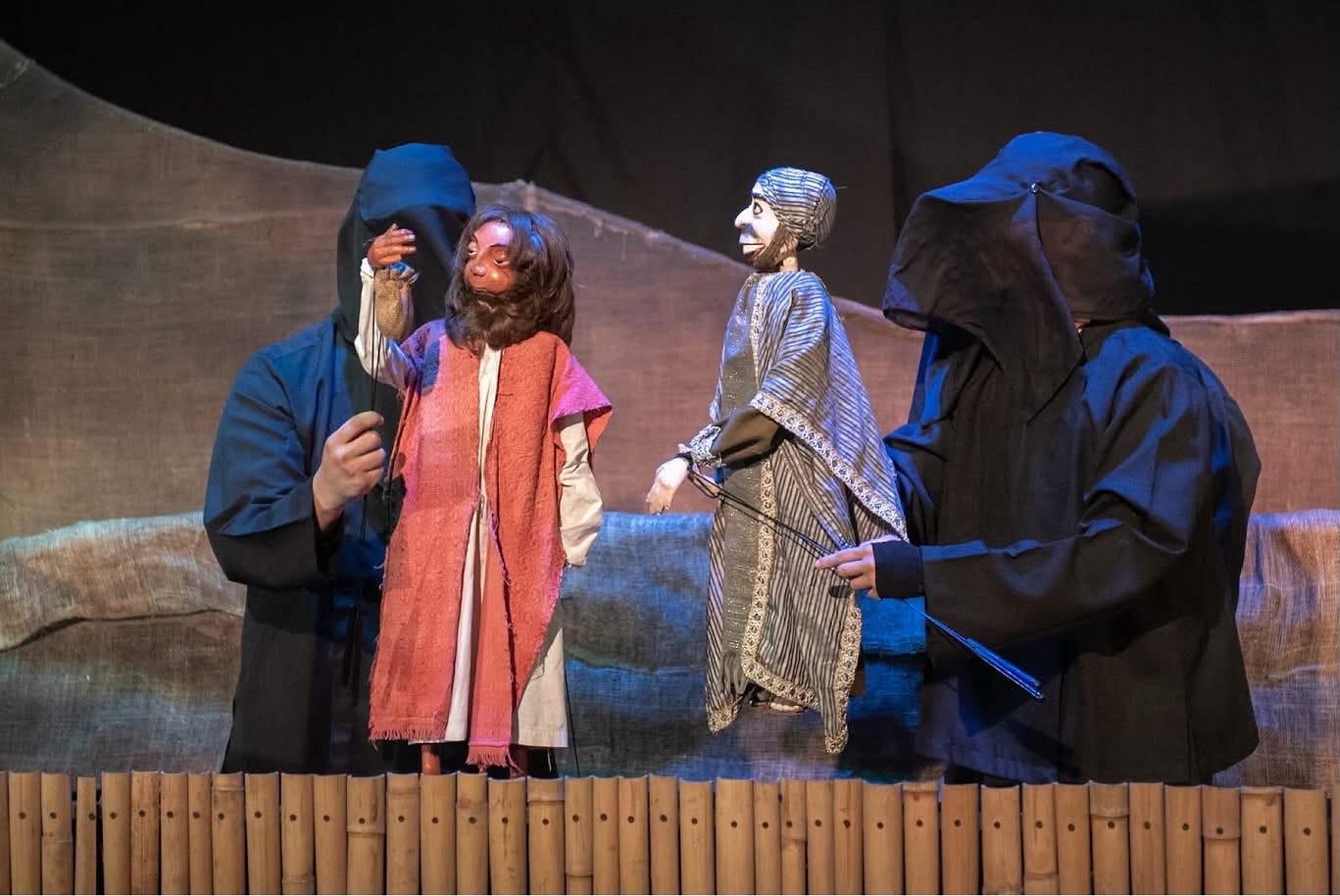
Prof. Vladimeir Gonzales, shared on Facebook by Teatrong Mulat ng Pilipinas (Mulat Theater).
The work likewise operates as a site of transmission as techniques, sensibilities, and ways of perceiving are passed on, revised, and embodied anew. Training here exceeds technical acquisition, cultivating instead a disposition attuned to material resistance, gestural precision, and the contingencies of encounter. What is transmitted is a mode of attention that lingers on the threshold between control and surrender, intention and emergence. The play’s aesthetic logic permeates across contemporary Philippine theater. Works such as Prinsipe Bahaghari written by Vladimeir Gonzales register this diffusion, where traces of its sensibilities surface as an underlying structure of feeling shaping performance and reception. Such traces rarely announce themselves overtly as they operate at the level of rhythm, pacing, and perceptual orientation, inviting a reconsideration of theater-making as a practice grounded in mediation and relationality.
At the level of spectatorship, a distinct perceptual field is produced as the audience occupies a liminal zone where object and figure, material and animation, remain in productive tension. Awareness of the puppet’s constructedness coexists with an investment in its vitality. This dual consciousness intensifies engagement, turning perception into an active, reflexive process rather than a passive reception of illusion. Where actor-centered theater often strives toward seamless embodiment, this mode foregrounds the mechanics of its own making. The puppeteer’s presence, partially concealed or fully visible, interrupts any illusion of autonomy, exposing the conditions through which movement and meaning are generated. Such exposure does not diminish the performance, rather, it becomes the ground of its force.
In this field, distinctions between animate and inanimate begin to loosen. The puppet, materially inert, acquires vitality through motion and the audience’s perceptual investment. Its aliveness remains provisional, dependent on relation and attention. What emerges is a form of being that resists stable categorization, prompting a reconsideration of how life and subjectivity are apprehended. This reconsideration gains particular resonance in Papet Pasyon, where the narrative of Christ’s passion is already shaped by historical, cultural, and ideological mediations. Long informed by dominant representations, from cinematic portrayals of a white Jesus to doctrinal frameworks that fix theological meaning, the pasyon arrives laden with inherited imagery. The use of puppets introduces a critical distance, displacing the authority of these representations and opening the narrative to rearticulation.

Prof. Vladimeir Gonzales, shared on Facebook by Teatrong Mulat ng Pilipinas (Mulat Theater).
The figure at the center of this displacement mediates the conditions of viewing. Its stylization resists the pull of illusionistic realism, sustaining instead a space where meaning remains unsettled. Interpretation becomes an active process, negotiated within the encounter between viewer and form. What is seen is never given in full; it is assembled in the act of looking. Affective experience is likewise recalibrated. Emotional resonance does not rely on the immediacy of human expression but emerges through the interplay of movement, material, and rhythm. The gestures observed like articulated limbs, suspended pauses, and calibrated motions, generate an affective register intensified by their very artificiality. This recognition of the puppet reproduces the perception and awareness of its uncanniness, the double vision that allows the audience to recognize the inanimate puppet and its imagined character. This then permit the feelings to arise through mediation, shaped by the tension between presence and construction.
Putting emphasis on the register of puppetry in theater, this certain approach produces a degree of double vision through which we see the puppet as an object and at the same time as a living presence that serves as the actor of the play. The figure moves, and we read intention rather than canceling each other out, these perceptions coexist, asking us to hold both the material and the imagined at once. Even when the puppeteer is visible (positioned to a level of invisibility), this doubleness deepens as our gaze shifts between the human body that animates and the figure that seems to act on its own, thus creating a shared field where agency is punctuated by this approach.
Puppetry, as an approach to theater-making invites attention to its very construction of animation on the stage. Because the puppet remains both animate and inanimate, it carries emotion in a way that is at once intensified and distanced but is not diminished of its narrative certainty. What emerges then is this lingering feeling/ awareness/ experience of “uncanniness” that is produced by the puppet on the stage, that emphasizes the pluralistic meaning of simultaneous and multiple. In this regard, the notion of autonomous subjectivity gives way to a more distributed understanding of agency. What appears singular is revealed as the effect of relational processes. Animation emerges through the convergence of object, performer, and spectator, that participates in the production of presence while positioning life as a negotiated condition on the stage.
Perhaps these musings attempt to reconfigure the sensation I experienced after watching Papet Pasyon 2026, establishing puppetry as a more intriguing and provocative material in theater and performance. Papet Pasyon presents the possibility to gesture beyond the relegation of puppetry as mere metaphorical and nostalgic materials in actor-centered productions and highlights its own capacity to unsettle conventional theater approaches. This, in turn, opens more expansive possibilities for rethinking and theorizing the approaches to the growing Philippine contemporary theater.
메타데이터
- post_id
- b387cbff2f47
- slug
- why-puppetry-b387cbff2f47
- url
- https://medium.com/@benjaminsumabat/why-puppetry-b387cbff2f47
- canonical_url
- https://medium.com/@benjaminsumabat/why-puppetry-b387cbff2f47
- author_url
- https://medium.com/@benjaminsumabat
- status
- ok
- fetched_at
- 2026-07-09 13:13:48




