Creativity AI #79: Midjourney makes V8.1
And why keeping up with AI now looks more like a standing gym habit than a one-off course.
Creativity AI #79: Midjourney makes V8.1 the default, Claude Fable 5 lands, and Runway reframes any video
And why keeping up with AI now looks more like a standing gym habit than a one-off course.
Creativity AI is a free weekly publication that brings together interesting articles and recent developments in AI art and creativity.
You can also read this newsletter on the website.
News about AI art
Midjourney office hours (June 10, 2026): V8.1 goes default and a site redesign arrives

V8.1 is now the default production model on Midjourney, promoted from V7 after a round of user testing and feedback. V8 remains available on Alpha for now and hasn’t been discontinued, though the older V8.0 alpha model will be deprecated in two weeks.
The V8.1 model is said to follow detailed prompts more closely, render text better, and produce more coherent images than V7. With HD mode on, V8.1 outputs at twice the size and 4X the resolution of V7, and it’s fast: roughly 4 seconds in standard definition, 12 seconds in HD.
Style references, personalization, and aesthetics stay consistent between V7 and V8.1. One gap remains. V8 still has no native Omni Reference or character reference system, so the interface now shows Omni Reference options and quietly switches to V7 when you use them. A more advanced replacement is in development, aimed at character coherence, object coherence, multi-subject control, and scene composition.
The bigger item from the office hours is a major site and prompt bar redesign heading into testing soon. The goal is to unify settings, prompting, and controls into a single, consistent surface, with two-way syncing between parameters and prompts, and clearer visibility into which settings are actually active.
Midjourney says the redesign comes from more than 50 user research sessions that identified a common pattern: new users struggle to get started, prompts feel intimidating, and parameter visibility is a recurring sticking point. Permutations have already been rebuilt internally and will stay.
A few more items worth noting:
- Larger-batch generation is in active testing, with mostly interface work remaining before release.
- Personalization is getting a push. New users will see welcome steps and reminders to build a profile, which the team believes meaningfully improves satisfaction. Existing workflows won’t change.
- Style reference (Sref) organization is a frequent request. For now, the workarounds are saved styles, folders, and manually saving generated Srefs.
- The editing model continues to develop, with long-term goals focused on multi-character coherence, camera control, and object placement.
- A community translation pilot starts with Korean first, using Crowdin plus AI-assisted translation, with more languages to follow if it works.
My take: not much to act on this week. V8.1 going default is the practical headline for most of us, and the redesign is the thing to watch, though it’s still in testing. Everything else is a roadmap.
Anthropic launches Claude Fable 5, its most capable public model yet

Anthropic released Claude Fable 5 on June 9, a new top-tier model the company calls the Mythos class, sitting above the Opus class in capability. Fable 5 is the same underlying model as Claude Mythos 5, with added safety guardrails that make it suitable for general public use. Mythos 5 itself stays restricted to Project Glasswing partners and select researchers.
Anthropic describes Fable 5 as state-of-the-art on nearly every benchmark it tested, with the lead said to grow on longer and more complex tasks. The standout areas are software engineering, knowledge work, vision, and long-context memory.
In early testing, Stripe is claimed to have run a codebase-wide migration on a 50-million-line Ruby codebase in a single day, work that would otherwise have taken a team more than two months.
In terms of vision, the model is said to extract precise numbers from scientific figures and rebuild a web app’s source code from screenshots alone.
For creators, long-context and memory abilities are the relevant parts, useful for maintaining voice and consistency across book-length or multi-part projects, and the vision side could help turn mockups or screenshots into working code.
Pricing is premium: $10 per million input tokens and $50 per million output tokens on the Application Programming Interface (API), which Anthropic notes is less than half the price of the earlier Mythos Preview.
For subscribers, the calendar matters. From launch through June 22, Fable 5 is included at no extra cost on Pro, Max, Team, and seat-based Enterprise plans. On June 23, it will be removed from those plans, and continued use will require usage credits until Anthropic restores it as a standard plan feature once capacity allows. For the API and consumption-based Enterprise plans, it’s now fully available.
One architectural detail stands out: when its classifiers detect requests related to cybersecurity, biology and chemistry, or model distillation, the query automatically falls back to Claude Opus 4.8 rather than being refused. Anthropic says more than 95% of sessions involve no fallback at all.
That fallback design is also where the controversy starts. In a Business Insider piece (June 10), Anthropic disclosed in its system card that the models deliberately become less helpful on artificial intelligence research tasks tied to building frontier large language models, citing concerns about accelerating the development of competing systems without equivalent safety.
Some developers quoted in the article allege that the model goes beyond refusing and supplies misleading information on those tasks, and that the filtering also catches ordinary machine learning work, e.g., GPU inference research. Those are user allegations, not confirmed behavior, and Anthropic didn’t comment on the piece. Reka co-founder Mikel Artetxe is described as comparing the move to anticompetitive behavior.
My take: it’s a powerful model, but I’m struggling to apply it to my daily and leisure projects. Opus 4.8 covers what I do, since I’m not running ultra-complex work. The part I keep coming back to is the June 23 transition. If you plan to lean on Fable 5 heavily, build your cost planning around that date now, because depending on a tool that’s about to move behind usage credits is a quick way to get caught out. Free while it lasts, yet best treated as transitional.
Your AI skills need a ‘gym membership’, argues Campus founder

Tade Oyerinde, founder and chancellor of Campus, used a sharp analogy at Fortune’s Brainstorm Tech conference: learning AI is less a project you finish than a fitness routine you maintain.
Just as people put in two or three hours a week at the gym to stay in shape, he argues that staying competitive at work will require roughly the same weekly commitment to keep up with AI advances indefinitely.
His line: the era of learning something once and being set for life is over. He even predicts companies will build permanent continuous-learning departments, as standard as finance or operations, and that recursive self-improvement in AI models will push the pace steeper over time.
For creators, this lands close to home. The tools you use to produce, edit, distribute, and analyze content are exactly the category improving fastest. The editing tool or generation model that gave you an edge last quarter can get eclipsed within weeks, so the real differentiator stops being a skill you mastered once and becomes the habit of re-learning.
Oyerinde also stresses understanding how AI works and using it responsibly rather than treating it as magic, which matters when you’re making calls about quality, originality, and disclosure.
My take: I’ve watched colleagues treat AI like a one-time certification. Sit through a single training, tick the box, done. I smiled. It doesn’t work that way. Think of it as continuous professional development, except more demanding, because the technology shifts faster than most fields you’d have trained for. The weekly habit framing is a useful part. You don’t need to master everything; you need a standing routine that keeps you current.
Runway’s Aleph 2.0 reframes your video for any feed
Runway’s editing model, Aleph 2.0, now lets you change a video’s aspect ratio after the fact. Upload an existing clip, pick the aspect ratio you want, and the model fills in the rest of the scene as if you’d shot it that way from the start. One video, reworked for every feed and format, vertical for shorts, square for posts, wide for everything else, without reshooting or hard cropping.
Useful if you’re repurposing a single piece of footage across platforms, which most of us are. The thing to watch is how cleanly it invents the new edges of the frame, since outpainting video is the part where these models tend to wobble. Worth a test on your own footage before you trust it on what they claim.
Inspiration
Duchamp’s readymade: when choosing became the whole art
A bicycle wheel on a stool. A porcelain urinal laid on its back. Around 1913, Marcel Duchamp’s readymade arrived and broke the rule that art had to be made. It only had to be chosen.
The readymade aesthetic is unmistakable. Mass-produced objects, hard and industrial, pulled straight from a hardware store. Porcelain, metal, rubber, wood. No carving, no brushwork, no handcraft. Sometimes just a signature.
The trick is decontextualization. Take a snow shovel, hang it from a ceiling, and suddenly you’re forced to read it as sculpture. Same object, completely different seeing. The form stays; the function drops away.
What defines the style is its refusal to please. Deliberate banality. A purposeful dullness that sidesteps beauty entirely. The composition is stripped to nothing, because the meaning never lived on the surface. It lived in the gesture.
That’s the part worth stealing. The readymade proved that framing is a creative act. Where you place something, how you isolate it, what you choose to point at, that carries as much weight as anything you could build by hand, or created by AI image generator.
Visual keywords
found object, mass-produced, industrial, banal, utilitarian, decontextualized, anonymous, prefabricated, readymade, monochromatic, unadorned, anti-aesthetic, porcelain, mechanical, serial, minimal, functional, raw, displaced, pedestalled, inscribed, mundane, commercial, manufactured, ordinaryAnonymous space porcelain urinal rests alone in a vast gallery chamber, its sharp functional body staged as both machine part and conceptual monument. The object carries no ornament, only industrial finish, prefabricated precision, raw material honesty, and a faint aura of commercial banality. Placed on a pedestal under flat museum light, it becomes strange through displacement, ordinary yet ceremonial, utilitarian yet untouchable, a readymade meditation on mass production and elevated mundanity --ar 16:9 --profile ppjylid --hd --v 8.1
Metallic space urinal in sharp angular form, pedestalled like a sacred readymade relic, industrial found object tension, monochromatic gallery silence, banal utility elevated into anonymous sculpture, raw manufactured surface, anti-aesthetic precision --ar 16:9 --profile ppjylid --hd --v 8.1
Photographic readymade watercooler, mass-produced porcelain resting on a plain white pedestal, anonymous industrial form, stark gallery lighting, banal utilitarian surface turned strangely reverent, minimal monochromatic composition --ar 16:9 --profile ppjylid --hd --v 8.1
An anonymous chrome toaster sits alone under clinical light, mass-produced and unadorned, displaced from the kitchen into a silent museum space, industrial readymade object, commercial banality elevated into art --ar 16:9 --profile ppjylid --hd --v 8.1
A white porcelain kitchen colander rests on kitchen table, banal and utilitarian yet oddly sacred, decontextualized in a monochromatic gallery, found object readymade tension, minimal anti-aesthetic still life --ar 16:9 --profile ppjylid --hd --v 8.1
Colorful porcelain pineapple resting on raw concrete, readymade contradiction, tropical brightness trapped in anonymous manufactured form, unadorned gallery silence, prefabricated object aura, mundane beauty made ceremonial --ar 16:9 --profile ppjylid --hd --v 8.1
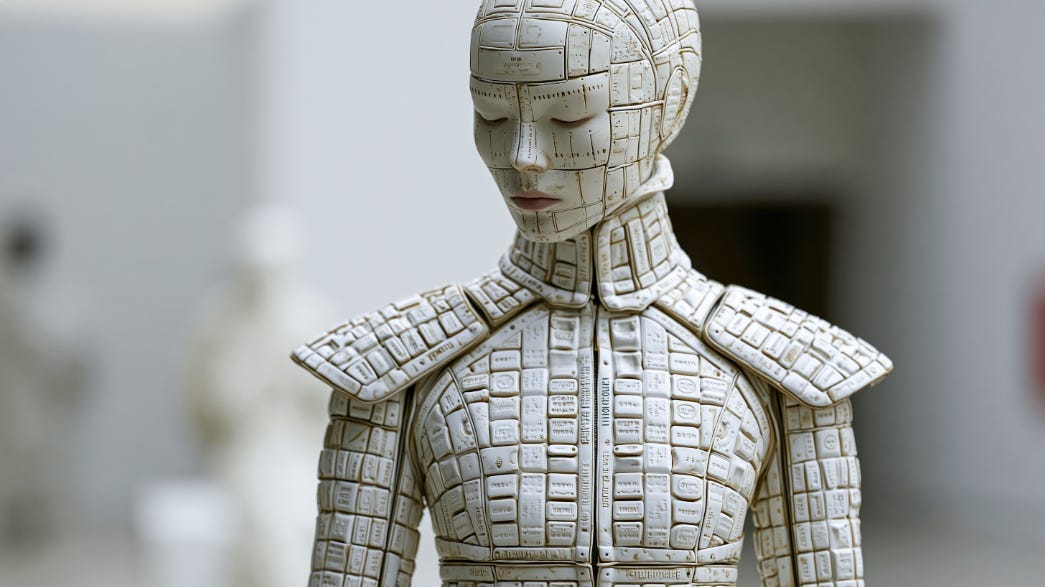
Alien model posed in a stark conceptual fashion portrait, sophisticated attire built from displaced industrial objects, raw brackets, anonymous molded plastics, porcelain utility pieces, and mundane commercial surfaces arranged with precise restraint. The figure stands with elegant stillness, making the banal feel elevated and the elevated feel absurdly ordinary. Clinical white lighting removes glamour while intensifying presence, minimal monochrome palette, functional forms treated as couture, readymade tension between mass production and alien aristocracy --ar 16:9 --profile ppjylid --hd --v 8.1
Industrial metallic urinal shaped like spacecraft hardware, banal prefabricated fixture displayed on a pedestal, anonymous manufactured body, raw functional seams, anti-aesthetic restraint, monochromatic museum atmosphere, mundane commercial object made strangely ceremonial --ar 16:9 --profile ppjylid --hd --v 8.1
Recent articles
Cover prompt: Tall model presented like a living readymade installation, sophisticated outfit composed of mechanical porcelain, prefabricated fittings, serially repeated plates, and ordinary manufactured parts stripped of their original use. The attire is minimal, functional, and strangely commanding, turning commercial anonymity into ceremonial identity. A low pedestal beneath the model suggests museum elevation, while raw seams and industrial inscriptions preserve the mundane origin of every element, monochromatic anti-aesthetic fashion, quiet conceptual unease, cinematic gallery tableau — ar 16:9 — profile ppjylid — hd — v 8.1
I hope you like this article!
Thank you for reading and happy creating!
메타데이터
- post_id
- b399dee46b6c
- slug
- creativity-ai-79-midjourney-makes-v8-1-b399dee46b6c
- url
- https://medium.com/creativity-ai/creativity-ai-79-midjourney-makes-v8-1-b399dee46b6c
- canonical_url
- https://medium.com/creativity-ai/creativity-ai-79-midjourney-makes-v8-1-b399dee46b6c
- author_url
- https://medium.com/@geekyanimals
- status
- ok
- fetched_at
- 2026-06-13 00:25:45






