Dismantling the Dream: Reagan’s Lasting Impact on American Society
Let me state up front that this is not a political post but sometimes politics and policy intersect with the arts and when it does, it is…
Dismantling the Dream: Reagan’s Lasting Impact on American Society
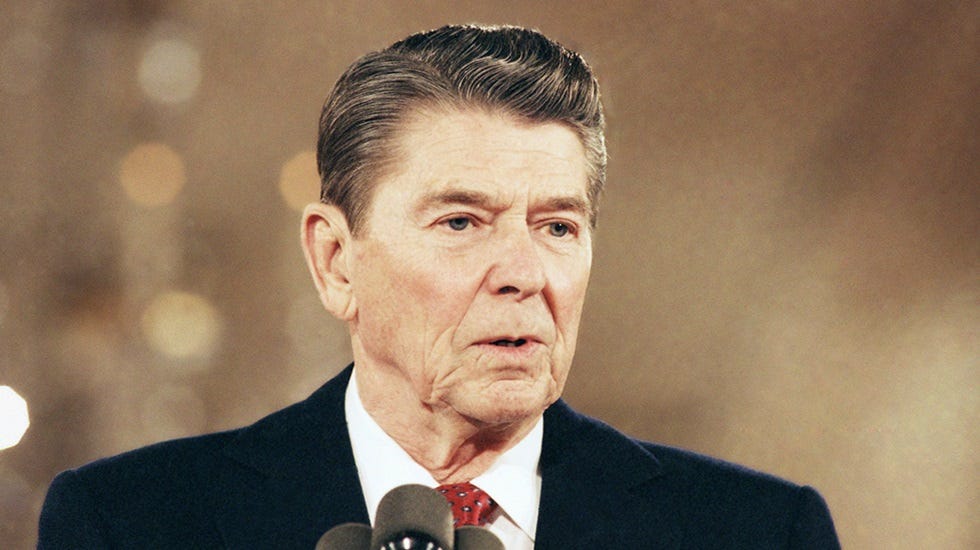
Let me state up front that this is not a political post but sometimes politics and policy intersect with the arts and when it does, it is necessary to highlight that fact. Conservatives fondly remember Ronald Reagan as this idyllic President, but I contend that everything that is wrong with our modern society traces back to the policies of Reagan. In 1980 when Reagan was elected, the top marginal tax rate was 71% and nobody talked about income inequality. When he left office in 1988, the top marginal tax rate was 39% and income inequality quickly entered the lexicon. Cause and effect. Another of Reagan’s legacies which has been destructive to society was the Telecommunications Act of 1986.
The 1986 Telecommunications Act represents a pivotal moment in American broadcast media history, fundamentally reshaping the radio and television industries in ways that many industry veterans and media analysts consider detrimental. This legislation, which loosened ownership restrictions and altered the regulatory landscape, triggered a cascade of consequences that continue to reverberate through these industries decades later.
Prior to 1986, the Federal Communications Commission (FCC) maintained strict ownership limitations on broadcast media. Individual entities were restricted in how many radio and television stations they could own nationally, and local ownership was tightly controlled to ensure diverse voices in each market. The underlying philosophy was that the airwaves belonged to the public and should serve public interests through diversity of ownership and programming.
The Act dramatically altered this landscape by increasing national ownership caps for both radio and television stations, relaxing local ownership restrictions that had prevented single entities from dominating individual markets, extending license terms, and reducing regulatory scrutiny in the renewal process. Additionally, it eliminated certain public service requirements that had been central to broadcast regulation.
The most immediate and profound effect was a wave of consolidation that transformed the industry. Large corporations quickly acquired smaller, independent stations across the country. Companies like Clear Channel (now iHeartMedia) grew from owning a handful of stations to controlling hundreds nationwide.
This consolidation fundamentally altered the competitive landscape. Independent station owners, unable to compete with the economies of scale and financial resources of corporate giants, often had little choice but to sell their stations.
As ownership concentrated, programming decisions increasingly came from corporate headquarters rather than local stations. This shift led to a significant transformation in broadcast media. Standardized programming formats became replicated across markets, with a noticeable reduction in local content and community-focused programming. Stations increasingly relied on syndicated shows and voice-tracking technology that allowed them to sound local while operating with minimal local staff. Programming strategies became more risk-averse, focusing primarily on maximizing ratings rather than serving diverse audience interests.
The impact on local journalism was perhaps most concerning. News departments were downsized or eliminated entirely at many stations, with resources for investigative reporting dramatically diminishing. Local coverage was systematically replaced by national stories and syndicated content, effectively undermining the watchdog function that local broadcast media had traditionally served in communities.
The business model of broadcasting underwent a fundamental transformation. Advertising rates became increasingly set by corporations with dominant market positions. Employment in the industry contracted as stations consolidated operations, and career paths for broadcast professionals narrowed, with fewer independent stations offering entry-level opportunities. The emphasis shifted from balanced profitability and community service to maximizing shareholder returns.
A crucial precursor to the transformation of media was the abolition of the Fairness Doctrine in 1987, another Reagan-era policy change that would have profound implications for media landscape. The Fairness Doctrine, established in 1949, had required broadcast stations to present controversial issues of public importance in a manner that was honest, equitable, and balanced. Its elimination effectively removed the regulatory requirement for broadcasters to provide opposing viewpoints, creating a fertile ground for the rise of partisan media. This policy shift directly contributed to the emergence of right-wing talk radio and, ultimately, the founding of Fox News in 1996, fundamentally altering the media’s role in public discourse and political communication.
As the decades passed, the consequences of the 1986 Act and the abolition of the Fairness Doctrine became increasingly apparent. There was a dramatic reduction in the diversity of voices and perspectives in broadcast media, a deterioration of radio’s local identity and connection to communities, financial instability in the industry as debt-laden corporations struggled to maintain profitability, and a significant decline in broadcast journalism’s capacity to inform the public about local issues.
Defenders of the Act point to increased efficiency and the ability of larger companies to invest in new technologies. Critics, however, contend that these benefits came at too high a cost to media diversity, localism, and the public interest.
The legacy of the 1986 Telecommunications Act demonstrates how regulatory changes can fundamentally transform an industry. While the legislation achieved its goal of modernizing telecommunications regulation, many industry professionals and media scholars argue that it sacrificed the localism and diversity that had long been central to American broadcasting, ultimately doing more harm than good to the radio and television landscape.
메타데이터
- post_id
- b39bd583ad01
- slug
- dismantling-the-dream-reagans-lasting-impact-on-american-society-b39bd583ad01
- url
- https://medium.com/@themadmusicasylum/dismantling-the-dream-reagans-lasting-impact-on-american-society-b39bd583ad01
- canonical_url
- https://medium.com/@themadmusicasylum/dismantling-the-dream-reagans-lasting-impact-on-american-society-b39bd583ad01
- author_url
- https://medium.com/@themadmusicasylum
- status
- ok
- fetched_at
- 2026-06-09 15:37:30