Staking vs Lending: Which Earns More (and Safer)?
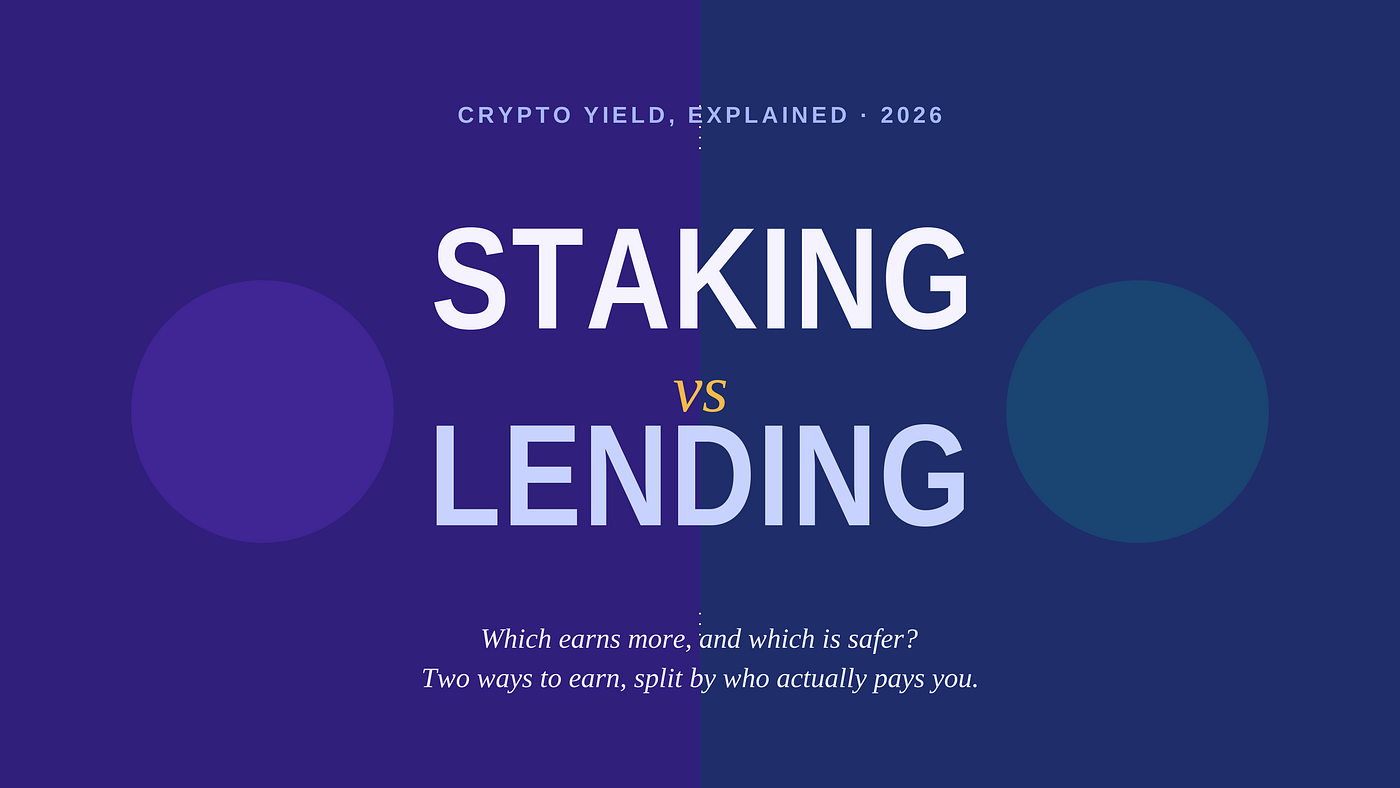
Two ways to earn on crypto, split by one question: who actually pays you, a network handing out rewards or a borrower paying to borrow.
Staking vs Lending: Which Earns More (and Safer)?
Two ways to earn on crypto, split by one question: who actually pays you, a network handing out rewards or a borrower paying to borrow.
In 2025, borrower demand pushed DeFi lending deposits past $50 billion and Aave alone crossed $1 trillion in cumulative lending volume. Every cent of that yield was paid by someone borrowing. Over the same period, about a third of all ETH, worth more than $100 billion, sat staked for a base reward under 3 percent a year, paid in a token whose dollar value moves.
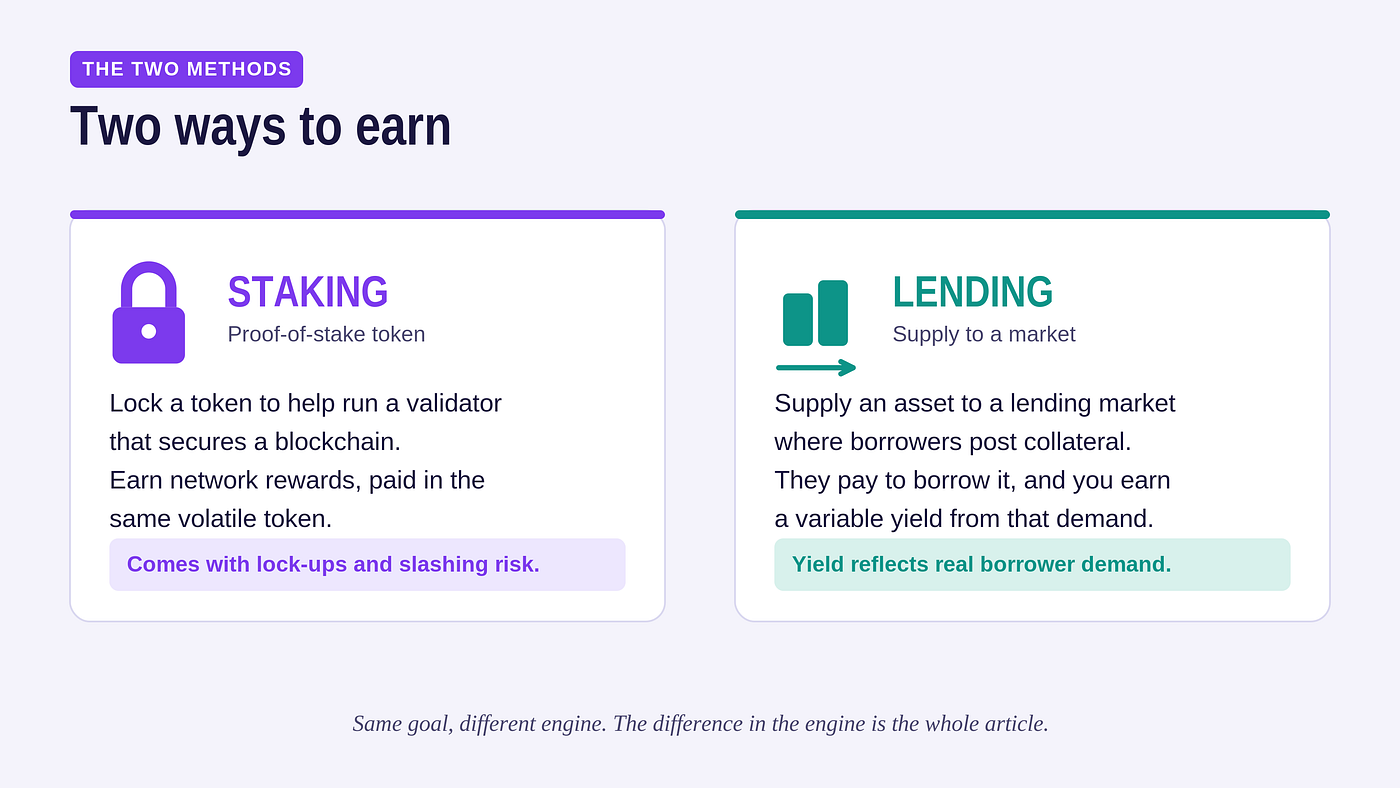
Staking vs lending describes two different ways to earn on crypto. Staking locks a proof-of-stake token to help run a validator and earns network rewards. Lending supplies an asset to a market where borrowers post collateral and pay to borrow it.
Neither earns more or is safer in the absolute. They carry different risks, and their rewards come from different places. Staking rewards are often paid in the same volatile token and can be partly new issuance; lending yield is paid by borrowers, so it reflects real demand. A yield-bearing stablecoin such as sUSDS is a third option with its own diversified risk profile. Nothing here is risk-free.
What is staking?
Staking is committing a proof-of-stake token to help run or delegate to a validator that secures a blockchain, in return for network rewards paid in that same token. Ethereum and Solana work this way.
Because your stake does real work, the network pays you, and both the reward and your principal sit in a volatile asset. Staking also carries conditions: funds can face an unbonding or exit queue before you withdraw, and validators that misbehave or go offline can be slashed, losing part of their stake. A companion piece on staking vs saving crypto covers this side in more depth.
What is lending?
Lending is supplying an asset to a market where borrowers post collateral and pay to borrow, and you earn a variable yield from that borrower demand. The rate rises and falls with how much borrowers want the asset.
Lending carries its own risks: the smart contract can fail, a borrower’s collateral can fall too far and leave bad debt, and you may be unable to withdraw when many people want the same liquidity at once. For the full risk picture, read is crypto lending safe.
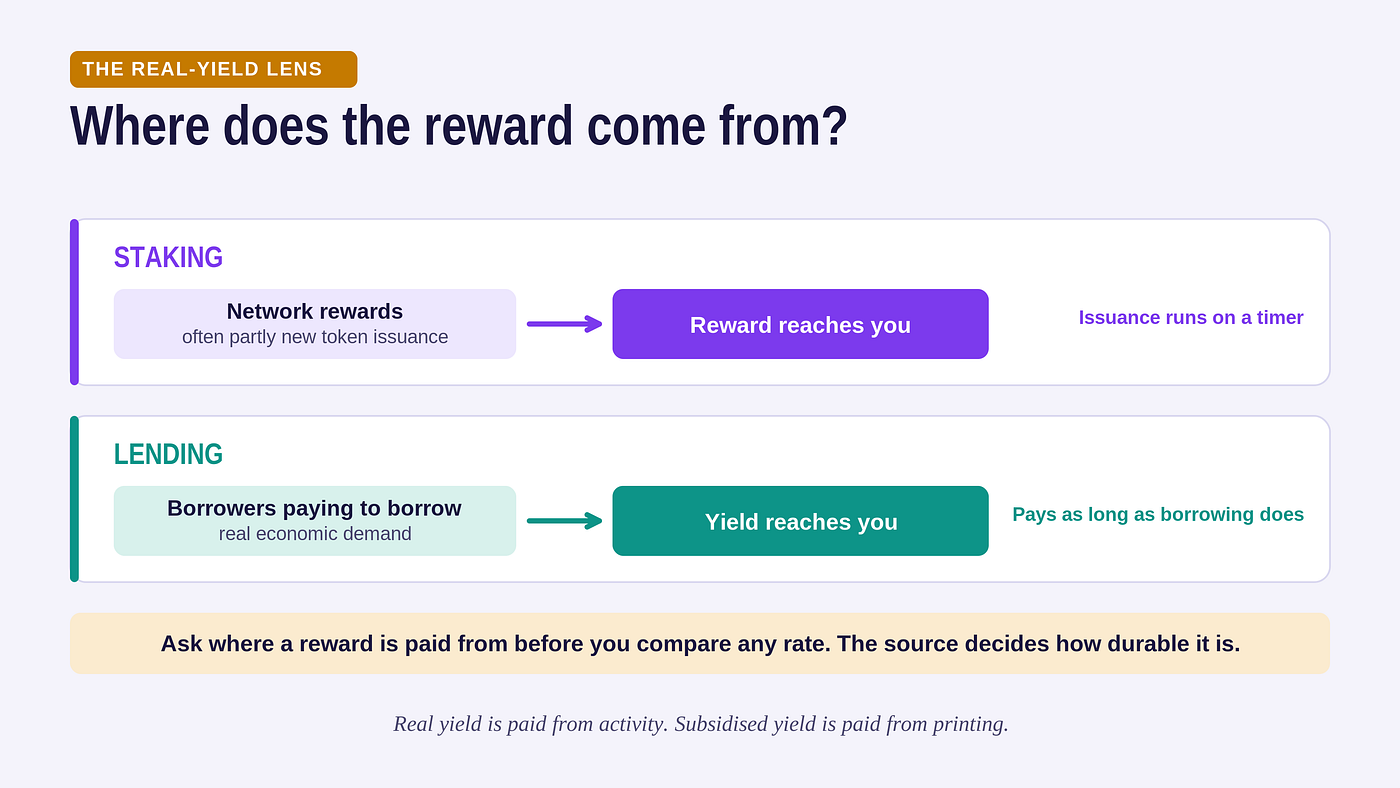
Ask where a reward is paid from before you compare any rate. The source decides how durable it is.
Staking vs lending: the key differences
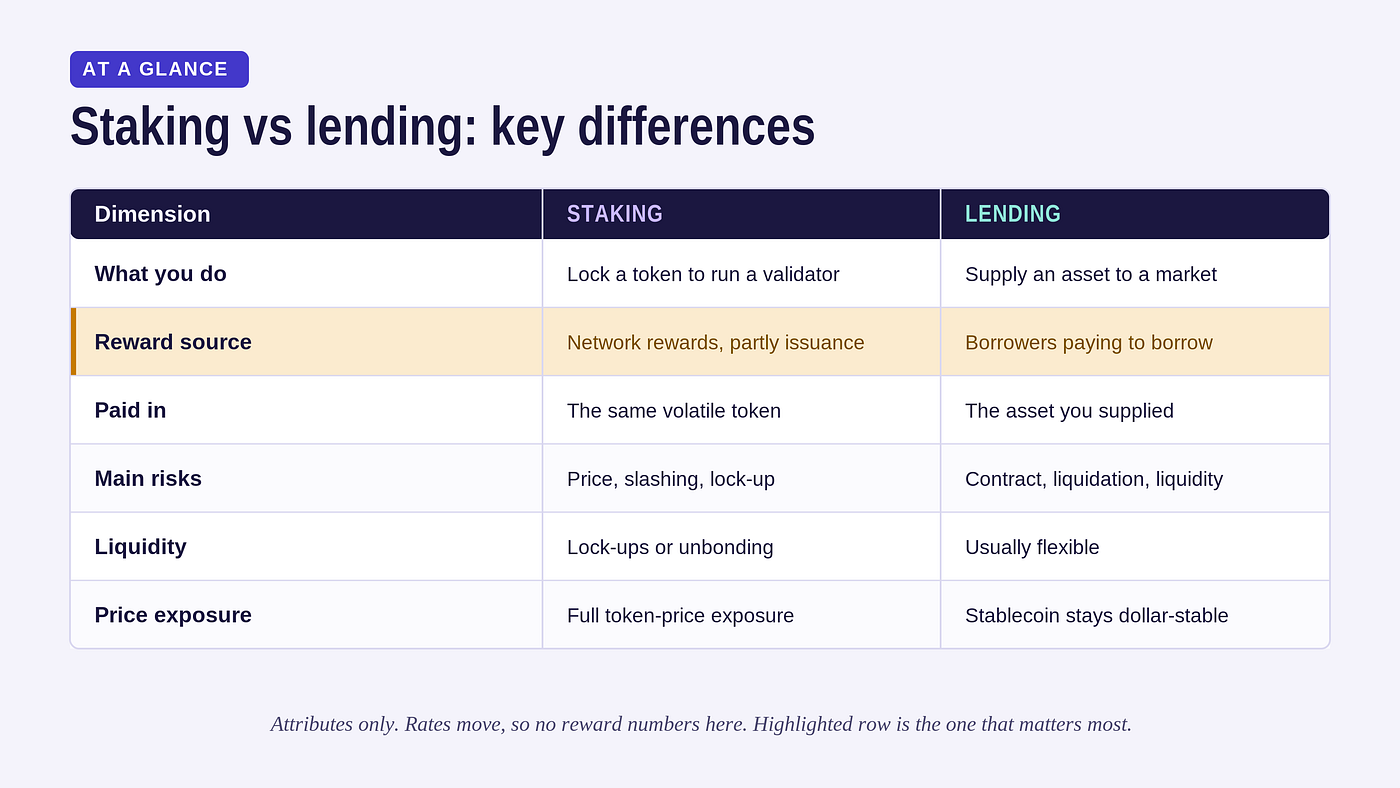
The core difference is where the reward comes from and what it is paid in. Everything else follows from that.
- What you do. Staking locks a token to help run a validator; lending supplies an asset to a lending market.
- Where the reward comes from. Staking pays network rewards, often partly new token issuance; lending yield comes from borrowers paying to borrow, which reflects real demand.
- Paid in. Staking usually pays in the same volatile token; lending usually pays in the asset you supplied.
- Main risks. Staking carries price, slashing, and lock-up risk; lending carries smart-contract, liquidation and bad-debt, and liquidity risk.
- Liquidity. Staking can involve lock-ups or unbonding periods; lending is usually flexible but depends on utilization.
- Price exposure. Staking gives full exposure to the token’s price; lending depends on the asset, and a stablecoin stays dollar-stable.
Which earns more, staking or lending?
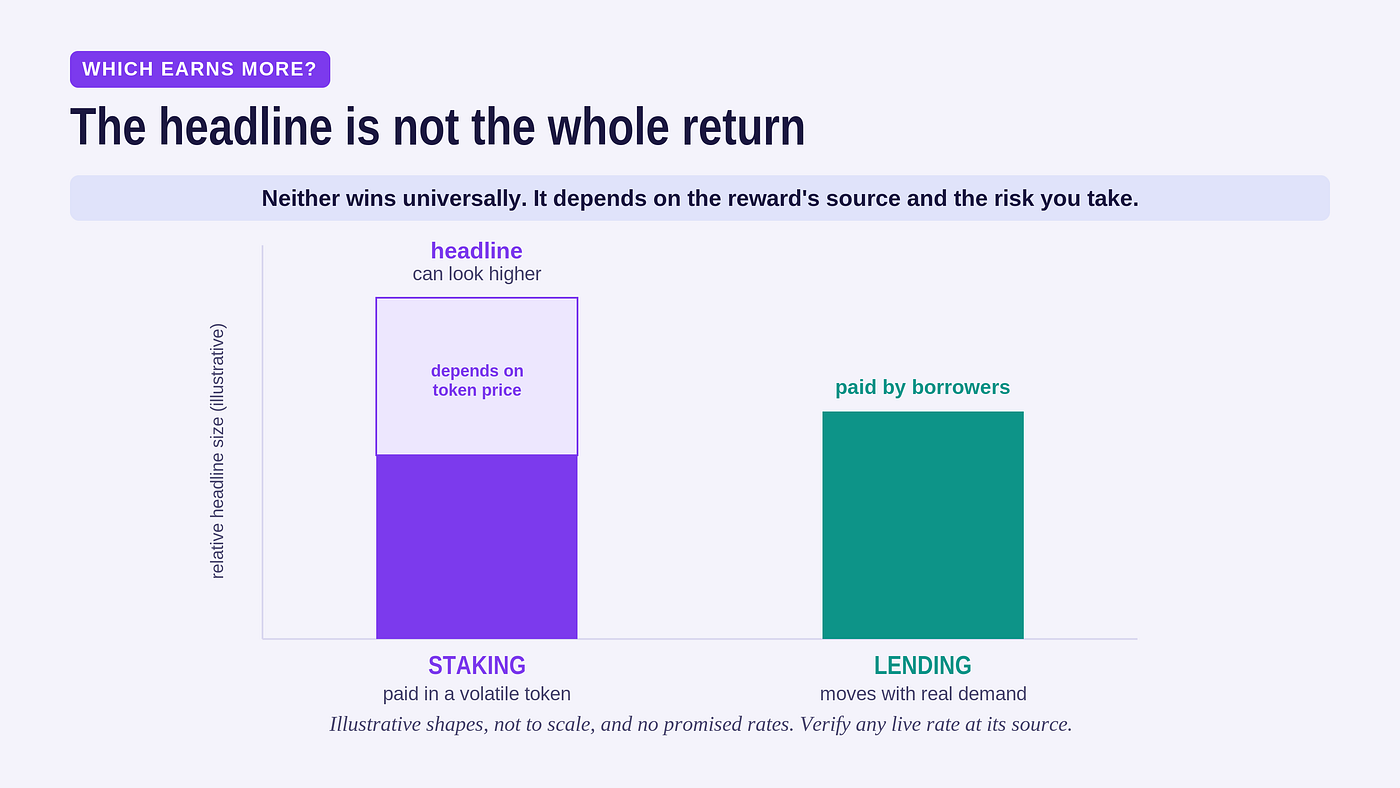
Neither earns more universally. It depends on where the reward comes from and the risk you take. A staking headline rate can look higher, but part of it may be new token issuance rather than income the network earned, and it is paid in a volatile token, so what you keep depends on the token’s price.
Lending yield is paid by borrowers, so it reflects real demand, and it rises and falls with that demand. The useful lens is the real-yield question: does a reward come from real economic activity, or from issuance? That shapes how durable it is. The honest takeaway is that the bigger headline number is not always the bigger reliable return. For where crypto yield actually comes from, see where stablecoin yield actually comes from.
Which is safer, staking or lending?
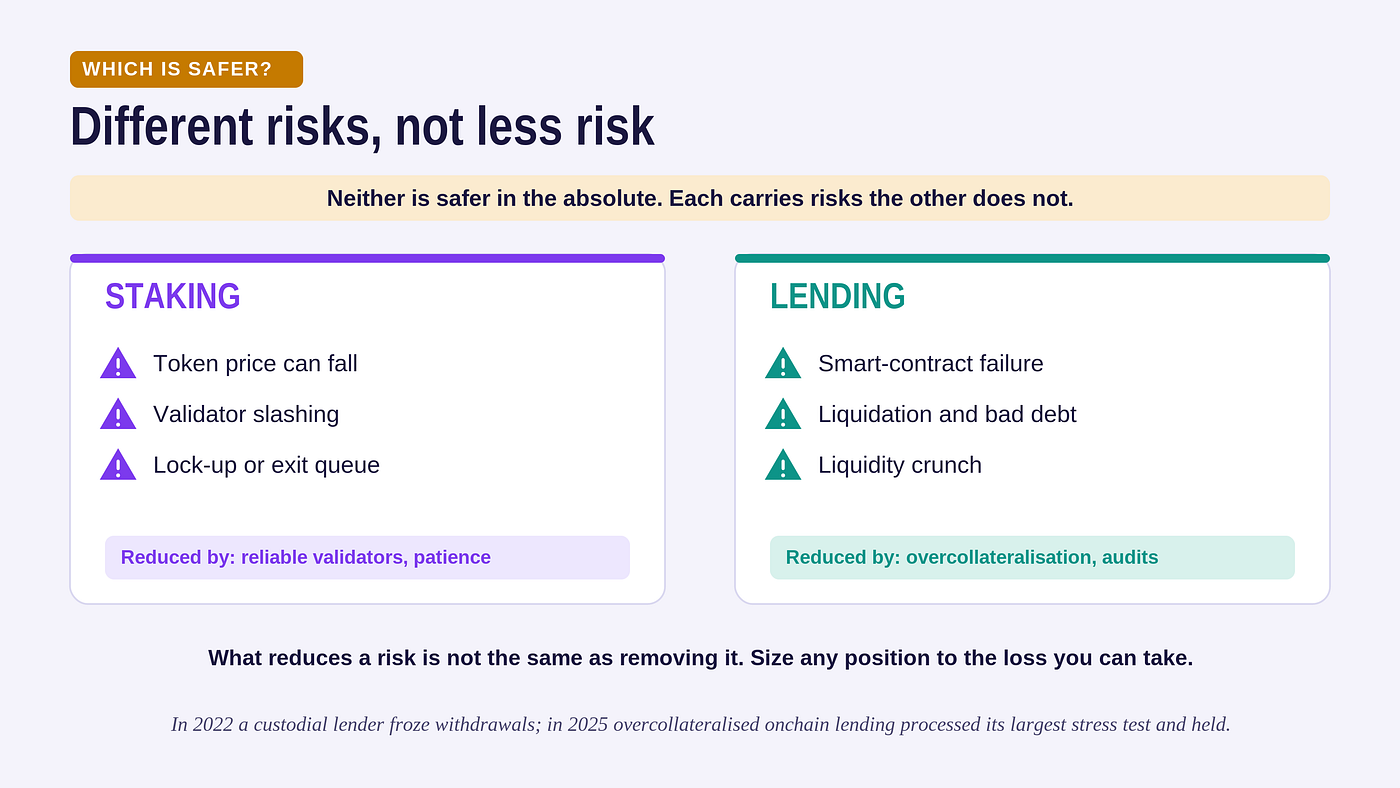
Neither is safer in the absolute, because they carry different risks. Staking exposes you to the staked token’s price swings, to lock-ups and exit queues, and to slashing if a validator fails. Lending exposes you to smart-contract failure, to liquidation and bad debt, and to liquidity crunches.
What reduces each risk is different too. For staking, it is understanding lock-ups and choosing a reliable validator. For lending, it is overcollateralization, audits, a real track record, and healthy liquidity. Aave processed its largest stress test in October 2025 and stayed solvent, while in 2022 the custodial lender Celsius froze withdrawals and filed for bankruptcy. Neither approach removes risk.
A third option: a yield-bearing stablecoin
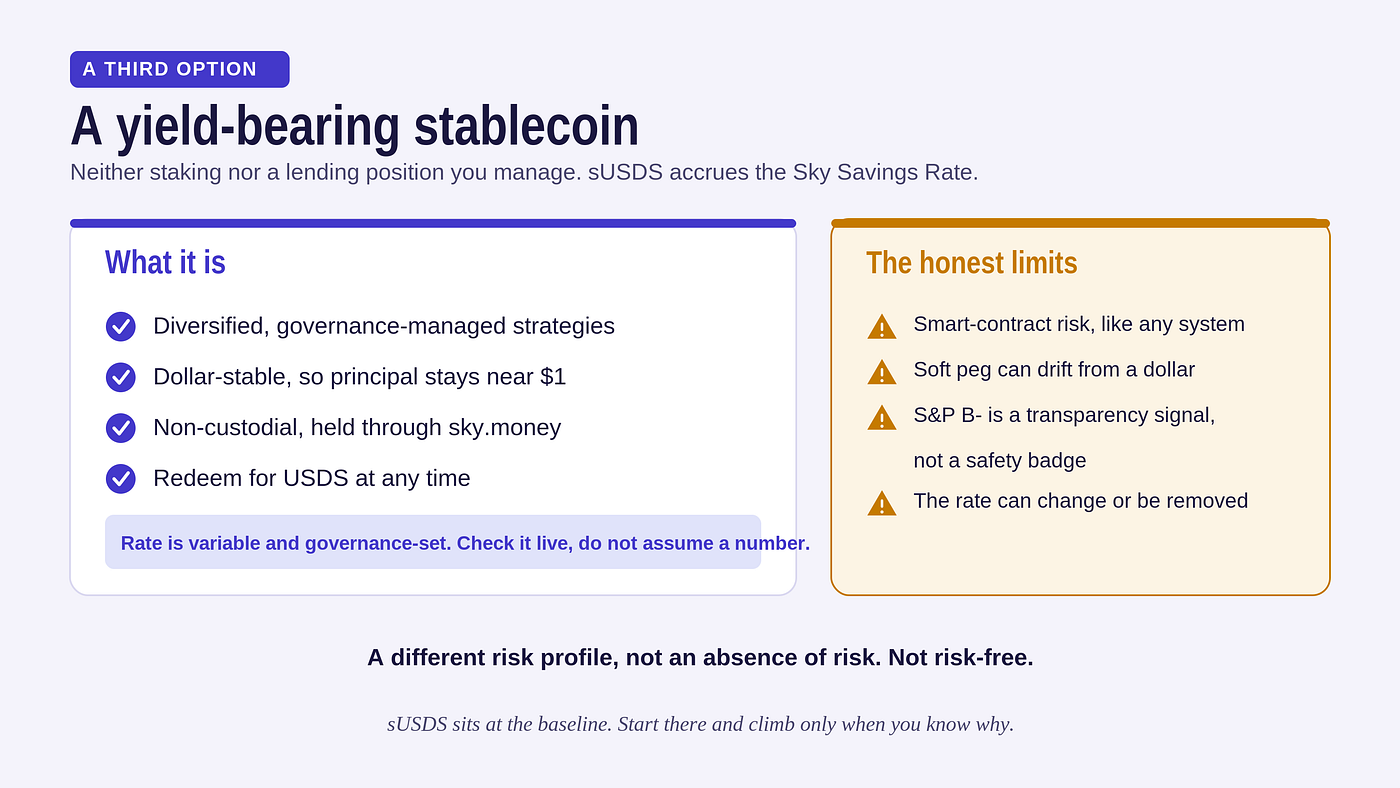
Staking and lending are not the only ways to earn. A yield-bearing stablecoin such as sUSDS is a third option: you are not staking a volatile token or managing a single lending position. You hold a stablecoin whose yield comes from a diversified, governance-managed set of strategies, it stays dollar-stable, it is non-custodial, and you can redeem for USDS at any time.
sUSDS accrues the Sky Savings Rate (SSR), a variable, governance-set rate funded by Sky Protocol revenue rather than by a token printed to attract deposits. This is a different risk profile, not an absence of risk. sUSDS still carries smart-contract risk, USDS is soft-pegged and can drift from a dollar, and S&P assigned Sky Protocol a speculative-grade B- rating in 2025 with flagged concerns, so read it as a transparency signal and not a safety badge. The rate is variable, so check it live at financial.skyeco.com.
A different risk profile is not an absence of risk. Start at the baseline, and climb only when you know why.
Which is right for you?
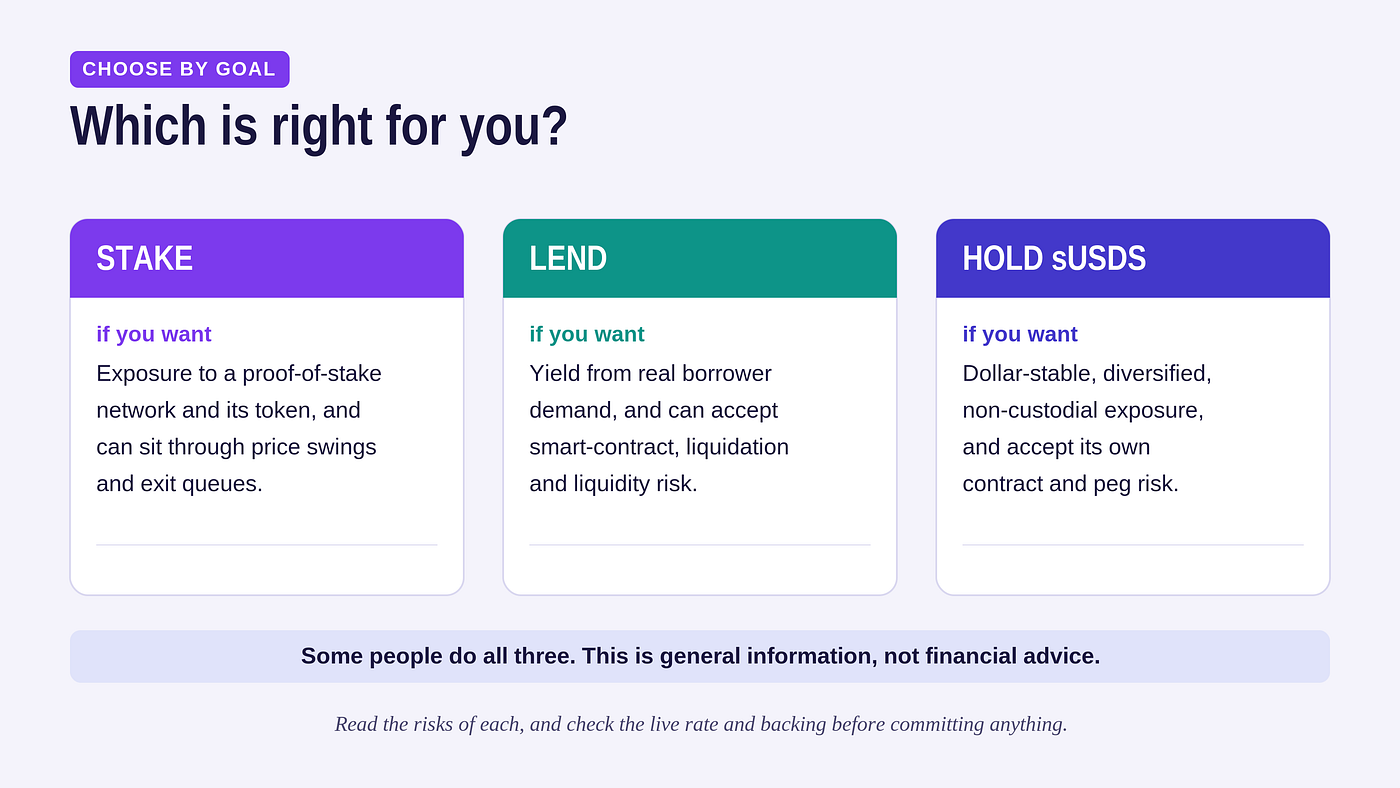
Choose by what you want your money to do.
- Stake if you want exposure to a proof-of-stake network and its token, and you can tolerate price swings and exit queues.
- Lend if you want yield from real borrower demand and can accept smart-contract, liquidation, and liquidity risk.
- Hold a yield-bearing stablecoin if you want dollar-stable, diversified, non-custodial exposure and accept its own smart-contract and peg risk.
Some people combine them: a long-term stake plus dollar reserves in a stablecoin savings position. This is general information, not financial advice.
Final thoughts
If you are weighing staking vs lending, decide where you want your reward to come from before you compare any rate.
I would rather earn from a source I can name, a borrower paying to borrow or a diversified set of strategies I can watch onchain, than from a headline number paid in a token whose price I am also betting on.
Staking fits when you believe in a network and can sit through its volatility. Lending fits when you want yield from real demand and will manage the risk yourself.
When you want your dollars to stay dollars while they earn, a yield-bearing stablecoin is the calmer third option. Match the tool to the job, and check the live rate and backing before you commit anything.
Frequently asked questions
What is the difference between staking and lending? Staking locks a proof-of-stake token to help run a validator and earn network rewards paid in that token. Lending supplies an asset to a market where borrowers post collateral and pay to borrow it, and you earn yield from that demand.
Which earns more, staking or lending? Neither universally. Staking can show a higher headline reward, but it is paid in a volatile token and may be partly issuance. Lending yield is paid by borrowers and varies with demand.
Is staking or lending safer? Neither in the absolute. Staking carries price, slashing, and lock-up risk; lending carries smart-contract, liquidation and bad-debt, and liquidity risk. Neither removes risk.
Where does the yield come from? Staking rewards come from the network and are often partly new issuance. Lending yield comes from borrowers paying to borrow, so it reflects real economic demand.
What is real yield in this context? Yield paid from real economic activity, such as borrowers paying interest on collateralized loans, rather than from new token issuance. Real activity can keep paying; issuance runs on a timer.
Is there an option that is neither? Yes. A yield-bearing stablecoin like sUSDS offers diversified, governance-managed exposure that stays dollar-stable and is redeemable anytime, though it is not risk-free and still carries smart-contract and peg risk.
메타데이터
- post_id
- b3a06ee09aaa
- slug
- staking-vs-lending-which-earns-more-and-safer-b3a06ee09aaa
- url
- https://medium.com/@ky.cheung.0806/staking-vs-lending-which-earns-more-and-safer-b3a06ee09aaa
- canonical_url
- https://medium.com/@ky.cheung.0806/staking-vs-lending-which-earns-more-and-safer-b3a06ee09aaa
- author_url
- https://medium.com/@ky.cheung.0806
- status
- ok
- fetched_at
- 2026-07-21 23:13:50