Discourses from the Typhoon’s Eye №32 — Learning to Flow
Impermanence is one of the most central teachings in Buddhism, yet it is also one of the most misunderstood. Most people understand it…
Discourses from the Typhoon’s Eye №32 — Learning to Flow
Impermanence is one of the most central teachings in Buddhism, yet it is also one of the most misunderstood. Most people understand it intellectually but still struggle deeply when life shifts in painful or unexpected ways. We make plans, build identities, form relationships, and create structures that help us feel secure… only to watch many of them eventually change, fracture, or disappear.
Knowing this, how can we live peacefully in a world that never stops changing?
Student:
Can you tell us what impermanence really is? How can we live peacefully in a world that feels so unknowable and always in flux? Our best bet seems to be planning ahead, but how can we succeed at that when everything can fall apart? And when things do fall apart… how do we deal with it?
Teacher:
Ah.
This is one of the great human questions. Not merely a Buddhist question, but a deeply human one. Because whether we study Dharma or not, all of us eventually collide with the same fact:
Nothing stays as we wish.
Bodies age. Relationships change. Health shifts. Money comes and goes. Governments rise and fall. Ideas become outdated. Even mountains slowly wear down.
And perhaps most unsettling of all… The future refuses to reveal itself.
When people first hear the teaching of impermanence, they often understand it too abstractly. They think impermanence merely means, “Things change.”
And while that is true, it is also incomplete.
Impermanence is not only about dramatic change. It points to something far more intimate: that all conditioned phenomena are dynamic processes, not fixed things.
Look carefully.
What you call a tree appears solid and stable, but is it really?
The tree is growing, exchanging air, moving water, responding to light, aging, decaying, becoming soil… all at once!
So where is the fixed “tree”?
The word tree is just a convenient label placed upon a flowing process.
The same is true of your body. The same is true of emotions. Even the thing you call “self.”
The mind prefers nouns, but reality often behaves more like verbs.
It is not merely “a river.” It is rivering.
It is not merely “a self.” It is selfing.
It is not merely “life.” It is living.
So why does impermanence disturb us so deeply? Why are we so easily affected by it?
Quite simply, it is because the mind wants stability.
It wants guarantees. It wants certainty. It wants control.
It wants answers to endless questions:
What will happen? Will I be safe? Will this relationship last? Will this success remain? Will this pain end? Did I make the right choice?
Of course, this desire is understandable, but reality makes no such promises.
And as many wise people across cultures have seen — whether Gautama Buddha, Laozi, Epicurus, or Marcus Aurelius — much of suffering comes not from change itself, but from demanding that change behave predictably.
You ask, “How can we live peacefully in a world that is unknowable and always changing?”
First, by seeing clearly that peace cannot be built upon certainty.
This is a subtle, but crucial point. Many people unconsciously believe that once everything becomes stable and predictable, then they can and will relax.
But when has that ever truly happened?
Even in comfortable times, uncertainty remains. The mind simply shifts its anxiety to the next possible problem.
So if peace depends on total control… Peace never arrives.
This is why the story of the old frontier farmer and his horse endures.
His horse runs away.
The villagers say, “Terrible luck.”
The farmer replies, “Maybe.”
The horse later returns, bringing wild horses with it.
“Wonderful luck!”
“Maybe.”
His son breaks his leg trying to tame one.
“Terrible luck!”
“Maybe.”
War comes, and the injured son is spared conscription.
“Wonderful luck!”
“Maybe.”
The story points to something simple and profound: Events are just events!
Not only that, but our judgments about them are often premature.
What seems like disaster may become blessing. What seems like success may become suffering.
Reality is wider than our immediate interpretations.
This does not mean nothing matters. It just means humility is wise.
Now, you ask about planning.
Should we plan ahead? Of course.
Zen is not anti-planning. The Daoist sage is not careless. Monks still prepare food for winter.
Planning is intelligent. It is only our attachment to plans that is the problem.
There is an important difference between using plans and believing plans control reality.
Make plans. Save money. Care for your health. Prepare for likely difficulties. Use reason. Think ahead.
Good. Wise. Necessary.
Nature itself teaches this. We plant in spring, tend in summer, and harvest in autumn in order to prepare for winter.
But remember: A plan is a tool, not a prophecy.
We can prepare for many things, but we cannot control the weather.
We cannot stop insects from destroying crops. We cannot prevent every storm, every earthquake, every landslide.
If the landslide destroys the house… Well… Perhaps the house needed renovation anyway! Hahaha.
Many people suffer twice. First in imagination. Then in reality. Sometimes, even only in the imagination.
Planning becomes suffering when the mind demands, “This must go according to script.”
Reality rarely follows our scripts… And it certainly never reads them.
So how do we deal with everything falling apart?
First, by seeing something strange… When looking from another angle, we notice that nothing was ever fully assembled to begin with.
This sounds odd, but look carefully.
We say things “fall apart” because we imagine they were solid, stable wholes to begin with. But all conditioned things were always changing. The apparent stability was temporary pattern, not permanent structure.
Consider a sand mandala.
Beautiful. Intricate. Sacred. …And then swept away.
Its fragility is not a defect. Its fragility is part of its nature. So too with much of life.
Now beginners sometimes hear impermanence and think it sounds bleak.
But no.
Impermanence is not only the source of loss… It is also the source of possibility.
It is because all things can change!
Pain can heal. Habits can transform. Grief can soften. Ignorance can become wisdom. Winter becomes spring.
If things were permanent, suffering would be permanent too.
So what is peace?
It is not certainty, nor control. And it is certainly not perfect planning.
Peace is the growing capacity to remain present and responsive amid uncertainty.
Not rigid. Not passive.
Responsive. And alive!
A rigid tree snaps in strong wind. A living bamboo bends.
Which survives?
This is why practice matters. Meditation does not make the world predictable. It trains the mind to meet unpredictability with less panic and less clinging. You begin trusting not that life will obey you, but that awareness can meet whatever comes.
People often ask, “How do I stop being afraid of change?”
Perhaps you do not. Perhaps fear still arises sometimes.
The deeper question is, “Can you remain intimate with life even while uncertainty exists?”
Look at this tea.
It is warm now. Soon it will cool. Later the cup will crack. One day even the clay returns to earth.
Yet right now… tea!
Warmth. Steam. Taste.
Nothing missing.
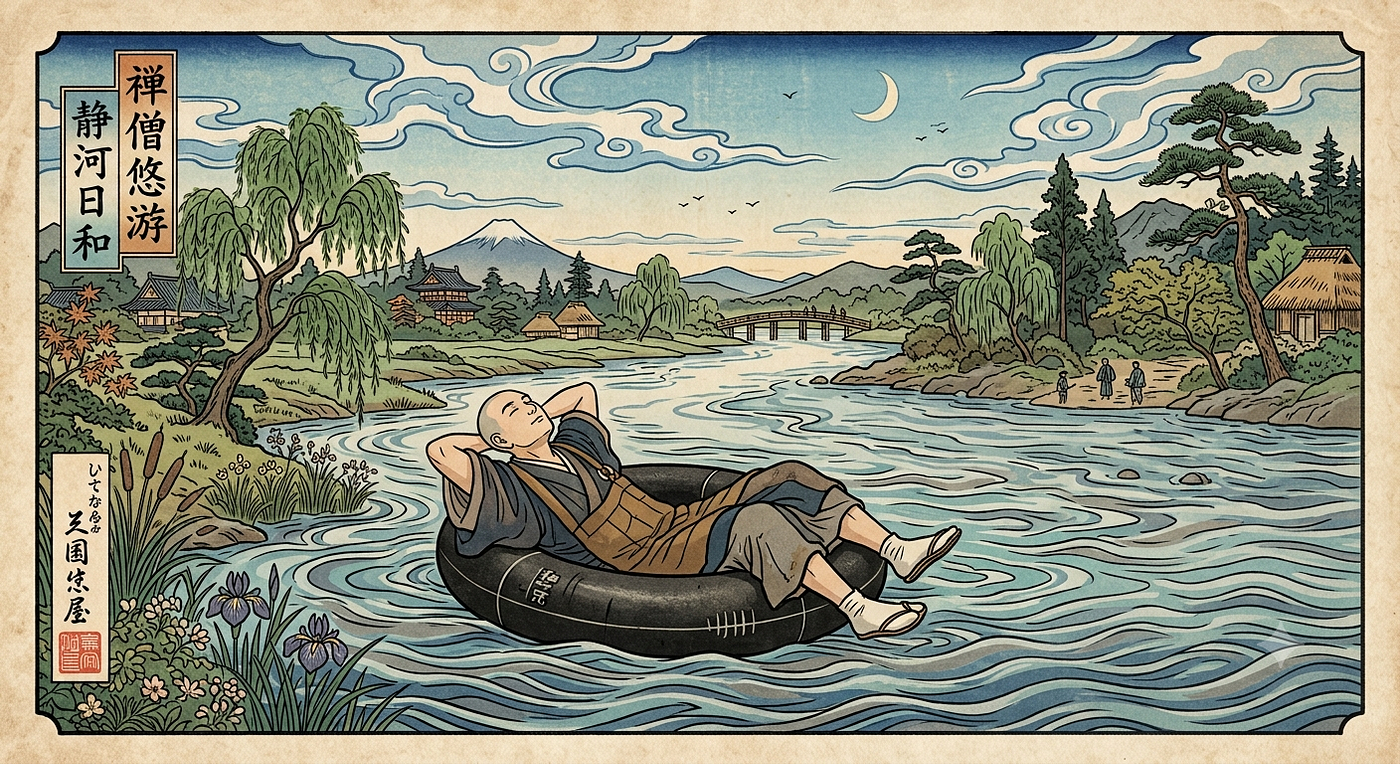
The river flows whether you cling or not. Peace comes not from stopping the river, but from learning how to float.
So what about you, fellow practitioners of the Way of Just Sitting? 😉
How do you relate to impermanence in your own life? Do you find yourself resisting change, trying to control the river, or are you learning, however imperfectly, to flow with it?
As always, feel free to share your experiences and thoughts in the comments. The conversation may help other practitioners who are also exploring the same questions.
Gasshō 😊🙏🪷
메타데이터
- post_id
- b3bc218a3c81
- slug
- discourses-from-the-typhoons-eye-32-learning-to-flow-b3bc218a3c81
- url
- https://medium.com/@ryudo.anju/discourses-from-the-typhoons-eye-32-learning-to-flow-b3bc218a3c81
- canonical_url
- https://medium.com/@ryudo.anju/discourses-from-the-typhoons-eye-32-learning-to-flow-b3bc218a3c81
- author_url
- https://medium.com/@ryudo.anju
- status
- ok
- fetched_at
- 2026-07-09 13:13:48