Barbie: A Case Study on Impact Strategy in Fiction Films
Could all businesses be impact ones? Could all films be impact ones? Most of them maybe?
Barbie: A Case Study on Impact Strategy in Fiction Films
Could all businesses be impact ones? Could all films be impact ones? Most of them maybe?
I believe it is undeniable that all stories influence how we think both individually and also as a society, when it manages to scale and reach a great number of people.
The most powerful mean of mass reach nowadays are films, with their “compact” form, enriched by visuals and sound. A proper immersive experience that transports us into a specific world and add strong data points to how we think.
With that said, in these articles (Is a story just a story part 1 and part 2) I explored my reasoning around the need to intentionally consider the impact any story has on society. Here, I would like to dive into the first example of how I would partially apply one of my Impact Production Frameworks to now widely known films as many people ask me: what does an (Creative) Impact Producer do?
Here’s how I personally work. Let’s jump into it!

Overview of the topics covered in the Article
2023 was the year the world turned pink. The Barbie fever took over shop windows, and the much-anticipated movie grossed over 1 billion USD. Lovers loved it; haters hated it. But these are the facts: it was the only film to gross over 1 billion USD that year. Additionally, it was produced by a woman, co-written and directed by a woman, and had quite a punchy line: the real world is where there’s only room for men.
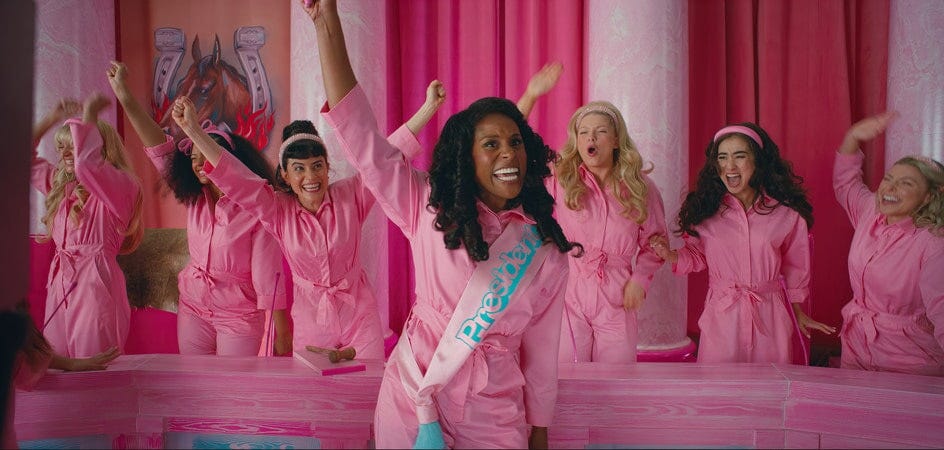
Photo: TM & © 2024 Warner Bros. Entertainment Inc. Barbie, The movie.
I’m a great fan of both Margot Robie and Greta Gerwig — so I had to watch it.
In my humble opinion, they did a GREAT job. What an incredible storyline, an unique world, characters, performances, soundtrack. Such a shame they didn’t get the Oscar nominations they deserved — at least the award for one original song.

Director Greta Gerwig, with Margot Robbie, both in pink, on the set of ‘Barbie.’ Photo: CONTACTO | El Pais
And the impact world was divided and I even felt I needed to adjust this article quite a few times…On one side, the movie looked like a commercial machine of a pink plastic world. On the other, it became an empowerment tool for millions of girls and women all around the world. Some countries even banned its screening. And more recently a new wave of people condemning how it somewhat exposed me. So…?
Above all, this movie reminded the world the potential impact at scale of the film industry and pop culture. So, what if this had been intentionally an impact-driven film?
I’ll walk you through one of my frameworks and give an overview of a approach they could have used.
Important disclaimers: I haven’t been involved with the film in any capacity and have no privileged inside information; this is an exercise to exemplify some concepts through a story that is quite widely known. It’s not an exhaustive and comprehensive work. My objective is to inspire you to look at (your) films from a different perspective.
In this article I will cover essentially steps to be taken during Development.
Depending on what is decided during this planning phase, we’ll see its implementation later during Pre-Production, Production, Post, Distribution, and so on.
In any case, an impact strategy does not bullet-proof a film against backlashes — it’s impossible to please everyone — but it can put the filmmakers on a better position to say what it is that they wanted to highlight with their story.
1. Creativity is Queen
In this approach, it all starts with the story — with a dream, with a vision, with a passion. This is where I believe the entertainment industry differs from others. One can create stories out of impact objectives, but there’s something special about Art that is coming purely from creativity. This is the approach I will cover in this article. Rick Rubin says: the audience comes last. And it eventually does need to come in…
💡Story kick-off: once the story is established, an impact vision is created along with the concept. Together, they work as the ⭐North Star for the production development
🎀 Barbie Case

Photo: TM & © 2024 Warner Bros. Entertainment Inc. Barbie The Movie
For Barbie that could have meant to explicit: we want this movie to give women an inspiration to break the current patriarchal structures and follow their dreams.
Every film should have a Theory of Change. This is a framework that has been used for decades to create a logical path to achieving an impact vision. It can be quite complex or simple, and its use is to clearly communicate what the story is highlighting and how it can expand the conversation around its impact. We will dive into it shortly.
2. Development
i) Story Development:
Margot Robie secured the rights and looked for the person who would write and direct her vision: Greta Gerwig.
Whenever we are telling a story, we have a great responsibility to understand what stereotypes and “truths” we are selling, and to whom.
- Are there different groups & voices that should be included in the writing process?
- Should experts & professional (ie healthcare professionals) be interviewed to develop the characters and refine the story?
- What other cultural landmarks are there tackling the same subject?
- What kind of behavior is the story reinforcing or highlighting?
In this case, from the beginning we could feel the story was way beyond just the character of the stereotypical Barbie (Margot Robbie) which made it quite rich and inclusive. The production team was already an adequate one to tell the story (note that Greta wrote it with her husband). Some of the main behaviors/beliefs that were strongly highlighted in the film:
a) Women are capable of everything, in Barbieland.
- Strong alignment with Women’s Rights
b) Underrepresented voices and “minorities” (from the point of view of Men in power — America Ferrera’s character) can make a difference.
c) Strong alignment with diversity and inclusion principles, along with individual empowerment
- A very diverse cast showing that Barbie come in all shapes and color
d) The real world is dominated and made by and for men.
- Given that this is a stereotypical representation of how the world is, rejecting principles of equality and justice, at the end of the story, it would need to be turned around.
ii) Strategy Definition
What to do with all that? The Theory of Change.
With that, we start to draft the film’s Theory of Change. It is a tool that help us visualize the connection among the story elements and the impact, or behavioral change it aims at.
· Story Elements (Inputs)
· Business Results (Outputs)
· Behavioral inspiration (Outcomes)
I) Vision: We drafted the impact hypothesis:
a. Women are capable of everything, in Barbieland.
- Strong alignment with Women’s Rights
b. Underrepresented voices and “minorities” (from the point of view of Men in power — America Ferrera;s character) can make a difference.
c. Strong alignment with diversity and inclusion principles, along with individual empowerment
Note that I left “The real world is dominated and made by and for men” intentionaly out of the impact goals. Let’s see if and why we would leave it in as we go…
II) Audience: And WHO should actually be reached by this story?
We cannot talk about impact and films without talking about an audience.
This film has been made by and for women essentially. Of all ages. Of all colors, nationalities, ethnicities. It is a film that wants to ignite self-confidence in women while questioning the status quo.
Important consideration: what’s more important for the filmmakers — to inspire women or to change men’s perspectives? It might be hard to do both at the same time without compromising the power of the story elements.
I believe this is where many men got hurt with the film, as the portrayal of their gender wasn’t exactly a positive one. It was provocative. Could there be a way where you don’t “lose” the other half of the audience, or would it compromise the power of the story?
I will leave this question open on purpose, because it could change the structure of the story considerably and thus also our exercise. So bear with me as we define the impact focus of this film on women — because that’s what it is in the end, in my perspective.
III) Inputs: We go back to the story and the production pillars.
What elements in the story will be the inputs to reach those impact visions? Here are a few:
a. There are all kinds of Barbies beyond sterotypical Barbie
b. Barbieland works well as an integrated society while also allowing each Barbie to be her own self.
c. Barbie finds out about the real world and how things are not how she thought the should be.
d. There is a strong and critical supporting character that brings the fantasy world closer to reality
e. The stark contrast between Barbieland and the real world (heels or Birkenstocks?) sets the conflict
f. The duo Barbie and Ken bring contrasts and tension to the story to allow the narrative to unfold from personal and emotional perspectives.
IV) Outputs
The story needs to go somewhere to impact people, so the more reach it has, the more impact potential it has. Yet, just being watched is not enough.
The outputs are essentially the story messages and the business results that one aims with the film, steered by the kind of impact intended.
Some questions to consider the intended business results:
a. What are the strategic territories where it could and should be screened?
b. What kind of festivals (if any) would be beneficial to help exposing the message to more people from the intended audience?
c. Should any specific screening rights be negotiated with Sales Agents/Distributors in order to leverage the impact? Ie special screenings with partner organizations that work with girls&Women empowerment/in vulnerable situations etc.
From a commercial and impact perspective, the more people from the audience are reached, the better. My approaches tend to prioritize extensive reach, as we want to ensure the film is also financially sustainable to continue supporting further impact. Yet, in many instances, it makes sense to also add very specific output objectives if the film can change specific things in society, for instance, laws, development of specific impact campaigns, and so on.
On the story side, here our some Outputs we could identify, given the Inputs we highlighted:
a. Together women can accomplish more and get through obstacles imposed by a strong patriarchal society.
b. Barbies are successful in the most different areas of society, regardless of how they look
c. Stereotypical Barbie fights against the Corporate
d. Kens also have their place in Barbieland and are part of the society
e. There is room for everyone
V) Outcomes
And what are the intended behavioral changes we would like to see in the audience after exposed to the film? How are the story elements presented, and how are they being perceived?
We will know that by creating touch points with the audience. This is where impact campaigns and measurement kicks in.
Here a few possible Outcomes for Barbie:
a. Girls&Women feel empowered and inspired to follow their own path
b. Women are hopeful about the change that sisterhood can bring about
c. Underrepresented people recognize their strenght and are empowered to use their voices
d. People get confident about the power of a more equal and diverse society

Visualization of the Theory of Change focused on the story, connecting Inputs (Bottom) to Outputs (Middle) to Outcomes (Top). Copyright Ella Impact Productions.
iii) (Impact) Strategy Development
For me, impact/commercial strategy has to start right along with story development, as they work in parallel. The strategy should be based on the Theory of Change, which will, in turn, clarify the impact goals of the film and define the values of the production, helping in the process of selecting the right partners to bring on board. In the independent film world, this is even more crucial to bring in funds to make the film possible. One important reminder is that a film is not ready until it is locked. It changes and evolves throughout the process, and thus the impact strategy will also be a living tool to be reviewed, refined, and expanded until the campaigns are actually launched.
A film’s (specially) impact strategy development and deployment has a lot to do with partnerships to create pathways to leverage the impact and broaden the reach. Each player brought into the creation of the film will likely support it further once it is launched.
Perspectives to be considered:
- What is the main theme of the film and what are the organizations & brands addressing it?
a — Which brands are mostly championing female empowerment on different areas? Not only from a fashion perspective, but also women in STEM, Leadership, ARts etc
b — Which companies and institutions are working with underrepresented groups and serving them?
c — If changing men’s perspective is an impact goal, are there male-focused brands that stand for equal rights?
- Where is this story going to be told and who are the right organizations/people to partner with, both to develop it further and co-produce?
- If this story was told in a country other than the US, what other production company(ies) could come on board to make sure that culture is accurately described and could involve the local communities not only during production, ie shooting, but also during development?
- Which markets & audiences would benefit the most from the film? What partnerships should be secured to reach the audiences this film addresses?
- From a pure commercial perspective, one could have focused only on Western countries already open to the concept, where women have already been fighting and winning some battles.
- From an impact perspective, could there be some adaptations to the script that would allow it to travel further and get to cinemas/streamers where such contents would never be produced and give them the opportunity to be exposed to a message that could change perspectives?
iv) Impact Campaigns
A big part of the work then is to come up with a few initiatives that would allow the conversation to go beyond the big or small screen.
A few examples:
- Many films have already websites and social media profiles, so why not use them to share resources that can help the audience around the main topic of the film, give helpful information to trigger conversations and reflections, and think about creative ways to show the main messages of the film.
- A film can both leverage the audience for other organizations (for and non-profit) as well as tap into their audiences. The more people can have access to hopeful, positive and inspiring content, the better!
- As part of the release campaigns, draft both off and online sessions with the cast & crew, adding guests to talk beyond the specifics of the film, but going into the impact topic as a whole.
- Partner with a specific Non-Profit or Impact business to donate or match donations
The sky is the limit — or actually the budget. If budget is illimited or well funded by an organisation, there could be special events & screenings, focus groups, interviews, online webinars… but. let this not discourage anyone.
The important thing is to get started and it can be very low budget. Examples:
- Adding a frame at the end of the movie with a QR code to send the audience to a website and present a few numbers of reality behind the fiction presented.
- Create a website to present and point the audience to some resources
- Draft an interview for the Premiere including talking points around the impact, recording it and then sharing online
3. Budget
Money tells us many things… how it is distributed and spent shows priorities. It is a really broad topic on its own, and here I would like to just sprinkle some ideas around responsible production.
Most low budget films try to squeeze as much as possible, given it is so hard to secure financing. And many high budget films allocate resources in a way that it still doesnt benefit whom they should.
-
How many days of shooting are needed under which circumstances? Is it enough to allow the crew proper rest and time with family (if not on set)?
-
What benefits are being offered to the crew and cast?
-
Is there decent boarding&catering, emotional&health support
-
Compensation — is it fair and does it respect market standards? Will the crew and cast be compensated extra in case of success?
-
Impact — how much will be invested in creating the right partnerships, screenings, research, reports to make the message travel and reach where it should?
I hope this article starts to give a bit of light into what could impact lenses look like when applied to the film world.
Impact Producers have been around for a longer time creating more specifically impact strategies for documentaries.
In my case, I consider myself a Creative Impact Producer, meaning that my work is that of a creative producer but with impact lenses. It starts from conception of a content, preparing it to be good enough material to allow for sound impact strategies.
If this triggers your curiosity and you would be interested in exploring a few ways to make your film more impactful, or if you would like to discuss ideas to create meaningful and entertaining stories that support specific impact topics, just email me for a consultation session — hello@ellaimpact.com
Meanwhile, check out the intro episode of Screening Change and follow it not to miss the launch of Season 1 coming soon. Screening Change is the only podcast where we talk with filmmakers that are also in the journey of bringing more hope, love and joy to the screens.
Can’t wait to see how much positive impact can we create by giving our stories ways of navigating beyond the screens!
메타데이터
- post_id
- b3c0a53e95c1
- slug
- barbie-a-case-study-on-impact-strategy-in-fiction-films-b3c0a53e95c1
- url
- https://medium.com/@julia.profeta.johansson/barbie-a-case-study-on-impact-strategy-in-fiction-films-b3c0a53e95c1
- canonical_url
- https://medium.com/@julia.profeta.johansson/barbie-a-case-study-on-impact-strategy-in-fiction-films-b3c0a53e95c1
- author_url
- https://medium.com/@julia.profeta.johansson
- status
- ok
- fetched_at
- 2026-08-18 22:33:10