AI is mimicking Nature’s Patterns
Should we use it to replace nature’s ability?
AI is mimicking Nature’s Patterns
Should we use it to replace nature’s ability?
Source: https://unsplash.com/photos/a-group-of-people-riding-motorcycles-down-a-street-ToreMukKf9U
We often look at a scene and conclude it is chaotic if we are unable to see any order in it. But look deeper, and over time, many of the constituents in the scene are going about their activities in some orderly fashion. Each of the constituents may simply be repeating its pattern as it joins other constituents, just like the individual riders who were going about their daily routine on their motorcycles. Once we could see the patterns, the scene was no longer chaotic.
Patterns have been an area I spent time in as an IT Architect. We look at how to create policies for architecture (pattern or rules to comply), how to evaluate the architecture (looking for patterns that worked before), and how to define the architecture for an IT solution (looking for reusable patterns), such as design patterns, combining hardware, software, and solutions that were tailored to meet user requirements.
The knowledge of architecture patterns exists in my head, accumulated over years of experience in designing programs and systems.
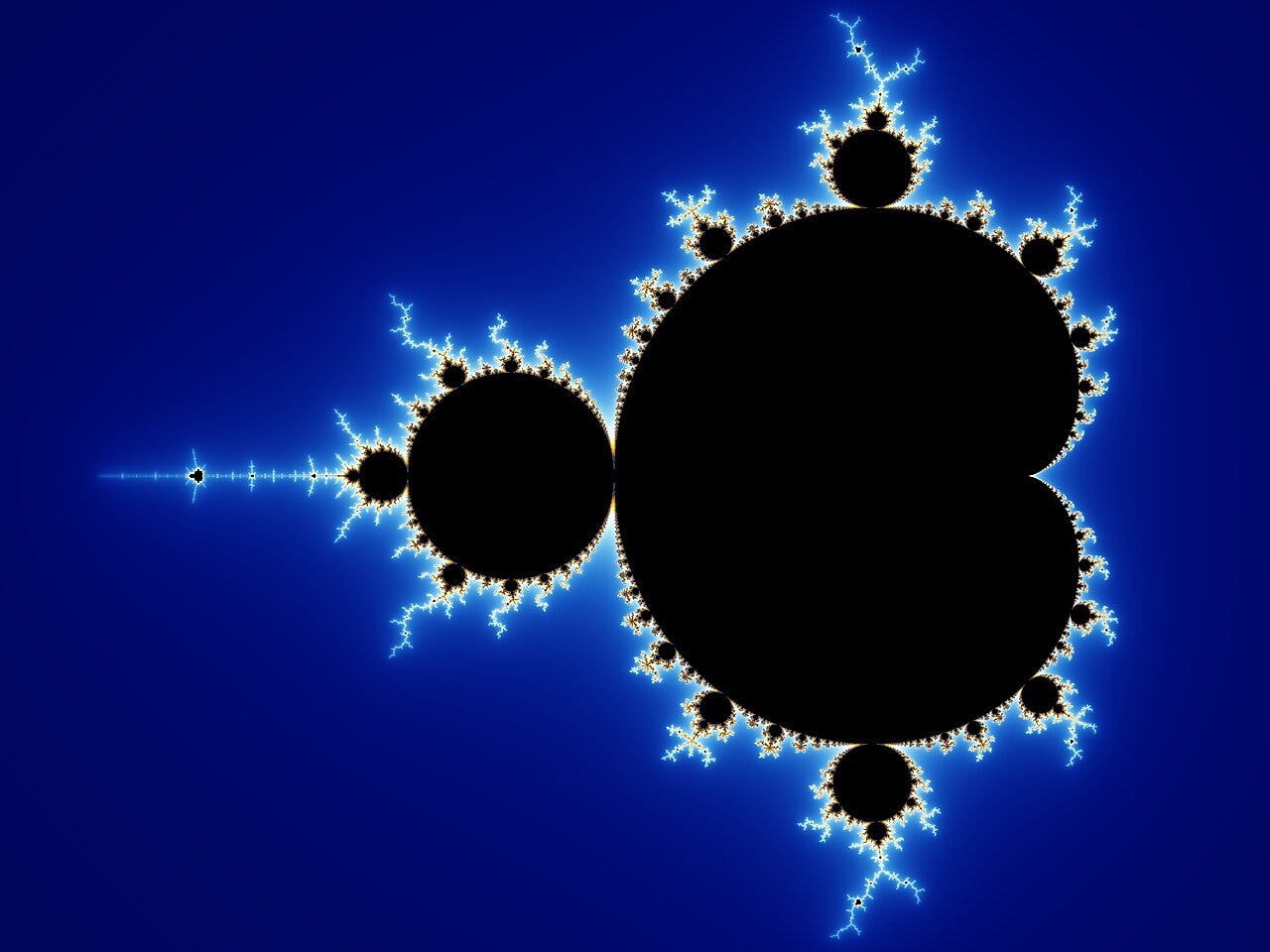
Created by Wolfgang Beyer with the program Ultra Fractal 3. — Own work, CC BY-SA 3.0, https://commons.wikimedia.org/w/index.php?curid=321973
Patterns are a seemingly basic concept, but something so pervasive and fundamental in our world. A pattern is an observation of a repeating configuration of observations or appearance, sometimes in sequence, sometimes in concurrent appearances, and sometimes in recursion (like the Mandelbrot fractal in the above image). It offers a way for us to recall something that has been seen or heard (or detected), or experienced with a combination of our senses (like smell, taste, touch, and the usual sight and sound). It provides a snapshot of the observed sensing via some form of information encoding. It lets us sense order out of seeming chaos. It is like a form of memory recall, though not exactly like what we have in computers. We see patterns via recognizing a face, an object, a place, a scene, and even in our dreams. We cannot usually recollect all the details and be able to recreate exactly what we saw, but we can recognize it even if some parts are obscured. We hear sounds that we recognize as a familiar voice, words from someone speaking, calls from animals like birds, sounds made by objects in the world around us, and music. We smell the fragrance of food, of flowers, and we detect the awful smell of foul objects. These are all instances where we recall a pattern that we have somehow recorded in our pattern memory. We were trained to recognize these patterns over a long period of time or over multiple exposures to them.
Pattern recognition is not unique to us. It is nature’s way of solving chaos and complexity in the natural world. We have atoms and molecules that make up physical and chemical objects. These then create biological objects that populate the entire Planet. With the large number of molecules and objects, and reacting to each other, the world is naturally chaotic and complex. But somehow, underneath this complexity, order emerges and allows us to make sense of the chaos via recognizing patterns. And this is not just for us humans and animals; patterns are used in every living thing, including plants and microorganisms. Chemical patterns exist for bacteria and other microscopic life forms, and essentially all living things evolved with the use of patterns to sense and respond to the world around. Each successive evolution helps to enhance pattern capabilities for the next generation.
By following a pattern, we often use our bodies to respond to events or actions that are required of us, such as swinging a tennis racket to hit a ball. We must have gone through some amount of training with the racket to swing at the ball target. Sometimes we might call this muscle memory, but it is a pattern of behavior of our muscles that we have developed over time with multiple training practices.
Why are we capable of this? Fundamentally, we might think there is an organic computer in our brain that is making all these possible. This computer is somehow able to read all our sensors and is programmed to react in the way we have behaved. The patterns we have do not seem to be exactly reproducible, like making a copy of what we can outside of our body. It is somehow just encoded like a form of analog memory, to let us identify a pattern or deny a pattern. Once we can determine if there is a match, we can then take action. And if we deny the pattern or detect an anomaly, we may somehow create a new memory pattern for the new observations. This might sound like a lot of steps of processing, but I’m sure you don’t expend much effort in recognizing a new face and then remembering it after seeing it multiple times.
What do patterns have to do with Artificial Intelligence (AI)? Well, AI can now recognize patterns. We copied the architecture of neurons and simulated them on computers in the form of neural networks. We use neural networks to mimic nature’s ability of pattern recognition. We assemble numerous samples of training data with labelling and train the neural networks to recognize patterns. And with the immense capacity we have with computer hardware and cloud technologies, we could collate large datasets to train the neural networks. With the model created from the training data, we can then evaluate queries using the model. This is what AI is today. In fact, we can engineer AI solutions to recognize almost anything in nature. In computer vision, we could use AI to recognize faces, vehicles, objects, and many things we see with our eyes. In Large Language Models, we could use AI as a subject matter expert in text narratives. In Image and Video Models, we could use AI to create photo-realistic images and videos. All of them rely on neural networks as the foundation layer.
I think AI can be a very useful tool for humans, but if it were to extend to even replace our physical abilities, then it would go against nature and what our bodies have been developed for. It would also mean a gradual degradation or atrophy of our physical abilities as we increasingly rely on them. Imagine that we could build a better eye that can see other spectrums (infrared and ultraviolet), a better ear that can hear like the bats (like a sonar radar), better hands that can respond faster and stronger, or even work without our conscious control, better legs that can jump higher and run faster. What would we become?
Furthermore, AI is not always right. The ability to detect or generate a pattern does not mean it can do so with 100% accuracy on all occasions. Patterns in the natural world are probabilistic; it is not the actual order (formula or rules) of how the constituents work. AI does not know or comprehend the underlying order. AI created patterns through the use of training datasets, and no one understands the relationship in the database maintained by the AI. We merely store vectors and weights in the database. The answers or instances of patterns generated by the AI may not be the same as the expected response. That’s where we sometimes say the AI hallucinates.
But human intelligence is different. Our intelligence (pattern recognition) is honed over time, and its accuracy (or efficacy) improves by learning new samples and unlearning bad instances. We often and do make mistakes, but we learn from a young age to manage the risks when we make mistakes. We have a natural ability to apply our intelligence while managing the risks associated with making the inference.
AI, on the other hand, is designed with a well-scoped use case in mind. AI using LLM seems to be a generic tool, but if it is used outside the scope of its training datasets or beyond the scope of its use cases, then it is likely to offer a response that might not be correct (hallucination).
So how should we be using AI? My suggestion would be to continue to use it as a tool. If it is good at recognizing patterns of an area of expertise, we could use it to substitute for our own, but we will always retain the last judgment of its quality or the final decision to apply. If we are unable to make judgments on that area of expertise, we should not employ it as our own and empower it to take actions, as we are not able to manage the risks associated with it.
I am an advocate for barefoot shoes. You can see this article on my one-year experience with barefoot shoes. We have gotten too used to cushioned shoes, even though they are damaging our bodies. We started wearing shoes about 40–50 thousand years ago. The shoes were mostly made of animal leather or plant fibres, and they were essentially for protecting the soles against rough ground and keeping warm. The shoes then had a wide toe box, a thin and soft sole, flat with zero stack height, and flexible with great ground feel.
But in the 1960s, we started to have rubber-cushioned running shoes. They provide hardened support to allow stomping your heel against the ground so that you can run faster with the cushioned support. We changed our natural walking gait. But this is not the way our bio mechanics is designed for. Like many mammals, we were designed to use our front foot to land our strides and to use hip rotation to move our legs (with glutes). But with heel striking and the uneven stack height (heel higher than toe), people experience strains and pains in their knees and back.
AI is like cushioned shoes. Initially, we feel great with it, helping us to walk and run further. Then, with neural network technology, we expand the applications of shoes or for AI to have computer vision, Large Language Models with narrative expertise, Video models that generate lifelike videos, and so on. It’s like enhancing shoes with different materials (rubber and silicon) for different sports, like football, basketball, racket games, sprinting, and marathons. We become dependent on shoes for many of our physical activities and lose our natural abilities in our feet. There are 26 bones in each foot with 33 joints. There are 20 intrinsic muscles in each foot, and 30 major tendons crossing the ankle into the foot. All of these abilities stand to atrophy as we rely on our cushioned shoes to walk and run, where they feel more like armour than protective skin.
In summary, patterns and analog memory in living organisms are about meeting continuous, adaptable changes — whether in plants’ growth patterns, animals’ neural circuits, or biochemical pathways — that help an organism respond more effectively to its environment.
We as a species have made great progress with the creation of technology as tools that allow us to advance ourselves and control the world around us. Technology is created through a thorough understanding of the why and how the world works, and we use technology to either mimic or substitute how nature works. We create cars to move us like our legs, planes to fly over great distances like the birds, medicine to heal us, cameras to capture the world like our eyes, solar cells to trap solar energy like photosynthesis, and many more. But these technologies were used as tools, never to replace us or our abilities.
With the advancement and proliferation of modern AI technologies, we are now seeing the substitution of our capabilities with AI. Evolution has conferred us many abilities, and if these are not utilized, they would likely atrophy. Modern AI has merely mimicked our natural abilities, but we should still retain the final say in applying them.
메타데이터
- post_id
- b3d0ea2b3045
- slug
- ai-is-mimicking-natures-patterns-b3d0ea2b3045
- url
- https://medium.com/@jangthye/ai-is-mimicking-natures-patterns-b3d0ea2b3045
- canonical_url
- https://medium.com/@jangthye/ai-is-mimicking-natures-patterns-b3d0ea2b3045
- author_url
- https://medium.com/@jangthye
- status
- ok
- fetched_at
- 2026-07-20 01:21:36