Beyond the Beep: How Emergency Cell Broadcasts Actually Work 📱🚨
The moment that triggered this
Beyond the Beep: How Emergency Cell Broadcasts Actually Work 📱🚨
The moment that triggered this
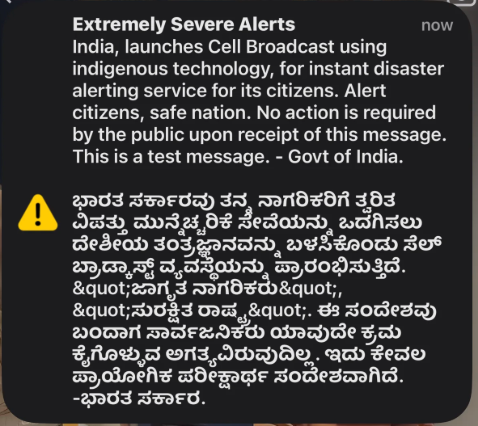
Today at 11:45 AM. My phone was on Do Not Disturb. All notifications were silenced. Then, out of nowhere, a piercing siren went off and an “Extremely Severe Alert” took over my entire screen.
It was a nationwide Cell Broadcast test, and you may have received it too based on your location.
As a developer, my first thought wasn’t “What’s happening?” but “How did that happen?”
How did a message bypass my OS-level silence? Why didn’t my two SIM cards trigger it twice? Is it even possible to secure a system that needs to reach everyone instantly?
1. How did this bypass DND and Silent mode?
This is intentional. Our phone is designed to ignore our settings for critical alerts.
It happens across multiple layers working together:
- The modem flags the message as critical the moment it arrives.
- The OS overrides DND and silent mode.
- The audio system forces the speaker to play loudly.
- The UI takes over the full screen.
In short, our phone says: “This is important enough to ignore your preferences.”
2. Is this hardware or software?
Both, and they’re tightly coupled.
- Hardware (modem): Always listens for these alerts on a dedicated channel. It can wake the phone instantly, even from deep sleep.
- Software (OS): Decides how to display it, plays the sound, and handles accessibility (vibration, text-to-speech, etc.).
This isn’t just an app feature. It’s baked into the chip.
3. What technology powers this?
This is the most interesting part. It’s not SMS. It’s not the internet. It’s Cell Broadcast.
Instead of sending a message to each phone individually:
- The tower sends one broadcast.
- Every phone in range receives it simultaneously.
Think of it like FM radio. One transmission, millions of listeners. That’s why it:
- Works instantly
- Scales to millions
- Survives network congestion (when SMS and calls usually fail)
4. Why did I receive it only once (even with 2 SIMs)?
Good catch. Even though Airtel sends it, Jio sends it, and multiple towers around us broadcast it, our phone shows it only once.
Each alert carries a Message ID and a Serial Number. Our phone simply checks: “Have I already shown this one?” If yes, it silently drops the duplicate.
So both SIMs receive it, but the OS de-duplicates before alerting us.
5. How does priority logic work?
Every alert carries metadata like Severity, Urgency, and Certainty.
When something is markedExtreme + Immediate + Observed, it jumps to the highest priority and interrupts everything.
A simple way to think about it:
- Normal notification = queue (waits its turn)
- Emergency alert = interrupt (stops everything)
6. Can I change the alert tone?
No, and that’s intentional.
The sound is fixed, loud, and deliberately unpleasant. Why? Because our brain reacts faster to unfamiliar, alarming sounds than to familiar ones.
If it played our favourite song, we might ignore it for a second. In emergencies, even seconds matter.
7. Can someone fake these alerts?
This is the tricky, and genuinely concerning, part. Imagine a bad actor broadcasting a fake alert in a crowded place. Panic, stampede, chaos. So yes, it is possible. There are two angles to think about:
a. Can a man-in-the-middle alter a real broadcast? Practically very hard. Broadcasts travel at millisecond latency from a high-power tower. Intercepting and rewriting that signal mid-air requires equipment and timing that’s far out of reach for casual attackers.
b. Can someone fake an alert from scratch? This is the bigger risk. Cell Broadcast messages are not end-to-end encrypted, and our phones trust whatever they receive on that channel. With a rogue base station (a fake cell tower using SDR hardware), an attacker can technically push a fake alert to nearby phones.
It’s not common or easy. It needs specialised hardware and physical proximity. But it’s a known weakness.
5G is starting to fix this with stronger authentication, and some systems now require an alert to be confirmed by multiple sources before the phone displays it.
8. Is this India-only?
Not at all. This is a global system with regional names:
- USA → WEA (Wireless Emergency Alerts)
- Europe → EU-Alert
- Japan → ETWS (Earthquake & Tsunami Warning System)
- India → Cell Broadcast
The underlying tech is the same, which is why our phone works abroad and why alerts still reach us while roaming.
Final takeaway
This system is a great example of practical engineering:
- One broadcast → millions of users
- Works without internet
- Overrides user settings when needed
- Designed for worst-case scenarios
It’s not user-friendly by design. It’s life-saving by design.
Closing thought
Next time your phone suddenly screams at you…
It’s not a bug. It’s a system designed to work when everything else fails.
Did you get the alert? What was your reaction?
메타데이터
- post_id
- b3d9f4faa36c
- slug
- beyond-the-beep-how-emergency-cell-broadcasts-actually-work-b3d9f4faa36c
- url
- https://medium.com/@ashish-kr/beyond-the-beep-how-emergency-cell-broadcasts-actually-work-b3d9f4faa36c
- canonical_url
- https://medium.com/@ashish-kr/beyond-the-beep-how-emergency-cell-broadcasts-actually-work-b3d9f4faa36c
- author_url
- https://medium.com/@ashish-kr
- status
- ok
- fetched_at
- 2026-07-17 09:30:33