Chapter 2:Thinking in Concepts
Concepts build our world model
Chapter 2:Thinking in Concepts
Concepts build our world model
Forget Words. Start Thinking in Concepts.
In everyday life, we often confuse the word we use for something with the thing itself.
Take the word “apple.” To you, that might mean a red fruit. To a techie, it might mean a company. To a teacher, it might mean newton’s law of gravity.
All of these are different meanings, and in SKOS, each of these would be a different concept.
🔑 A concept is an idea. A label is just a name for that idea.
SKOS helps you model the idea, not just the label.
What is a Concept?
A SKOS Concept is an abstract unit of thought. It could be:
- A physical thing (like “Apple” the fruit)
- A category (like “Citrus Fruit”)
- A subject (like “Climate Change”)
- A genre (like “Science Fiction”)
- A role (like “First Responder”)
It’s not tied to a specific language, spelling, or phrasing — it’s just the idea.
In SKOS, each concept is given a unique ID (usually a URI), and then we assign labels to it so humans can understand it.
One Concept, Many Labels
Let’s revisit the “apple” example. In SKOS, you might define:
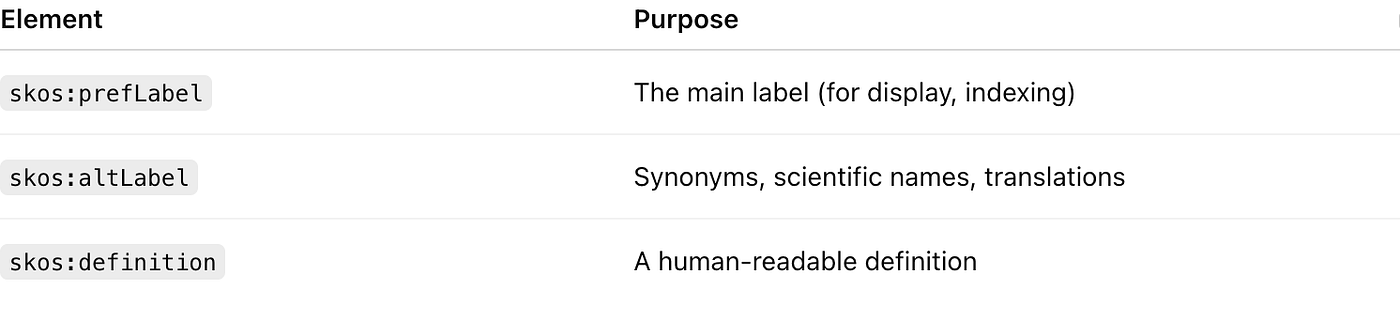
:apple a skos:Concept ; skos:prefLabel “Apple”@en ; skos:altLabel “Malus domestica”@en ; skos:altLabel “Pomme”@fr ; skos:definition “A round fruit of a tree of the rose family”@en .
A fun fact: Apples are from the family of roses
Avoiding the Label Trap
Imagine you’re building a recipe website. You allow users to tag recipes with ingredients. Some users type “eggplant,” others type “aubergine.”
Without SKOS, your site treats them as two different things.
With SKOS, both labels point to the same concept:
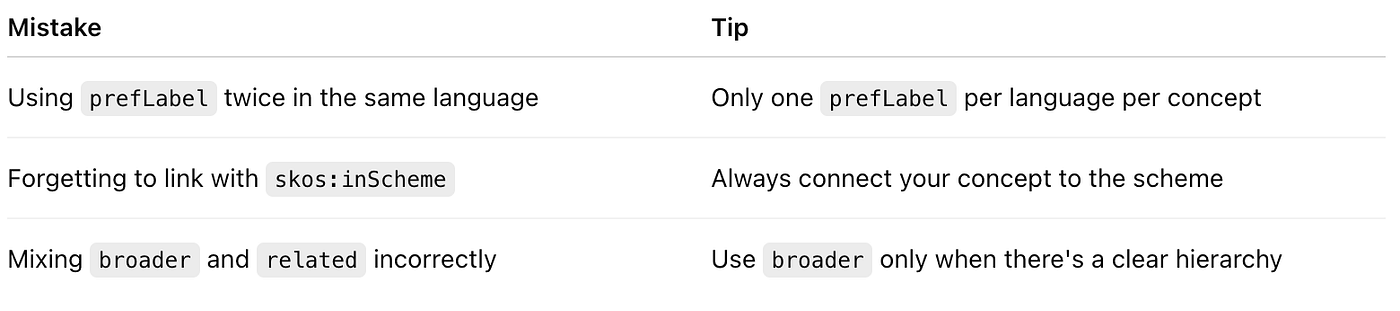
:eggplant a skos:Concept ; skos:prefLabel “Eggplant”@en ; skos:altLabel “Aubergine”@en ; skos:inScheme :IngredientVocabulary .
🎯 Now your search results are consistent, and your data is harmonized.
Concepts Can Be Broad or Narrow
Concepts aren’t isolated. They form hierarchies and networks. Let’s say you’re building a fruit taxonomy:
:fruit a skos:Concept ; skos:prefLabel “Fruit”@en .
:citrus a skos:Concept ; skos:prefLabel “Citrus Fruit”@en ; skos:broader :fruit .
:orange a skos:Concept ; skos:prefLabel “Orange”@en ; skos:broader :citrus .
Now you have
Fruit └── Citrus Fruit └── Orange
This structure lets you ask:
- “What are all citrus fruits?” → Orange, Lemon, Lime…
- “What is broader than orange?” → Citrus Fruit
Related Concepts, Not Just Hierarchies
Not all relationships are “parent/child.” Some are associative.
For example, “Orange” and “Vitamin C” are related but one is not broader than the other.
Use skos:related for this:
:orange skos:related :vitaminC .
These relationships help build concept networks rather than rigid trees.
Concepts Are Reusable and Linkable
One of the strengths of SKOS is that you don’t need to reinvent every concept.
You can link to existing vocabularies like DBpedia, Wikidata, or other organizations’ SKOS models.
Example:
:apple skos:exactMatch <http://dbpedia.org/resource/Apple> .
This makes your vocabulary part of the larger Linked Data ecosystem.
Summary
- SKOS is built around concepts, not labels.
- A concept is an idea; labels are how we refer to it in different ways or languages.
- Concepts can be organized into broader/narrower hierarchies or linked via associations.
- SKOS helps unify, clarify, and standardize the way we talk about things.
메타데이터
- post_id
- b3e400f830a8
- slug
- chapter-2-thinking-in-concepts-b3e400f830a8
- url
- https://medium.com/knowledge-engineering/chapter-2-thinking-in-concepts-b3e400f830a8
- canonical_url
- https://medium.com/knowledge-engineering/chapter-2-thinking-in-concepts-b3e400f830a8
- author_url
- https://medium.com/@aiforhuman
- status
- ok
- fetched_at
- 2026-07-18 20:11:55