UTM Naming Conventions That Keep Your Analytics Clean
Your UTM tags are lying to you. Not because they are broken, but because whoever set them up last quarter used a different format than…
UTM Naming Conventions That Keep Your Analytics Clean
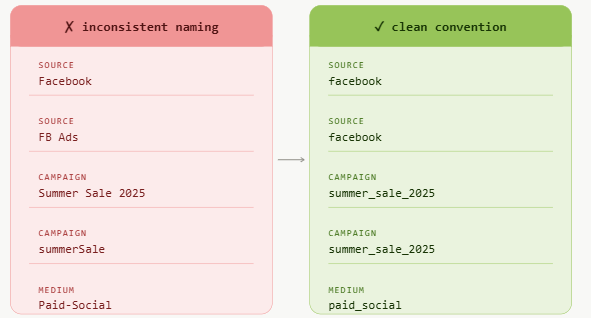
Your UTM tags are lying to you. Not because they are broken, but because whoever set them up last quarter used a different format than whoever set them up this quarter. Now your Google Analytics dashboard is a graveyard of “Facebook” and “facebook” and “FB” and “fb-paid,” all counting as separate sources. You have no idea what is actually working.
This is a UTM naming convention problem. And it is more common than you think.
According to Google’s own Analytics Help documentation, UTM parameters were designed to give you precise campaign attribution. In practice, most teams treat them like sticky notes; everyone writes what they want, in the format that makes sense to them in the moment, and then wonders why the reports look like noise.
The fix is not complicated. It just requires one decision made once, written down, and enforced. Here is how to build that system.
What UTM Parameters Actually Are (And Why the Naming Part Matters)
A UTM tag is a snippet added to a URL that tells your analytics platform where a visitor came from and which campaign sent them. A complete UTM URL looks like this:
[https://yoursite.com/landing-page?utm_source=newsletter&utm_medium=email&utm_campaign=summer_launch_2024](https://yoursite.com/landing-page?utm_source=newsletter&utm_medium=email&utm_campaign=summer_launch_2024)
There are five parameters. Three are mandatory if you want meaningful data:
- utm_source — Where the traffic originates. Think:
google,facebook,newsletter - utm_medium — The channel type. Think:
cpc,email,organic - utm_campaign — The specific campaign. Think:
summer_sale,product_launch_q3
The optional two:
- utm_content — Differentiates ads or links within the same campaign (useful for A/B tests)
- utm_term — Originally for paid search keywords; sometimes repurposed for audience segments
None of this is controversial. What teams get wrong is not the what, but the how they spell it. And spelling, in analytics, is everything. Email and email are two different sources. Facebook_Ads and facebook-ads are two different campaigns. Your platform is case-sensitive and space-sensitive, and it has no ability to guess your intent.
The cost of inconsistency is not cosmetic. It is data fragmentation. You cannot confidently answer “which channel drove the most signups last month” when your email campaigns are split across four different source values.
The Core Rules of a Solid UTM Naming Convention
Every team’s UTM convention will look slightly different, but the effective ones share the same underlying rules.
Rule 1: Always Use Lowercase
This is the single highest-impact rule you can implement today. Lowercase everything: source, medium, campaign, content, term. No exceptions.
utm_source=Facebook and utm_source=facebook land in two different rows in your reports. If your team is small and you catch it fast, you can backfill. If you are six months in, you cannot.
Set the expectation once: all UTM values are lowercase, always.
Rule 2: Replace Spaces With Underscores or Hyphens, Then Pick One and Never Switch
Spaces in URLs get encoded as%20, which works but looks ugly and sometimes breaks link previews. Replace them with either underscores (_) or hyphens (-). Both are readable. Both are widely supported.
The choice matters less than the consistency. Pick one. Write it in your style guide. Use it across every team that touches UTMs.
Most teams that run into chaos mid-year discover that one person was using underscores and another was using hyphens. They both look fine in a URL. In a pivot table, they create duplicate campaign rows.
Rule 3: Build a Controlled Vocabulary for Source and Medium
Do not let people invent source and medium values from scratch. Define the approved list and only add to it through a deliberate decision.
Example approved source list:
googlefacebookinstagramlinkedinnewsletterpodcastpartner_[name]
Example approved medium list:
cpc(all paid search)paid_social(all paid social)emailorganic_socialreferralaffiliatedirect
When someone needs a new value, a new platform, or a new channel type, they add it to the master list before using it. Not after.
Rule 4: Use a Consistent Campaign Naming Structure
This is where campaign naming rules do the most work. A campaign name should be readable by someone who was not in the briefing. It should contain, at a minimum:
[product/topic]_[initiative]_[date or quarter]
For example:
saas_trial_launch_q1_2025ebook_lead_gen_jan2025retargeting_cart_abandonment_q3
Some teams add a prefix for the business unit or region: us_saas_trial_launch_q1_2025. That adds specificity but also length. Keep it readable. A campaign name that takes 45 seconds to decode defeats the purpose.
UTM Naming Convention Examples That Work in Practice
Seeing real UTM naming convention examples is more useful than reading abstract rules. Here are three scenarios with the naming decision spelled out.
Scenario 1: Paid social ad for a product launch
You are running Facebook and Instagram ads for a new feature drop in March 2025.
utm_source=facebook/utm_source=instagramutm_medium=paid_socialutm_campaign=feature_drop_mar2025utm_content=video_a/utm_content=video_b(for A/B testing the creative)
Scenario 2: Email newsletter promoting a blog post
Your weekly newsletter links to a new article on pricing strategy.
utm_source=newsletterutm_medium=emailutm_campaign=weekly_digest_mar2025utm_content=pricing_article_cta
Scenario 3: Co-marketing partnership with another brand
You are driving traffic from a partner’s blog.
utm_source=partner_brandnameutm_medium=referralutm_campaign=comarketing_q1_2025
In each case, a person who has never seen these URLs before can understand the context. That is the test. If you need to look it up to know what it means, the naming is not working.
Where Most Teams Actually Break Down
The convention document exists. The rules are clear. And yet, six months later, the reports are still fragmented. Here is why.
Problem 1: The convention lives in a doc that nobody opens. If the style guide is a Google Doc buried in a folder, it is effectively invisible. The naming decision needs to be enforced at the point of link creation, not discovered after the fact.
Problem 2: New people do not know it exists. Every person who creates UTM links needs to be onboarded to the convention. That includes contractors, agency partners, and anyone who manages social scheduling tools.
Problem 3: There is no validation step. Teams that enforce naming conventions successfully build a checkpoint into their workflow. Before a campaign launches, someone reviews the UTMs. Not to be pedantic, to catch the misspelling that would split a month of data into two rows.
This is exactly the problem that tools like LinkUTM’s Rules feature solve: you define your naming rules once, and the tool validates every UTM against them before the link goes live. The rule becomes automatic, not dependent on someone remembering to check.
How to Roll This Out Without Starting a Fight
If you are introducing UTM naming conventions to a team that has been winging it, you will meet resistance. Not malicious resistance, just the natural friction of changing a habit that people did not know was a habit.
The rollout that works: do not rewrite history, start clean from today.
Pick an effective date. Define the convention. Train the people who create links. Set up a shared link builder (spreadsheet template, dedicated tool, whatever fits your stack) that formats the values correctly by default. Make compliance the path of least resistance.
For the old data, acknowledge it is fragmented and move on. Trying to retroactively clean six months of inconsistent UTMs is a significant project with uncertain payoff. A clean convention going forward compounds in value every week.
HubSpot’s UTM tracking guide recommends building a UTM spreadsheet tracker that serves as both the link builder and the running record of all active campaigns. That combination, consistent naming plus a central record, is the baseline that most high-functioning marketing teams operate from.
The Actual Payoff: What Clean UTM Data Lets You Do
This is worth stating plainly, because the payoff is not just “cleaner reports.”
When your UTM naming convention is consistent, you can reliably answer:
- Which source drives the highest conversion rate, not just the most traffic
- Which email campaigns outperform others on the same topic
- How a paid campaign compares to organic over the same period
- Which partner or affiliate sends quality traffic versus volume traffic
Ahrefs’ guide to UTM parameters notes that clean UTM data is foundational to multi-touch attribution, understanding not just the last click before a conversion, but the full path a customer took. You cannot build that model on fragmented data.
Every week you operate with inconsistent naming is a week of data you cannot fully use. The cost is invisible in the moment. It shows up when you try to make a budget decision and cannot trust your own numbers.
The One Thing to Do Before You Leave This Article
Write down three things:
- Your approved source values (the platforms and origins you use)
- Your approved medium values (the channel types)
- Your campaign naming structure (the formula, with one example)
That is your UTM naming convention. It fits on a single page. Share it with everyone who touches campaign links. Put it somewhere they will actually find it, not a buried doc, but wherever your team manages work.
The analytics problem most marketers think they have is a tool problem or a data problem. Usually, it is a naming problem. And naming problems are the easiest kind to fix.
Have you run into UTM chaos on your team? What broke down, and what fixed it? Drop it in the comments; the specifics are usually more instructive than the general advice.
메타데이터
- post_id
- b3f28f5aae36
- slug
- utm-naming-conventions-that-keep-your-analytics-clean-b3f28f5aae36
- url
- https://medium.com/@Hannah_Brooks/utm-naming-conventions-that-keep-your-analytics-clean-b3f28f5aae36
- canonical_url
- https://medium.com/@Hannah_Brooks/utm-naming-conventions-that-keep-your-analytics-clean-b3f28f5aae36
- author_url
- https://medium.com/@Hannah_Brooks
- status
- ok
- fetched_at
- 2026-06-15 20:49:13