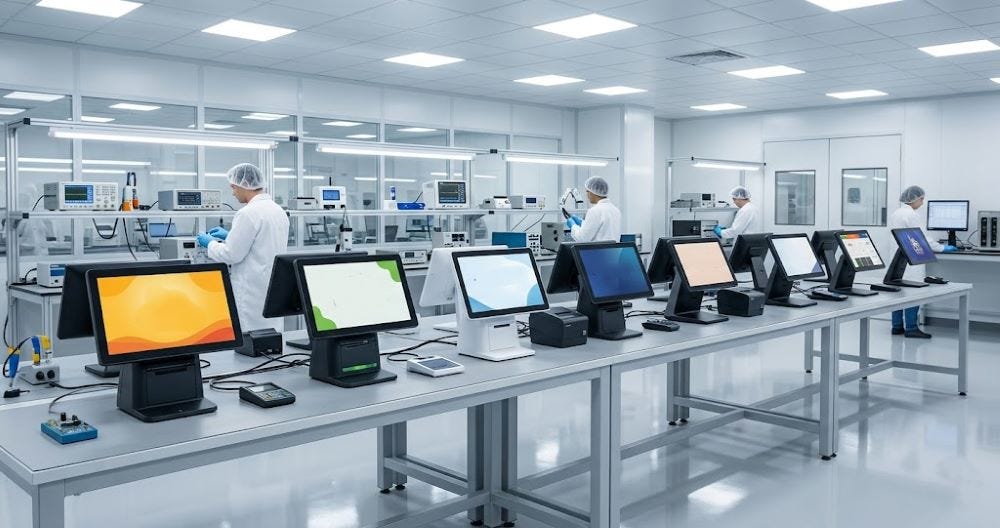
India’s POS Market: Local Brands vs. Global OEM — A Buyer’s Decision Framework
Meta Description
India’s POS Market: Local Brands vs. Global OEM — A Buyer’s Decision Framework
Meta Description
India’s POS terminal market is booming. But for distributors and brand owners, choosing between local suppliers and global OEM partners requires a clear framework. This guide walks you through the trade-offs.
If you’re sourcing POS hardware for the Indian market, you’ve likely seen two types of suppliers:
- Local Indian brands (Pine Labs, Mswipe, Posiflex, etc.)
- Global OEM manufacturers (primarily based in China)
Neither is universally “better.” The right choice depends entirely on your business model, software requirements, and scaling plans.
This article provides a decision framework — not another ranking. We’ll look at where each model excels, and where it falls short.
Why India’s POS Market Is Different
India’s digital payment growth is among the fastest globally. Government initiatives, smartphone penetration, and a massive SME base have shifted demand from traditional terminals to smart Android POS, mobile systems, and integrated solutions.
But the market also has unique challenges:
- Intense price competition
- Cost sensitivity at the merchant level
- Need for device durability in hot/humid environments
- Multilingual software support
For bulk buyers, this means balancing cost, performance, local support, and technical capability.

The Core Trade-Off: Local Support vs. Customization Depth
Here’s the simplest way to frame your decision:
If you prioritize…Then consider…
Fast on-site service, local compliance, lower initial MOQ
Local Indian brandHardware that looks like yours, OS preload, bulk pricing at scaleGlobal OEM (China)
Let’s break this down further.
When a Local Indian Brand Makes Sense
Local brands like Pine Labs, Mswipe, and Posiflex India have strong on-the-ground presence. They offer:
- Faster service response — technicians available locally
- Lower MOQs for standard models
- Easier compliance with local regulations
- Familiarity with Indian payment gateways and tax systems
If you need 50–200 units quickly and don’t require hardware customization, a local brand is a practical choice.
The limitation? Most local brands offer limited customization — typically software/UI changes only. Hardware modifications (logo, housing, ports) are rarely possible.
When a Global OEM (China) Makes More Sense
Chinese OEM manufacturers serve a different procurement need. They are the right fit when:
-
You need custom hardware. Logo on the chassis. Specific housing color. Custom port layout. Off-the-shelf local brands rarely offer this.
-
You’re preloading software. The hardware must ship with your own Android APK or Windows image. OEMs can do this at the factory.
-
You plan to scale across regions. Multiple locations need identical hardware. Centralized procurement from one OEM ensures consistency.
-
You want better cost control at volume. Bulk pricing improves as order size grows. Local brands often have fixed retail-like pricing.
-
You require project-based collaboration. Technical support during development. Sample validation before mass production. Dedicated account management.
The OS Decision: Android vs. Windows (And Why It Matters)
One factor that’s often overlooked: operating system flexibility.
Android POS is popular for its modern interface and app ecosystem. But many enterprise environments — especially retail chains with legacy software — still require Windows POS.
Not every local Indian brand offers both. Good OEMs typically support both OS options on similar hardware platforms.
Before selecting a supplier, know your end customer’s software environment. The hardware is just a shell; compatibility drives long-term satisfaction.
Importing from China to India: What to Expect
If you decide to go the OEM route, importing from China involves a few extra steps:
- Legal compliance — import numbers, BIS certification for electronics
- Supplier vetting — factory visits or third-party audits
- Sample testing — never skip this step
- Freight and customs — sea freight for bulk, air for urgent
- Tariffs and taxes — check current rates with a customs broker
The lead time is longer (typically 4–6 weeks from order to delivery), and you’ll need to manage documentation carefully. But the payoff is deeper customization and better bulk economics.
A Realistic OEM Example: What to Look For
When evaluating OEM manufacturers, look for:
- OS versatility — both Android and Windows lines
- Customization track record — past white-label projects
- Certifications — CE, FCC, RoHS (for smooth customs)
- Sample policy — pre-production samples before mass order
- Lead time commitment — in writing, with penalties for delays
One manufacturer that fits this profile is MINJCODE. They focus on OEM/ODM work — logo customization, OS preload, housing modifications — rather than competing as a consumer brand. Their hardware lines include both Android and Windows countertop POS, with lead times around 15–25 days for bulk orders.
You can see their approach on their [main site], but the key point is this: a good OEM partner works like an extension of your product team, not just a box shipper.
Final Takeaway for Distributors and Brand Owners
There is no single “best” POS manufacturer for India. The right partner depends on:
- Your business model (distributor, brand owner, reseller)
- Your end customers’ software environment
- Whether you need hardware customization
- Your order volume and scaling timeline
Local brands = speed and local service Global OEMs = depth and control at scale
Smart buyers don’t choose “India vs China.” They match supplier capabilities to their specific business requirements.
If you’re actively evaluating POS hardware for an upcoming project, the original article includes a more detailed list of Indian manufacturers and a step-by-step import guide.
👉 Read the full version here: [Top 10 POS Terminal Manufacturers in India and How Buyers Compare Global OEM Suppliers](News — Best POS machine Supplies in 2025)
메타데이터
- post_id
- b3fa52249eca
- slug
- indias-pos-market-local-brands-vs-global-oem-a-buyer-s-decision-framework-b3fa52249eca
- url
- https://medium.com/@MINJCODE/indias-pos-market-local-brands-vs-global-oem-a-buyer-s-decision-framework-b3fa52249eca
- canonical_url
- https://medium.com/@MINJCODE/indias-pos-market-local-brands-vs-global-oem-a-buyer-s-decision-framework-b3fa52249eca
- author_url
- https://medium.com/@MINJCODE
- status
- ok
- fetched_at
- 2026-06-26 21:52:29