AI Accelerates Research Outputs Faster than Human Expertise Can Develop — and that Should Concern Us
While removing inefficiency, it can also erode human capability development.
AI Accelerates Research Outputs Faster than Human Expertise Can Develop—and that Should Concern Us
While removing inefficiency, it can also erode human capability development.

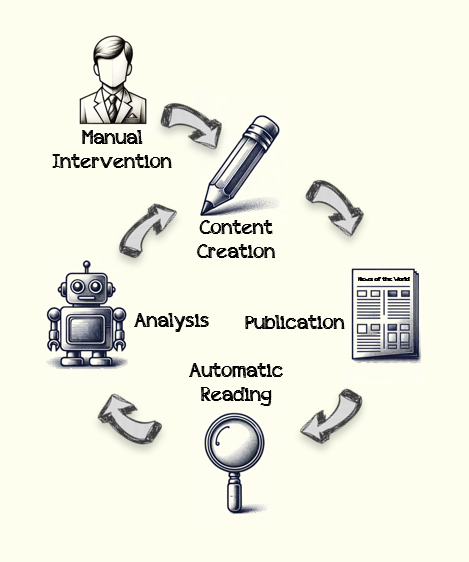
Source: Image by the author via ChatGPT
Introduction
Picture this: It’s 2030. Your team’s qualitative research AI tool has generated a polished report in record time. Timelines are impossibly tight, and before anyone has had the opportunity to properly immerse themselves in the data, the client requests a formal readout. A team member presents the findings.
Midway through, a stakeholder asks a difficult question.
Silence.
You realise something unsettling: the data has been seen, but not truly understood. AI has processed the evidence, but reflexivity never happened — only synthesis did.
The outputs arrived faster than the thinking could mature.
Much of the discussion around AI today focuses on hallucinations, technical capability, or whether AI can produce good analysis. I think there is another issue emerging: compression.
AI can increasingly compress the journey from: Raw evidence → synthesised insight.
Sure, for businesses this sounds great. Faster insights often mean faster decisions, faster action, and less time spent ‘boiling the ocean’ (yes, we cringe).
But what happens when systems become capable of producing polished outputs faster than humans can develop the capabilities that traditionally made those outputs trustworthy in the first place?
Between raw evidence and synthesis, humans traditionally develop things that matter:
- interpretive maturity
- judgement
- reflexivity
- contextual understanding
- navigating ambiguity
AI models themselves are ultimately built from human thought processes, expertise and intelligence. The goal should not be surrendering these capabilities to AI and washing our hands clean.
In optimising for speed and efficiency, are we unintentionally eroding the very human capabilities that make insight trustworthy in the first place?
Human tethering: what gets lost in compression?

Source: Image by the author via ChatGPT
The idea of ‘human tethering’ shows up, conceptually, in many fields (eg. psychology), even if it goes by different names.
At its core, ‘human tethering’ is a simple idea: people understand things better when they stay close to the real experience, evidence, or context instead of relying only on summaries or second-hand information.
Whether in psychology, research, design, or business, the message is consistent: staying connected to the source helps people make better sense of what they’re seeing.
Across these spaces, a common principle emerges: expertise depends not only on arriving at conclusions, but on maintaining a meaningful connection to the evidence, context and reasoning that produced them.
Take the GPS (that’s Google Maps or Waze for the non-boomers), for example. It’s incredibly useful.

Can we still navigate without GPS — or have we outsourced an age-old human capability? Source: Image by Thelolgic on Instagram
It helps us navigate faster, reduces cognitive load, and removes unnecessary friction. But over time, it has also quietly changed how many people develop spatial intuition itself. Some drivers today become completely dependent on navigation systems; without them, some simply cannot navigate — even on routine drives.
The concern with AI in research may be similar.
Good researchers are tethered to their evidence. They know not only what they think, but why they think it.
Personally, I would never feel comfortable presenting another researcher’s work if I had not spent time deeply engaging with the data myself. Even if I understood the report on the surface, I would not be cognitively tethered to the thinking behind them.
Traditionally, research often moves through a developmental chain:
Raw transcript → Observation → Pattern → Interpretation → Insight → Recommendation
However, AI is increasingly used to compress six cognitive steps into one.

Source: Image by the author
The question then, becomes: What gets lost when compression leads to substitution?

Source: Image/table by the author
AI as scaffold versus substitute
There is an important distinction between AI substituting parts of the thinking process versus scaffolding it.
Increasingly, AI is being used to infer, interpret and conclude on our behalf — effectively outsourcing parts of the cognitive work that researchers are continuously developing in their careers. But perhaps a more meaningful role for AI is not to replace thinking altogether, but to strengthen it.
Used well, AI can act as a scaffold for thinking — helping researchers organise information, challenge assumptions, surface blind spots and pressure-test interpretations.
This builds directly on an idea I explored in my ***previous article*** on AI in qualitative research, where I argued that the most meaningful role for AI may not be as an analysis engine, but as a cognitive partner and co-consultant.
But if AI increasingly participates in our thinking processes, a larger question begins to emerge: what happens when cognitive partnership gradually becomes cognitive substitution?

Source: Image/table by the author
AI can absolutely infer, interpret, synthesise. But researchers should still remain cognitively engaged in these activities. AI should support capability development and skill acquisition — not bypass them.
Friction and the apprenticeship problem
Research maturity has traditionally developed through a gradual process:
Junior
→ Build foundational familiarity with evidence and human behaviour
Mid-level
→ Develop intuitive interpretation and sense-making capabilities
Senior
→ Exercise critical judgement under ambiguity and make tough but defensible calls
But what happens when AI begins performing parts of the interpretive work before humans have learned how to do it well?
You may unintentionally create researchers who become operationally efficient before becoming experienced — able to produce outputs quickly, but with fewer opportunities to develop maturity traditionally built through repetition, ambiguity and challenge.
In our quest for efficiency, we need to realise that not all friction is bad.

Source: Image by Design Language XYZ
Some forms of friction are deeply developmental. Sitting with ambiguity, noticing contradictions, defending reasoning, being wrong, and revising interpretations are often where important learning happens. These moments can feel slow or uncomfortable, but they are also where interpretive maturity gets built.
Other forms of friction simply consume energy without creating much developmental value: manual tagging of themes, repetitive administration, spreadsheet cleaning, formatting decks, or operational work.
The goal isn’t to eliminate effort altogether. It is to remove the wrong kinds of effort while protecting the forms of cognitive engagement that help researchers mature.
Designing research teams for the AI era
If AI changes how expertise develops, organisations may also need to rethink how research work itself is designed.
The pressure to reduce cost, streamline teams and increase productivity is understandable — and AI will likely accelerate many of these shifts. At the same time, expertise, judgement and interpretive maturity do not scale at the same speed.
Responsible capability design therefore becomes less about preserving old ways of working, and more about preserving the conditions through which expertise develops.
So what might responsible capability design actually look like?
Principles of a AI-era Research Function
i. Preserve exposure to raw material
No insight without immersion. Don’t allow researchers — particularly more junior researchers — to operate only at the level of synthesis. Exposure to raw evidence builds familiarity, intuition and pattern recognition in ways that summaries alone often cannot.
ii. Require reasoning ownership
Own the reasoning, not just the result. Researchers should be expected to defend interpretations even if relying on AI-generated conclusions. Producing an answer is one thing; understanding why it holds up is another.
iii. Design for cognitive participation, not just output production
Wrestle with sense-making before you outsource. People should still wrestle with ambiguity, assumptions and competing interpretations. Research maturity is often developed through active participation in the thinking process, not simply through exposure to final outputs. This could mean requiring researchers to propose and defend their own interpretations first, compare competing explanations, or explicitly surface assumptions before consulting AI-generated synthesis.
iv. Use AI to deepen interrogation, not replace it
Challenge AI, and let AI challenge you. AI should function as an intellectual challenger rather than an oracle. Rather than asking AI to generate “the answer”, teams could use it to pressure-test assumptions, identify contradictory evidence, explore alternative interpretations, or ask: “What might we be missing?”
Rethinking the apprenticeship model
From information access → interpretive ownership
With AI today, the differentiator for research is:
“Can you defend why this interpretation holds up?”
NOT:
“Can you generate themes quickly?”
Interpretation, defensibility, contextual judgement and ambiguity navigation become the capabilities that distinguish strong researchers from efficient research operators.
From passive exposure → deliberate cognitive training
Organisations may increasingly need to deliberately design:
- ambiguity exposure
- interpretive exercises
- reasoning critiques
- synthesis debate sessions
- assumption interrogation
Almost like cognitive gyms for researchers.
From output review → reasoning review
As polished outputs become increasingly easy to produce, mentorship itself may also need to evolve. The emphasis may gradually shift away from evaluating outputs alone:
❌ “Is the report clear and coherent?”
❌ “Does the narrative make sense?”
towards deeper questions:
💡 “How did you arrive at this interpretation?”
💡 “What evidence supports it?”
💡 “What alternative or competing explanations did you consider?”
💡“What assumptions might be shaping this conclusion?”
The emphasis gradually moves from reviewing outputs towards reviewing reasoning itself, i.e.:
- reasoning chains
- evidence quality
- interpretive logic
- reflexivity
- defensibility
From linear apprenticeship → layered collaboration with AI
AI may create value at two levels:
Acceleration layer: automate and speed up foundational cognitive tasks such as retrieval, recall, comparison and pattern surfacing.
Thinking-partnership layer: strengthening the quality of human thinking through structured interrogation, broader perspective-taking and more deliberate reasoning.
The objective is not to outsource meaning-making, but to strengthen it.

Source: Image/table by the author
What happens if we get this wrong?
I. Premature expertise: polished outputs without mature thinking
AI may enable increasingly sophisticated outputs before the underlying thinking has had time to mature. Researchers may learn to generate polished narratives and themes long before developing the interpretive judgement traditionally built through immersion and ambiguity.
The risk is not poor analysis alone. It is accelerating the appearance of capability faster than capability itself.

Outputs can be deceiving — does the evidence, interpretation and logic beneath hold up? Source: Image by Buzzfeed
II. Compression of apprenticeship and talent development
If AI increasingly performs interpretation and synthesis, parts of the developmental journey through which expertise traditionally formed may become compressed or bypassed.
The result? Researchers who become operationally efficient before becoming experienced.
III. Redistribution of research work without redistribution of expertise
As AI lowers barriers to conducting research, ownership may increasingly shift toward product managers (PMs), UX or product designers and broader teams. Greater proximity to users can create faster and more integrated decision-making, but access to AI tools does not automatically create methodological rigour or interpretive maturity.
AI may make research increasingly accessible, but accessibility alone does not automatically create expertise.

Source: Base image by Pilot Institute
IV. Weakening challenge culture and critical dialogue
Strong research cultures rely on constructive tension: competing interpretations, questioning assumptions and challenging conclusions.
As research becomes increasingly distributed and AI-generated outputs become more polished and authoritative, teams may become less likely to interrogate findings deeply. Consensus may gradually become easier than critique.
V. Decoupling outputs from understanding

Source: Image by the author
AI can increasingly create the appearance of:
- synthesis
- expertise
- analytical rigour
without necessarily creating:
- judgement
- contextual understanding
- defensibility
- reflexive reasoning
Organisations become faster at producing (questionable) outputs while gradually weakening the human developmental processes that made those outputs trustworthy in the first place.
IV. Amplification of weak decisions through false confidence
AI not only accelerates research outputs — it may also amplify premature confidence before the evidence is interrogated.
Polished reports and coherent narratives can create a perception of certainty even when evidence remains incomplete or weakly interrogated. Teams may unintentionally mistake fast, well-packaged answers for stronger thinking.
Final thoughts
Humans don’t merely adapt technology to fit into their lives; repeated use of technology gradually reshapes how humans think and learn as well.
AI can produce increasingly good synthesis in many contexts. But beyond output quality itself, organisations should be paying closer attention to how capability development in research keeps pace. Expertise, judgement and interpretive maturity still develop at human speed.
GPS didn’t merely optimise navigation. Over time, it created an over-dependence on tech, while changing how humans developed spatial awareness itself. I suspect AI may be beginning to do something similar with qualitative thinking.
In a nutshell, the AI-era apprenticeship model should optimise for accelerated support while making space for human maturation:

Source: Image/table by the author
The end goal is no longer simply operational efficiency through AI — instead, it becomes:
- long-term capability architecture
- talent pipeline quality
- future expertise formation
- institutional resilience
As we continue to scale the use of AI in qualitative research, consider: what kind of expertise ecosystem might we be unintentionally creating (or eroding)?
Acknowledgements
Shoutout to Jason Anderson for the inspiration on human tethering, and Ayza Sayany for the thought-provoking question that led to this piece of writing.
About the author

Hello! Connect with me on LinkedIn
Hariz leads the Research & Strategy function at Trinax — a Singapore-based technology agency, driving human-centred innovation across the public sector and digital product ecosystems. Formerly an architect, he is now a LUMA-certified design thinking practitioner with 12 years of experience in UX, product and service design.
He has hands-on experience integrating AI into qualitative research — testing tools, rigorously evaluating their capabilities, and embedding them into real-world workflows. Previously, he worked at Grab, MING Labs and Standard Chartered Bank.
메타데이터
- post_id
- b402aa0c52cb
- slug
- ai-accelerates-research-outputs-faster-than-human-expertise-can-develop-and-that-should-concern-us-b402aa0c52cb
- url
- https://pub.towardsai.net/ai-accelerates-research-outputs-faster-than-human-expertise-can-develop-and-that-should-concern-us-b402aa0c52cb
- canonical_url
- https://pub.towardsai.net/ai-accelerates-research-outputs-faster-than-human-expertise-can-develop-and-that-should-concern-us-b402aa0c52cb
- author_url
- https://medium.com/@harizlimyihao
- status
- ok
- fetched_at
- 2026-06-09 15:37:30