ACID Properties — Beyond what’s generally discussed and taught
When most people learn the ACID properties (Atomicity, Consistency, Isolation, Durability), they get the textbook definitions: “all or…
ACID Properties — Beyond what’s generally discussed and taught
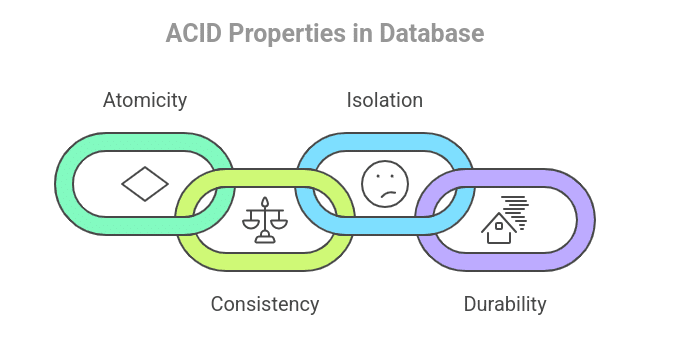
When most people learn the ACID properties (Atomicity, Consistency, Isolation, Durability), they get the textbook definitions: “all or nothing,” “valid states,” “locks,” and “written to disk.”
But senior engineers look at ACID differently. At scale, ACID isn’t a magical, free guarantee — it is a brutal, beautifully engineered fight against physics, hardware failures, and concurrency.
Here is a deep dive into the senior-level mechanics of ACID, why they make RDBMS so powerful, and the hidden trade-offs you face when relying on them.
1. Atomicity & Durability are Actually the Same Thing Under the Hood
Textbooks separate Atomicity (rollback on failure) and Durability (data isn’t lost). In reality, they are twins managed by a single mechanism: the Write-Ahead Log (WAL) and the Storage Engine architecture.
[Transaction Begins] ──> [Write to WAL (Append-Only Sequential Disk)] ──> [Modify In-Memory Buffer] ──> [Acknowledge Success] ──> [Lazy Flush to Data Files]- The Inside Secret: Databases almost never write data directly to the table files on disk when a transaction commits. Random I/O is too slow. Instead, they append the change to a sequential, lightning-fast log file (the WAL) and update the data in RAM (Buffer Pool).
- The Magic: If the server screams and loses power mid-transaction, the database reboots and performs a Crash Recovery process. It reads the WAL to execute a Redo phase (ensuring Durability for committed acts) and an Undo phase (ensuring Atomicity by wiping out uncommitted half-measures).
2. Consistency is a Lie (It’s Actually App-Level Logic)
Database marketing loves the word “Consistency,” but it is arguably the most misunderstood letter in the acronym.
- The Inside Secret: The database engine only enforces structural consistency (foreign keys, data types, unique constraints). It has absolutely no idea if your business logic makes sense.
- The Reality: If a bug in your Python code accidentally transfers $10,000 to the wrong user account, the database will happily commit it. The database guarantees a consistent schema state; business consistency is entirely on the senior engineer’s application design.
3. Isolation is where Performance Goes to Die
True isolation means transactions run as if they are the only thing happening in the universe. But perfect isolation requires massive locking, which kills concurrency.
To solve this, modern RDBMS use MVCC (Multi-Version Concurrency Control) instead of heavy locks.
- The Inside Secret: When you update a row in PostgreSQL or MySQL (InnoDB), the database doesn’t overwrite the old data. It creates a new version of the row and tracks its visibility using transaction IDs.
- The Impact: Writers don’t block readers, and readers don’t block writers. However, this introduces bloat. The database must constantly run background processes (like Postgres’s
VACUUM) to clean up dead row versions (garbage collection).
Why ACID is So Insanely Good
The reason RDBMS dominate banking, healthcare, and core tech stacks isn’t just because they are safe — it’s because they radically simplify application architecture.
- Offloading Cognitive Load: Without ACID, your application code has to handle partial network drops, hardware crashes, and race conditions. You would have to manually write code to “undo” Step 1 if Step 2 failed. ACID acts as a safety net, allowing developers to write code assuming the happy path.
- Predictable Operational Models: Because the rules of MVCC and WAL are strictly mathematical, debugging a production database issue is deterministic. If a deadlock happens, the database explicitly tells you which two index locks collided.
The Pros & Cons of an ACID-Compliant Architecture
The Pros
- Data Integrity: Highest possible guarantees against corruption. Perfect for ledgers, inventory tracking, and identity management.
- Strict Concurrency Safety: Out-of-the-box protection against dirty reads, non-repeatable reads, and phantom reads (depending on your isolation level).
- Declarative Constraints: The database acts as the single source of truth, enforcing business boundaries (e.g.,
balance >= 0) at the lowest layer, protecting you from buggy microservices.
The Cons (The Senior Trade-offs)
- The CAP Theorem Trap: ACID prioritizes Consistency over Availability when network partitions occur. If you distribute an ACID database globally (e.g., across multiple data centers), write latency skyrockets because nodes must agree before committing.
- Throughput Bottlenecks: Because of the WAL, every commit requires an
fsync()system call—physically waiting for the disk controller to confirm data is on non-volatile storage. Your database write speed is fundamentally bounded by the physical hardware speed of your disk's sequential writes. - Horizontal Scaling is Painful: Scaling an ACID database up (bigger CPU, faster NVMe drive) is easy. Scaling out (sharding across 50 servers) breaks traditional ACID. While distributed SQL databases like Google Spanner or CockroachDB achieve this, they require incredibly complex, atomic hardware clocks (TrueTime) or intense consensus protocols (Raft/Paxos) to manage the overhead.
메타데이터
- post_id
- b408f7d6c95f
- slug
- acid-properties-beyond-whats-generally-discussed-and-taught-b408f7d6c95f
- url
- https://medium.com/@mohammadrazim880/acid-properties-beyond-whats-generally-discussed-and-taught-b408f7d6c95f
- canonical_url
- https://medium.com/@mohammadrazim880/acid-properties-beyond-whats-generally-discussed-and-taught-b408f7d6c95f
- author_url
- https://medium.com/@mohammadrazim880
- status
- ok
- fetched_at
- 2026-07-08 21:45:35



