Why Jet Engine Thrust Decreases with Altitude — and How Engineers Try to Preserve It
Jet engines are often described in terms of power, but in aviation the more accurate term is thrust. A jet engine does not push an aircraft…
Why Jet Engine Thrust Decreases with Altitude — and How Engineers Try to Preserve It
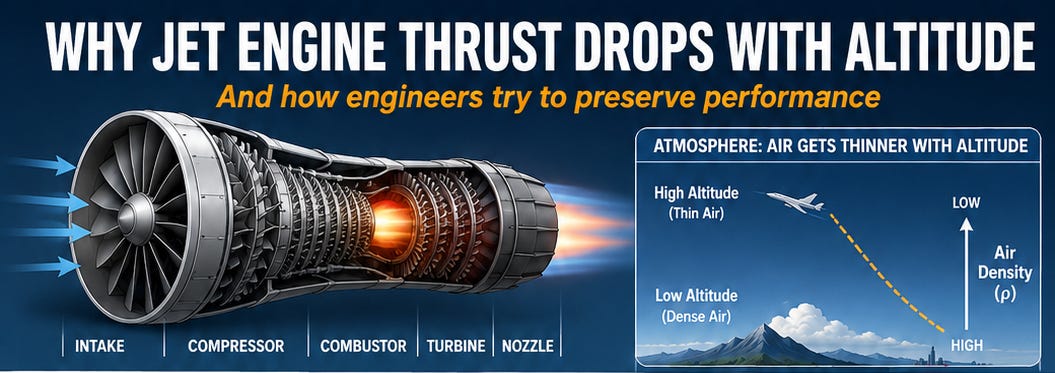
Jet engines are often described in terms of power, but in aviation the more accurate term is thrust. A jet engine does not push an aircraft forward by turning wheels or transferring mechanical power to the ground. It produces forward force by accelerating air rearward. The more air it can take in, compress, burn with fuel, and exhaust at high velocity, the more thrust it can generate.
This is why altitude has such a direct effect on jet engine performance. As an aircraft climbs, the atmosphere becomes thinner. Air density drops, pressure decreases, and the amount of oxygen available in a given volume of air becomes lower. Even though the percentage of oxygen in the atmosphere remains broadly similar, the number of oxygen molecules entering the engine per second decreases. For a jet engine, this is the central problem: at high altitude, there is simply less usable air.
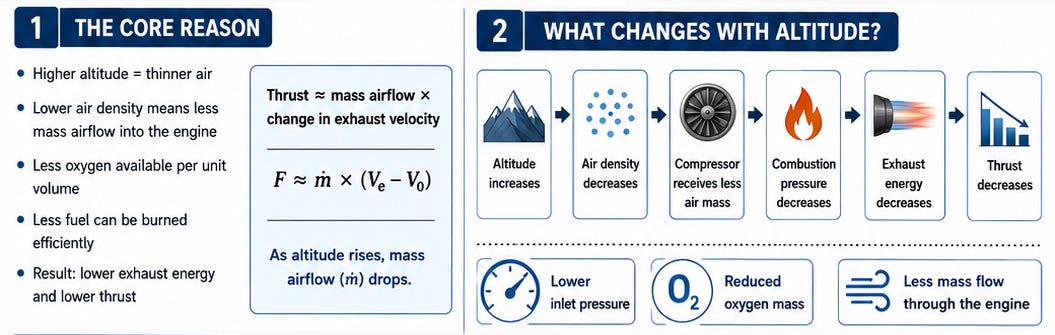
The basic thrust principle can be simplified as:
Thrust ≈ mass airflow × change in exhaust velocityIn other words, the engine’s thrust depends heavily on how much air mass passes through it every second. At sea level, dense air allows the engine to ingest a large mass of air. At high altitude, the same engine inlet captures less air mass because the atmosphere is less dense. With less air entering the engine, less fuel can be burned efficiently, and the total energy released in the combustion chamber decreases. The result is lower exhaust energy and reduced thrust.
The compressor also faces a more difficult operating condition at altitude. A jet engine compresses incoming air before it enters the combustion chamber. However, when the air entering the compressor is already at a lower pressure, the compressor has less mass and pressure to work with. This reduces combustion pressure and limits the energy that can be extracted by the turbine and converted into high-speed exhaust flow.
There is also a thermal limit. Engineers cannot simply inject more fuel to compensate for thin air. If too much fuel is added without enough oxygen, combustion becomes inefficient and unstable. More importantly, turbine blades are exposed to extreme temperatures. Every engine has strict limits for turbine inlet temperature, compressor stability, and material endurance. Modern engine control systems regulate fuel flow to keep the engine inside safe operating margins. These limits prevent the engine from maintaining full sea-level thrust at high altitude.
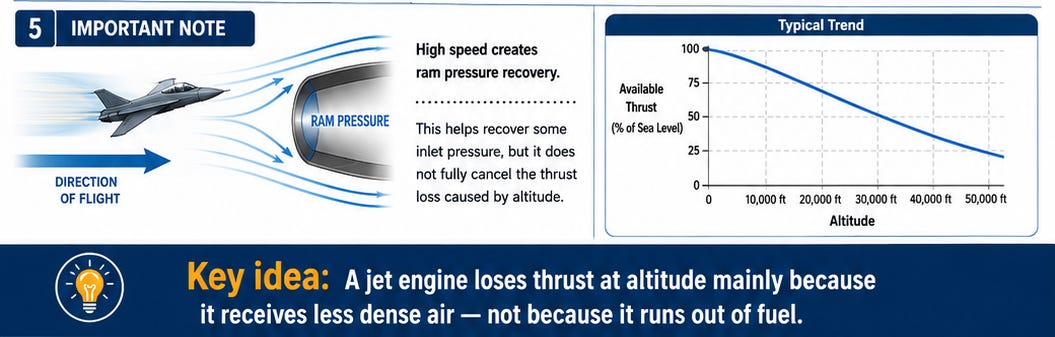
Aircraft speed can partially offset this loss. As an aircraft moves faster, air is forced into the inlet with greater dynamic pressure. This effect is known as ram pressure recovery. At high speeds, especially in supersonic aircraft, the inlet itself becomes a critical part of the propulsion system. It slows and compresses incoming air before it reaches the compressor, helping the engine recover some lost pressure. However, this does not fully erase the effect of altitude. It only reduces the penalty.
Engineers use several methods to preserve thrust at altitude.
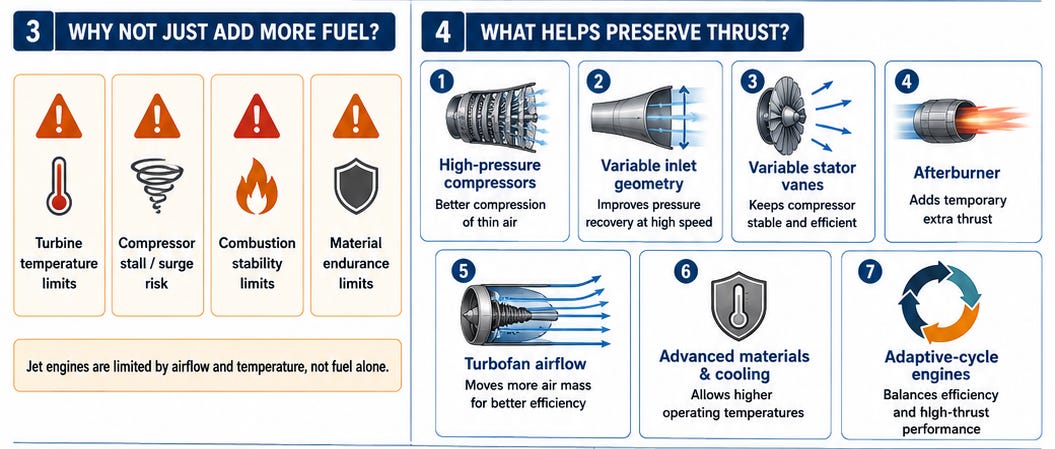
One method is to design compressors with higher pressure ratios. A more advanced compressor can squeeze thin air more effectively, improving combustion conditions and maintaining better performance at altitude. This requires stronger materials, more complex blade geometry, and careful control of compressor stability.
Another solution is the use of variable geometry inlets. High-speed military aircraft often use adjustable inlet ramps, cones, or doors to manage airflow across different speeds and altitudes. These systems control shock waves, recover pressure, and deliver smoother airflow to the compressor. In some aircraft, the inlet is almost as important as the engine itself.
Variable stator vanes inside the compressor also help. These adjustable blades change angle depending on engine speed, altitude, and airflow conditions. Their purpose is to keep the compressor operating efficiently and prevent stall or surge. Without this kind of control, the engine would have a narrower and less stable operating envelope.
Afterburners provide another way to increase thrust, although only temporarily. An afterburner injects fuel into the exhaust stream after the turbine. This creates a major thrust boost, useful for takeoff, combat maneuvers, and supersonic flight. The disadvantage is extreme fuel consumption. Afterburners do not make the engine fundamentally more efficient at altitude; they simply burn additional fuel to produce extra thrust for a limited time.
Turbofan engines address the problem differently. By using a fan to move a larger volume of air, they increase total mass airflow and improve propulsive efficiency. Large high-bypass turbofans are ideal for commercial aircraft because they are efficient at subsonic speeds and high cruising altitudes. Fighter aircraft, however, usually use low-bypass turbofans because they need compact size, high speed capability, and better performance across aggressive flight regimes.
Advanced materials also play a major role. If turbine blades can survive higher temperatures, the engine can extract more energy from combustion. Single-crystal superalloys, ceramic coatings, and internal cooling channels allow modern turbines to operate at temperatures that would destroy older engines. Higher temperature tolerance directly improves thrust and efficiency.
The most advanced approach is the adaptive-cycle engine. These engines are designed to change airflow behavior depending on mission conditions. They can act more like an efficient turbofan during cruise and more like a high-thrust military engine during acceleration or combat. This gives future aircraft better range, better thermal management, and stronger high-altitude performance.
The essential truth remains simple: a jet engine is limited by air before it is limited by fuel. At altitude, the engine does not lose thrust because fuel becomes unavailable. It loses thrust because the atmosphere provides less dense air, less oxygen mass, and lower inlet pressure. Preserving thrust at altitude is therefore a problem of airflow, compression, temperature management, and inlet design.
In modern aviation, high-altitude engine performance is not achieved by one solution alone. It comes from a combination of aerodynamic design, compressor technology, advanced materials, digital engine control, and mission-specific propulsion architecture. The higher and faster an aircraft flies, the more the engine and the surrounding airflow system must operate as a single integrated machine.
메타데이터
- post_id
- b41068c7ca64
- slug
- why-jet-engine-thrust-decreases-with-altitude-and-how-engineers-try-to-preserve-it-b41068c7ca64
- url
- https://medium.com/@onurtatver/why-jet-engine-thrust-decreases-with-altitude-and-how-engineers-try-to-preserve-it-b41068c7ca64
- canonical_url
- https://medium.com/@onurtatver/why-jet-engine-thrust-decreases-with-altitude-and-how-engineers-try-to-preserve-it-b41068c7ca64
- author_url
- https://medium.com/@onurtatver
- status
- ok
- fetched_at
- 2026-06-15 20:49:13