Functional Error Handling in Java Using Vavr with Spring Boot
It seems functional programming has not got the respect it deserved and the one prime reason to it is that there is a learning curve…
Functional Error Handling in Java Using Vavr with Spring Boot

It seems functional programming has not got the respect it deserved and the one prime reason to it is that there is a learning curve attached to it.
It needs a style adjustment as well as thinking approach shift and on top pf that benefits of it doesn’t seems obvious since it does not guarantee a performance improvement and in fact sometime counterintuitive when it comes to performance.
Pure functions
Having said that its heart is at right place. It emphasizes on pure functions which does not have side effect and always depends on the reliability. No matter when and how and how many time a pure function is called it is guaranteed to produce the same result.
Examples :
public class PurityExamples {

    // 1. Impure: depends on and modifies external state
    private static int counter = 0;

    /**
     * Impure because:
     *  - It reads from and writes to the static `counter` field (external state).
     *  - Calling this method twice with the same input produces different results.
     */
    public int incrementCounter(int value) {
        counter += value;      // side effect: mutating external state
        return counter;        // result depends on previous calls
    }

    // 2. Impure: performs I/O (side effect)
    /**
     * Impure because:
     *  - It prints to System.out (external side effect).
     *  - Its “result” (console output) isn’t captured in the return value.
     */
    public void greetUser(String name) {
        System.out.println("Hello, " + name + "!");  // side effect: I/O
    }

    // 3. Impure: depends on current time (non-deterministic)
    /**
     * Impure because:
     *  - It uses `System.currentTimeMillis()`, which varies between calls.
     *  - Same input yields different output over time.
     */
    public long getDelayedTimestamp(long delayMillis) throws InterruptedException {
        Thread.sleep(delayMillis);                   // side effect: blocking
        return System.currentTimeMillis();           // non-deterministic value
    }

    // 4. Pure: deterministic computation, no side effects
    /**
     * Pure because:
     *  - It only uses its input `a` and `b`; no external state or I/O.
     *  - Always returns the same sum for the same inputs.
     */
    public int add(int a, int b) {
        return a + b;
    }

    // 5. Pure: filtering a list without mutating it
    /**
     * Pure because:
     *  - It returns a new List and does not modify the input `numbers`.
     *  - For the same input list, it always returns the same filtered list.
     */
    public List<Integer> filterEven(List<Integer> numbers) {
        return numbers.stream()
                      .filter(n -> n % 2 == 0)
                      .collect(Collectors.toUnmodifiableList());
    }

    // 6. Pure: mapping values
    /**
     * Pure because:
     *  - It transforms each string but neither reads nor writes external state.
     *  - Always produces the same output list for the same input list.
     */
    public List<String> uppercaseAll(List<String> strings) {
        return strings.stream()
                      .map(String::toUpperCase)
                      .collect(Collectors.toList());
    }

    // 7. Impure: mutates the input list using forEach
    /**
     * Impure because:
     *  - It directly modifies the contents of the passed-in `strings` list.
     *  - Calling this method twice on the same list will yield different intermediate states.
     */
    public void uppercaseInPlace(List<String> strings) {
        // Mutate each element to its upper‐case form
        strings.forEach(str -> {
            int idx = strings.indexOf(str);
            strings.set(idx, str.toUpperCase());
        });
    }

}
So there are few key ways to check if a function is pure or not, whether it has a side effect or not, whether calling it multiple time will produce different behaviors (either by providing different result or altering the argument in some manner).
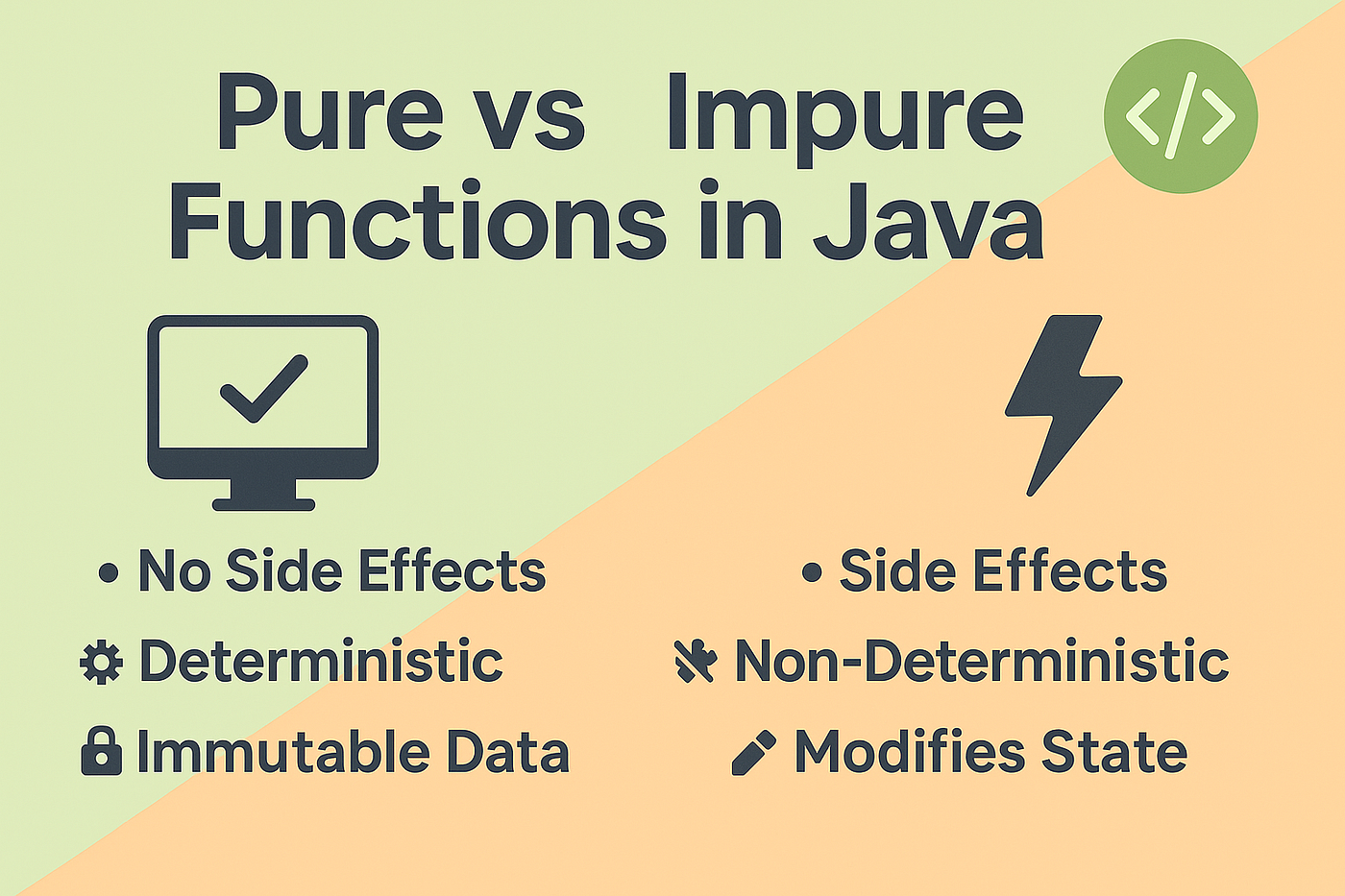
Why pure function matters?
A pure function since is simple to reason with the probability of it having bug reduces manifold. It is safe to call this function from anywhere in any context since it’s guaranteed to perform reasonably.
Since pure function does not have side-effect and does not alter anything outside it’s own little scope. When it comes to concurrency ‘prevention is better than cure’. That’s why immutable object shines in multi-threaded environment and if we really think it through pure function has similar attribute as immutable object. Pure functions are often thread-safe.
Think if we try to use as much of pure functions, and let us say have 75% of our functions as pure functions. It alleviates the pain of debugging a great deal. It’s easier to write test cases for these functions. For any issue we might be quick to check the remaining 25% of the code base. 100% pure functions for most product are not possible, since we would need to handle context and state in applications, we will have necessary side-effect to handle.
Even if someone is not aware about pure function they still use it, most of our utils are pure functions. A method which returns boolean based on object is null or not is a pure function.
An exception is a side-effect
It should be obvious, since an exception make a function indeterministic.
Java’s traditional approach to error handling — checked exceptions and try-catch blocks—can be verbose, brittle, and often leads to tangled logic, especially in deeply nested service layers. In functional programming, error handling typically avoids exceptions and instead uses algebraic types like Either, Try, and Option to model computations that may fail.
Why Traditional Exception Handling Falls Short
Consider this common pattern in Java:
try {
    String result = service.getData();
    return ResponseEntity.ok(result);
} catch (IOException | SQLException e) {
    log.error("Failure", e);
    return ResponseEntity.status(500).body("Error occurred");
}
This code tightly couples data fetching with exception handling and pollutes business logic with infrastructural concerns. It also limits your ability to compose or chain results cleanly.
Enter Vavr’s Try
**Vavr**, a functional programming library for Java, to implement elegant, composable, and robust error handling in a Spring Boot application. We’ll cover the Try monad in detail, a powerful alternative to traditional try-catch logic.
Try is a monadic container that captures the result of a computation that might throw an exception. It has two states:
Success<T>if the computation completed successfullyFailure<T>if an exception was thrown
import io.vavr.control.Try;

public String getUserEmail(String userId) {
    return Try.of(() -> userRepository.findById(userId).getEmail())
              .recover(ex -> "unknown@example.com")
              .get();
}
recover works as a fallback, in case there is a connection error in fetching the user or the user does not exists, the Failure<String> state is triggered and recover is applied, recover takes the exception as an argument to build your fallback logic around it.

Composing Try value
Try supports map, flatMap, and filter:
Try.of(() -> fetchUser())
   .map(user -> user.getEmail())
   .filter(email -> email.endsWith("@company.com"))
   .recover(ex -> "fallback@company.com")
   .get();
This reads almost like a natural pipeline, with each stage transforming or validating the result, all while safely handling exceptions.
Integration with Spring Boot
Dependency
<dependency>
    <groupId>io.vavr</groupId>
    <artifactId>vavr</artifactId>
    <version>0.10.4</version>
</dependency>
Service
@Service
public class CustomerService {

    @Autowired
    private ExternalClient client;

    public Try<Customer> getCustomer(String id) {
        return Try.of(() -> client.fetchCustomer(id));
    }
}
If we analyze getCustomer method, with the use of Try, it has become pure, there are no side effect and for same id it will generate same try, no matter how many time it is invoked.
Controller
@RestController
@RequestMapping("/api/customers")
public class CustomerController {

    @Autowired
    private CustomerService service;

    @GetMapping("/{id}")
    public ResponseEntity<?> getCustomer(@PathVariable String id) {
        return service.getCustomer(id)
                      .map(ResponseEntity::ok)
                      .getOrElseGet(e -> ResponseEntity.status(500).body(e.getMessage()));
    }
}
This neatly separates business logic and error handling, leading to cleaner and more maintainable code.
Using Try with Either
When you need to return a detailed failure object instead of an exception:
public Either<ErrorDetails, User> getUser(String id) {
    return Try.of(() -> repository.getUserById(id))
              .toEither()
              .mapLeft(Throwable::getMessage)
              .mapLeft(msg -> new ErrorDetails("FETCH_ERROR", msg));
}
Benefits
- No checked exceptions: Removes boilerplate try-catch blocks.
- Composable: Chain operations using map/flatMap, like in functional pipelines.
- Pure functions: Your functions remain referentially transparent (same input → same output).
- Testing and mocking: You can test success and failure flows by manipulating
Try.
Drawbacks and Caveats
- Learning curve: Developers unfamiliar with monads or functional constructs may find it non-intuitive.
- Overhead: Wrapping every operation in
Trymay introduce a slight performance hit and visual clutter if misused. - Interoperability: Libraries that expect traditional exceptions might require adapter layers.
More about Vavr
Though this write-up is mostly about error handling. Vavr library has other utility built around core-concepts of functional programming as partial application, currying, immutability etc.
It’s composite and rather lightweight, I could go though it’s documentation (not line by line) within 20 minutes. I would encourage to do the same for any fellow developer trying to delve more on functional programming.
Conclusion
Vavr’s Try offers a clean, functional approach to handling errors in Java, especially in Spring Boot microservices where reliability and readability matter. It encourages composing operations into safe, declarative pipelines and shifts error handling from imperative logic to expression-based recovery strategies.
By integrating Try into your service and controller layers, you promote robustness and reduce the chaos of nested try-catch blocks—leading to microservices that are easier to maintain and reason about.
메타데이터
- post_id
- b428a3e6d137
- slug
- functional-error-handling-in-java-using-vavr-with-spring-boot-b428a3e6d137
- url
- https://medium.com/@27.rahul.k/functional-error-handling-in-java-using-vavr-with-spring-boot-b428a3e6d137
- canonical_url
- https://medium.com/@27.rahul.k/functional-error-handling-in-java-using-vavr-with-spring-boot-b428a3e6d137
- author_url
- https://medium.com/@27.rahul.k
- status
- ok
- fetched_at
- 2026-07-19 18:13:15