Mastering HTTP Fundamentals for Robust API Design
A Comprehensive Guide to HTTP Methods, Headers, Versioning, and Security
Mastering HTTP Fundamentals for Robust API Design
A Comprehensive Guide to HTTP Methods, Headers, Versioning, and Security
In today’s API-driven world, understanding the core building blocks of HTTP is essential for every backend developer. Whether you’re designing REST APIs, integrating services, or optimizing performance, a strong command of HTTP concepts helps you build reliable, secure, and scalable applications.
This article provides a production-grade overview covering HTTP methods with their safety and idempotency properties, request/response structures, essential headers, API versioning strategies, and key security considerations. It also includes practical Spring Boot examples to help you apply these concepts immediately.
1. HTTP Methods: Idempotency & Safety
Understanding HTTP methods requires looking at two key traits:
- Safe: The method does not modify the state of the resource on the server (Read-only).
- Idempotent: Making the exact same request multiple times yields the same server state as making it once.
Here is a clear comparison:
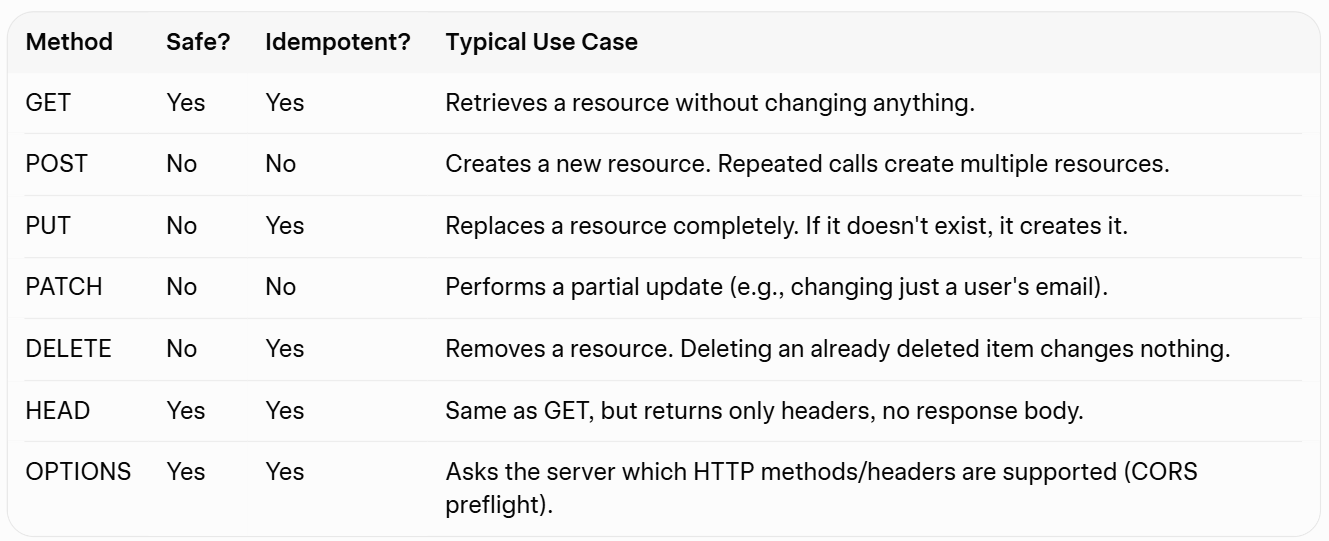
Note on PATCH Idempotency: While PATCH can be written idempotently, it is technically classified as non-idempotent because sequential operations like {“increment”: 1} will change the resource state differently with every execution.
Choosing the right method ensures your API behaves predictably, especially under network retries or concurrent requests.
2. Request & Response Structure
An HTTP communication consists of two plain-text blocks separated by a blank line (\r\n).
Request Structure
POST /api/v1/users HTTP/1.1         <-- Start Line (Method, Path, Protocol)
Host: api.example.com               <-- Headers (Metadata)
Content-Type: application/json
Authorization: Bearer xyz123
{                                   <-- Body (Payload - separated by a blank line)
  "name": "Jane Doe"
}
Response Structure
HTTP/1.1 201 Created                <-- Status Line (Protocol, Status Code, Status Text)
Content-Type: application/json      <-- Headers (Metadata)
Location: /api/v1/users/42
{                                   <-- Body (Payload)
  "id": 42,
  "name": "Jane Doe"
}
This transparent structure makes HTTP easy to debug using tools like cURL, Postman, or browser developer tools.
3. Essential HTTP Headers
Headers pass vital metadata between the client and the server. They are grouped below by functionality:
Content & Negotiation Headers
- Content-Type: Tells the receiver the media type of the payload (e.g., application/json, text/html).
- Accept: Sent by the client to tell the server what data format it expects in return (e.g., Accept: application/json).
Authentication & Redirection Headers
- Authorization: Carries credentials for authenticating the client (e.g., Bearer <JWT_TOKEN> or Basic <CREDENTIALS>).
- Location: Used in redirection (3xx status) or when a new resource is created (201 Created) to specify the resource’s URL.
Caching Headers (Performance)
- Cache-Control: Directives for caching mechanisms in both browsers and shared caches (e.g., max-age=3600, no-store).
- ETag (Entity Tag): A unique identifier (hash) token assigned to a specific version of a resource. If the resource content doesn’t change, the server checks the ETag and returns a 304 Not Modified status to save bandwidth.
Using these headers properly improves security, performance, and client experience.
4. API Versioning Strategies
When breaking changes are introduced to an API, versioning ensures existing client integrations do not break.

Choose the strategy that best fits your architecture and client needs. URI versioning is often the most straightforward for teams getting started.
5. Security: CORS, CSRF, and Security Headers
CORS (Cross-Origin Resource Sharing) CORS allows servers to specify which origins (domains) are permitted to access their resources. It works through headers returned in response to preflight OPTIONS requests.
CSRF (Cross-Site Request Forgery) CSRF attacks trick authenticated users into performing unwanted actions. Protect against them using anti-CSRF tokens, SameSite cookies, and preferring token-based authentication over cookies for APIs.
Important Security Headers Always include headers like Strict-Transport-Security, X-Content-Type-Options: nosniff, Content-Security-Policy, and X-Frame-Options to harden your application.
Spring Boot Implementation Example
Here is how you can implement these concepts in Spring Boot:
Java
@RestController
@RequestMapping("/api/v1/users")  // URI Versioning
@CrossOrigin(origins = "https://your-frontend.com")
public class UserController {
    @GetMapping("/{id}")
    public ResponseEntity<User> getUser(@PathVariable Long id) {
        return ResponseEntity.ok()
                .eTag("user-" + id)
                .cacheControl(CacheControl.maxAge(3600, TimeUnit.SECONDS))
                .body(userService.findById(id));
    }
    @PostMapping
    public ResponseEntity<User> createUser(@RequestBody User user) {
        User created = userService.save(user);
        return ResponseEntity.created(URI.create("/api/v1/users/" + created.getId()))
                .body(created);
    }
    @PutMapping("/{id}")
    public ResponseEntity<User> updateUser(@PathVariable Long id, @RequestBody User user) {
        return ResponseEntity.ok(userService.update(id, user));
    }
    @PatchMapping("/{id}")
    public ResponseEntity<User> patchUser(@PathVariable Long id, @RequestBody Map<String, Object> updates) {
        return ResponseEntity.ok(userService.patch(id, updates));
    }
    @DeleteMapping("/{id}")
    public ResponseEntity<Void> deleteUser(@PathVariable Long id) {
        userService.delete(id);
        return ResponseEntity.noContent().build();
    }
}
This example demonstrates proper use of HTTP methods, versioning, ETag for caching, and CORS configuration.
Final Thoughts
Mastering HTTP fundamentals — from method semantics to security headers — is one of the best investments you can make as a backend developer. These concepts directly impact the reliability, performance, and security of your APIs.
Apply them consistently, document your APIs well (preferably with OpenAPI), and always prioritize idempotency and safety where possible.
What are your favorite HTTP practices or pain points? Share them in the comments!
Happy coding!
메타데이터
- post_id
- b438d29d3af9
- slug
- mastering-http-fundamentals-for-robust-api-design-b438d29d3af9
- url
- https://medium.com/@sr.amritkar2006/mastering-http-fundamentals-for-robust-api-design-b438d29d3af9
- canonical_url
- https://medium.com/@sr.amritkar2006/mastering-http-fundamentals-for-robust-api-design-b438d29d3af9
- author_url
- https://medium.com/@sr.amritkar2006
- status
- ok
- fetched_at
- 2026-08-08 09:10:25





