Revisiting: “Harry Potter and the Philosopher’s Stone” (2001)…
The movie that started a much-loved franchise…
Revisiting Classic Movies
Revisiting: “Harry Potter and the Philosopher’s Stone” (2001)…
The movie that started a much-loved franchise…
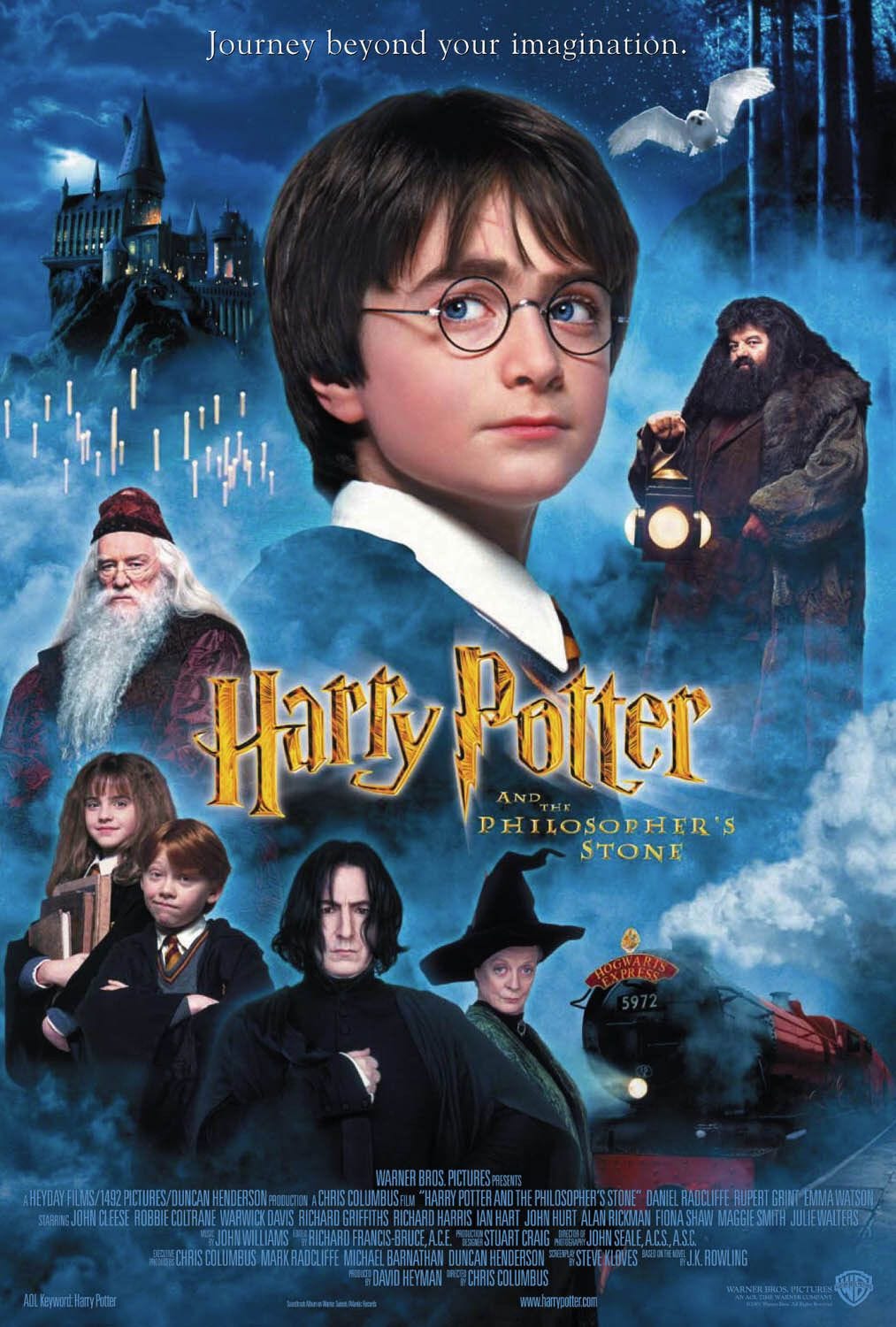

Tuesday, 14 April 2026, a fairly ordinary day, was the day I first saw the movie Harry Potter and the Philosopher’s Stone under this particular title. There is, as pretty much everyone knows, a first time for everything.
[embed]
The first movie in the franchise, in three countries (the USA, India, and the Philippines), is titled Harry Potter and the Sorcerer’s Stone. I’ve lost count of how many times I’ve seen Harry Potter and the Sorcerer’s Stone.
[embed]
I can’t believe a quarter of a century has passed since Harry Potter and the Philosopher’s Stone was released. Tempus. fugit. Time, regardless of whether you’re having fun or not, flies. I believe it was during mid-November. It may have been sometime between 11/17 and 11/21/2001. I saw it when I was living in Seattle. I digress.

The first installent of any franchise, regardless of what that franchise is, must do a lot of heavy lifting. Harry Potter and the Philosopher’s Stone, rather than the literary world, introduces us to the cinematic universe in which our favorite characters exist.
Much of the world-building, the big-screen version, can be attributed to director Chris Columbus. Before getting the gig as director, something that might surprise fans, Columbus had written a script. He impressed the studio with his dedication to the material.

Every detail, clear and precise, adds great depth to each scene. Nothing, from Diagon Alley, Hogsmeade Train Station, and the moving staircases of Hogwarts, is left to chance. The attention to detail is incredible.
Great movies require a great score. John Williams, one of the greatest composers of the last and current centuries, brings his talents to this magical world. Williams, from the mid-1950s onwards, has enjoyed a lengthy career providing excellent music to numerous franchises. These franchises include but aren’t limited to Home Alone, Indiana Jones, Jaws, Star Wars, and Superman. It is not surprising, given his history, that Williams brought some of his finest work to the Harry Potter movies.

It has been suggested that, despite the evidence, Harry Potter and the Philosopher’s Stone is close to the literary source material. Close, as many Potterphiles will tell you, isn’t close enough. The only conclusion I could suggest, noting the differences between the book and the movie, is that Harry Potter and the Philosopher’s Stone would have been at least one hour longer.

Kenneth Branagh as the titular character in “Hamlet.”
As it stands, from published material, the production is a little over two and a half hours. Some people don’t have the patience to sit through a movie exceeding two hours. Most of the movies I find engaging, particularly Kenneth Branagh’s adaptation of Hamlet (1996), are at least two and a half hours. Hamlet, a movie Branagh stars in, produced, wrote, and directed, runs four hours and two minutes.
There are several scenes Potterphiles would have liked to have seen make it to the big screen. In the movie, during a scene where Harry Potter (Daniel Radcliffe), Ron Weasley (Rupert Grint), and Hermione Granger (Emma Watson) visit Rubeus Hagrid (Robbie Coltrane) out of acceptable hours, there is a reference to Severus Snape (Alan Rickman) being one of the professors protecting the stone. The Potions Riddle that Snape devised to protect the stone, despite Hagrid alluding to it earlier in the production, is inconveniently not in the movie.
There are other differences which readers picked up on straightaway. Harry, when he encounters the Mirror of Erised, doesn’t see his entire extended family. In the movie, possibly due to either casting issues or budgetary restraints, Harry sees only his parents.
The scene where Harry first meets Draco Malfoy (Tom Felton), on the staircase at Hogwarts, is fairly entertaining. It covers a lot of ground in such a short timespan. This, however, isn’t where Harry meets Malfoy in the source material. Referencing the book, something I frequently do, Harry first crosses paths with Malfoy in Diagon Alley.
The way Professor Quirinus Quirrell (Ian Hart) dies in the book isn’t the same as that seen on screen. The written version of this scene has Quirrell die when Voldemort leaves his body. The professor, possibly more visually appealing, turns to dust when Harry touches him. It could be argued that the version that was brought to the big screen is, to a certain extent, visually appealing.
There are also missing characters. Charlie Weasley, one of Ron’s brothers, is referenced but not seen. Professor Binns is also nowhere to be seen. A character I would have liked to have seen, further to both Charlie and the professor, is Peeves the Poltergeist. Peeves, in J.K. Rowling’s books, is hilariously funny. The character provides readers with comic relief. The first time I read Harry Potter and the Philosopher’s Stone, I remember almost falling off my chair laughing.
[embed]
It’s not as if a talented actor, in this case Rik Mayall, had not been cast as Peeves the Poltergeist. There is part of me that wonders what the movie would have been like if the character had been in the movie.
Mayall, during an interview, talks about playing Peeves. Clearly, from what Mayall says during the brief interview, the comedian wasn’t remotely amused by being cut from the movie. But, in saying that, Mayall got paid for his time.
Several characters, throughout the eight-movie run, speak of Harry having his mother’s eyes. The literary version of the titular character, like his mother, has blue eyes. During the filming of Harry Potter and the Philosopher’s Stone, matching the source material, Radcliffe was supposed to wear blue contact lenses. It was soon discovered that Radcliffe has an allergy to contact lenses. While it is a minor difference, obviously, it is still a difference.

A new Harry Potter TV series, developed by HBO, is currently in development. The series, potentially spanning seven seasons, will dig deeper into the source material than any of the movies. The main cast, including Dominic McLaughlin, Alastair Stout, Arabella Stanton, John Lithgow, Janet McTeer, Paapa Essiedu, and Nick Frost, has some seriously big shoes to fill. Fans of the movies, consciously or not, will likely make comparisons between the TV series and the movie.
메타데이터
- post_id
- b444ea729a4b
- slug
- revisiting-harry-potter-and-the-philosophers-stone-2001-b444ea729a4b
- url
- https://www.harshlight.news/revisiting-harry-potter-and-the-philosophers-stone-2001-b444ea729a4b
- canonical_url
- https://www.harshlight.news/revisiting-harry-potter-and-the-philosophers-stone-2001-b444ea729a4b
- author_url
- https://medium.com/@shainethomas
- status
- ok
- fetched_at
- 2026-06-09 15:37:30