A 2026 Playbook for HR Teams Using Teamtailor to Hire Smarter, Not Slower
For years, recruitment leaders have been told that the key to better hires is attracting more candidates. With modern ATS platforms and…
A 2026 Playbook for HR Teams Using Teamtailor to Hire Smarter, Not Slower
For years, recruitment leaders have been told that the key to better hires is attracting more candidates. With modern ATS platforms and job-board integrations, that piece is largely solved. Today, your real challenge is not getting applicants — it is turning a flood of CVs into a shortlist that your hiring managers trust.
Teamtailor has become a go‑to ATS for mid-sized companies and global teams that want to nail the candidate-facing side of hiring. Its career-site builder is among the best in class, and its interface is friendly enough that hiring managers actually log in and use it.
But if you are an HR leader or recruitment agency owner in 2026, you may have already spotted the gap: the tool that makes you look good to candidates is not necessarily the one that helps you screen them efficiently.
This article is a practical playbook for HR teams and agencies running on Teamtailor who are tired of drowning in CVs. You will see where Teamtailor shines, where it struggles, and how adding a specialized screening layer like Hirevire can help you hire smarter without rebuilding your entire tech stack.
Why HR and Agencies Still Choose Teamtailor in 2026
Before we talk about what is missing, it is worth appreciating why Teamtailor remains a popular ATS choice.
- Employer branding power: Teamtailor’s drag-and-drop career-site builder lets you launch visually polished, brand-aligned careers pages quickly. You can add media, testimonials, and localized content that resonates with different markets without writing custom code.
- Collaborative workflows: Recruiters, hiring managers, and leadership can all work inside the same interface, leaving feedback, scoring candidates, and tracking pipeline stages with minimal friction.
- Candidate relationship management: The built-in CRM layer allows you to nurture talent pools over time rather than starting from zero with every new requisition.
- Automation and analytics: Automated triggers for emails and status changes, plus reporting on metrics like time-to-hire and source quality, help lean HR teams operate like larger ones.
For HR and agencies alike, these strengths add up to a compelling proposition. You get a branded candidate experience, a centralized place to manage requisitions, and enough automation to keep communication moving. It is no surprise the platform has been adopted by thousands of companies worldwide.
The Hidden Cost: Manual, Shallow Screening
Yet when you talk candidly with recruiters, you hear a different story beneath the surface. Despite the clean UI and automation, their daily work still involves a lot of manual filtering and shallow decision-making at the top of the funnel.
Teamtailor’s AI Co‑pilot can help sort CVs and draft content, but it leans heavily on keyword matching rather than deeper, contextual assessment. There is no native support for async video interviews, audio answers, or rich screening workflows that capture how a candidate thinks and communicates before you commit to a live call.
This leads to familiar pain points:
- Recruiters open CVs one by one (often in awkward embedded windows) and try to judge potential in 30 seconds.
- Candidates who write great résumés but lack soft skills slip through, while those who are stronger in person get overlooked.
- Hiring managers complain that shortlists are inconsistent from one recruiter to another.
In high-volume roles, this can quickly become unmanageable. The ATS is tracking your candidates, but it is not giving you enough signal to select the right ones efficiently.
Why “Just Switching ATS” Often Fails
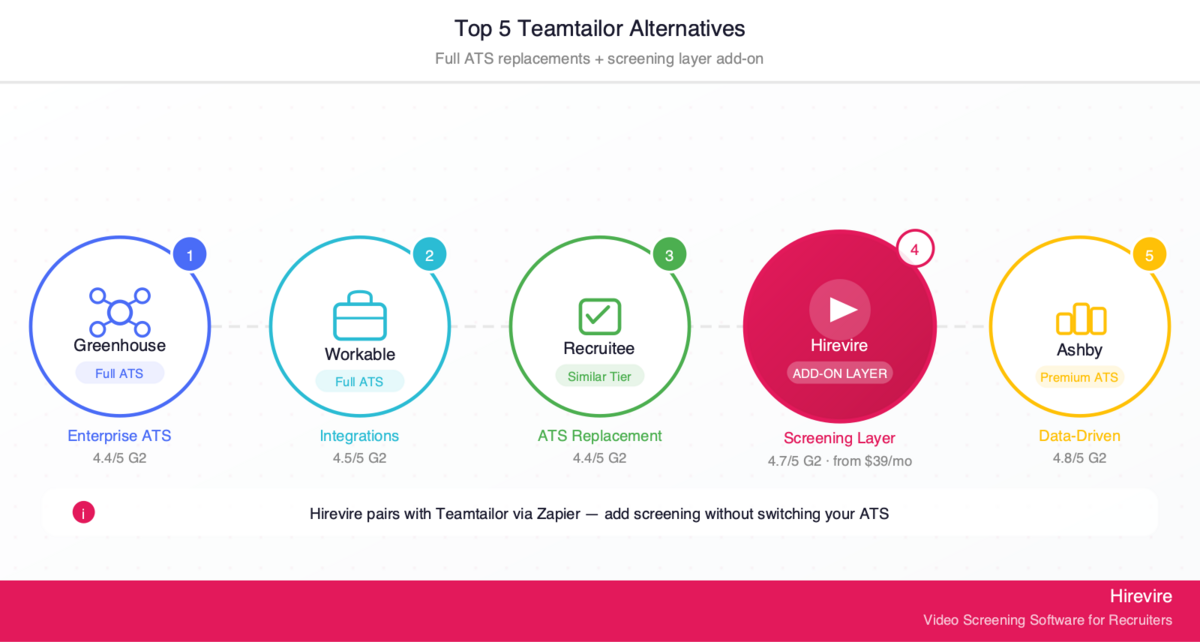
At this point, many organizations start a new ATS evaluation cycle. Greenhouse, Workable, Recruitee, Ashby — each offers its own mix of structured hiring, integrations, and analytics. However, switching ATS is expensive, slow, and risky.
You have to:
- Rebuild your careers site or adjust your employer-brand assets to the new system
- Export and re-import candidate data, sometimes losing historical notes or pipeline history along the way
- Reconfigure automations, integrations, and approvals
- Retrain every recruiter, hiring manager, and HR stakeholder on the new interface
It is not unusual for a migration to take 4–8 weeks from decision to full adoption. During that time, your hiring engine is partly disassembled. For recruitment agencies in particular, that is a dangerous window in which speed and reliability can dip right when clients expect consistency.
For many teams, the honest truth is this: they do not need a completely new ATS. They need a way to make smarter decisions within the one they already have.
Rethinking the Stack: ATS as Backbone, Screening as Brain
A more sustainable approach is to treat your ATS as the backbone of your hiring stack and plug in specialized tools where it falls short. In the case of Teamtailor, that missing piece is screening depth.
This is where a platform like Hirevire comes in. Rather than competing with Teamtailor, it complements it by focusing exclusively on structured pre‑screening via async responses.
Here is the conceptual model:
- Teamtailor: Owns the careers site, job postings, and core pipeline stages.
- Hirevire: Owns the “high-fidelity questions” that filter serious, high-potential candidates from the rest — before they land on your calendar.
Candidates apply through your familiar Teamtailor flow. Then, via integration, they receive a Hirevire link where they answer carefully designed questions through video, audio, text, and file uploads. Recruiters and hiring managers review and rate responses asynchronously, collaborating to build a shortlist that is both fast and thoughtful.
What Async Screening Looks Like in Practice
Imagine you are hiring for a customer success manager role.
Instead of jumping straight from CV to 30-minute phone screens, you insert a Hirevire questionnaire right after “application received.” Candidates are asked to:
- Record a short video describing how they handle frustrated customers
- Answer a text question about their approach to onboarding new accounts
- Upload a short email they might send after a client escalation
All of this happens on the candidate’s schedule, with no login required and no software to install. Hirevire transcribes video and audio responses automatically in multiple languages, so even global teams can scan content quickly.
Your recruiters log in, skim transcripts, watch only the most promising responses, leave ratings and comments, and then push the top candidates forward in Teamtailor. The result is a shortlist that feels “pre‑vetted” without hours of live calls.
The Benefits for In‑House HR Teams
For in-house HR and talent acquisition, this model unlocks several benefits:
- Quality of hire: You hear and see communication skills, thought process, and culture fit long before an offer.
- Time savings: Recruiters reclaim hours each week by avoiding redundant phone screens that reveal nothing new.
- Consistency and fairness: Every candidate for a role gets the same core questions, which supports more structured, bias-aware evaluation.
- Scalability: When hiring spikes, you can handle more candidates with the same team size because the initial screening happens asynchronously.
Because Teamtailor stays in place as the backbone, your stakeholders do not feel the shock of a full platform change. Instead, they see the experience improving: better shortlists, faster feedback cycles, and more meaningful interviews.
The Edge for Recruitment Agencies
Recruitment agencies live or die by two things: speed and trust. Clients trust you when your shortlists consistently contain candidates who show up well in final interviews. They stick with you when you can deliver those shortlists quickly.
Adding Hirevire on top of Teamtailor helps on both fronts.
- Speed: You can invite dozens or hundreds of applicants into structured async screening within hours of posting a role. Reviewing those responses is significantly faster than running individual discovery calls.
- Proof of value: When you send candidate profiles to clients, you can include links to their recorded responses (within the rules of your process and privacy agreements). Clients now see what you saw, which makes your recommendations more credible.
- Differentiation: Many agencies still rely heavily on CV-forward submissions. Offering a richer, media-based candidate profile makes your service stand out and demonstrates a more modern, thoughtful approach to hiring.
Because Hirevire integrates through standard connectors like Zapier, even smaller agencies without in-house engineering can set up this flow quickly.
Addressing Common Concerns
When HR leaders and agency owners first hear about async screening, they often raise a few concerns. Let us address them directly.
- “Will this add friction for candidates?”
Done poorly, yes. Done well, it becomes a positive differentiator. The key is to keep screenings focused, respect candidates’ time, and clearly explain why you are using this format: to give them a fairer, more structured opportunity to present themselves beyond a CV.
2. “What about our employer brand?”
Because Teamtailor continues to power the careers page and initial application, your front door remains as polished as ever. Hirevire becomes a natural extension of that experience — especially if you frame it as “share your story” instead of “complete this tedious form.”
3. “Is the tech stack going to get too complicated?”
In reality, you are simplifiying the parts that matter most. Teamtailor remains the system of record for requisitions and pipeline; Hirevire becomes your specialist screening engine. With standard integrations, the data flows automatically between them.
A Simple Rollout Plan for Your Teamtailor + Hirevire Stack
To make this concrete, here is a step-by-step rollout plan you can adapt:
- Audit your current pipeline
Identify roles where screening consumes disproportionate time — high-volume entry-level roles, customer-facing positions, or roles with many similar applicants.
2. Pick one role for a pilot
Choose a live or upcoming requisition where you can experiment without massive risk. Align key stakeholders on the goal: reduce time spent on low-signal calls while improving shortlist quality.
3. Design a 4–6 question async screening flow
Draft a balanced mix of video, audio, and text questions that map directly to the core competencies for that role. Use clear, candidate-friendly language and indicate approximate time required.
4. Integrate Teamtailor and Hirevire
Use Zapier or webhooks so that candidates who apply in Teamtailor automatically receive Hirevire invitations. Decide which pipeline stage in Teamtailor should represent “screening initiated” and “screening completed.”
5. Run the pilot, measure outcomes
Track metrics such as recruiter hours saved, time-to-shortlist, and manager satisfaction with candidates who reach live interview stages. Collect qualitative feedback from candidates as well.
6. Standardize and scale
Once you see clear gains, roll out similar flows for comparable roles, reusing question sets and tweaking only where necessary.
Turning Volume into Advantage
In 2026, HR teams and recruitment agencies that win will not necessarily be the ones with the flashiest careers site or the longest tech stack. They will be the ones who transform application volume into decision-making advantage.
Teamtailor already does a lot right. It gives you a strong candidate-facing presence, a collaborative ATS, and enough automation to keep your workflows humming. Its weaknesses in screening depth and integration breadth are genuine — but they are also fixable without walking away from the platform.
By pairing Teamtailor with a purpose-built screening tool like Hirevire, you can:
- Keep your employer brand strong
- Dramatically reduce manual, low-signal work
- Build shortlists your hiring managers and clients trust
- Move faster than competitors without sacrificing quality
If you are ready to stop drowning in CVs and start hiring smarter with the tools you already have, upgrading your screening layer is the most leveraged move you can make.
To dive deeper into how Teamtailor performs in 2026 — its pricing ranges, strengths, and where it falls short — you can explore this detailed review:
**Read more about Teamtailor’s pricing, features, and alternatives.**
메타데이터
- post_id
- b4469d9b32af
- slug
- a-2026-playbook-for-hr-teams-using-teamtailor-to-hire-smarter-not-slower-b4469d9b32af
- url
- https://medium.com/hirevire/a-2026-playbook-for-hr-teams-using-teamtailor-to-hire-smarter-not-slower-b4469d9b32af
- canonical_url
- https://medium.com/hirevire/a-2026-playbook-for-hr-teams-using-teamtailor-to-hire-smarter-not-slower-b4469d9b32af
- author_url
- https://medium.com/@hsanat
- status
- ok
- fetched_at
- 2026-06-22 12:55:45