The Most Misunderstood Phrase Jesus Ever Spoke
Why Jesus’ original audience heard a message of resistance, where modern readers hear a message of compliance
The Most Misunderstood Phrase Jesus Ever Spoke
Why Jesus’ original audience heard a message of resistance, where modern readers hear a message of compliance
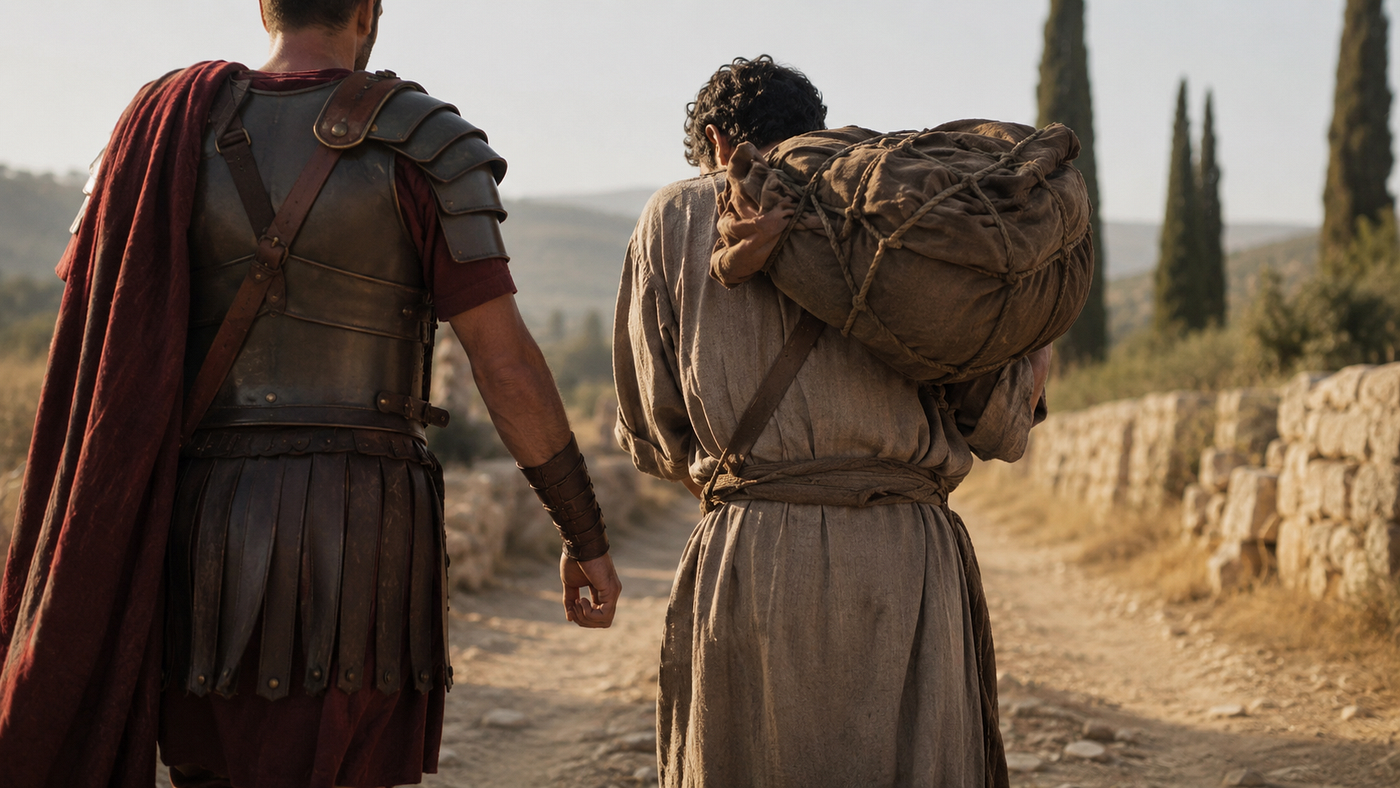
Image created by author on Canva Pro
In 2005, all 529 runners who completed the Chicago Lakeshore Marathon achieved something no marathon runners had ever done before.
You see, traditionally a marathon is 26.2 miles. But, at the Chicago Lakeshore Marathon in 2005, the genius who marked out the course miscalculated, and so the course was a full mile longer that what it should have been.
So, all 529 runners completed an extra mile.
As you can imagine, there was a huge uproar, disqualifications, complaints, legal challenges, threats, protests — all because the runners had to go an extra mile. Clearly, when it comes to the marathon, nobody wants to have to go further than they need to, and I can understand that. I have no desire to punish my body with unnecessary exercise either.
But beyond this once-off sporting event, I think this reflects a general human condition: Most of the time — almost always — people don’t want to do more than they have to do.
I don’t want to. You don’t want to.
No one wants to go the extra mile.
On going the extra mile
Yet, Matthew 5:41 records these words of Jesus Christ:
“If anyone forces you to go one mile, go with them two miles.”
The phrase “going the extra mile” is one of those Biblical phrases that has become part of our everyday vernacular. We often hear the phrase “go the extra mile” tossed around casually, encouraging us to put in additional effort or longer hours, especially in our workplaces. In fact, you could imagine the phrase “They always went the extra mile” being used at the retirement party of a well-respected employee.
Meanwhile, in the church that I grew up in, “going the extra mile” was often interpreted in a way that emphasized meekness and passive acceptance. We were taught that going the extra mile meant enduring mistreatment without protest, submitting ourselves to the will of others even in the face of injustice and being walked all over for the sake the gospel.
But, when Jesus first used the phrase, “going the extra mile,” that’s not how his listeners would have understood it. In fact, back in the first century, his audience would have been taken aback by what he said. When Jesus mentioned going the extra mile, it wasn’t just a casual remark. It hit home hard, striking a nerve and stirring up some real discomfort among the crowd.
The real meaning of going the extra mile has been lost in the two thousand years since.
Let me explain…
A critique of power
When Jesus said, “If someone forces you to walk with him for a mile, walk with him for two instead” who was the “someone” that Jesus was referring to? To understand who the “someone” was, you need to understand what was going on at that time in history.
When Jesus uttered these words, the region was under Roman occupation, with Roman soldiers wielding authority and power over the local populace. One aspect of this authority was the legal right for a Roman soldier to compel a non-Roman citizen to carry his gear for one mile. No matter what you were doing, if a Roman soldier stopped you, you had to drop everything to help him.
It was just one of the ways that Rome exercised its power and control over the colonised people. It was a form of humiliation for the Roman solider to make you like his pack mule for 1000 paces. One thousand paces — which was one Roman mile — was the legal limit.
Then he had to let you go.
It’s difficult for modern readers to appreciate just how humiliating this arrangement would have felt.
Imagine being in the middle of your workday. Perhaps you are carrying produce to market, repairing a fishing net, heading home to your family, or tending your crops. Suddenly, a Roman soldier points at you. There is no discussion. No negotiation. No appeal process.
You drop what you are doing and carry his equipment, not because you want to, not because it is the right thing to do. You do it because he has power and you do not.
Every step of that mile would have been a reminder of who was in charge. Every pace reinforced the reality that Rome ruled and ordinary people were expected to know their place. The soldier wasn’t merely transporting his gear. He was exercising authority.
This is what makes Jesus’ teaching so startling. We often read his words as if he were offering advice about kindness or generosity. His original audience would have heard something entirely different. They would have heard him speaking directly into a daily experience of humiliation, resentment, and powerlessness.
And that changes everything.
Because the question Jesus is addressing is not, “How can I be nicer?”
The question is, “How do I remain fully human when someone else is treating me like less than human?”
A Roman Soldier was NOT allowed to force anyone to go more than the first mile. In fact, if a Roman soldier made someone go the second mile, he could be severely punished. Possible penalties included the loss of rank, being given rations of barley instead of wheat (I suppose wheat tastes better?), and having to stand in front of the centurion’s tent all day (the ancient equivalent of being put in the “naughty corner.”)
So, why would anyone attempt to carry a Roman’s pack an extra mile? You can imagine that when Jesus told his listeners to carry a Roman soldier’s pack not one mile, but two miles — double what they were required to by law — his listeners may well have scoffed, “There ain’t no way I’m carrying some dirty Roman’s pack a single step further than what I am required to by law! No way! Forget it!”
However, what Jesus was really offering was not a meek act of submission, but a profound act of non-violent resistance. You see, by volunteering to surpass the mandated limit of one mile, the individual that the Roman was seeking to humiliate could reclaim their agency and dignity. This voluntary act wouldn’t just showcase God’s generosity; it would also put the soldier in a very awkward position since accepting the extra mile would mean breaking the law.
Not only that, for the Roman to accept the help, he must accept it as one who is on equal footing with the person offering the help.
Therefore, the proposal of the “second mile” was actually a tactic to expose the power imbalance and peacefully challenge the system by embracing its absurdity. Far from cowardice, it required immense bravery. This subversive gesture reversed the power dynamics, turning the soldier’s attempt at intimidation into awkward embarrassment. The oppressive regime found itself exposed and disoriented, unsure of how to respond.
Perhaps this is why the teaching has lost some of its edge over the centuries.
Those with power tend to prefer interpretations that keep power intact.
It is far safer to teach that “going the extra mile” means working harder, complaining less, and quietly accepting whatever comes your way. That interpretation asks nothing of the powerful and everything of the powerless.
But Jesus was doing something far more radical.
He was teaching people how to resist without becoming violent. How to challenge injustice without surrendering their dignity. How to expose the absurdity of oppressive systems without picking up a sword.
The second mile was not passive. It was creative. It was disruptive. It was courageous.
So you see, “Going the extra mile” was not about accepting injustice or submitting to oppressive forces. It was a strategic and intentional act of resistance — a way to reclaim agency in the face of dehumanizing circumstances. By exceeding the expectations imposed upon them, Jesus’s followers could disrupt the status quo and challenge the structures of oppression that held them captive.
Make no mistake, “Going the extra mile” was Jesus’s way of critiquing the use and abuse of power.
Now, that puts a different spin on things, doesn’t it?
The traffic is light on the second mile
Today, the phrase “going the extra mile” has been co-opted and diluted, stripped of its revolutionary implications and reduced to a motivational slogan or productivity tip. But its true meaning remains as relevant and transformative as ever. In fact, I can think of three really good reasons why going the extra mile is more crucial now than ever.
The opportunity mile
Imagine the look on the Roman soldier’s face. He has just reached the end of the legally required mile. He is expecting you to drop the pack and head back home. Instead, you keep walking.
“Where are you going?” he asks.
“With you.”
For perhaps the first time, the soldier has a question.
“Why?”
Why would someone volunteer for something they are not required to do? Why would someone who has every reason to resent me choose a different response?
The second mile creates curiosity.
Most human interactions are predictable. We return insult for insult. We mirror aggression with aggression. We treat people according to what they deserve.
The second mile interrupts that pattern. It creates a moment where people become curious enough to ask questions they would never have asked otherwise. That is the opportunity hidden within the second mile.
The freedom mile
When you go the extra mile, it sets you free! Everyone who carries a Roman’s pack the first mile is doing it because they have to. They are a slave. The first mile is the “have-to” mile.
But, everyone who carries a Roman’s pack the second mile is doing it because they want to. They are not doing it because they are a slave anymore. No! They are doing it because they are free!
When you go the second mile, you make this amazing transition from slavery to freedom, from being an inferior to being an equal, from weakness to strength. The person who was lording it over you suddenly becomes your peer. The person who was being so demanding of you only a few minutes ago, has suddenly been disarmed of that power. The first mile is the “have-to” mile, but the second mile is the “want-to” mile.
To walk the second mile is to walk in freedom!
The unconditional mile
But there is one more reason to walk the second mile. The first mile is motivated by obligation. You walk it because you have to. You walk it because somebody else has the power to compel you. It is the mile of duty, compliance, and necessity. It is the minimum that is required of you.
The second mile is different.
The second mile is motivated by something else entirely. It is motivated by love.
Not the kind of love that is merely a feeling. Not the kind of love that appears when people are kind to us and disappears when they are not. The kind of love Jesus spoke about was far more costly than that. It was a choice. It was a deliberate decision about the kind of person you wanted to be, regardless of how other people behaved toward you.
That is what makes the second mile so powerful.
The person carrying the Roman soldier’s pack has every reason to be resentful. They have been inconvenienced, humiliated, and reminded that they live under the authority of an occupying empire. Nobody would blame them for carrying the pack exactly one mile, dropping it at the soldier’s feet, and walking away.
Instead, they choose to keep walking.
Not because the soldier deserves it. Not because the soldier has somehow earned their respect. And certainly not because they approve of the system that allows such treatment in the first place.
They do it because they refuse to allow the behaviour of another person to determine their own character.
This is where the second mile becomes an act of love. It is not passive acceptance. It is not becoming a doormat. It is not allowing yourself to be abused. It is the decision to remain generous in a world that often rewards bitterness. It is the choice to remain compassionate without surrendering your dignity. It is the refusal to become a mirror image of the very thing you oppose.
The second mile says something profoundly human: You may have power over me, but you do not get to decide who I become.
That, perhaps, is the deepest freedom of all.
Love and challenge in equal measure
This simple little phrase of Jesus — go the extra mile — exposes his genius. Somehow Jesus was able to come up with a way to show love, and challenge the inappropriate use of power at the same time.
I will walk the extra mile because you can’t make me, and I will walk the extra mile because you can’t stop me either. I am free to say “no” and with that freedom I choose to say “yes.”
That’s the beauty of it, isn’t it?
When we choose to walk the extra mile, we’re not just passively accepting the status quo or blindly following the rules. We’re challenging the rules. We’re actively asserting our own agency and reclaiming our dignity, all while extending love to those around us whether they deserve it or not.
Dan Foster is the author of “The Bible is Your Story: What the characters of Scripture reveal about the patterns shaping your life.”
The Backyard Church is not just a blog. It’s a real online community for people who have faith but can’t, don’t, or won’t go to church. Join today.
If you’re a writer or blogger who wants to grow your voice and build momentum online, I also run Bloggers Academy — a smaller community where I teach what I’ve learned growing from zero to 100,000+ followers. Learn more here
For more articles on life, faith, and spirituality, Sign-up for my newsletter. Also, feel free to send questions and story ideas to thebackyardchurch@gmail.com
메타데이터
- post_id
- b459877ee228
- slug
- the-most-misunderstood-phrase-jesus-ever-spoke-b459877ee228
- url
- https://medium.com/backyard-theology/the-most-misunderstood-phrase-jesus-ever-spoke-b459877ee228
- canonical_url
- https://medium.com/backyard-theology/the-most-misunderstood-phrase-jesus-ever-spoke-b459877ee228
- author_url
- https://medium.com/@danfosterwriter
- status
- ok
- fetched_at
- 2026-07-16 12:44:52