103 What the Storm Has Always Shown Us — Without Us Ever Seeing It
We believe we understand a storm because we have observed it all our lives. Yet what appears obvious often rests on sequences we have never…
103 What the Storm Has Always Shown Us — Without Us Ever Seeing It
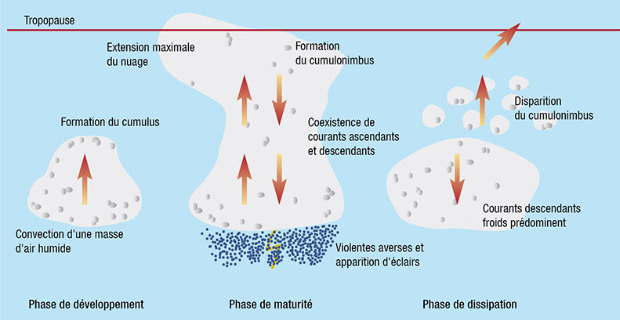
We believe we understand a storm because we have observed it all our lives. Yet what appears obvious often rests on sequences we have never truly examined. Habit replaces analysis, and repetition creates the illusion of understanding. But the moment we slow our gaze, following each transition without skipping any, this familiar phenomenon begins to reveal something else.
There are phenomena we assume we understand simply because they unfold before us again and again. The storm is one of them. It rumbles, flashes, and crosses the sky with such regularity that its mechanism seems self-evident. And yet, when followed step by step, without shortcuts or simplifications, a different picture emerges: one in which coherence depends on transitions that are often more fragile than assumed. The question is not only what is described, but how each stage truly connects to the next.
- The process begins with a localised warming of air near the ground, generally attributed to solar radiation, establishing the initial energy input of the system.
- This warmed air becomes less dense than the surrounding air, introducing a difference in density.
- The warmer air then begins to rise, forming an ascending current.
- Yet before this movement becomes established, the air may remain in a state of local stagnation, as if suspended between two states, where forces are momentarily balanced and no clear vertical motion occurs. This subtle moment marks a crucial transition.
-
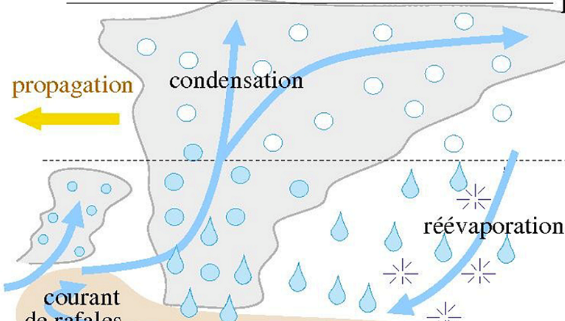
As the ascent continues, the water vapour contained in the air condenses into droplets, making the cloud visible.
-
This condensation releases latent heat, reinforcing the upward motion.
-
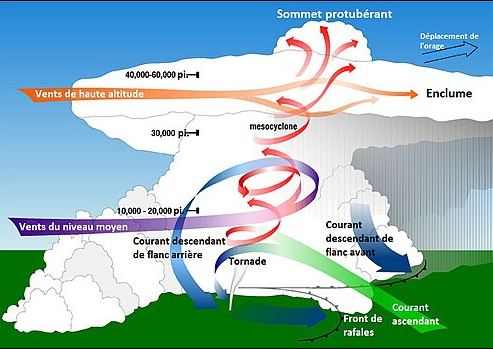
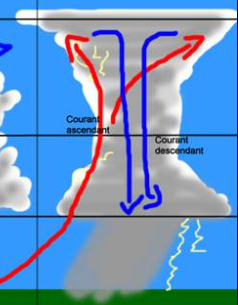
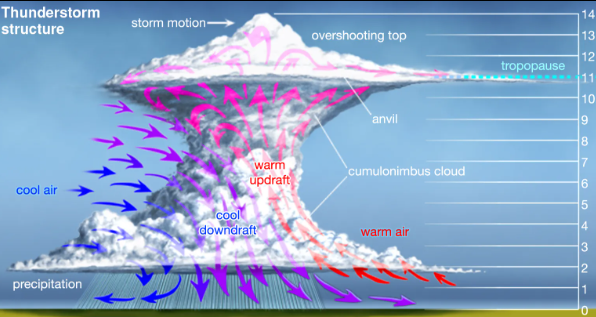
Gradually, the system organises itself into a more complex structure in which opposing flows coexist. Some air rises while other air descends, and within this coexistence a particular balance emerges, though its organisation remains difficult to fully grasp.
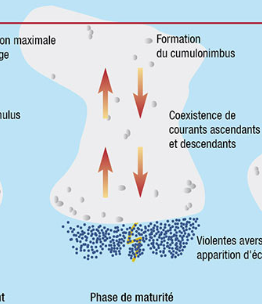
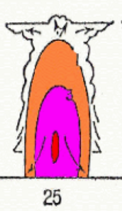
- The cloud develops and may evolve into a cumulonimbus.
At this stage, an essential nuance appears. A storm does not necessarily follow a rigid sequence of steps. It behaves instead as a conditional system, in which each state only emerges when specific thresholds are reached. Some phases may be extremely brief, others incomplete, and others still entirely imperceptible. Thus, the initial stagnation (4) may not be observable when instability is immediate; the structuring of the cloud (8) may remain partial if energy is insufficient; and more advanced processes may never occur if their specific conditions are not met. What appears as an absence is often simply a transition that is too rapid, too weak, or never fully realised.
- Within the cloud, particles collide continuously.
-
These interactions lead to a separation of electrical charges.
-
The charges begin to organise, with positive charges generally higher and negative charges lower.
-
From this organisation, an electric field emerges and progressively intensifies. Yet the transition from simple charge separation to a stable, structured field remains difficult to define precisely.
-
When this field reaches a certain threshold, the air becomes locally conductive.
- A descending leader forms from the cloud.
-
At the same time, ascending leaders may rise from the ground.
-
Their connection forms a continuous conductive channel.
-
A lightning discharge occurs, abrupt and intense.
-
The air is violently heated, expands, and generates a shockwave perceived as thunder.
-
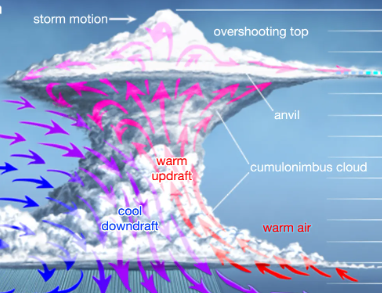
The storm reaches its stage of full development, a state of unstable equilibrium.
-
Precipitation intensifies.
-
Descending currents strengthen and reach the ground.
-
Then a rapid drop in temperature occurs, almost abrupt, altering the state of the system. The air becomes suddenly denser, sinks, and imposes a new dynamic. This moment does not merely represent a step; it resembles a rupture — a shift in the energy balance whose magnitude is difficult to reconcile with the apparent continuity of the phenomenon.
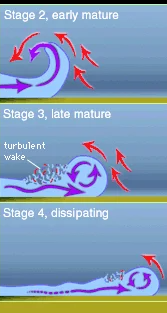
- The supply of warm air gradually diminishes.
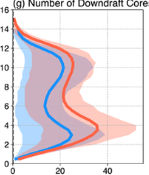
- The storm then slowly dissipates, losing its internal coherence.

Viewed in its continuity, this sequence reveals a structure far less mechanical than it appears, where certain transitions — subtle yet decisive — govern the behaviour of the whole system. What once seemed linear proves dependent on local equilibria, thresholds that are or are not reached, and transitions that are sometimes invisible. The storm is no longer merely a phenomenon to describe.

It becomes a phenomenon to question.
메타데이터
- post_id
- b45f4b02e7b0
- slug
- 103-what-the-storm-has-always-shown-us-without-us-ever-seeing-it-b45f4b02e7b0
- url
- https://medium.com/@gouvielos/103-what-the-storm-has-always-shown-us-without-us-ever-seeing-it-b45f4b02e7b0
- canonical_url
- https://medium.com/@gouvielos/103-what-the-storm-has-always-shown-us-without-us-ever-seeing-it-b45f4b02e7b0
- author_url
- https://medium.com/@gouvielos
- status
- ok
- fetched_at
- 2026-06-09 15:37:30