Building a Culture as Creative as the Drinks | The Something & Nothing Story
It’s easy to build a brand that looks different. It’s much harder to build a company that works differently.
Building a Culture as Creative as the Drinks | The Something & Nothing Story

Something & Nothing Premium Sodas
It’s easy to build a brand that looks different. It’s much harder to build a company that works differently.
Everyone needs to stand out in a crowded market. Be disruptive. Be clever. Something & Nothing wanted more. They wanted their ethos to live in every sip and every meeting. Every conversation. Every decision.
From day one, co-founders Oliver Dixon and Rupert Pugsley were clear: this wasn’t about hierarchy or ego. It was about care, creativity, and connection. “We are thinkers, not followers,” they remind their team, and they meant it.
By mid-2021, S&N had grown from two co-founders to a team of eight, all working remotely, all passionate, all creative. And with that came the challenge: how do you stay collaborative and effective without losing the culture that made the company worth building?
As a specialist in leadership beyond hierarchy, my role was clear: Help the team hold onto what made them unique while giving them practical tools to collaborate, communicate, and thrive.
Five years on, this is the story of a creative brand making a big impact on the market and putting just as much care into the people building it.
Small Changes, Big Impact
When I began working with Something & Nothing, we started with fortnightly sessions between me, Olly and Rupert, the two co-founders. It was clear they had a vision of what they wanted their culture to feel like. They’d defined their purpose, mission and values, they’d created an inspiring and creative brand, and their commitment to infusing their culture with as much passion and purpose was impressive.
I began my work with a simple intervention. At the start of each session, we ‘checked-in’. This is a tool that can be used at the start of all kinds of meetings; an opportunity for everyone in the meeting to call out any distractions or share something that’s on their mind. The introduction to the check-in is simple: Share whatever you would like to share to feel present and connected for our meeting.
It sounds small, but for two co-founders who’d worked closely together for the last 2 years, it meant discovering things about each other they hadn’t realised before. They shared some ideas and project goals, but the real insight came from sharing the pressures they were feeling. We often expect leaders to be driven, results-oriented, almost machine-like in their endeavours. This was an opportunity to discover what lay beneath the surface.
The awareness the check-ins brought to our sessions meant that Olly and Rupert could slow down for a minute and listen properly, understanding not just what each other was working on but also how they were experiencing it. They made the connection at the core of the business more human.
Designing Communication
Next, we tackled team communication and transparency. I designed a meeting style inspired by Holacracy’s tactical meetings. These were all-hands sessions where team members could update each other on work, ask questions, and, crucially, ask:
“What do you need to fulfil the purpose of your role?”
When this question is introduced, it reinforces individual accountability and legitimises asking for support, shifting the meeting culture away from a traditional format. Even the best intentions to help your people feel able to speak up in meetings can fall flat without clear structures that provide a process for them to do so.
In this case, team members immediately started asking for what they needed, offering ideas, and making suggestions. We’d sent a clear signal to everyone that their voice matters.
We also moved the company from WhatsApp to Slack, a change that subtly reinforced the importance of both transparency and work-life boundaries. Slack created the opportunity to distinguish between personal and professional communication, while allowing conversations to be organised and visible across channels.
Slack isn’t perfect. It can easily become a distraction or encourage quick responses over thoughtful ones. It works best when balanced with other forms of communication that allow for deeper, more reflective conversations. But alongside the new meeting structure, it gave Something & Nothing a more intentional and sustainable way to communicate as a remote team.
A Handbook with Personality
To anchor S&N culture in practice, we created a handbook written in the brand’s voice: creative, fun, thoughtful, accessible.
Pages like ‘Feed Your Curiosity’ encourage the team to take a day each quarter to explore art, culture, or experiences that nourish them.
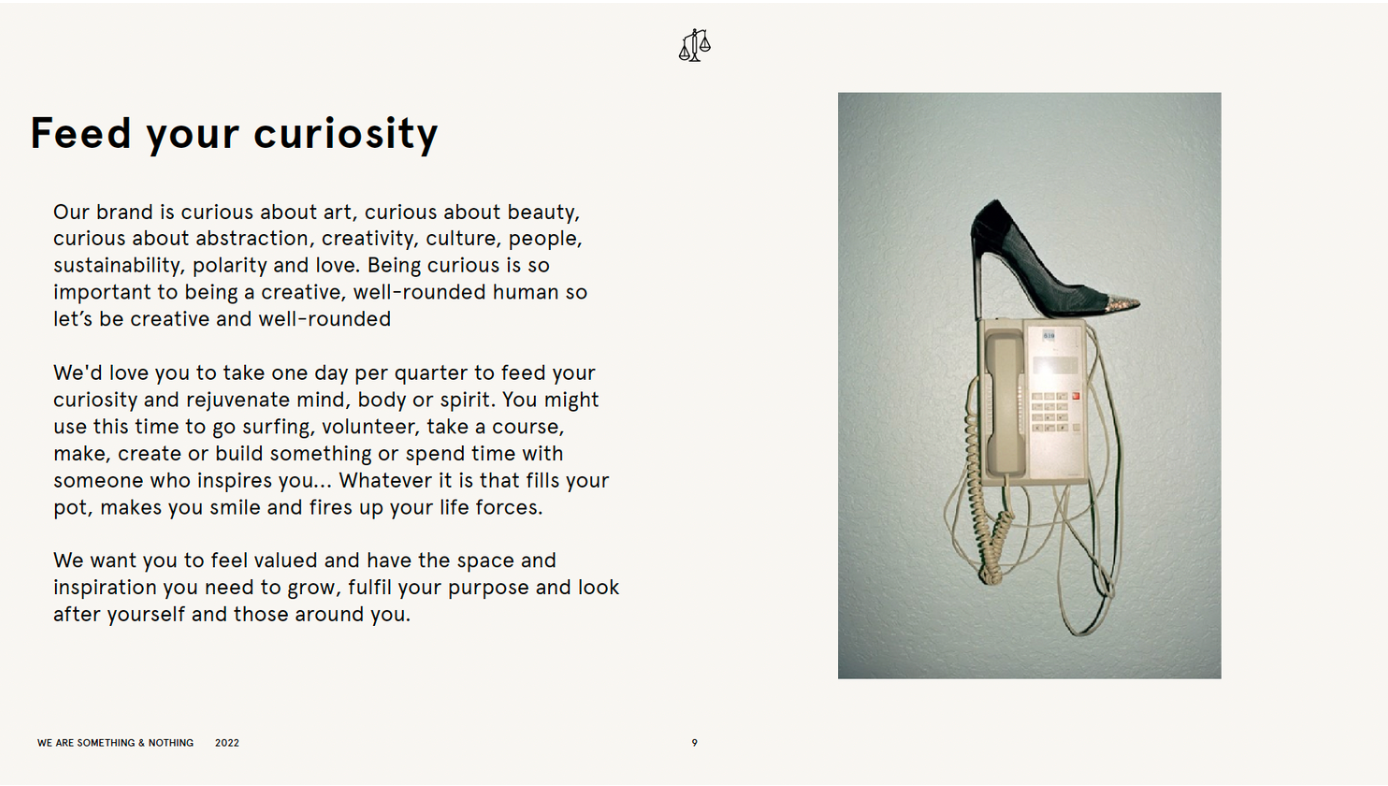
Something & Nothing Handbook
Another page of the handbook, ‘Random Acts of Kindness’, offered ideas to spark generosity in everyday life: paying someone a compliment, sharing seeds for a garden, or sending a postcard.
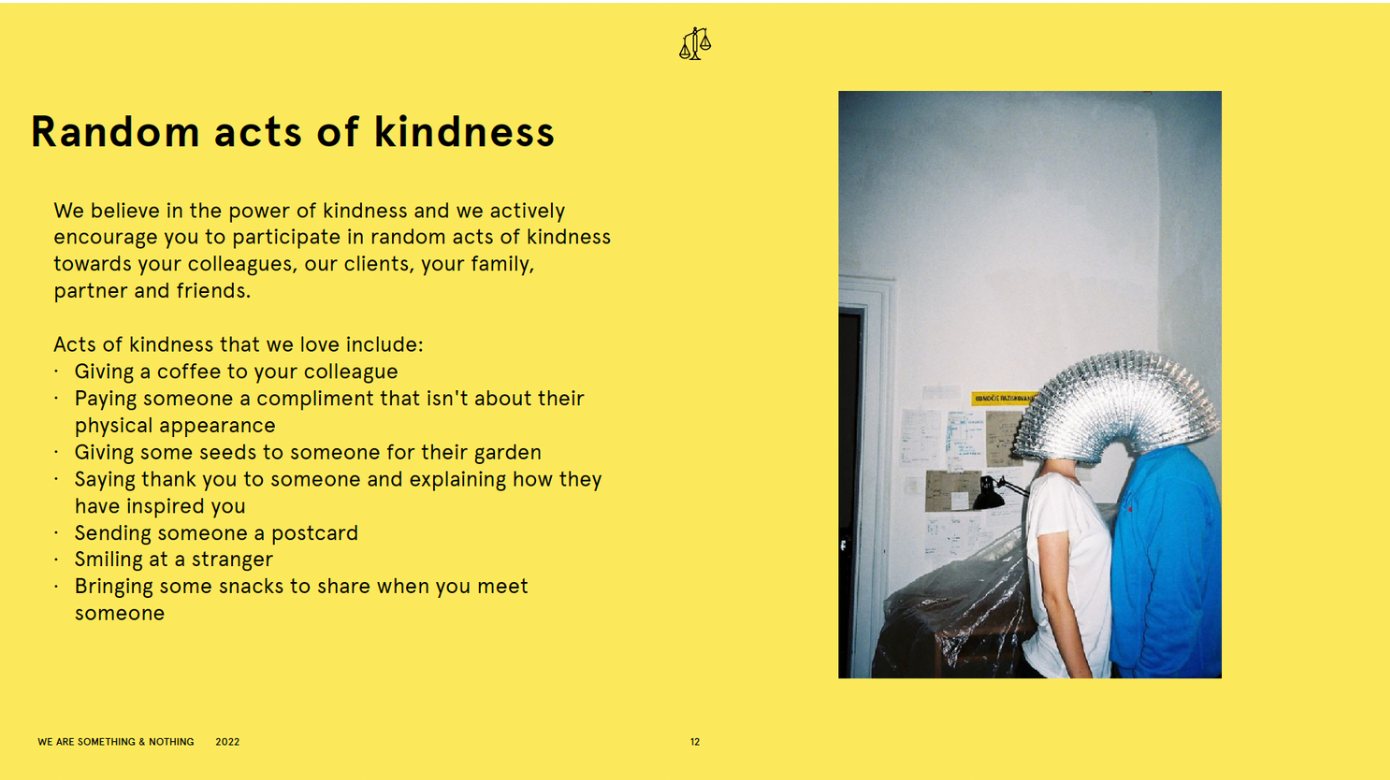
Something & Nothing Handbook
This handbook wasn’t a gamechanger in isolation, but it reinforced the culture and matched the brand’s tone. When you’ve invested in a brand ethos designed to catch the attention of your customers and inspire brand loyalty, it makes sense to bring that same ethos to your people through your internal comms.
Role Mapping
We also explored role mapping; a natural step for a growing company trying to stay clear and collaborative without defaulting to hierarchy.
Rupert took the lead, mapping roles and responsibilities across the organisation using Maptio. The intention was to make work visible, show how everything is connected, and create transparency without hierarchy.
But when the map was introduced, it didn’t land. The team hadn’t been involved in shaping it, and it felt slightly abstract. It became clear that the organisation didn’t need a full role map at that stage. Clarity was already emerging through conversation, trust, and shared ownership.
What stayed was Rupert’s instinct that the organisation is less like a hierarchy and more like pods or planets that gravitate around a shared purpose whilst having their own distinct sphere. This is how S&N operates with different teams having their own gravitational pull, moving independently but still connected.
We haven’t yet found the perfect way to map that, and we’ll need to resolve this as the company grows further, but as things stand, S&N is living their reality without over engineering things.
Designing Connection ~ The Nothing Meetings
Being a remote-working company, one of Rupert’s main concerns was how to cultivate an ongoing sense of connection within the team. They gathered in person once every few months for strategy planning and a much-needed social, but Rupert knew they’d soon be expanding globally, and they needed a practical and effective way of bringing people together.
Based on an extended version of the check in, combined with ideas from Liberating Structures, I designed a unique monthly event for them, which was less about meeting, more about gathering. Less about business, more about who they are as people. Less about doing, more about being.
Over time, these meetings became the cornerstone of S&N culture and with the monthly all-hands business meetings, known as the ‘Something Meetings’, these new spaces for the team to gather were named ‘Nothing Meetings’.
The process is simple. A theme for each Nothing Meeting is chosen by the nominated facilitator. Over time the themes have become beautiful enquiries that reflect the creativity of the company. The simplest examples of some of the themes are things like ‘What’s your favourite travel memory’ or ‘How do you apply self-care’. During the 60–90 minute gathering, everyone has the opportunity to speak, without crosstalk, feedback, or distractions.
Nothing Meetings are not compulsory. Freedom of choice is important for a session like this. But attendance is high, and 5 years on the Nothing Meetings are a highlight in everyone’s month.
In 2026, I asked Rupert for his reflection on what made the Nothing Meetings so special.
“Before a Nothing Meeting, I often wonder if I have time for 90 minutes of ‘nothing’ but as soon as I join the session, I know that this is where I’m meant to be.”
Rupert continues:
“Our Nothing Meetings do exactly what they need to do. They give us space to listen to each other and drop our guard in a healthy way. When we do this, authenticity becomes easier and authenticity breeds trust and connection.”
The Nothing Meetings are a monthly space that give people permission to be human, sharing fears, joys, and ideas. It’s clear they directly support the culture of care, courage, and curiosity that Something & Nothing stands for.
Photo by Kyle Glenn on Unsplash
Leadership Beyond Hierarchy
Something & Nothing isn’t a ‘flat’ organisation. There are leaders; not by title, but by experience, example, and lived reality. Authority exists, but the need to exert authority is rare, and if needed, it happens courageously, not forcefully.
The focus on authenticity means there are no power games, no ego-driven decisions, no sense that leadership needs to dominate the room. Leadership is modelled through curiosity, openness, and honesty, and that shows up most clearly when things aren’t going well.
In one instance, a team member wasn’t performing to expectations. Instead of moving straight to judgement, the founders leaned into one of their core values: curiosity. The question wasn’t “Why aren’t they delivering?” but “What might be going on here?”
That shift opened up a very different kind of conversation. It became clear that the individual was dealing with personal challenges that were impacting their work. Rather than escalating pressure, the team responded with care, creating space to talk, understand, and collaboratively find a way forward.
The result wasn’t just a short-term improvement. Over time, that same team member went on to exceed their targets the following year.
This same culture shows up in how your people respond to leadership, too. In another moment, a team member felt uncomfortable with a decision made by the founders. In many organisations, that discomfort might stay unspoken, or surface as quiet frustration. Here, it became a conversation.
With encouragement from a colleague, they spoke directly with Olly and Rupert. The conversation was open and honest; the kind that only happens when authenticity is genuinely embedded in a culture. The tension didn’t escalate, it dissolved. What could have become distance instead became understanding.
Tensions like these happen in every organisation. How they’re handled is what allows S&N to avoid the power games that can quietly turn cultures toxic. These small, often invisible conversations are where courage shows up, and they only happen through deliberate effort and continuous investment in a values-driven culture.
What does it feel like to join Something & Nothing?
It’s one thing to talk about Something & Nothing’s culture from the inside out, but does the reality match expectations when you join a company like this?
David Robinson joined S&N in April 2025 after a career in traditional hierarchical organisations. He had been told the structure was flat, with no job titles, no egos, no line managers. But the reality far exceeded his expectations.
“From day one, people feel they can be themselves, and this is a direct result of the co-founders showing up so genuinely. Leadership isn’t about authority — it’s about authenticity, example, and trust.”
David reflected that he had never experienced transparency like this in a work environment.
“If I told my previous leadership about this, they’d probably ask, ‘Why do you need transparency? I just tell people what to do.’ Here, it’s the opposite; you’re trusted to know, to ask, to contribute.”
The culture signals that it’s safe to be curious, to ask questions, and to show vulnerability. Everyone is expected to contribute to the company’s purpose, not just follow directions. That trust and authenticity create a sense of belonging immediately. David even noted that this culture helps people flourish faster
“When you feel seen, heard, and trusted from the start, you bloom quicker.”

Photo by Ashkan Forouzani on Unsplash
For new joiners, it’s an environment where authority exists but doesn’t dominate; curiosity is valued over control, and the focus is on collaboration, connection, and creative problem-solving.
Some people need a little guidance to adapt. When a team member stepped up to facilitate a Nothing Meeting for the first time, their instinct was to choose a topic that was connected to their role. They thought they were making the most of the session by linking it to a project they were leading.
A coaching conversation helped them see they had much more freedom than they realised. The beauty of the Nothing Meetings is that the team becomes thinkers, not followers. Each month’s topic should be broad, varied, creative, inspiring, and unexpected; designed to spark curiosity, challenge assumptions, and delight. The smile on their face when this landed was a joy.
A Culture Built with Intent
The standout feature about the Something & Nothing culture is that it is not performative. The energy inside the company is as real as the creativity of its branding. But cultures like this don’t sustain themselves by intention alone.
As the company grows further, the conditions will continue to change. More people. More complexity. The risk isn’t that the culture disappears overnight; it’s that it slowly dilutes as speed, scale, and commercial demands compete with care, curiosity, and connection.
At its core, what makes the Something & Nothing culture distinctive is not a single initiative, but a combination of choices that reinforce each other:
**#1 Authenticity** | Olly and Rupert set the tone through how they show up; bringing their vulnerability into their leadership and not being afraid of their own humanity.
**#2 Internal Brand** | Culture is treated with the same care as the product.
**#3 Serious About Not Being Too Serious |** Creativity and playfulness without losing clarity or accountability.
**#4 Honesty | **Even when it’s uncomfortable, honest conversations are not avoided.
**#5 Vulnerability** | Designing spaces that make vulnerability feel normal, not risky.
**#6 Connection** | Built into the working week, not added on top of it.
What stands out in this case is not that S&N has ‘cracked’ culture. It’s that they’ve been willing to design for it, noticing when something doesn’t work, adapting, and moving on without over-complicating.
Behaviours and habits like these will always outperform rules and policies when it comes to creating a resilient, high-value culture. What sets S&N apart is the level of attention they’ve given to how they work, not just what they produce.
The final words of this story go to Rupert and Olly themselves:
“There is no eureka moment, unique selling point or false function. There are a million pieces to this story. We don’t know the ending but this is the beginning. A love of flavour, our planet and beauty.
We don’t know what will happen next, but we are excited to find out.”
If you’re curious about how Nothing Meetings or Leading Beyond Hierarchy could support your organisation, get in touch to explore how this approach could work for your team, spark conversations, and guide your organisation toward a more adaptive, human, and purpose-driven way of working.
메타데이터
- post_id
- b475e0daaf85
- slug
- building-a-culture-as-creative-as-the-drinks-the-something-nothing-story-b475e0daaf85
- url
- https://medium.com/@sallymccutchion/building-a-culture-as-creative-as-the-drinks-the-something-nothing-story-b475e0daaf85
- canonical_url
- https://medium.com/@sallymccutchion/building-a-culture-as-creative-as-the-drinks-the-something-nothing-story-b475e0daaf85
- author_url
- https://medium.com/@sallymccutchion
- status
- ok
- fetched_at
- 2026-08-03 19:22:05