Context is everything: what UNHCR’s AI personalisation pilot teaches us
When UNHCR ran a pilot using AI-personalisated content, one market saw average gifts jump from $2 to $18.60. Nearly tenfold. Another market…
Context is everything: what UNHCR’s AI personalisation pilot teaches us
When UNHCR ran a pilot using AI-personalisated content, one market saw average gifts jump from $2 to $18.60. Nearly tenfold. Another market saw no income uplift whatsoever. Both results, as it turns out, are exceptional.
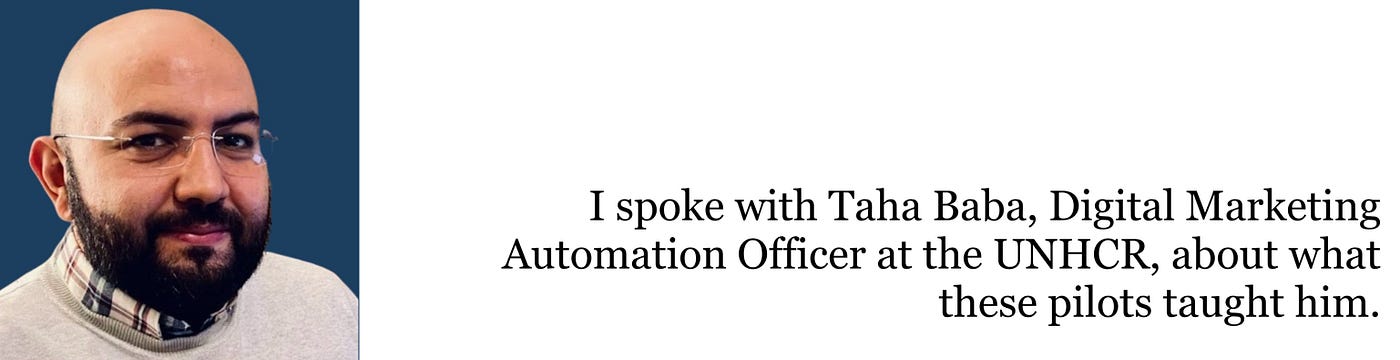
Taha is one of those people who quietly runs rings around most of the sector with a team of five and an apparently supernatural ability to get things through UN procurement. When he told me a recent $1.5 million RFQ took him six weeks, I nearly fell off my chair. Taha is also an AI super-user, and his skills are only matched by his enthusiasm.
Recently Taha oversaw AI personalisation pilots at UNHCR, testing fully AI-generated personalised email copy across three national markets.
Not segmented templates with a first name dropped in, but genuinely individual emails grounded in each donor’s actual giving history.
The process involved anonymising donor data before it left the building (no small feat), sending it to a supplier, receiving personalised copy back in structured chunks, and injecting it into their existing automation platform. No new CRM. No six-figure tech investment.
The AI tool took donor giving history and other markers to create a truly bespoke AI-generated text for each individual donor, rather than segment-based personalisation. What this looked like in practice could be going from:
“Thank you for your generosity in the past year. Because of donors like you, we have been able to continue our efforts to alleviate hunger in Sudan.”
to
“Your generosity in the past year, with a remarkable total of £1280 across 3 donations, has not only placed you in the top 10% of donors in Buenos Aires but also contributed significantly to treating 430 children with severe acute malnutrition in Sudan. Through your contributions, especially the £300 specifically designated for our Plumpy’Nut therapy appeal, you’ve become a cornerstone of our efforts to alleviate hunger.”
The pilots took place across three different markets.
Market A was a large developing-country. The team picked their most engaged donors, people who were already opening emails, and sent them a personalised communication for the first time.
Average gift among those who opened went from $2 to $18.60.
Taha’s honest about the caveat: “We selected the most engaged people.” So yes, these were already the donors most likely to give. But here’s the thing: even they had been averaging just $2. Something about receiving a communication that actually reflected their relationship with UNHCR clearly moved people. “I think they received this kind of personalised communication for the first time ever,” Taha said, “so they got activated.”

When we shift from personalisation to hyper-personalisation, donors really feel seen.
Market B is where it gets more interesting. This team had been doing something genuinely unusual: writing personalised emails manually, through Outlook, to a small high-value list. Proper personalisation, the kind that takes time. It had worked spectacularly well. When they ran the AI version, income didn’t budge.
Same performance as the handwritten emails.
My first read was that this was a cautionary tale. But after some discussion I realised that this was also a huge win.
The team went from spending hours writing individual emails to getting the whole list done in two or three hours.
“This is real personalisation,” Taha said. “Not the normal, silly automation, just replacing the name with first name and calling it personalisation.” So the AI didn’t beat what they were already doing. It just meant they didn’t have to spend hours of their lives doing it. I can only imagine the efficiency gains.
Market C is the one I find most encouraging. The smallest market in the test, where one analyst built on the existing AI pilots internally to generate personalised emails entirely in-house, in Spanish.
The result? A thirty-five percent increase in average gift.
“She got full credit herself,” Taha told me. “She did fantastic work.” This is the model Taha is building towards: bringing a proof of concept in from outside, demonstrating it works, then owning it internally.
It’s cheaper, more sustainable, and you don’t have to tell anyone your prompts.
So three tests, three different outcomes, and the technology was largely the same in each case. What changed was the context. Where donors had never had real personalisation before, the gains were dramatic. Where they already had it, the AI matched the outcome and freed up the team’s time. Where it was built in-house by someone who knew the audience, it produced solid results for almost no cost.
Does this mean AI is the magic wand we have all hoped for? In short, no.
Taha has a test he uses when teaching AI to his team. He asks them to get a large language model to argue that the earth is flat. To begin with, it won’t, but if you insist and prompt it a few times, it will come up with some relatively convincing arguments.
“This is exactly when people start understanding that an LLM is a tool. It gives you fake data if you give it fake inputs.”
The point being: it will tell you what you ask it to tell you, which is either very useful or quite dangerous depending on what you ask.
As Taha says, “AI is not magic.” But you can get some pretty magical results with the right data foundation and prompts.
Taha Baba is Digital Marketing Automation Officer at UNHCR and a real font of knowledge on LinkedIn. Check out his profile here. The tests described were conducted across three UNHCR national markets in late 2025.
I’m Anna Hessenbruch, and this blog is where I document examples of best practice from the charity sector in the UK and Denmark. In my day to day, I help charities with their fundraising strategies, improving their donor and member retention, and utilising AI to achieve real results. Come say hi!
메타데이터
- post_id
- b496d6ef2185
- slug
- context-is-everything-what-unhcrs-ai-personalisation-pilot-teaches-us-b496d6ef2185
- url
- https://medium.com/@supporterexperience/context-is-everything-what-unhcrs-ai-personalisation-pilot-teaches-us-b496d6ef2185
- canonical_url
- https://medium.com/@supporterexperience/context-is-everything-what-unhcrs-ai-personalisation-pilot-teaches-us-b496d6ef2185
- author_url
- https://medium.com/@supporterexperience
- status
- ok
- fetched_at
- 2026-06-09 15:37:30




