CPA Licensure Examination in the Philippines: Complete Guide
The CPA Licensure Examination in the Philippines is one of the most important professional examinations for aspiring accountants who want…
CPA Licensure Examination in the Philippines: Complete Guide
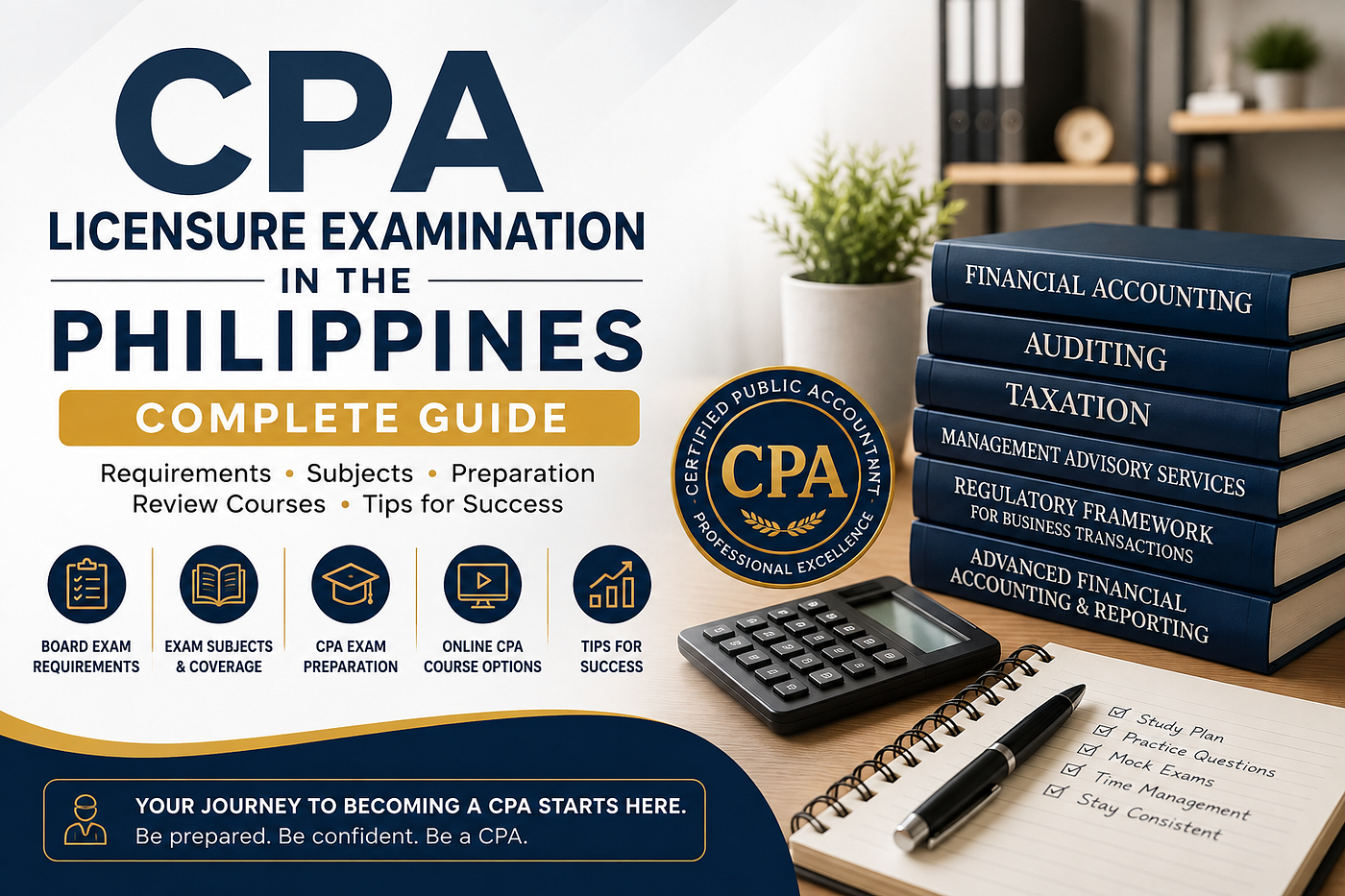
The CPA Licensure Examination in the Philippines is one of the most important professional examinations for aspiring accountants who want to become Certified Public Accountants (CPAs). Passing the CPALE allows qualified accounting graduates to pursue professional opportunities in public practice, private companies, government agencies, academe, and other accounting-related fields.
Preparing for the examination requires more than simply reviewing accounting concepts. Candidates need to understand the eligibility requirements, application process, examination subjects, schedule, study strategies, and available **cpa review courses** before beginning their preparation.
This complete guide explains everything aspiring CPAs need to know about the CPA Licensure Examination and how to approach effective CPA exam preparation.
What Is the CPA Licensure Examination in the Philippines?
The CPA Licensure Examination in the Philippines, commonly called the CPALE or CPA Board Exam, is the professional examination for individuals seeking to become Certified Public Accountants in the country.
The examination is administered by the Professional Regulation Commission (PRC) through the Board of Accountancy (BOA). Candidates must meet the prescribed educational and eligibility requirements before they can apply.
The examination evaluates an applicant’s knowledge and understanding of important accounting, auditing, taxation, financial reporting, and business-related concepts.
For aspiring accountants, passing the CPALE is an important milestone toward obtaining a professional CPA license and building a long-term accounting career.
Who Can Take the CPA Board Exam?
Before starting your CPA exam preparation, it is important to determine whether you meet the eligibility requirements.
Generally, applicants must have completed the required accounting education and satisfy the qualifications established by the Board of Accountancy and PRC.
Prospective examinees should always verify the latest requirements directly with PRC because application procedures, documentary requirements, and other regulations may be updated.
CPA Board Exam Requirements
Understanding the cpa board exam requirements should be one of the first steps in your preparation.
Applicants should prepare the required documents and ensure that their educational qualifications comply with the current rules.
Depending on the current PRC requirements, applicants may need documents such as:
- Completed application requirements
- Valid identification documents
- Educational credentials
- Transcript of Records
- Recent photographs
- Other documents required by PRC or the Board of Accountancy
Because requirements can change, candidates should check the latest official PRC announcements before submitting an application.
Why Should You Check the Requirements Early?
Waiting until the application period to check your documents can create unnecessary problems.
Start by:
- Checking your eligibility.
- Reviewing the current PRC requirements.
- Preparing your academic documents.
- Checking your application information.
- Monitoring official announcements.
- Completing the application before the deadline.
Taking care of administrative requirements early allows you to concentrate on your actual CPA exam preparation.
CPA Licensure Examination Subjects
The CPALE covers major areas of accounting and related professional knowledge.
The examination traditionally covers six major subject areas:
1. Auditing
This area evaluates knowledge of auditing concepts, procedures, standards, professional responsibilities, and the application of auditing principles.
Candidates should understand both theoretical concepts and practical applications.
2. Management Advisory Services
This subject focuses on accounting information used for management decision-making.
Topics may involve management accounting, financial analysis, planning, budgeting, and decision-support concepts.
3. Financial Accounting and Reporting
Financial Accounting and Reporting is an important area because it tests candidates’ understanding of accounting standards, financial statements, recognition, measurement, presentation, and reporting.
A strong understanding of accounting fundamentals is essential when preparing for this subject.
4. Taxation
Taxation covers important concepts related to Philippine taxation.
Candidates should develop a strong understanding of tax principles, rules, computations, and applications included within the examination coverage.
5. Regulatory Framework for Business Transactions
This subject covers laws, regulations, and other rules relevant to business and accounting practice.
Understanding how regulatory requirements apply to business transactions is important for candidates preparing for the CPALE.
6. Advanced Financial Accounting and Reporting
This subject involves more advanced accounting and financial reporting concepts.
Candidates should build a strong foundation in financial accounting before moving into more complex topics.
Important: Always verify the latest CPALE syllabus and examination coverage through official PRC and Board of Accountancy announcements because examination policies and coverage may change.
How to Prepare for the CPA Licensure Examination
Successful CPA candidates generally need a structured approach rather than relying solely on last-minute studying.
Here is a practical framework for CPA exam preparation.
1. Understand the Examination
Start by learning:
- Examination subjects
- Coverage
- Requirements
- Application process
- Examination schedule
- Passing requirements
- Available review resources
Understanding the examination structure helps you create a realistic preparation strategy.
2. Assess Your Current Knowledge
Before beginning intensive review, identify your strongest and weakest subjects.
For example:
Subject Current Level Priority
FAR Strong Medium
AFAR Moderate High
Auditing Weak Very High
Taxation Moderate High
MAS Strong Medium
RFBT Weak Very High
This allows you to allocate your study time based on actual needs.
3. Create a CPA Review Study Plan
A study plan can prevent you from spending too much time on one subject while neglecting others.
A basic review cycle could include:
Phase 1: Foundation
Review fundamental accounting concepts and identify knowledge gaps.
Phase 2: Intensive Review
Study each examination subject systematically and work through practice problems.
Phase 3: Practice
Answer large numbers of practice questions under timed conditions.
Phase 4: Final Review
Focus on weak areas, frequently tested concepts, formulas, rules, and mistakes from previous practice sessions.
4. Practice With Questions
Reading review materials is only one part of CPA preparation.
Practice questions help you:
- Apply concepts
- Identify knowledge gaps
- Improve problem-solving speed
- Become familiar with question formats
- Develop time-management skills
- Track your progress
After completing a practice test, don’t simply check your score.
Review every incorrect answer and determine why you got it wrong.
5. Use a CPA Review Course
A structured cpa review course can provide a more organized preparation experience for candidates who need guidance.
Depending on the provider, review programs may include:
- Lectures
- Review materials
- Practice questions
- Mock examinations
- Progress tracking
- Discussion sessions
- Instructor support
- Digital learning resources
When evaluating cpa review courses, consider the quality of the instructors, learning materials, practice resources, schedule, accessibility, and support available to students.
Online CPA Course vs. Face-to-Face Review
Technology has changed how candidates prepare for professional examinations.
An **Online Review Courses** can be particularly useful for students and working professionals who need flexibility.
Advantages of Online Review Courses
- Study from different locations
- Flexible learning schedules
- Access recorded lectures
- Review lessons multiple times
- Combine work and study
- Reduce travel time
- Access digital resources
However, online learning also requires discipline. Candidates should establish a consistent study routine and minimize distractions.
Face-to-Face Review
Traditional classroom-based review can provide:
- Direct interaction with instructors
- Structured schedules
- Classroom discussions
- Peer interaction
- A dedicated study environment
Hybrid Review
A hybrid review approach combines online resources with face-to-face review learning.
The best option depends on your learning style, schedule, location, and preparation needs.
How Long Should You Prepare for the CPALE?
There is no single preparation period that works for everyone.
Your ideal timeline depends on:
- Accounting background
- Previous academic performance
- Familiarity with CPALE subjects
- Available study hours
- Work commitments
- Whether you are a first-time taker or retaker
- Strengths and weaknesses
Some candidates may prefer an intensive preparation period, while others may benefit from a longer and more gradual study plan.
The important thing is to establish a realistic schedule and follow it consistently.
CPALE Study Tips for First-Time Takers
If you are taking the CPALE for the first time, consider the following strategies.
Build Your Fundamentals
Don’t rush into difficult problems without understanding the underlying concepts.
Study Consistently
Regular study sessions are generally more sustainable than relying on occasional long sessions.
Practice Under Time Limits
The actual examination requires effective time management. Include timed practice in your preparation.
Track Your Mistakes
Maintain a mistake log containing:
- Question
- Correct answer
- Your answer
- Reason for the mistake
- Concept that needs review
Review this log regularly.
Don’t Ignore Weak Subjects
Candidates sometimes spend too much time reviewing subjects they already understand.
Your weakest areas often deserve additional attention.
CPALE Preparation Tips for Retakers
Retaking the CPALE provides an opportunity to analyze what happened during your previous attempt.
Instead of simply repeating the same study strategy, ask:
- Which subjects were most challenging?
- Which topics caused the most mistakes?
- Did I run out of time?
- Did I complete enough practice questions?
- Was my study schedule realistic?
- Did I use appropriate review materials?
- Did I spend enough time reviewing weak areas?
Use your previous experience to create a more targeted study plan.
How to Choose the Right CPA Review Courses
With different cpa review courses available, candidates should evaluate their options carefully.
Consider these factors:
1. Learning Format
Determine whether you prefer:
- Online
- Face-to-face
- Hybrid
2. Review Materials
Check whether the program provides comprehensive and updated learning resources.
3. Practice Questions
Practice questions are essential for testing your understanding.
4. Mock Examinations
Mock exams can help you evaluate your readiness and improve time management.
5. Instructor Support
Access to knowledgeable instructors can be valuable when you encounter difficult concepts.
6. Schedule Flexibility
If you’re working or managing other responsibilities, choose a program that fits your schedule.
7. Technology and Learning Tools
Digital platforms, recorded lectures, question banks, progress tracking, and other tools can enhance your preparation.
Why Choose REO for CPA Exam Preparation?
REO CPA Review Center Philippines provides a structured CPA review ecosystem designed to support candidates throughout their preparation.
The REO CPA Review program offers multiple learning modalities, including online and face-to-face options, allowing candidates to select an approach that fits their circumstances.
Its learning resources include recorded lectures, live lectures, quick videos, flashcards, practice questions, consultations, and access to digital learning tools.
This combination can help candidates move through the preparation process from concept building → practice → assessment → final review.
Online CPA Review for Working Professionals
Preparing for the CPALE while working can be challenging.
An online review program can provide greater flexibility because candidates can study around their professional schedules.
A practical routine could look like:
Weekdays: 1–2 hours of focused review
Weekends: Longer study sessions + practice examinations
Final weeks: Mock exams + weak-area review + intensive practice
The key is consistency.
Even a shorter daily study session can contribute significantly when maintained over an extended period.
Common CPALE Preparation Mistakes
Avoid these common mistakes during your preparation.
Studying Without a Plan
Jumping randomly between subjects can make it difficult to measure progress.
Memorizing Without Understanding
Memorization can help with certain concepts, but understanding how and why concepts work is essential.
Ignoring Practice Questions
Knowing the theory does not automatically mean you can solve examination problems quickly.
Studying Only Your Favorite Subjects
Strong subjects are comfortable, but weak areas can significantly affect your overall preparation.
Leaving Everything Until the Last Month
Last-minute preparation can create unnecessary pressure.
Not Reviewing Mistakes
Incorrect answers are valuable learning opportunities. Understand the reason behind every mistake.
Final Thoughts
Preparing for the CPA Licensure Examination in the Philippines is a significant undertaking, but a structured approach can make the process more manageable.
Start by understanding the cpa board exam requirements, learn the examination coverage, assess your current knowledge, create a realistic study plan, and dedicate sufficient time to practice.
Whether you choose an Online CPA Course, face-to-face review, or a hybrid learning approach, consistency is one of the most important elements of effective CPA exam preparation.
Most importantly, don’t view the CPALE as a test you can prepare for overnight. Build your foundation, practice regularly, learn from your mistakes, and use reliable review resources throughout your preparation journey.
For candidates looking for structured cpa review courses, REO provides multiple review modalities and learning resources designed to help aspiring CPAs prepare for the examination.
Ready to start your CPA journey? Explore REO’s CPA Review program and choose the review format that works best for you.
Frequently Asked Questions
Q1. What is the CPA Licensure Examination in the Philippines?
The CPA Licensure Examination is the professional examination administered through the PRC and Board of Accountancy for individuals seeking to become Certified Public Accountants in the Philippines.
Q2. What are the CPA board exam requirements?
The cpa board exam requirements include meeting the prescribed educational and eligibility qualifications and submitting the required documents to PRC. Requirements may change, so applicants should verify the latest official requirements before applying.
Q3. What subjects are included in the CPALE?
The examination covers six major areas: Auditing, Management Advisory Services, Financial Accounting and Reporting, Taxation, Regulatory Framework for Business Transactions, and Advanced Financial Accounting and Reporting.
Q4. Is an Online CPA Course effective?
An Online CPA Course can be an effective option for candidates who prefer flexible learning. Its effectiveness ultimately depends on the quality of the program and the candidate’s consistency, discipline, and engagement with the materials.
Q5. How should I start my CPA exam preparation?
Start by understanding the examination requirements and coverage, assessing your strengths and weaknesses, creating a study plan, selecting appropriate review resources, and practicing regularly.
Q6. Which CPA review course should I choose?
Choose a cpa review course based on your learning style, schedule, budget, preferred modality, quality of materials, practice resources, instructor support, and overall learning system.
Q7. Are CPA review courses necessary?
They are not the only way to prepare for the CPALE, but structured cpa review courses can provide organized materials, lectures, practice questions, assessments, and academic support that may make preparation more systematic.
메타데이터
- post_id
- b49e2a9244ee
- slug
- cpa-licensure-examination-in-the-philippines-complete-guide-b49e2a9244ee
- url
- https://medium.com/@canniffpatrick423/cpa-licensure-examination-in-the-philippines-complete-guide-b49e2a9244ee
- canonical_url
- https://medium.com/@canniffpatrick423/cpa-licensure-examination-in-the-philippines-complete-guide-b49e2a9244ee
- author_url
- https://medium.com/@canniffpatrick423
- status
- ok
- fetched_at
- 2026-08-21 19:15:13
