Data Governance Runs on Incentives, Not Mandates.
Your governance program is not failing because your platform is bad. It is failing because the person you asked to document fifty datasets…
Data Governance Runs on Incentives, Not Mandates.
Your governance program is not failing because your platform is bad. It is failing because the person you asked to document fifty datasets has a backlog of 400 tickets, no time, and no reason to care.
That is the whole story. Data governance runs on incentives. You have been running it on mandates.
TL;DR
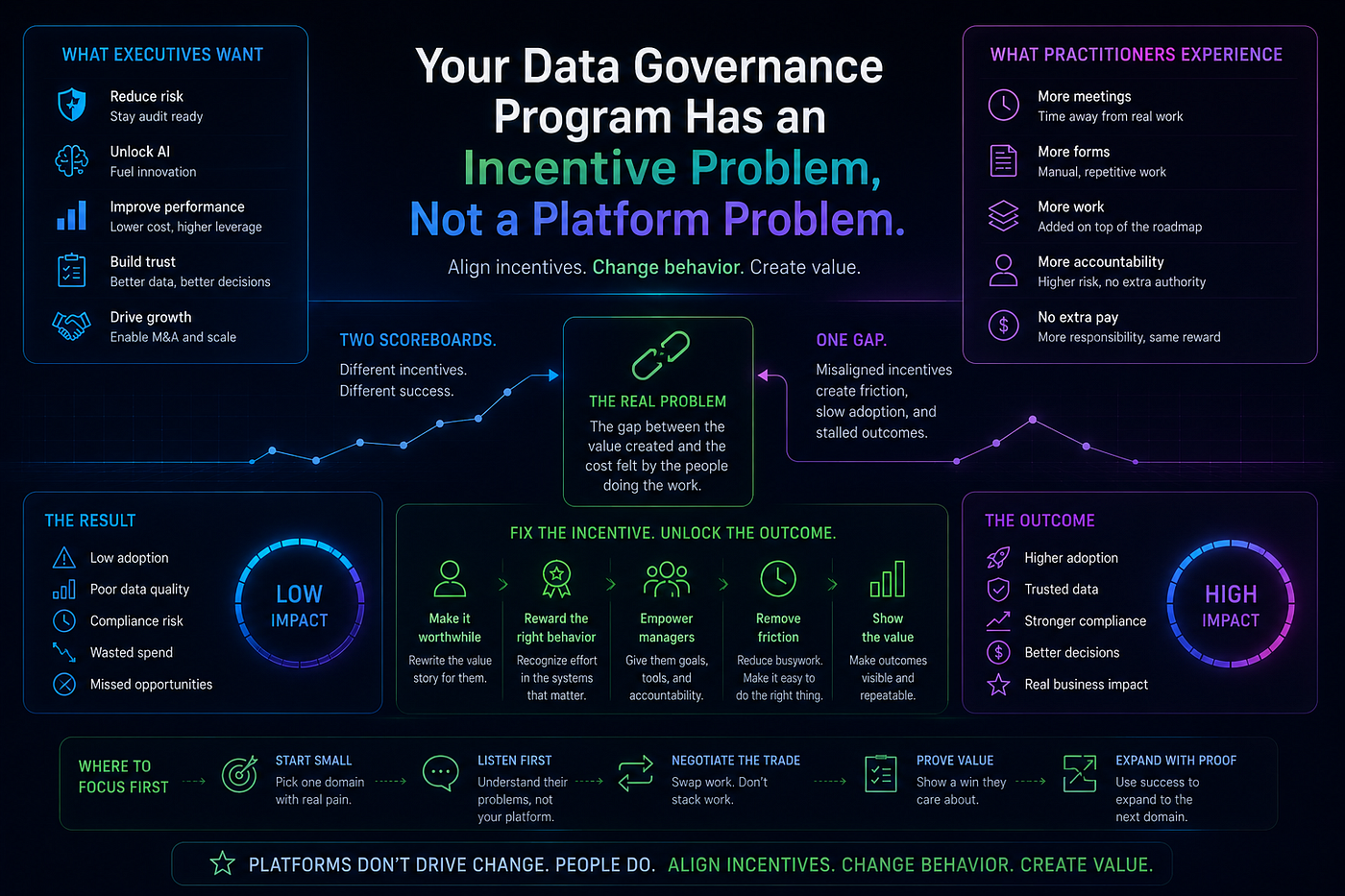
Data governance has two completely different incentive structures running in parallel, and they do not match. Executives see reduced risk, faster AI, and cleaner audits. The people on the floor, including data engineers, analysts, and business users, see more meetings, more forms, and more accountability with zero extra pay. They tell you the quiet part out loud: “it is not in my job description, so I am not going to do it.” They are right. Until you change the incentive structure on both sides, no platform, no mandate, and no town hall will close the gap.
The Executive Pitch That Keeps Failing
Walk into any boardroom right now and the data governance pitch sounds the same. Reduce regulatory risk. Unlock AI use cases. Improve data quality. Consolidate platforms. Pass audits. Be ready for the next acquisition.
Every one of those points is true. Every one of those points is also completely irrelevant to the analyst who just got asked to write business descriptions for 200 columns by Friday.
This is the gap nobody wants to talk about. Executives buy governance because they see the upside. The people who actually have to do governance work see only the downside. Until you fix that asymmetry, you can buy the best data governance platform on the market and your coverage dashboard will still be flat six months later.
The platform vendors will not tell you this. Their demos show clean lineage, glowing quality scores, and AI-ready datasets. What the demos do not show is the human being who had to sit down and tag every column. That person is the entire program.
So before you spend another dollar on a governance platform, ask the harder question: who benefits, who pays the cost, and how are you closing that gap?
Two Worlds, Two Scoreboards
Picture two people in your organization on the same Monday morning.
The first is the Chief Data Officer. Their bonus is tied to AI initiatives shipping on time, audit findings going down, and a vague bucket called “data maturity.” They walked out of last week’s leadership meeting with a clear story: governance is the foundation for everything we want to do this year. They are bought in. They are excited. They are about to send an email that starts with “Team, as part of our enterprise governance initiative…”
The second person is a senior data engineer on the marketing analytics team. They have a release shipping Wednesday. The pipeline they own breaks every other Friday because of upstream schema changes nobody warned them about. Their last performance review measured velocity, on-time delivery, and SLA hits. Governance was not on the list.
Now the email lands. The engineer is being asked to:
Fill in business glossary terms for the datasets they own. Approve access requests as a data owner. Attend a weekly governance working group. Document data lineage in a tool they have never used. Tag sensitive columns according to a classification scheme that did not exist last quarter.
What is the rational response? Ignore the email and ship the release. That is not laziness. That is the system working exactly as designed. You measure them on velocity, you get velocity. You ask them to slow down for governance, and they do the math.
Two scoreboards. Two worlds. Same company.
The Question Nobody Answers Honestly
Sit in enough data steward training sessions and you will hear the same question, dressed up in different clothes, every single time.
“What’s in it for me?”
It comes out as “How will this be measured in my goals?” or “Who is paying for the time I spend on this?” or the most direct version, “Am I getting compensated for taking on this role?”
Most governance programs answer this question with a slide that lists benefits to the company. Faster decisions. Less rework. Better trust in data. Fewer fire drills.
Read those benefits again. Every single one of them accrues to the organization, not the person. None of them show up in a performance review. None of them lead to a raise. None of them get someone promoted.
If you cannot answer “what’s in it for me” with something that lives in their world, your program is running on goodwill. Goodwill burns out fast.
The honest answers usually look something like this. You will spend less time fielding the same question fifty times because the answer will be in the governance platform. Your name on a well-documented dataset gets seen by leadership and helps your case for promotion. The classification work makes you the only person who actually knows where the regulated data lives, which is leverage. We are reducing your other workload to make room for this, on paper, with your manager.
If you cannot make any of those statements true, you do not have a governance program. You have a wishlist.
“It Is Not in My Job Description”
Talk to enough business users about data governance and you will hear this exact sentence, word for word, on repeat.
“It is not in my job description, so I am not going to do it.”
The first time you hear it you might bristle. After the tenth time, you realize they are right. Strictly speaking, governance work is not in their job description. Nobody updated the JD when the program launched. Nobody added it to the goal-setting template. Nobody told their manager to weight it during performance reviews. The expectation just appeared one day in an email from the CDO.
So when a finance analyst gets asked to validate the business glossary definition of “active customer,” what they actually hear is “do me a favor, on top of everything else, with no recognition.” Of course they push back. The system gave them no reason not to.
This is where most programs make their biggest mistake. They treat the pushback as a culture problem. They send another email about how governance is “everyone’s job.” They run a town hall. They show another slide about the importance of data trust. None of it works, because none of it addresses the actual issue. The work is genuinely not in the job description. Pretending otherwise is a small lie that every adult in the room recognizes.
This is also where the gap between management and the floor gets exposed most clearly. The executive sponsor truly believes governance is part of everyone’s job because in the executive view of the world, “improving the data” is a self-evident good and a shared responsibility. The business user lives in a different world. Their world is a JIRA backlog, a quarterly target, and a manager who measures them on output. Asking them to take on accountability without changing any of those signals is a one-way trade. They notice.
The fix is the boring administrative work most programs avoid. Update the job description. Get HR involved. Add governance responsibilities to the role definition for owners and stewards. Add them to the goal-setting template for the teams you depend on. Make sure the line manager knows that part of their team’s evaluation now formally includes this work.
Once governance is in the job description, the pushback flips. The analyst who said “it is not my job” stops saying it, because now it is. The manager who quietly de-prioritized it can no longer do that without consequence. The CDO stops having to beg for time. The work becomes part of how the team operates, not an extra ask.
It sounds bureaucratic. It is bureaucratic. That is the point. Governance lives or dies in the formal systems that allocate human time and reward. If you are not willing to change those systems, you are not running a governance program. You are running a request, and requests are easy to ignore.
Why Top-Down Mandates Quietly Die
Top-down works for things people already want to do. It does not work for things that add friction to their day.
When governance is announced as an executive initiative and pushed down through the org chart, here is the choreography that follows. The CDO sends the email. The VPs forward it with a thumbs up. Directors schedule a kickoff. Managers tell their teams to attend. The teams attend, nod, and go back to their actual work. Three months later, dashboards show 12 percent of datasets documented and falling. Six months later, someone calls a “reset.”
This is not a failure of communication. This is what happens when accountability flows downward but value does not.
The pattern has a name in change management literature. It is called compliance theater. People do enough to avoid getting in trouble and not one ounce more. You can spot it by looking at your governance platform. Are descriptions copy-pasted? Are owners assigned to the same five people across hundreds of datasets? Are tags applied in big batches at the end of the quarter? Theater.
The reason theater shows up is simple. The cost of doing the work is real. The cost of not doing the work is fuzzy. People optimize for what is real.
If you want governance to stick, you have to flip that equation. The cost of not doing it has to be specific and visible to the person whose behavior you want to change. The cost of doing it has to be reduced, not added on top of their existing job.
That is change management. It is harder than buying a tool.
The Five Faces of Governance Theater
If you want to know whether your program is real or theatrical, you do not need a maturity assessment from a consultancy. You need to look for five patterns. They show up in every stalled program I have ever seen.
The copy-paste descriptions. Open ten random datasets in your governance platform and read the descriptions out loud. If three or more of them sound generic, like “This table contains customer information related to transactions,” you have copy-paste. People are filling in the field to make the validation pass. They are not describing anything. The platform is a checkbox, not a knowledge asset.
The five-name owner list. Export your list of data owners and sort by frequency. If the same five names show up across hundreds of datasets, those people are not actually owners. They are placeholders, usually senior managers who got volunteered to make the dashboard turn green. Real ownership is distributed because real ownership requires actual context about the data, and no human being has context on 200 datasets.
The end-of-quarter blitz. Look at when documentation activity happens in your platform. If 70 percent of it lands in the last two weeks of every quarter, you have a blitz. People are doing just enough work to hit a metric, then disappearing until the next deadline. The work is performative. Nothing has actually changed about how data is used day to day.
The unread glossary. Pull the analytics on your business glossary. Most glossaries get heavy traffic the week they launch and almost nothing after that. If your glossary is not getting steady weekly views from people outside the governance team, the people writing definitions are writing for an audience of zero. That is demoralizing, unsustainable, and a strong signal that the rest of the org does not see the value yet.
The orphaned working group. Almost every governance program kicks off with a council or working group. Most councils are full of senior leaders for the first three meetings, then get quietly delegated to junior representatives, then start being canceled because of “scheduling conflicts.” If your council can disappear for two months without anyone noticing, the program has lost its center of gravity.
Spot two or more of these and you are running theater. The instinct in most organizations is to respond with stricter enforcement: tighter validation rules, escalation emails, executive nudges. That makes things worse. It treats the symptom and ignores the disease. The disease is the incentive gap. Until you fix that, every enforcement action just teaches people to do better theater.
Rewrite the Benefits in the Reader’s Language
Here is a small experiment. Take your last governance pitch deck. Strip out every benefit that is phrased in terms of the company. Compliance, risk, AI readiness, audit, M&A, board reporting, all of it. What is left?
In most decks, almost nothing.
Now rebuild it. For each role you are asking to change, write three benefits in their language.
For a data engineer: fewer 2 a.m. pages because schema changes get caught upstream. Fewer “what does this column mean” Slack pings. A trail of ownership that protects you when something breaks at 11 p.m. on a Sunday.
For an analyst: trustworthy data that does not need to be re-validated every time. A common glossary so you stop arguing with finance about what “active customer” means. Less time hunting for the right table.
For a product manager: faster experiment setup because the data is already documented. Confidence that the metrics in your dashboard match the metrics in the executive report. Fewer last-minute fire drills because someone deprecated a table without telling you.
For a data scientist: a feature store with provenance, so your model does not get retrained on data that quietly changed schema. AI governance that protects you from being blamed when a model drifts because of upstream issues you could not see.
Notice none of those benefits mention the company. They are all selfish, in the good way. They speak to pain the person already feels. That is the only kind of benefit that gets someone to change behavior on a Monday morning.
The rule of thumb: if the benefit could be cut from the slide without changing the listener’s day, it is not really a benefit. It is a wish.
The Middle Layer Is Where Programs Live or Die
Top-down does not work. Bottom-up does not scale. The actual leverage point is your middle managers.
This is the layer that translates strategy into work. They write the goals. They run the standups. They sign off on time spent. If a director tells their team that governance work counts toward their performance review, it suddenly counts. If they do not, it does not, no matter what the CDO said in the all-hands.
So if you are running a governance program and you have not won over middle management, you are pushing on a string. The CDO can scream into the void all day. The line manager has more influence over whether someone documents a dataset than the entire executive team combined.
What does winning over middle management actually look like? Three concrete moves.
First, you give them air cover. Their team’s velocity will dip during the rollout. You need to acknowledge that publicly and protect them from the inevitable “why are you behind on your roadmap” conversation. If you do not, they will quietly de-prioritize governance the moment delivery pressure shows up, which is always.
Second, you give them tools that make them look good. A dashboard that shows their team’s documentation coverage, ownership, and quality scores. Something they can put in their own quarterly review to show progress. Make them the hero of the story.
Third, you tie a slice of their bonus or rating to it. Not a huge slice. Five percent will do. But it has to be real, and it has to show up in the system that drives their pay. If governance is not in the comp plan, it is not real.
This last one is uncomfortable. Most organizations recoil from changing comp structures. Do it anyway. The companies that get this right are the ones that stop pretending governance is a separate, free, parallel workstream.
The Compensation Question Is Not Optional
Let me say the quiet part out loud. If you are asking someone to take on data steward duties, own a domain, sign off on access requests, attend governance councils, and field stewardship questions, you are giving them a second job.
You can dance around this for a while. You can call it “part of the role” and stretch the definition of their existing job description. You can promise visibility and growth. You can lean on goodwill.
But the people who do this work know exactly what is happening. They are doing extra work without extra pay. The good ones either burn out or leave for somewhere that pays them for the work they actually do. The ones who stay become quietly cynical, which is worse.
The serious organizations have stopped dancing. They have created formal stewardship roles with formal job ladders. They pay a stewardship premium, sometimes a flat dollar amount, sometimes baked into the band. They write the responsibilities into the job description so the work is visible during reviews.
You do not need to do all of this on day one. But you do need a credible answer to “am I getting paid for this.” If your answer is “it counts toward your career growth,” that is not an answer. That is a delay tactic.
AI Governance Makes the Incentive Problem Twice as Hard
If you think data governance is a tough sell, wait until you start asking for AI governance.
Data governance asks people to document datasets. AI governance asks them to document model intent, training data lineage, evaluation results, fairness assessments, drift monitoring, prompt templates, retrieval sources, and the business reasoning behind every decision the model makes. It is data governance with an order of magnitude more documentation, more accountability, and more emotional weight, because if the model gets it wrong, somebody is going to be in a meeting explaining why.
The incentive gap gets worse here for three reasons.
First, the people building AI systems are usually the most in-demand and least patient with paperwork. Data scientists and ML engineers are operating under intense pressure to ship something the business is excited about. Asking them to slow down to document model risk feels like asking them to argue against their own success. Their incentive is speed and impact. Governance feels like the opposite of both.
Second, the surface area is bigger and changes faster. A dataset is relatively static. A model is a moving target with new versions, new prompts, new retrieval sources, and new failure modes every sprint. The documentation cost is not one-time. It is continuous. That breaks the goodwill model immediately, because goodwill works for one-time asks and falls apart for ongoing ones.
Third, the consequences of failure are now visible to executives in a way they never were for plain data quality issues. A bad dashboard is awkward. A biased loan model is a press release. The scrutiny is higher, which means the documentation expectations are higher, which means the workload is heavier, which means the incentive gap is wider.
The same rules apply, but the stakes are higher. You have to translate AI governance benefits into the builder’s language. A model card protects you when leadership asks why the model behaved a certain way. Drift monitoring saves you from being paged six months from now when the model quietly stopped working. Evaluation logs become your evidence in the post-mortem that is definitely going to happen. Prompt versioning means you can roll back when a “minor tweak” turns out to be catastrophic.
You also have to stop pretending AI governance can be a side quest. Either it is built into the model development lifecycle from day one, with sprint capacity allocated to it, or it is a checklist somebody fills in after the fact. The after-the-fact version is actively dangerous because it creates the illusion of safety while doing none of the work.
The teams that get this right treat AI governance as a release gate, not a documentation chore. The model does not ship until the governance artifacts exist, and the time to produce them is on the project plan from the beginning. That single change rewires the incentive. The work goes from “extra” to “required to ship,” and engineers respond to required-to-ship the way they always have. They do it.
If you remember nothing else about AI governance, remember this. With data, you might still get away with goodwill for a while. With AI, you cannot. The pace is too fast and the surface area is too big. Build governance into the workflow from day one or spend the next three years chasing it.
A Practical Sequence That Actually Works
If you are running a program right now and reading this with a slow pit in your stomach, here is the unglamorous sequence that tends to work.
Pick one domain. Not the whole company. One. Marketing analytics, finance reporting, customer data, whichever one has the most pain and the most willing leadership. Get it right there before you go anywhere else.
Sit with the people in that domain and listen. What do they spend time on that a governance platform could eliminate? What questions do they get asked over and over? What broke last quarter? Build the value story for governance out of their actual pain, not the pitch deck.
Negotiate the trade. For every hour of governance work you are asking for, name an hour of existing work that gets removed, automated, or deprioritized. If you cannot name it, you are stacking. Stacking does not work.
Get the manager bought in before the team. Make sure governance work shows up on the team’s official roadmap, not in a side document. If it is not on the roadmap, it does not exist.
Show the win. Six weeks in, point at something specific that got better because of the work. A question that did not need to be asked. A pipeline change that did not break a downstream report. Make the value visible in the language of the team.
Then, and only then, expand. Use the first domain as the proof point and the playbook for the next one.
This is slow. It is not the org-wide rollout your executive sponsor is asking for. It is the only thing that works.
What You Just Read
The argument was simple, even if the work is not.
Executives buy governance for benefits that show up at the company level. Practitioners pay the cost in their own time and energy. Until those two scoreboards are aligned, no amount of technology, training, or top-down mandate fixes the gap.
The fix is not a better platform. The fix is rewriting the benefit story in the language of the person being asked to do the work, winning the middle management layer, and being honest about compensation. Without those three things, your program is running on goodwill, and goodwill burns out.
Closing Thought
The governance programs that work are not the ones with the loudest executive sponsorship or the prettiest platform. They are the ones where the data engineer two layers down quietly thinks, “yes, this is making my job better, and someone noticed I did the work.”
Fix the incentives and the documentation fills in on its own. Keep mandating and you can keep buying platforms forever.
Your move.
메타데이터
- post_id
- b4ae8c8a91e9
- slug
- data-governance-runs-on-incentives-not-mandates-b4ae8c8a91e9
- url
- https://medium.com/the-semantic-layer/data-governance-runs-on-incentives-not-mandates-b4ae8c8a91e9
- canonical_url
- https://medium.com/the-semantic-layer/data-governance-runs-on-incentives-not-mandates-b4ae8c8a91e9
- author_url
- https://medium.com/@marcoOesterlin
- status
- ok
- fetched_at
- 2026-06-14 11:28:49