Reclaiming The Agrarian Reform Discourse
Notes and Statements on the Commemoration of Peasants’ Day 2022
Reclaiming The Agrarian Reform Discourse
Notes and Statements on the Commemoration of Peasants’ Day 2022
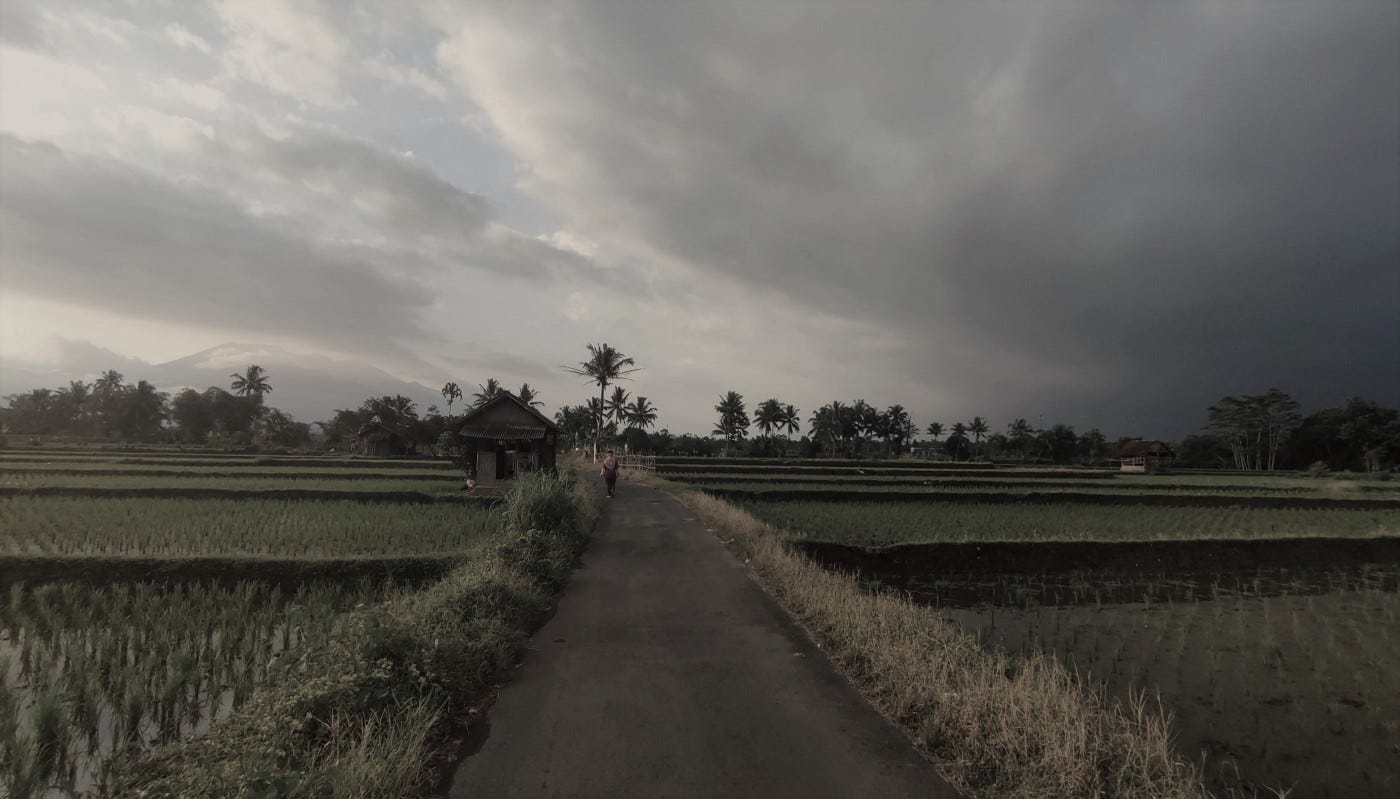
Personal Documentation (2022)
These notes and statements were formulated and written by members of Komite Bersama Perjuangan Reforma Agraria (KBPRA), including the Agrarian Resource Center (ARC), of which I am a member and contributor to this writing. This has appeared in a variety of ARC and KBPRA-owned publications.
Documents in .pdf format can be downloaded **here, while you can read the Indonesian version [here](https://syasyafeeq.medium.com/merebut-kembali-diskursus-reforma-agraria-168c3c9b36bc)**.
General Situation
The constitutional mandate to establish a new independent Indonesian society has never been realized to this day. Land Reform/Agrarian Reform (LR/AR) as a political instrument to build socialism in Indonesia has been entirely discontinued. The Basic Agrarian Law of Indonesia (UUPA 1960), the epitome of the constitutional mandate, was buried along with the 1965 massacre.
In post-1965, the domination of developmentalism as espoused by countries at the core of the capitalist system marks Indonesia’s return to the structure of global capitalism. Modernization and economic growth are pursued through re-reliance on foreign investment and loans. LR/AR was soon replaced with development agendas that favored merely wealthy peasants and landlords. It went hand in hand with efforts to revitalize large-scale plantations. The granting of private concessions to the ever-expanding extractive industries has resulted in the dispossession of peasants and indigenous peoples, as well as environmental degradation. The exploitation and the creation of cheap labor have intensified.
Land concentration and monopolization by landlords is an ongoing phenomena in Indonesian rural areas. As a consequence, there are a growing number of poor peasants,[1] farm workers, and landless peasants. The diminishing supply of land hampers their opportunities to grow and procreate. On the one hand, large-scale extractive industries control 40% (75 million hectares) of Indonesia’s total area. On the other hand, 120 million hectares have been designated as Forest State areas where agricultural activities are prohibited.[2] Due to the limited availability of land, it is expected that many peasants will deliberately clear other forested areas to engage in production and reproduction activities. Only because of this are they labeled as forest encroaches.
The agricultural census (2018) shows that the average land tenure per peasant household is only 0.78 hectares. Poor and absolute-landless peasant account for 59% and 36% of all current peasant households (about 37 million), respectively.[3] With such a land tenure structure, the Gini ratio of tenurial inequality by Indonesian peasant households is exceptionally high; during the previous six decades, it has never been below 0.5; it even reached 0.7 in 2018.[4] These figures demonstrate that, at least since 1965, state-led development initiatives have never sought to reform the unequal land tenure system in rural areas.
The post-1998 reformation also did not change the condition of inequality in land allocation and land tenure, which was the leading cause of poverty to date. In contrast, international and local investments in infrastructural development and the extractive industry have grown tremendously. Land grabbing that triggers agrarian conflicts and criminalization of the peasantry is still prevalent in many areas in Indonesia. The peasant is merely permitted to produce under the iron law of competition without state protection. Land rents and shared tenancy proportions monopolized by landlords only constrain the peasant; thus, debt bondage and usury from middlemen became inevitable. The release of agricultural land by peasants is becoming increasingly common. As a result, class differentiation is accelerating.
Rural communities are increasingly forced to move to urban centers due to limited land and economic resources in rural areas, though the opportunities in urban areas do not always mean better social and economic conditions. Not a few among them end up relying on the informal economy or taking up any odd jobs they could get, which are more vulnerable to oppression. They are also immediately encountered with high land selling/renting costs and costly access to public services — preconditions that encourage them to build “slum” settlements and thus become the only suppliers of cheap labor in urban areas. In turn, “slum” settlements will be deemed as unproductive and devoid of exchange value. This will later be a justification for the state to commodify and commercialize land and space for the sake of urban development[5], thus leading soley to another exclusion.
At the same time, the state prefers to accommodate private corporations through policies specifically tailored to their interests. The most recent policy is expressed in the Employment Creation Act in 2020 (UU Cipta Kerja), which is premised on the idea that private investment is the savior of economic growth. The initiative to establish the Land Bank (Bank Tanah) will hasten land appropriation for corporations. The development will continue within the framework of the colonial domein verklaring, which stresses land ownership by the state. Consequently, land grabbing and evictions under the pretext of development and public purposes can be socially and politically legitimized.
Not only will this have implications for the transformation of peasants into wage laborers, but it will also entangle woman communities that will continue to experience oppression after oppression while ignoring their social and biological reproductive work. Women communities are the most vulnerable to criminalization and harassment. In the current development framework, violence against women and femicidal tendencies are being perpetuated. The UUPA 1960 stipulates that all Indonesian citizens, men and women, have the same opportunity to obtain land rights and reap the benefits.[6] This means that rural development through LR/AR can accomplish social justice if it is underpinned by initiatives for gender justice — something that is nowhere to be found in today’s development of Indonesia.
LR/AR is indeed the most effective way to manage unequal land tenure structures, which can be the initial foundation for the development of national industry based on the agricultural sector; and provide the basis for altering unjust power structures in order to develop more participatory local and national institutions, thereby bolstering democracy.[7] Undoubtedly, the state’s current definition of “Agrarian Reform” was never intended for this reason. It is not only employed as a political strategy to win votes in elections, but also to provide sufficient ‘lubricant’ to operate capital accumulation, and to revitalize and construct capital circuits in various economic sectors.[8] At the same time, global land policy, backed by international banking institutions, views and place the LR/AR solely as a tool to enhance the land market by speeding and expanding rural communities’ certainty of land rights.
Critique of the “Agrarian Reform” á la Jokowi Regime
Land Reform/Agrarian Reform (LR/AR) in Indonesia already has a principal legal structure that is predicated on the UUPA 1960 as the parent of all forms of regulatory implementations for LR/AR. It was formed out of the will of the Indonesian people to completely break free from colonialism and feudalism and establish a new society. Soekarno once emphasized in his speech: without land reform, the Indonesian revolution is the same as a building without a foundation, a tree without a trunk, and big rhetoric without substance. Land reform means carrying out an absolute part of the Indonesian Revolution.[9]
The UUPA 1960, UUPBH 1960, UU 56/Prp/1960, and PP 224/1961 are the legal basis to regulate the implementation of LR/AR. The maximum and minimum limits of land area that a person or legal entity can hold and control through it are determined. Absentee (tanah guntai) and excessive lands, in addition to state-owned and (ex)swapraja lands, must be the principal aim of LR/AR for redistribution to the beneficiaries.[10] It is plainly stated that having people who have excessive land, while others have little to no land at all, can hamper the productivity of land and labor, which contradicts the principles of equality and justice.[11]
The initial hurdles the agricultural sector must surmount in rural areas to achieve optimum production is to reform the land tenure structure and mobilize agricultural labor. The UUPA 1960 had actually regulated how the production process should be managed collectively through village-level cooperative units. Cooperatives are meant to serve as an instrument to disperse the concentration of wealth or surplus resulting from the accumulation process so that it can be distributed for the benefit of national industrialization and the transition from an agricultural-based to an industrial-based economic structure. The UUPA 1960 and LR/AR were not positioned as an end goal but as means in the context of social change to establish a new Indonesian society.
Lamentably, we cannot perceive the achievements of the LR/AR 1960. The events of the 1965 genocide and the transfer of power to the dictator Soeharto have systematically terminated the LR/AR. Rural and national development is oriented towards an exploitative manner. Inequality in land tenure and allocation is likewise increasing.
The last two decades have been the moment when the LR/AR discourse has revived. Many people discussed it, and it became the jargon of many social movement organizations, who pinned their hopes on the ruling regime to implement and manage it. What makes it distinct is that the LR/AR initiated by the regime no longer has the same meaning as those stipulated by the constitution and the UUPA 1960. The meaning and significance of LR/AR have diminished to the extent that it is merely associated with land legalization or certification. Land redistribution no longer targets excessive and absentee lands. The agricultural production units and organizations have never been taken seriously, and no effort has ever been made to make the agriculture sector the foundation for national industrial development. The LR/AR is just jargon and a “gimmick” for the regime.
On this day, the Jokowi regime arranged a program that was stated as “Agrarian Reform”. Instead of being based on the constitution, the conception of which has stood since 1960, the Jokowi regime has defied it by issuing new regulations in 2018. The “Agrarian Reform (AR)” á la Jokowi regime, commonly known as TORA, proposes to give approximately 9 million hectares of land to poor peasants.[12] It should be noted that the majority of the provisions of the AR á la Jokowi regime consist mainly of asset legalization and land certification. Likewise, with (re)distribution of land claimed to come from ex-HGU with the status of Abandoned Land (Tanah Terlantar) and the release of Forest State areas that, in fact, have been long cultivated and controlled by the rural community through land occupation or reclaiming actions.[13] AR á la Jokowi regime does not target excessive and absentee lands, which have been a primary cause of concentration and inequality in land tenure.
Furthermore, it is illogical to adjudicate the land area in advance — as in the AR á la Jokowi regime program by highlighting 9 million hectares — without determining the precise number of peasant households as beneficiaries. If the aim is to reduce land tenure inequality, it would be reasonable for the land area of the LR/AR to be adjudicated based on the number of possible land beneficiaries. Even if the parcels of land claimed to have been (re)distributed through the AR á la Jokowi regime, there has never been a precise measurement of its impact on agricultural production levels, let alone a measurement of the agricultural sector’s contribution to national industrial development.
The exclusive emphasis on legalizing assets and certifying land is consistent with the neoliberal free market agenda. As a matter of fact, the AR á la Jokowi regime has become a new source of legitimacy for the regime to access foreign financing/loans, particularly from the World Bank, in order to expedite the operation of the land market. [14] Certified lands will be more transferrable, increasing the effectiveness and efficiency of the ‘free land market’. Not only will land transactions be expedited among individuals, but also indicate the ease for private investment to penetrate capital on legally secure land. Meanwhile, land certificates will be more apparent for landowners to access loans from the bank, which strengthens the banking industry and increases the role of finance in the operations of capitalism.
Agricultural input, a crucial production factor for small-scale peasants, continues to be monopolized by foreign companies. In this instance, the state plays its role in the most extensive possible import tap, instead of controlling and optimizing the national production system. The low price of imported products has forced peasants to sell their products much cheaper in order to remain competitive in the domestic market. Credit and debt bondage are, not surprisingly, the most common problems peasants confront today. The AR á la Jokowi regime has no intention of eliminating and reducing the practice of money rent and usury in rural areas by landlords, middlemen, and financial institutions. Rural communities that lack sufficient capital immediately fall into poverty and lose their land.
Such circumstances, together with the absence of maximum-minimum land tenure restrictions, have reinforced the concentration and inequality of land tenure. The purpose of the land is no longer perceived in terms of the production activities, but rather in terms of land’s status as a mere commodity or as equity in determining the size/quantity of wealth. Therefore, the AR á la Jokowi regime is unconstitutional because it defies the mandate of the UUPA 1960. Instead of restructuring land tenure, increasing agricultural labor productivity, and placing the agricultural sector as the basis for national industrial development, the AR á la Jokowi regime has facilitated private investment and boosted the land market, banking and financial economy.
We can firmly assert that the AR á la Jokowi regime is a fake and fraudulent Agrarian Reform. It is not Land Reform/Agrarian Reform whatsoever!
It is evident that the current ruling regime does not implement the LR/AR as it should. A regime that is not committed to the constitution is also uninterested in advancing the interests of the people. For this reason, instead of relying on state instruments or governmental means, the LR/AR and social movement organizations should pursue their own course of action. Land occupations prevalent from the 1970s until the fall of the New Order regime should and deserve to be replicated again in today’s situation in order to fulfill the mandate of the constitution and UUPA 1960, and to encourage social transformation. The offer to do so is to incorporate the principal points of the (re)distribution cum consolidation mechanism into an organized collective agenda, to wit how a group of beneficiaries can be united in one area that is attached as a collective economic unit.[15]
Again, LR/AR must be both a (re)distribution and a consolidation. Absentee land and land controlled or owned by landlords who have exceeded the maximum land tenure limit, as well as state lands like those in the State Forest area, should be (re)distributed and controlled by each individual or selected beneficiary in well-organized with the status of long-term tenure rights. The land and production process must be controlled through cooperative units managed by the beneficiaries themselves so as to eliminate competition that excludes each other, optimize productivity and enable collective business development in the spirit of gotong royong (mutual cooperation).
Between the organization and beneficiaries, there must also be an agreement on what to produce and how to produce it. It can also involve experts in the related fields as advisors or supervisors. In order to develop a community that is both economically and ecologically resilient, it is also possible to develop an economic unit of commercial and food (mixed crops) agriculture, agroforestry, or other forms of business that are compatible with the local environment and regional economic planning. It should be noted that (re)distribution cum consolidation is a mechanism whose development complies with the main ideas of LR/AR: land for the tillers. This mechanism is socially and economically transformative, employing a model of labor mobilization and land tenure that will be more productive in order to establish new agrarian relations in rural areas.
KBPRA Statement
The general description of agrarian problems in Indonesia that has been historically formed up to the present, as outlined above, enhances the KBPRA’s conviction in reclaiming the Agrarian Reform discourse in accordance with the mandate of the constitution and the UUPA 1960. There is no justification or rationalization for depending on the ruling regime to carry it out. This is a cue for organized social movement organizations to be the driving force in implementing Land Reform/Agrarian Reform following the constitution and placing it in the context of social transformation. Therefore, on this commemoration of National Peasants’ Day 2022, KBPRA would like to state:
First, that today’s “Agrarian Reform” program is aimed solely to reinforce capitalist relations in rural Indonesia. Asset legalization and land certification, which predominates the program, bind peasantries or its beneficiaries under the control of the neoliberal market. The increasingly intense foreign investment and land appropriation for corporations demonstrate that the ruling regime serves only the interests of capital. “Agrarian Reform” has become the regime’s legitimacy to access loans from international financial institutions that support capitalism and imperialism.
Second, that today’s “Agrarian Reform” program neither targets landlords nor prevents land monopolies. Excessive and absentee lands are not even targeted for redistribution. The ruling regime has no intention whatsoever to alleviate the Gini ratio of land tenure inequality by peasant households. Maintaining landlordism also means perpetuating the exploitation of peasantry or rural communities.
Third, that social movement organizations in rural and urban areas no longer need to wait for the state to initiate Land Reform/Agrarian Reform that is in accordance with the constitution and the UUPA 1960. From now on, social movement organizations must be the primary driving force in implementing Land Reform/Agrarian Reform by consolidating power ‘from below’ to create a radical social transformation.
Fourth, that the practice of Land Reform/Agrarian Reform must be placed back in the context of social transformation, specifically through the proposed mechanism (re)distribution cum consolidation: by organizing poor peasants, farm laborers, and landless peasants to manage and control land and production processes collectively to encourage the creation of new agrarian relations in the rural areas of Indonesia.
A luta continua!
[1] For more explaination on the concept of poor peasant, see: D. N. Aidit (1964), Kaum Tani Mengganjang Setan-Setan Desa, Yayasan Pembaruan, pp. 19–27
[2] See: Dianto Bachriadi (2020), “24.2: Manifesto Penataan Ulang Penguasaan Tanah ‘Kawasan Hutan’, ARC Books: pp. 13–17
[3] Ibid., pp. 68–70
[4] Ibid.
[5] Dianto Bachriadi (2021), Reforma Agraria dan Transisi Agraria, http://arc.or.id/reforma-agraria-dan-transisi-agraria, p. 16.
[6] The Basic Agrarian Law №5 of 1960 (UUPA 1960): Chapter I, Article 9 Paragraph 2.
[7] See: Roy L. Posterman, Mary N. Temple, Timothy M. Hanstad (1990), Agrarian Reform and Grassroots Development: Ten Case Stuide, Lynne Rienner Publisher, p. 2.
[8] Dianto Bachriadi (2021), Op. Cit., p. 13.
[9] Soekarno (1960), Laksana Malaekat yang Menyerbu dari Langit: Jalannya Revolusi Kita, Amanat Presiden Soekarno pada Ulang Tahun Proklamasi Kemerdekaan Indonesia 17 Agustus 1960 di Jakarta.
[10] According to PP 224/1961 the priority beneficiary includes smallholder, farm laborer, peasant under 0,5 hectares, and landless
[11] Explanation of Government Regulation in Lieu of Law №56 of 1960 (UU 56/Prp/1960) concerning Determination of the Maximum and Minimum Areas of Agricultural Land: General Explanation, Point 2, p. 2.
[12] See: Arahan dari Kantor Staf Presiden (KSP) (2016), Strategi Nasional Pelaksanaan Reforma Agraria 2016–2019.
[13] Dianto Bachriadi (2019), Panas Tak Sampai Petang: Reforma Agraria Dipandu Hutang, Seri Working Paper Kebijakan Agraria dan Pembangunan Pasca Orde Baru, Vol. 2 №3/WP-KAPPOB/II/2019, pp. 9–10
[14] Ibid.
[15] Dianto Bachriadi (2020), Op Cit., pp. 84–85.
메타데이터
- post_id
- b4b72c4bfcec
- slug
- reclaiming-the-agrarian-reform-discourse-b4b72c4bfcec
- url
- https://medium.com/@msyafeeq/reclaiming-the-agrarian-reform-discourse-b4b72c4bfcec
- canonical_url
- https://medium.com/@msyafeeq/reclaiming-the-agrarian-reform-discourse-b4b72c4bfcec
- author_url
- https://medium.com/@msyafeeq
- status
- ok
- fetched_at
- 2026-08-08 13:41:28