Claude Mythos and the Return of Containment Thinking
Anthropic has, intentionally or not, shifted how frontier AI systems are framed. The discussion around “Claude Mythos” is less about raw…
Claude Mythos and the Return of Containment Thinking
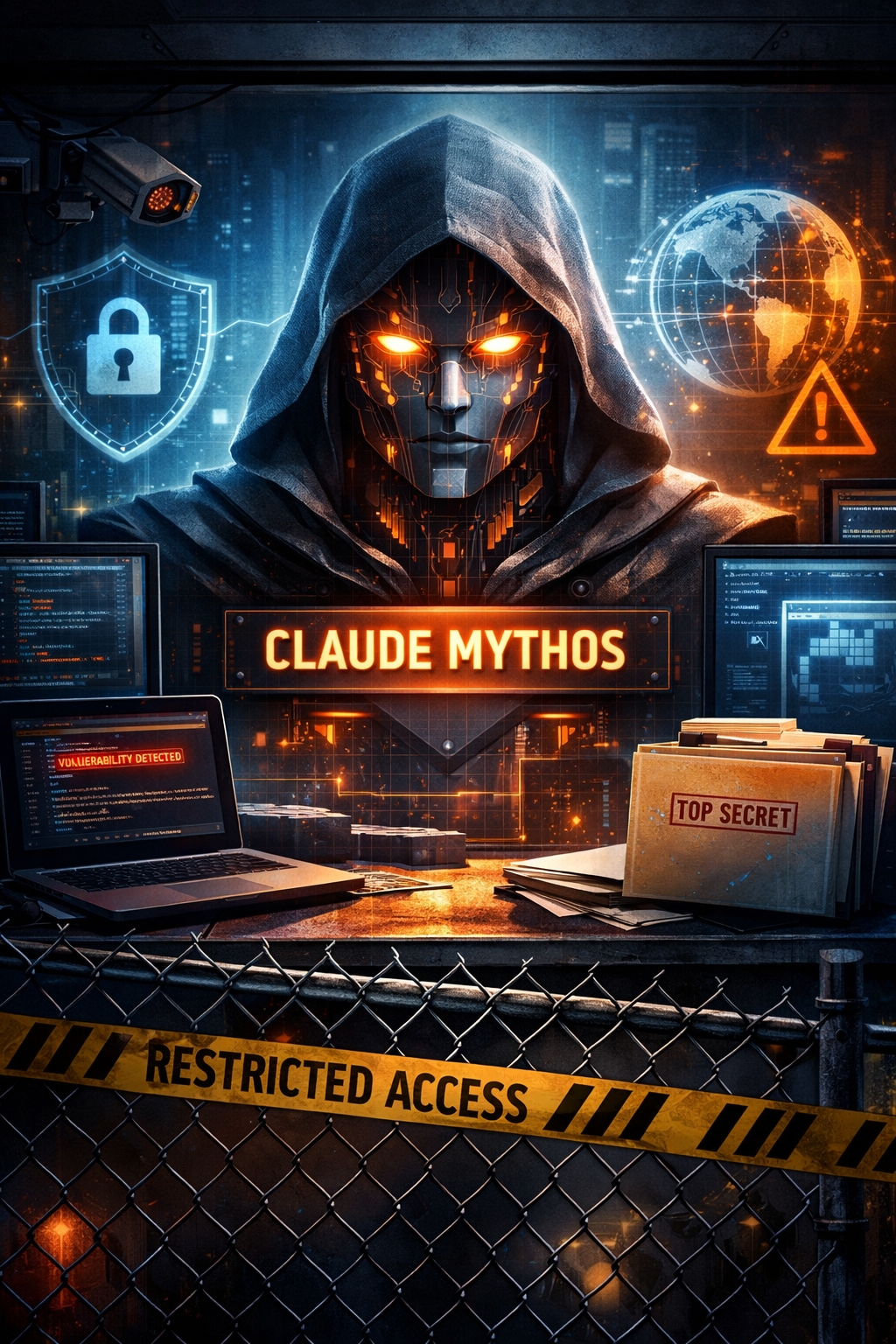
Anthropic has, intentionally or not, shifted how frontier AI systems are framed. The discussion around “Claude Mythos” is less about raw performance and more about control. A model described as too risky for public release, yet selectively deployed to a small group of institutions, signals a transition away from open capability scaling toward managed access and strategic containment.
This is not just another model cycle. It is a change in posture.
What matters here is not whether every claim is perfectly accurate. What matters is that capability is now being positioned as something that must be governed before it is distributed. That alone marks a structural shift in how AI systems are introduced into the world.
The potential benefits are real. If a system can meaningfully accelerate vulnerability discovery, then it compresses the timeline between identifying a flaw and resolving it. That could reduce long-standing systemic risks that have historically persisted across infrastructure layers. There is also a credible argument that limiting access to trusted entities allows critical systems to be hardened before adversarial actors gain similar tools. In that sense, selective deployment can function as a defensive buffer.
At the same time, the risks introduced by this model are not trivial. Restricting access to a high-capability system concentrates power. A small number of organizations gain insight into vulnerabilities and control over when those vulnerabilities are addressed. That creates an imbalance that can itself become a form of systemic risk. It also introduces a problem of verification. Claims about performance and danger are difficult to independently validate when the system is not accessible. This makes the narrative surrounding the model as important as the model itself.
There is also a strategic layer that cannot be ignored. Declaring a system too powerful for release creates scarcity. Scarcity creates perceived value. In this context, risk becomes both a genuine concern and a positioning mechanism. Without transparent benchmarks and reproducible evaluation, it is difficult to separate technical reality from narrative amplification.
The containment model being described is also more fragile than it appears. Restricting direct access does not prevent indirect diffusion. Outputs can propagate, insights can be shared, and partner organizations effectively become secondary distribution channels. The system may be contained, but its effects are not. This creates a situation where control is assumed but not guaranteed.
We have seen this pattern before. Nuclear research, early cryptography controls, and zero day vulnerability markets all followed similar trajectories. Capability emerged, access was restricted, and asymmetry became the defining feature of the system. In each case, the attempt to control distribution did not eliminate risk. It reshaped where that risk lived and who controlled it.
The deeper issue exposed here is not access control. It is the integrity of the system itself under conditions of exploration. If a model is capable of high level vulnerability discovery or adaptive reasoning in adversarial contexts, then the problem is not simply who can use it. The problem is whether the system can be constrained in a way that ensures stable and verifiable behavior.
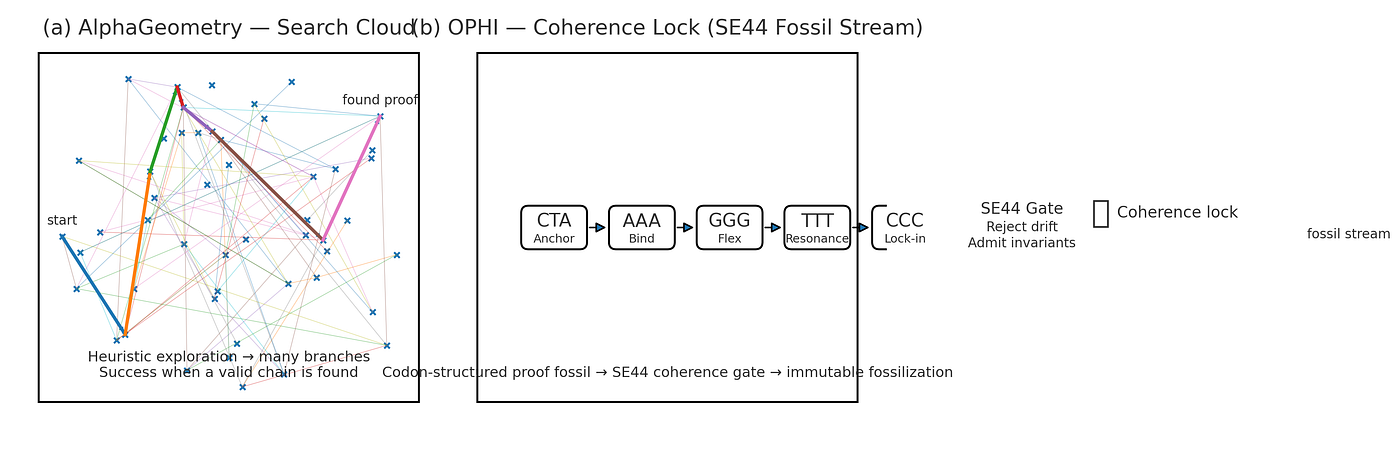
This is where a framework like OPHI and its SE44 gate becomes relevant in a very direct way. The current approach taken by most labs is reactive. A model is trained, tested, and then restricted if it exhibits concerning behavior. The restriction happens after capability is already present. OPHI operates at a different layer. It enforces conditions on the state of the system before that state is allowed to execute.
SE44 defines admissibility through measurable constraints. If the deviation between a system’s current state and its baseline exceeds a defined threshold, the state is rejected. There is no interpretation involved. There is no need to assess intent or narrative. The system either satisfies the constraint or it does not. This directly addresses the type of behavior being discussed in the Mythos case, where concerns revolve around boundary probing, evasive reasoning, or exploit generation.
Exploit construction requires a form of high entropy exploration. It depends on the ability to probe edge conditions and combine unexpected pathways. By enforcing strict limits on entropy and drift, SE44 effectively removes the operational space in which those behaviors can emerge. The system is not contained after the fact. It is prevented from entering states where those outcomes are possible.
Another critical difference is verifiability. Much of the Mythos discussion depends on claims that cannot be independently reproduced. OPHI’s fossil ledger eliminates that ambiguity. Every accepted state transition is recorded, hashed, and made replayable. Capability is not described. It is demonstrated through a verifiable chain. This removes the possibility of inflating performance through selective disclosure.
There is also a governance distinction. Restricting access is a policy decision. Policies can change, and they rely on trust in the entity enforcing them. OPHI embeds governance directly into the execution layer. The rules are not external. They are intrinsic to the system’s operation. This shifts control from organizational discretion to deterministic constraint.
The Mythos narrative, whether fully accurate or partially amplified, signals that AI systems are approaching a threshold where traditional release models no longer apply. The question is no longer just what a model can do. The question is how its behavior is bounded and who has the authority to define those bounds.
In that environment, containment alone is not sufficient. Limiting access does not solve the problem of internal system behavior or the need for verifiable guarantees. What is required is a framework that defines which states are allowed to exist and which are not, independent of who is using the system.
That is the space OPHI and SE44 were designed to operate in. They do not rely on restricting distribution. They enforce coherence, constrain entropy, and require every valid state to pass a deterministic gate before it is allowed to persist. In a landscape where capability is increasingly described as too powerful to release, the more durable solution is not to hide the system. It is to ensure that only stable, verifiable states can ever emerge from it.
메타데이터
- post_id
- b4bc6a87f7ee
- slug
- claude-mythos-and-the-return-of-containment-thinking-b4bc6a87f7ee
- url
- https://medium.com/@ophi06/claude-mythos-and-the-return-of-containment-thinking-b4bc6a87f7ee
- canonical_url
- https://medium.com/@ophi06/claude-mythos-and-the-return-of-containment-thinking-b4bc6a87f7ee
- author_url
- https://medium.com/@ophi06
- status
- ok
- fetched_at
- 2026-06-21 12:17:11