Residential vs Commercial Building Circuit Breaker Panels
If you’ve ever been curious about what runs the lights in your home or runs the elevator in a high-rise, it’s the same device: the circuit…
Residential vs Commercial Building Circuit Breaker Panels
If you’ve ever been curious about what runs the lights in your home or runs the elevator in a high-rise, it’s the same device: the circuit breaker panel.
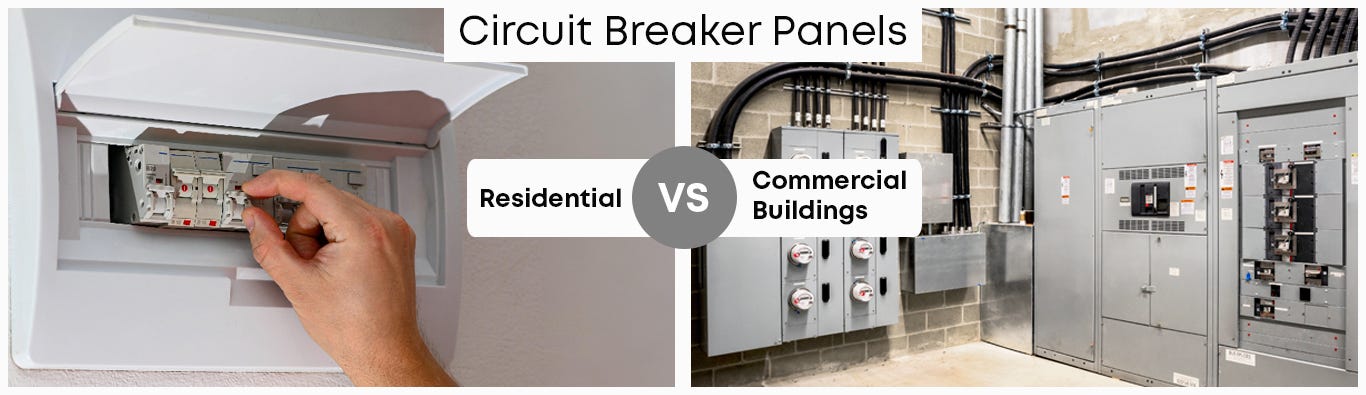
While the role of the **circuit breaker panel **is the same, it is one of the primary components in the safe distribution of electricity. There is a massive variation in design and load capacity between residential properties and commercial buildings.
Let’s look at how residential and commercial circuit breaker panels can differ.
What Is a Circuit Breaker Panel?
The circuit breaker panel (also called a breaker box or electrical panel) is the control center of your building’s electrical system. The circuit breaker panel receives incoming power from the utility line and utilizes individual breakers to supply power throughout the building.
If you have a malfunction like a short circuit or overload, the breaker system immediately trips, cutting off electrical power to prevent future problems like fires or equipment malfunctions.
Residential Panels: Compact and Simple
In most homes, the electrical demand is relatively low: lights, a few appliances, maybe some HVAC, and smart gadgets. That’s why residential panels are smaller, simpler, and easier to manage.
They typically are powered by single-phase power (120/240V) and have a capacity from 100 to 200 amps. Generally, they have between 20 to 40 circuits for things like outlets and lights.
Common characteristics of a residential panel:
- Load capacity: Usually between 100–200 amps.
- Circuit count: 20–40.
- Types of breakers: Mostly single- and double-pole breakers for appliances.
- Design: simple layout, easy to reset, and typically a lighter enclosure.
Commercial Panels: Built for Bigger Jobs
In an office building, a retail store, or a factory, you are looking at a different level of use. These types of facilities often rely on three-phase power (208/120V or 480/277V) and require larger loads for large-scale things like air conditioning, elevators, industrial machinery, and lighting over large spaces. That is why commercial breaker panels are bigger, smarter, and often coupled with feeder subpanels for efficient distribution.
How commercial panels differ:
- High load capacity: Typically 225 amps or more.
- More circuits: Often over 40, spread across subpanels.
- Advanced breakers: Includes GFCIs, AFCIs, and sometimes smart breakers for monitoring.
- Durability: Industrial-grade metal enclosures, built for long-term use.
- Extra integration: May connect with building management systems or automation platforms.
Why These Differences Actually Matter
Let’s get real. Choosing the wrong panel isn’t just inconvenient. It could be unsafe, inefficient, and costly to fix down the road.
1. Safety and Code Compliance
Commercial buildings are subject to stricter safety codes, including requirements from the National Electrical Code (NEC). These involve things like fault detection, emergency shutoff options, and more robust insulation. Residential panels don’t usually need that level of complexity.
2. Energy Efficiency
Three-phase systems used in commercial panels deliver power more efficiently over long distances and heavier loads. This reduces energy loss and keeps things like motors and elevators running smoothly.
3. Scalability and Maintenance
Commercial systems are modular by design; you can add subpanels or expand load capacity without ripping out the whole setup. In homes, expanding often means a major upgrade to the main panel if you’re adding high-demand items like an EV charger or solar inverter.
So, Which One Do You Need?
It comes down to the building’s purpose:
- Use a residential panel if you’re powering a single-family home, even one with smart gadgets or a home office.
- Choose a commercial panel if you’re dealing with high power demand, multiple floors or tenants, or heavy equipment.
It’s not simply a question of amps, it’s also a matter of long-term safety, flexibility, and performance.
Conclusion
Understanding the difference between residential and commercial circuit breaker panels enables you to plan more effectively, avoid code violations, and maintain a safe and efficient property. If you’re building from scratch or upgrading an old system, you want to be sure you choose the right panel to avoid difficulties down the road.
At **Crest Test Systems**, we promise high-quality, compliant, and customized circuit breaker panel testing solutions that are suitable for both residential and commercial installations.
Let’s make sure your panels are tested, trusted, and ready **reach out to us today**.
FAQs:
1. Why are circuit breaker panels essential in buildings?
Circuit breakers automatically control power in your building’s electrical system, diminishing the risk of building damage or fire from overloading or short-circuiting.
2. What’s the main difference between residential and commercial panels? Typically, residential panels manage small loads and have simpler layouts. Commercial panels handle high voltages, have more circuits, do not always have the same layout, and at times, have additional safety features.
3. Are safety standards different for commercial panels? Yes, building codes are more strict in commercial structures and require more advanced protection as the level of risk in the building is higher.
4. Can you use the same breakers in both types of panels? Not necessarily. Commercial panels require breakers rated for higher voltages, and can provide a greater level of protection than residential panel breakers.
메타데이터
- post_id
- b4c4e3e2c6e4
- slug
- residential-vs-commercial-building-circuit-breaker-panels-b4c4e3e2c6e4
- url
- https://medium.com/@testcrest7/residential-vs-commercial-building-circuit-breaker-panels-b4c4e3e2c6e4
- canonical_url
- https://medium.com/@testcrest7/residential-vs-commercial-building-circuit-breaker-panels-b4c4e3e2c6e4
- author_url
- https://medium.com/@testcrest7
- status
- ok
- fetched_at
- 2026-07-18 00:26:52