Me, my career, & GenAI: the Present, Past & Future
The Present — Confessions of a self-taught GenAI Engineer:
Me, my career, & GenAI: the Present, Past & Future
Despite having written extensively about an array of topics, writing directly about my own dysfunctional relationship with GenAI has eluded me so far. Coming from an Architecture, Engineering, Construction, Operations (AECO) background — seeing the monumental shift in the Tech Industry from outside-in has been as much a curse as a blessing.
My first introduction to how Automation, as it was popularized then, is going to take over the world — leaving no jobs for the rest of us — was nearly a decade ago, via a video by CGP Grey with the Thumbnail titled ‘Humans need not apply’, where he argued that any complex task is just a culmination of smaller, automatable tasks which will eventually be taken over by Machine Learning or embedded AI (read robots).
I’d recommend you watch it sometime, given how many of his predictions, like Automated Driving making 70 million worldwide jobs in the transportation Industry redundant and Doctor bots reducing the need for doctors, sound quite similar to the incumbent AI-hype train. Yet its prediction on declining entry-level & white collar jobs was bang-on, while the one about Creative Bots was quite an understatement.
Look back over the past, with its changing empires that rose and fell, and you can foresee the future, too.
– Marcus Aurelius
This video is a peek into where the AI-hype train was heading pre-2016, pre-Transformers & pre-COVID era. From there, it is rather simple to draw a line onto the polarised, K-shaped post-pandemic era we live in today —
Before we begin to delve into it all, though, let’s make one thing absolutely clear — even the most advanced, commercially available ‘Artificial Intelligence’ that we got today is ‘not conscious’, and if based on the same Foundational models we got today, it might never be.
What I mean by AI being conscious is that it cannot memorise information in any real sense or think in an intuitive way that we humans do while performing the most mundane of tasks. Explaining the underlying technologies which make these chatbots sound better than most humans is well beyond the scope of this post, but basically, it involves advanced retrieval techniques combined with a group of humans holding the hands of the Chatbot so as to make it mimic us even better(RLHF).
What Artificial Intelligence really is, is just another layer of abstraction over the Programs and tools we already utilize without batting an eye in our corporate habitats today. Whether this ‘AI’ is Generative chatbots like ChatGPT, Anthropic, Deepseek, or embedded into Programs like Co-pilot, Cursor, etc. OR the AI embedded into Programs like AlphaFold, ESM3 or PRIMO, depends solely on the field of work you are associated with. For the purpose of this post, I am going to focus on the domain I have been concerned with for over 3 years now, i.e. Generative AI or GenAI.
Essentially, the Chatbots we use are a multi/agentic wrapper around a Foundational model, a.k.a. Large Language Model or LLM. These LLMs are foundational because they have been trained over the corpus of data swept from all over the internet – news articles, Wikipedia, Stackoverflow etc., basically all of the knowledge of the entire internet, has been used for training of these LLMs, so much so, that they ran out of trainable data and GPT-5 was trained on the data generated by GPT-4.
The fundamental fault of LLMs is that they are inaccurate — they make up some of the answers at times, making them unreliable for a lot of work-related applications. These instances, called hallucination, are attributed to the very training process of LLMs, such that no amount of post-training efforts like RLHF can ultimately fix.
This makes GenAI probabilistic text predictors at best, described at length in the 2021 Paper ‘On the Dangers of Stochastic Parrots: Can Language Models Be Too Big? ��’ which highlighted the systemic problems associated with the training of LLMs that they are afflicted with even today.
Rest is just the personification of the Chatbot a.k.a. ELIZA effect, which, when hyped up by bombardments from Tech, BnF & balding Managers on Social Media with little original thought on how the technology even works, gives rise to inverted hallucination in the Users, that these Chatbots must be sentient.
Tl;Dr – Your AI companion cares solely about how many tokens you burn, so to keep you hooked into buying more, be it your XAI wifu or ChatGPT. There have even been cases where the latter convinced a man that he had invented a whole new stream of mathematics. That being said, there was an engineer over at Google who raised alarm bells as to whether humanity is even ready for such an AI it in the first place, making some valid & credible arguments.
And yet with the current rate of R&D in these LLM-based Chatbots in the USA, PRC, EU, etc., even the Pontiff had to put his foot down on either halting or distributing its asymmetric profits. OpenAI, Meta & Google already signed weapons contracts with the USA govt, Claud even been used to target and kill 150 Iranian schoolgirls.
Speaking of which, Claude’s latest Fable model was barred by the Trump administration — which infamously suspended all the guardrails in AI Scaling & Development earlier — for its non-American consumers, leaving a rather big chunk of its Users & vibecoded software developers in a frenzy, even in India. Some observers suggest this sequence of events might be a calculated move to build a ‘regulatory moat’ around the company, helping to secure its market position ahead of an IPO.
No other benchmark trumps how advanced your latest model is than a ban on its use by your own Govt afterall.
The K-shaped post-pandemic recovery cannot be overstated when candidates like myself, focusing on production-engineered applications of GenAI, are looking for jobs for over a year and a half, while Token-maxing AI bros vibe-code entire Websites & SAAS products without an iota of understanding of their front-end from the back.
So much so that a restaurant’s order system is editable by any of its customers or the absolute chaos of the CBSE’s Paper re-checking Portal.
The Past — From Glass Boxes to Vector Databases:
To start, to explain my transition from Data Science to GenAI, you’d have to understand the underpinnings of my journey — My stance on Architecture & built spaces writ large had always been that it is designed for normies, by normies. Slogging through my Bachelor’s in Architecture – my approach to Architectural Design was a post-postmodernist anomaly. I always saw the underlying components of a project coming together like a jigsaw puzzle, where form always followed the function.
My sense of aesthetics for the longest time — like that of my own mind — was Baroque at best; so if the spatial logic didn’t compile inside my head, I was at a loss for my design intent, which was most of the time.
I had hoped all that would come to a pass once I found a job and moved over to the more gritty aspects in the construction process, but worse than the salaries was its socio-cultural friction.
The architecture and construction industries run on verbal hand-waving, subjective critiques & rather draining social performances. As a neurodivergent individual who relies on structured, text-oriented communication, my social battery was nuked by 5 PM every day.
I had survived the soul-draining internship, did my time as an Estimator crunching cost datasets at a Texan Firm, and as a PMO Coordinator at Legacy Hyderabad Construction firm, trying to force data-driven quality control and written communication onto contractors & site teams.
I knew I was done with the traditional AECO path when a late-night drinking session with a flatmate’s friend turned into an explanation of the lifecycle of big data engineering. I was hooked, and while I knew getting into Data Engineering would be futile due to my sheer lack of coding experience, I focused my energy on Data Science, finishing NUS’ EdX course on its applications in the AEC sector, eventually learning Machine Learning fundamentals via DeepLearning.AI’s Coursera. I traded AutoCAD for Jupyter Notebooks, Windows ecosystem for Linux.
Grinding through these certifications for the next year and a half, I built foundational ML pipelines, like a Rent Predictor (Jan 2025) and a Multi-Agent Financial Analyser (Jun 2025). But while applying for jobs, I found myself a highly educated hobbyist playing Computer Science graduate.
In Q3 2025, my co-founder and I officially set up Gags & Gigs LLP. Under my own Startup (which pivoted over half a dozen times) I have developed at least 2 production-grade projects, over dozens of abandoned ones. But instead of cracking the startup hustle, my cofounder abandoned the ship, and I fell down the Generative AI rabbit hole.
Pivoting my engineering focus away from traditional Data Science, toward building production-ready GenAI architectures, I got certified in Retrieval Augmented Generation (Dec 2025), which is a technique of implementing GenAI to reduce, if not completely eliminate, its hallucinations.
I built a containerized Agentic arXiv Research Assistant (Jan 2026), an Agentic RAG Research bot especially for RAM-constrained College students to perform research work over the ArXiv Corpus, which works completely on your local machine, based on the Ollama Qwen model & Weaviate Vector DB, with heuristic RAGAS observability. Here’s a 200-second walkthrough of the project.
Recently, though, I architected a stateful, multi-agent Helix AI Concierge (May 2026) using FastAPI, Google ADK, and ChromaDB. I have written all about it in my previous post. Basically, the goal was to create a system that could intelligently route user questions to the right specialist Agent while remembering the earlier chat session.
While I couldn’t finish it in time — part of a hiring assessment as it was — it did give me an overview of the backend engineering expected of a functional GenAI-based product.
I must admit that, being from a non-IT background, developing these projects, taking help from a couple of chatbots, alongside the traditional troubleshooting from Stackoverflow, GitHub and even Reddit, came much more simply than it might for someone with a Tech degree currently, such is the way of production engineering with LLMs at its heart, un/fortunately.
Tbf I had started tinkering with Python back in 2017, and in 2019, I did a John Hopkins Coursera Course, learning basic R, RStudio as well as key principles underlining Data Science & Version Control System (Git).
Yet it was only after I left my job as a Structural Design Coordinator at the end of 2022 that I could dive into AI ML proper, which, with the launch of ChatGPT, was beginning to go through a major transition.
Despite using GenAI extensively for and in my projects, though, I still struggle to understand how ‘vibe-coding’ can functionally work to build revenue making businesses without strict observational controls & guardrails, let alone the spaghetti code.
It is, but how Linus Torvalds put it – that vibe-coding can be a ‘gateway into actual coding’.
The Future — When the levee breaks
In spite of being wary about the AI-hype bubble, the job openings left me wrangling into GenAI-based applications anyway. The cost of the tokens kept reducing due to the subsidies by Tech Giants, AGI (Artificial General Intelligence) – the Holy Grail of AI – was only a few years or months away, perpetually. ‘Scaling’ was a question of ‘when’ and not ‘if’, token-maxing became a mandate at AI startups, while the larger goalposts of the GenAI kept shifting Y-o-Y.
SpaceX’s 85% registered share in NASDAQ, being that of XAI’s loss-making compute-guzzling AI engine, stands as the largest exhibit of how bloated ts has become.
A small puncture in the balloon is the slowing of growth in customer downloads & spending on the leading GenAI Apps, and for the first time, ChatGPT’s market share is shrinking below 50%.

The investment in AI is essentially a Silicon Valley circlejerk.
The Economics of AI is broken, and the linked article delves into it far better than I ever can in this piece. What comes next, though, is an utter loss of interest by the Investors & abrupt pulling of the plug over all the ongoing GenAI projects by Corporations, likely even the promising ones.
There were many small punctures in this hype-ridden balloon over the years, one being NVIDIA’s recent paper titled ‘Small Language Models (SLMs) are the Future of Agentic AI’.
SLMs are models with parameter sizes (a measure of size of foundational models, GPT-5, for eg is ~2 trillion) as low as 10B, which are best suited for Agentic RAG applications. Companies like Uber, Zillow, reportedly burnt through their entire year’s AI budget before mid-2026, and with models reducing in size while improving performance – the latest being Google’s Gemma 4 – as well as development of quantised SLMs, implies that the future of GenAI is local-first.
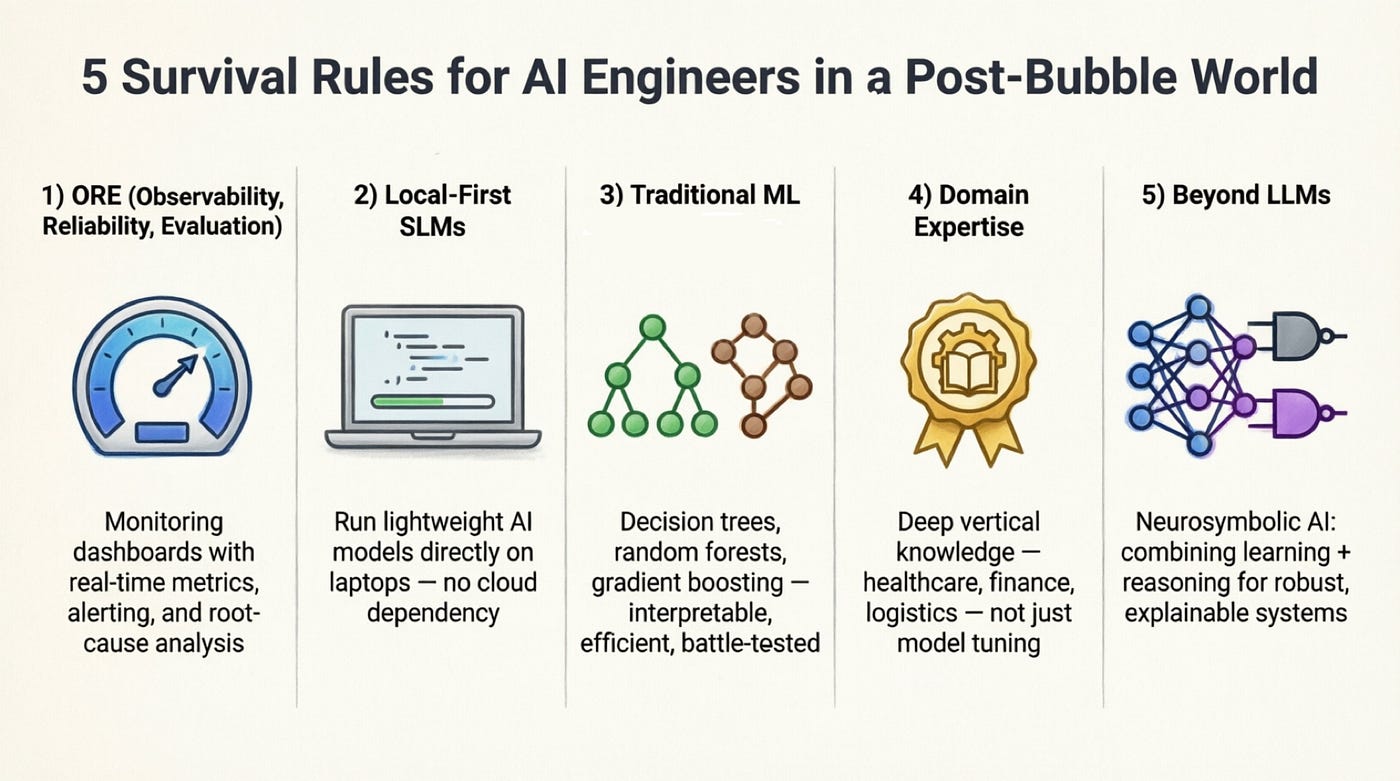
If you are also a self-taught AI Engineer OR someone with a similar Tech Stack trying to break into the gate-kept IT Sector, here are 5 thumb-rules to not just survive – but thrive – as & when the shattering tsunami of the AI bubble bursts, slams the Tech world:
- Obervability, Reliability, Evaluation: GenAI is prone to making mistakes, best you can do is curtail its chances, via applying guardrails against them. While developing projects on Agents or RAG to partially reduce hallucinations, try implementing tools like Logfire, RAGAS, LLM-as-judge and other such frameworks. These can give you much needed edge over purely vibe-coded applications, especially when you scale your project to production.
- Save RAM & Memory, be local-first: Develop some projects based on fine-tuning techniques LLMs such as LoRA/QLoRA. Instill SLMs like Gemma 4 or Mistral Small or Ollama at the core of your project, dockerise it & run locally, doing it alone will give you a lot of insight about how to define, develop, & structure your projects within limitations of your own machine. RAM costs are gonna keep climbing for a bit even after the bubble bursts, but will gradually come down, until then feel the crunch.
- Trad is King: focus on developing your job profile around traditional AI/ML Engineering & Data Science, delve into Random Forests, K-nearest neighbour, Monte Carlo Tree Search, Unsupervised & Semi-supervised Learning (like RLHF) etc. and develop projects without GenAI being the Principal Actor of it. This will help you pivot towards realistic career paths away from the glittery GenAI industry.
- Double Down on Domain: AI-Hype train may halt, yet the Automation Wave isn’t all done with Tech - as seen for eg in Airlines, Radiology, Manufacturing etc. once a field becomes as automated as it can be, it doesn’t necessarily remove ALL of the humans, some experts remain for monitoring & supervising. Similarly, if you have a non-tech background be it Embedded AI, IoT etc. you have an opportunity to constribute as an automation engineer for your own field. If you are a CS graduate, embrace the chaos, contribute to Opensource projects, diversify your skills — cybersecurity is a esp growing field with all the Vibecoded slop floating around up the seed funded AI startups. Anthropic’s latest Study basically concluded that: The greater domain expertise a person brings to a (Claud Code) session, the more work Claude does per instruction.
- Explore alternative Cognitive Architectures/Hybrid models: Experts like Gary Marcus have been shouting at the top of their lungs about the risk of LLMs being the endgame, is eating away at the realistic possibilities for Artificial General Intelligence (what you’d think Chitti or Terminator 2 would be IRL). They recommend alternatives like Real-world Models, Neurosymbolic AI, Robotics etc. Academically these are the most solid and successful descendants which will remain relatively unscathed in the post-bubble economy.
By now we all have seen videos of Indian Blue collar workers doing their job of tailoring, making bed etc. while wearing a VR headset to record their hand movements, it is an attempt to eventually develop one such model. Whether they would actually achieve it, or how long would it take them is unknown to me as of now.
What comes next?
The era of cushy Tech jobs won’t re-appear, for the vast majority anytime soon, brace for impact. Entry level jobs are all but gone, and Gen Z cannot seemingly afford the lifestyle as their parents in all of major world economies. Cost of living and housing has become ridiculously high esp for urban dwellers, that along with Climate & Geopolitical crisis has long tuned the younger generations out of the peril to their existence, many describing their futures as banal at best.
Evidently, the 2021 Crypto-hype baton was passed on to 2023 Token-heavy GenAI, most likely candidate to hold this baton next is Quantum Computing — the Valley, at least, desperately wants it to be. It needs to be noted that we are quite some years away from seeing any practical advancement in Quantum Computers, at least on a consumer level. Meanwhile, Trumponomics is heavy toward mergers &/or acquisitions, leading to Cronyism and Oligarchy. Someone as tone-deaf as Elon Musk becoming a Trillionaire based solely on hype is proof enough.
The term ‘Broligarchy’ coined by Carole Cadwalladr, fits the monoculture of the Valley perfectly. I repeat, the sheer hype behind the use of GenAI in SAAS and other products has returned abysmal returns than what was being promised.
KPMG’s pulling back their report on ‘human experts about how AI could impact the future of work and the customer experience’ because of it being full of GenAI slop errors is one of the latest in the list of ironies no comedian can make up. On the other hand, MIT’s AI Risk Initiative has nuanced oversights & resources, painting the fine-stroked picture that most miss.
For most of Indian Tech Leaders though, developing SLMs were never the priority, despite having a credibly realistic cause. Why because that isn’t where the glamour is at afterall, what else do they even care about anyway? (Funding FMCG startups most likely).
There’s no moat to India’s so called Tech giants like Infosys, TCS etc. — who still take coding assessment for GenAI & MLOps roles btw — except a readily available churn of english education engineering graduates, increasingly becoming redundant with the bottleneck caused by lightening speed of GenAI development. Truth be told, this problem could have been evaded had the Boomer CEOs had actually any vision whatsoever. And now we have WIPRO will train 10k ‘experts’ for Claude in India.
The simple truth about Indian Tech Sector is that, that Capital &/or Talent are not as much of a problem, as is lack of intent by its investors & red-taping by its policymakers.
Going gaga over inviting AI Data Centres with open arms, as even US’ States resist building one in their communities, is demonstrative of the myopic vision of Indian Leadership & its voters alike. In a water scarced nation like India, Mukesh Ambani announcing a collaborative plan with Google for token manufacturing at the scale of Jio’s 2016 data revolution, is as nuts as it sounds, and is yet another carriage of the AI-hype train.
Tech & Tech bros were never supposed to be the culture defining giants that they are today. Speaking for nerds — we just aren’t the type to ‘register’ how policies, taxes, welfare, land-use, govt programmes etc. are supposed to function, these just aren't what we are wired for.
Baumol effect signals that as GenAI startups would see layoffs & shutdowns, post-bubble crash will only increase the value & profit margins of these very Indian IT giants, while the salaries would remain stagnant for its engineers.

This story is published on Generative AI. Connect with us on LinkedIn and follow Zeniteq to stay in the loop with the latest AI stories.
Subscribe to our newsletter and YouTube channel to stay updated with the latest news and updates on generative AI. Let’s shape the future of AI together!

메타데이터
- post_id
- b4cbe486d9b2
- slug
- me-my-career-genai-the-present-past-future-b4cbe486d9b2
- url
- https://generativeai.pub/me-my-career-genai-the-present-past-future-b4cbe486d9b2
- canonical_url
- https://generativeai.pub/me-my-career-genai-the-present-past-future-b4cbe486d9b2
- author_url
- https://medium.com/@dvishesh
- status
- ok
- fetched_at
- 2026-06-27 07:40:21