Is Robotic Knee Replacement Right for You
Persistent knee pain can gradually take away the simple joys of life-walking comfortably, climbing stairs, traveling, exercising, or even…
Is Robotic Knee Replacement Right for You
**Persistent knee pain can gradually take away the simple joys of life-walking comfortably, climbing stairs, traveling, exercising, or even getting a good night’s sleep.** While medications, physiotherapy, and injections can provide temporary relief, there comes a stage when these treatments no longer work effectively. At that point, many patients begin exploring advanced solutions such as robotic knee replacement.
But how do you know if robotic knee replacement is the right choice for you?
This comprehensive guide explains the signs that indicate you may be a suitable candidate for robotic knee replacement, the benefits of robotic-assisted surgery, and when to consult an orthopedic specialist such as Dr. Vivek Kochar, a leading robotic joint replacement surgeon serving Mohali, Chandigarh, Panchkula, and Punjab.
Robotic knee replacement is an advanced form of knee replacement surgery that combines the expertise of the surgeon with robotic technology to improve surgical precision.
Contrary to common belief, the robot does not perform the surgery independently. The surgeon remains in complete control while utilizing robotic assistance for:
This enhanced accuracy often leads to:
The most common reason patients require knee replacement is osteoarthritis, a degenerative condition where the protective cartilage gradually wears away.
As cartilage deteriorates:
Over time, untreated severe arthritis can significantly reduce mobility and independence.
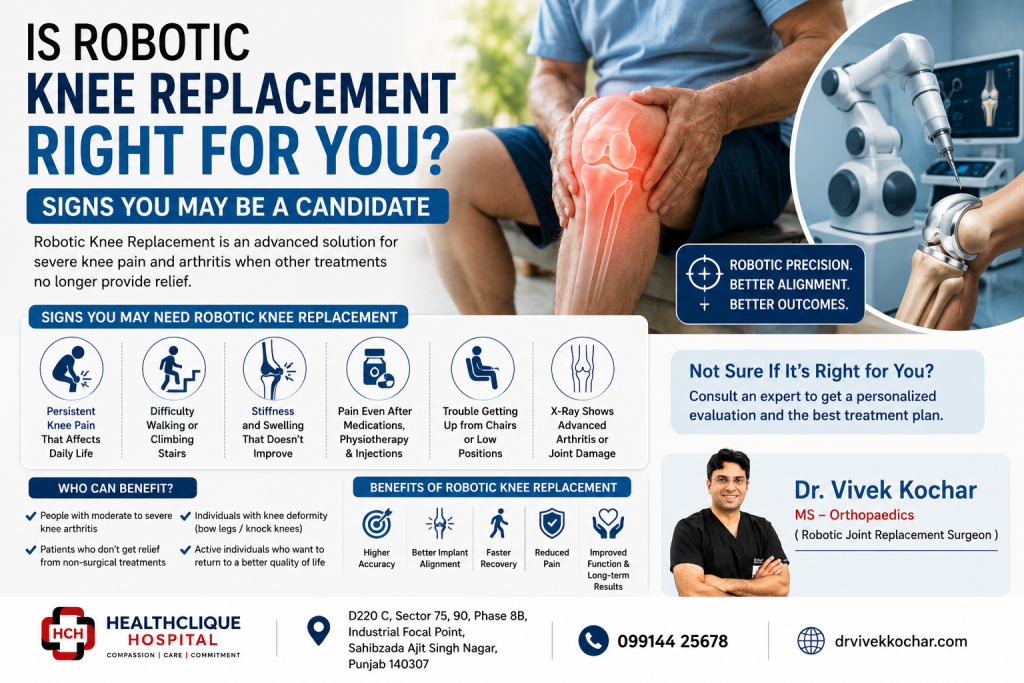
1. Persistent Knee Pain That Does Not Improve
One of the strongest indicators is chronic knee pain lasting several months or years despite treatment.
You may notice pain:
- While walking
- During standing
- While climbing stairs
- During exercise
- At night while sleeping
- Even during rest
When pain starts affecting your quality of life regularly, it is time to seek specialist evaluation.
2. Difficulty Walking Short Distances
Many patients begin avoiding activities because walking becomes uncomfortable.
You may experience:
If walking even short distances becomes challenging, knee arthritis may have progressed significantly.
3. Climbing Stairs Has Become Painful
Stair climbing places considerable pressure on the knee joint.
Common warning signs include:
This symptom is particularly common in advanced arthritis patients.
4. Knee Stiffness Limits Daily Activities
Many people focus only on pain and overlook stiffness.
You may be experiencing:
Severe stiffness often indicates advanced joint degeneration.
5. Knee Deformity Is Developing
As arthritis worsens, knee alignment may change.
You may notice:
- Bow-legged appearance
- Knock-knee appearance
- Uneven walking pattern
- Visible joint deformity
Robotic technology helps surgeons correct these alignment issues more accurately.
6. Non-Surgical Treatments No Longer Work
Most orthopedic specialists recommend conservative treatments before surgery.
These include:
- Pain medications
- Physiotherapy
- Weight management
- Lifestyle modification
- Knee braces
- Hyaluronic acid injections
- PRP injections
However, if symptoms continue despite appropriate treatment, surgery may become the most effective option.
7. Your X-Rays Show Advanced Arthritis
Sometimes the damage inside the knee is far more severe than patients realize.
Diagnostic imaging may reveal:
When imaging confirms advanced degeneration, robotic knee replacement often provides long-term relief.
8. Pain Is Affecting Your Sleep
Night pain is a major warning sign.
You may:
- Wake up frequently
- Struggle to find a comfortable position
- Experience throbbing pain at night
- Require painkillers regularly
When knee pain begins disturbing sleep, arthritis has often progressed significantly.
9. Your Daily Routine Is Becoming Difficult
Ask yourself:
Can you comfortably:
- Walk around the market?
- Go shopping?
- Travel?
- Attend social gatherings?
- Perform household activities?
- Play with grandchildren?
If knee pain is limiting normal life activities, replacement surgery may help restore independence.
10. You Want to Stay Active
Many patients delay surgery because they assume aging means reduced mobility.
This is not true.
Modern robotic knee replacement helps many patients return to:
The goal is not merely pain relief-it is restoring an active lifestyle.
You may be a suitable candidate if you:
✅ Have moderate to severe knee arthritis
✅ Experience chronic knee pain
✅ Have difficulty walking or climbing stairs
✅ Have failed conservative treatment
✅ Show significant joint damage on X-rays
✅ Have knee deformity
✅ Want long-term improvement in mobility
✅ Are medically fit for surgery
Not every patient with knee pain requires replacement surgery.
You may continue with non-surgical treatment if:
A detailed orthopedic assessment helps determine the best approach.
Greater Precision
Robotic technology allows highly accurate implant positioning.
Better Alignment
Proper alignment improves knee function and longevity.
Customized Surgery
Each knee is unique. Robotic planning tailors surgery to your anatomy.
Less Soft Tissue Damage
Improved precision helps preserve surrounding structures.
Faster Recovery
Many patients regain mobility sooner.
Improved Function
The knee often feels more natural after recovery.
Long-Term Benefits
Accurate implant placement may contribute to better long-term outcomes.
There is no single ideal age.
Patients commonly undergo surgery between:
However, the decision depends more on:
- Severity of arthritis
- Functional limitations
- Overall health
- Lifestyle goals
Some younger patients with severe arthritis may also benefit significantly.
When you visit Dr. Vivek Kochar, the assessment typically includes:
Medical History Review
- Pain severity
- Previous treatments
- Mobility limitations
Physical Examination
Imaging Studies
- X-rays
- Additional scans if required
Treatment Discussion
- Non-surgical options
- Surgical suitability
- Expected outcomes
- Recovery planning
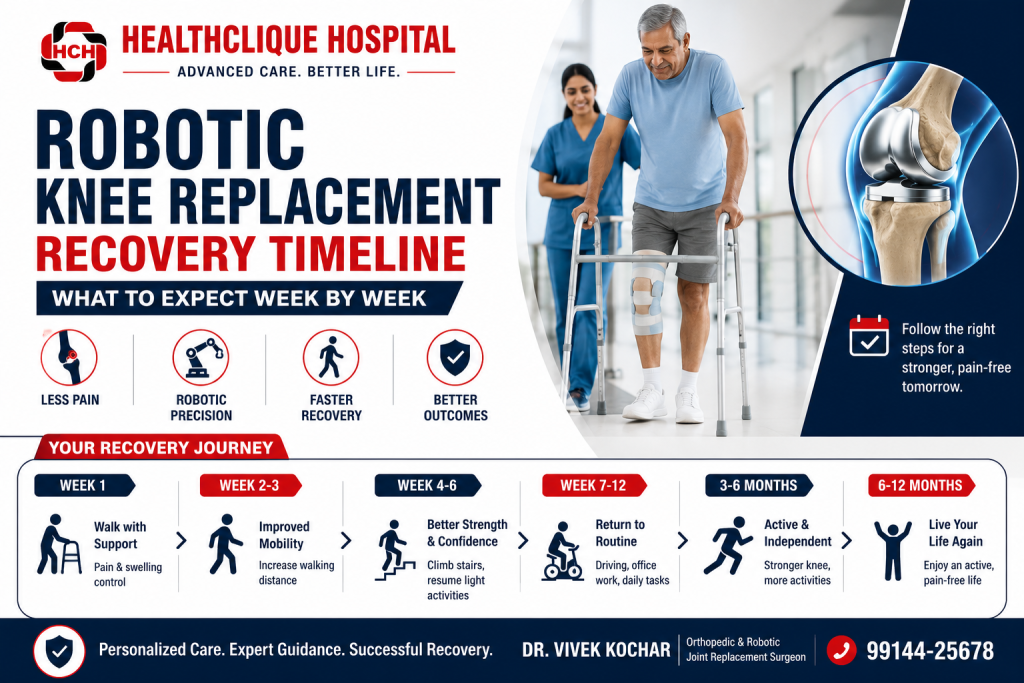
Most patients begin walking with assistance within a day of surgery.
General recovery timeline:
First Few Weeks
- Walking with support
- Physiotherapy begins
- Reduced pain gradually
4–6 Weeks
- Improved mobility
- Greater independence
2–3 Months
6–12 Months
Recovery varies depending on age, fitness level, and adherence to rehabilitation.
Patients across:
are increasingly opting for robotic-assisted joint replacement because of its precision-driven approach and potential for better functional outcomes.
As awareness grows, more individuals are seeking experienced robotic joint replacement specialists for advanced arthritis care.
1. How do I know if I need robotic knee replacement?
If severe arthritis causes persistent pain, stiffness, and difficulty performing daily activities despite treatment, you may be a candidate.
2. Is robotic knee replacement better than traditional knee replacement?
Robotic technology provides enhanced planning and precision, which may improve alignment and implant positioning.
3. What is the ideal age for robotic knee replacement?
There is no fixed age. The decision depends on symptoms, arthritis severity, and overall health.
4. Can robotic knee replacement help with severe arthritis?
Yes. It is commonly recommended for advanced osteoarthritis with significant joint damage.
5. How long does robotic knee replacement surgery take?
Most procedures take approximately 1–2 hours, depending on complexity.
6. How soon can I walk after surgery?
Many patients begin walking with assistance within 24 hours.
7. Will I need physiotherapy after surgery?
Yes. Physiotherapy plays a crucial role in achieving the best outcome.
8. Is robotic knee replacement painful?
Modern pain management techniques help keep postoperative discomfort manageable.
9. How long do knee implants last?
Many modern implants can function effectively for 15–20 years or longer, depending on various factors.
10. Where can I consult a robotic knee replacement specialist in Mohali?
You can consult Dr. Vivek Kochar, an experienced robotic joint replacement surgeon in Mohali, for a comprehensive evaluation and personalized treatment plan.
If knee pain, arthritis, stiffness, or mobility limitations are preventing you from enjoying daily life, a professional evaluation can help determine whether robotic knee replacement is the right solution.
MS Orthopaedics | Robotic Joint Replacement Surgeon
📍 Address: D220 C, Sector 75, 90, Phase 8B, Industrial Focal Point, Sahibzada Ajit Singh Nagar, Punjab 140307
📞 Phone: 099144 25678
🌐 Website: drvivekkochar.com
Early assessment and timely treatment can help you return to a more active, comfortable, and independent life.
Originally published at https://www.drvivekkochar.com on July 9, 2026.
메타데이터
- post_id
- b4ce8d1f14a1
- slug
- is-robotic-knee-replacement-right-for-you-b4ce8d1f14a1
- url
- https://medium.com/@vivekkochar.digital/is-robotic-knee-replacement-right-for-you-b4ce8d1f14a1
- canonical_url
- https://medium.com/@vivekkochar.digital/is-robotic-knee-replacement-right-for-you-b4ce8d1f14a1
- author_url
- https://medium.com/@vivekkochar.digital
- status
- ok
- fetched_at
- 2026-08-01 03:11:30