Did King David Write a Drinking Song into the Bible?
The Shepherd-King Psalmist and his unique “rambling, swerving, ecstatic song”; Psalm #7.
Did King David Write a Drinking Song into the Bible?
The Shepherd-King Psalmist and his unique “rambling, swerving, ecstatic song”; Psalm #7.

Image by falco from Pixabay
(Shared from Substack)
Happy 4th of July weekend!
(Apologies upfront to anyone who has been waiting for the next psalm in the Lyrical Psalms project to drop. It wasn’t just the combination of the holiday weekend and the recent birth in my family that delayed its release; it was actually the fascinating nature of this psalm that necessitated a more detailed write-up than usual.)
Did David write a drinking song?
I want you to step away for a moment, if you will, from all the modern Middle-Eastern connotations you have for the Bible, and open your mind to a more medieval approach to Christian understanding and interpretation of the Biblical narratives and histories.
Here are ten quick points for your intellectual consideration:
- David (followed by his son Solomon) united all twelve tribes of Israel into a single theocratic monarchy/empire, which promptly fractured a generation later into two kingdoms, the Northern Kingdom and the Southern Kingdom, ca 930 BC.
- About 200 years later (ca 720 BC), the Israelites of the Northern Kingdom were pillaged, taken away, and effectively scattered “to the winds” by the Assyrians and Phoenicians, and became known colloquially as the “ten lost tribes”.
- We know from European histories, traditions, and folklore that it was commonly believed throughout medieval Europe that the “ten lost tribes” were obviously scattered throughout Europe in the pre-Roman Empire period, and that early Christianity (before being monopolized by Rome in the 4th/5th century) was seen by many, not as a foreign invading religion, but as a return to their true Israelite heritage.
- We also have overwhelming linguistic evidence tying a huge number of European tribes to early Israelite tribe names and terms; namely, the Jutes (Judah), the Danes (Dan), the Belgians (Benjamin), the Franks/Flemish (Ephraim), the Poles/Poland (Zebulun), the Neopolitans (Naphtali), the Russians (Asher), the Monagasque/Monoikos/Monaco (Manassah), the Helveti (Levites), the Goths (Gad), the Saxon’s (Isaac’s/Isaachar’s sons), the Saracens (Sarah’s sons), the Iberians (Hebrews), the Brits (berit = “covenant” people in Hebrew), the Scots (sukkot = people of the “Tabernacle” in Hebrew), the Irish/Eire (ir/yer = people of the “City” or “Holy City”; Yer u Salem / Jerusalem), the Allemands/Allemani (people of El/Eli/Elohim), the Celts/Gauls (Chaldees/Gallilee), etc.
- The Coligny Celtic calendar, as found by the early Roman Empire, carved into a rock in Coligny, France, is the only known ancient calendar outside of the Law of Moses in the Bible that marks a 2.5-year lunar cycle, adding one extra month every 2.5 years to match years, seasons, and harvest times to the moon instead of the stars/zodiac.
- In that same vein, we have a lot of evidence of early Biblical festivals/feast days matching a lot of details of early “pagan” European festivals and feasts, including an odd calendrical switch that occurred in both the reign of King David and early Scandinavia/Northern Europe, in which the marking of the new year (and feasts associated with it) was shifted by six months from the fall to the spring. The Scandinavian Yule was originally synonymous with July (literally the same word), the month in which it was held, but it was switched to the middle of winter. Likewise, the Gaelic Samhain/Sauin (the Harvest/Beginning of Winter) is etymologically derived from the proto-Indo-European word semo, which is linked directly to both our modern English words Summer and sun AND the Hebrew word sama/shama for “heaven”, the realm of the celestial bodies; sun, moon, and stars. This also ties into the Hebrew Rosh Hashanah (Head of the Year or New Year), which is also a linguistic match for the Irish/Gaelic Oiche Shamhna (Samhain Eve). Moreover, the Hebrew “Valentine’s day” (Tu B’Av) in the middle of August is offset six months from the European Valentine’s Day we celebrate in the middle of February. Whereas, interestingly, the later Israelite festival (instituted during the Babylonian captivity, ca 500 BC, long after the Biblical calendar switch) celebrating Queen Esther (or Ishtar)’s beauty and victory, freeing the Israelites from their consignment to death, came to be known in Europe as Easter or Ostara, a celebration of new life and rebirth after winter, while the modern Jewish version is called Purim, is only celebrated a few weeks’ earlier in late February.
- In addition to all of that, we have a lot of matching tribal symbolism and traditions between the early Celts and European tribes and the Israelites of the Old Testament. The Germanic Jutes, who eventually came to rule England via the Saxons, used the lion as their symbol, which was the symbol of Biblical tribe of Judah, reinforcing that the match is more than merely linguistic in nature. Ireland and Scotland use a number of symbols specifically related to the Biblical King David, like the harp, the ram’s horn (shofar), the flute, and the shepherd’s crook.
- Furthermore, we know from Biblical evidence that the original Hebrews, the twelve tribes who were slaves in “Egypt”, were effectively genetically and physically indistinguishable from the Egyptians of the time (the main exception being the circumcized Hebrew males), and that modern genetic evidence proves that the pharaohs of Egypt were blond-haired, blue-eyed “Caucasians”.
- We also see repeated instances of physical descriptors throughout the Bible that the Israelites were fair-skinned to tan, with light/white, blond, brown, and even red hair, and blue, green, and hazel eyes.
- We also know from the rigorously scientifically tested evidence found within the relics of the Shroud of Turin and the Sudarium of Oviedo that the tortured and crucified man thereon (fully consistent with the gospel accounts of Jesus of Nazareth) was Near Eastern Aryan or Caucasian (which today, we would classify as “European”).
In short, there are a lot of interesting cultural ties between pre-Roman Imperial Europe and the early Biblical Israelites, giving a lot of credence to the idea that the “lost” Israelites were, in fact, scattered throughout Europe and intermarried with local pagan populations.
Modern Talmudic Judaism, as we tend to think of Judaism today, is a relatively more recent invention from the Talmudic period after the birth and establishment of Christianity — and was, in a lot of ways, a response or bifurcation away from Jewish Christianity and the large quantity of Jewish Christians in the first and second centuries AD.
In other words, from the medieval Christian perspective, the Kingdom of Israel in the Old Testament was a precursor to all of European heritage, tradition, culture, progress, and prosperity.
Jesus, in the New Testament, is trying to correct a culture gone horribly wrong by bringing them back to the original underlying principles of mercy, justice, love, the preeminence of life and humanity, etc., that God established in the Torah, from which Pharisaical Judaism had strayed.
And Jesus did this by trying to establish a spiritual kingdom of moral goodness and character that would eventually permeate the whole world, eventually leading to a literal kingdom of God across the whole earth, run by Jesus himself, at the last day.
Every Christian monarchy in medieval Europe viewed itself as a continuation of this kingdom-building process, tracing through Jesus back to the early Kingdom of Israel established by God in the Bible.
So, what does all this have to do with Psalm 7?
Well, Psalm 7, written by David, the “polygamous rockstar” shepherd king of Israel, begins with the inscription:
siggayown le dawid (A “shiggaion” of David) aser sar Yahweh (which he sang to Yahweh) al dibre kus ben yemini (concerning the words of Kush the Benjamite OR Gus, Jiminy’s son).
Now, here’s the important question… What is a “shiggaion”?
Well, the root word siga/shaga is said most correctly to mean: “to reel about”, “to swerve”, “to ramble”, “to wander”, “to behave drunkenly”, etc.
And this has led most Bible scholars to conclude that a “shiggaion” is some particular form of “rambling, swerving, or ecstatic poem”, and/or maybe it’s particularly expressive or passionate in its delivery.
However, we at the Lyrical Psalms Project, informed by our understanding of the early Celtic — early Israelite connection, especially with specific reference to David, the Psalmist, couldn’t help but come up with an alternative linguistic conclusion.
And this isn’t the first time we’ve done this. For instance, Psalm 8 begins with the inscription lamnasseah al hagittit, mizmowr la dawid (To the director over the “gittiye’s”, a psalm/song of David).
Now, when we looked into what a gitti or gittiye is — which modern Biblical scholars will tell you is a “Gittite harp” without any notion of what it was or how it was different from a regular harp of the time — we obviously noted the linguistic similarity between gitti/gittiye/gittia and our modern “guitar”. And when we looked into the history of the guitar, it traces at least as far back as the Mediterranean (specifically Greek/Turkish) kitaya/kithara around 700 BC.
Well, King David is allegedly writing psalms near the Mediterranean in the mid-900s BC.
If we can trace the guitar back at least 2700 years, why not 2950 years to an adjoining region? Especially when kitaya and gittiye are so obviously slight variations on literally the same word!
Maybe they had early guitars in Davidic Israel, and when the tribes were scattered in the 700s BC, they took early guitars with them to Greece and Turkey, among other places?
We concluded amongst ourselves that it’s not far-fetched at all. In fact, the early European “lute” linguistically matches other early European names for the European tribe known as the “Jutes” (pre-Dutch/Deustch), ie; Luden, Ljuten, etc.
In other words, it’s perfectly reasonable to conclude that the earliest guitars and lutes could all have come from the Israelite gittiye, or as I like to call them, “the guitars of Judah”.
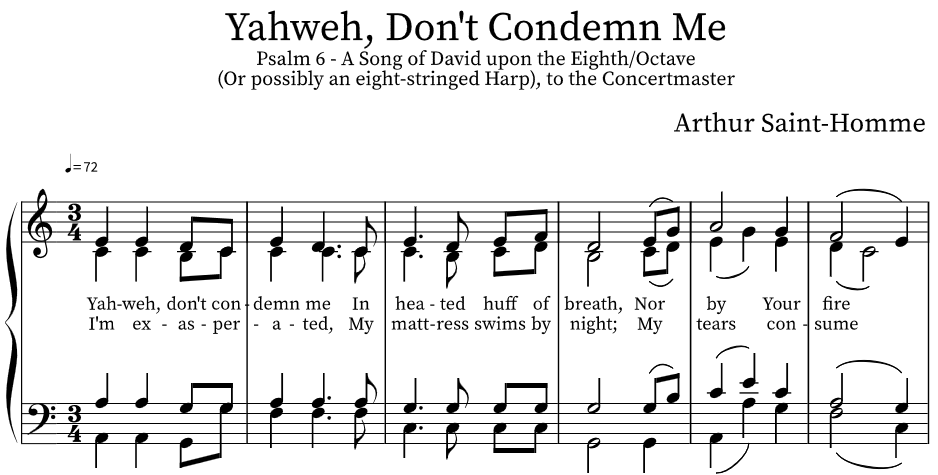
And so, our resident composer, Arthur, took certain stylistic features of early guitar-like music into consideration when composing our hymn-style version of Psalm 8.
Likewise, when he wrote three very different versions of The Lord is My Shepherd, it was the little Celtic ditty version that sang out to us as being “probably the most similar to what David originally wrote”.
Well, it’s fun little discoveries like these that got us thinking: what if that early root of siga/shaga as found in the “shiggaion” is also a precursor to the Irish “jig”/“gigue”; a lively dance or drinking song?
It’s a bit of conjecture, sure.
But it’s also totally plausible, keeping in with the Biblical character of David — a songwriting, rockstar-warrior king, who definitely drank and cursed and slept with a whole bunch of ladies, and wrote most of the psalms — that he may have written a catchy drinking song to mock his many enemies or to boast about his own better standing before God.
Now, we already published our more epic, rambling, swerving poetic version of Psalm 7 last week.
However, as we are wont to do, when we find significant potential variations in meaning or interpretation within a psalm, we try to create multiple hymn-style versions, spotlighting potential differences instead of simply picking our favorite interpretation and casting others aside.
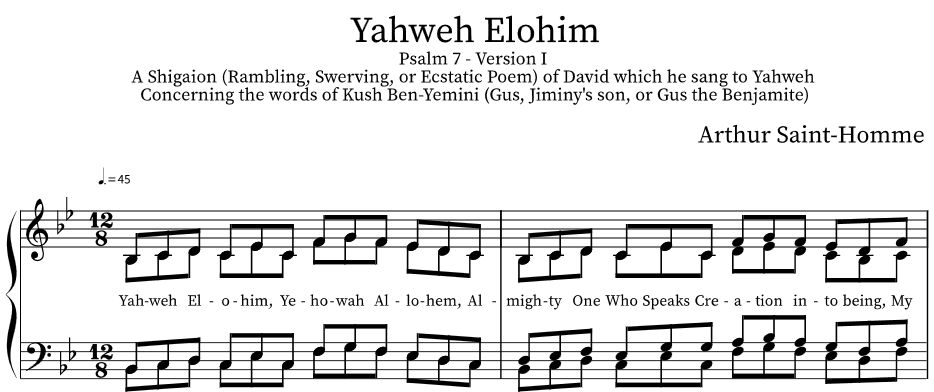
As such, in light of the potential reality that David may have written a drinking song, and everyone loved it so much they put it in the Bible, and also in happy coincidence with the 4th of July weekend and the World Cup, we thought it only fit to publish our drinking song version of Psalm 7.
Now, usually, I just share the lyrics here, and we keep the full score versions behind a paywall on Substack, but since we didn’t post anything over the holiday weekend, with permission, I’m sharing the full score here.


Shared with permission. Source: theostasisbooks.substack.com
There it is. If you want a downloadable pdf version, you’ll have to jump on as a paid subscriber on Substack.
We release sheet music for new non-AI-generated hymns/psalms each Sunday. Because we’re very dedicated to building non-AI-generated media, we will not have proper streamable music until we can put together a choir or ensemble to record these songs one by one.
However, we will be putting out the full Lyrical Psalter hymnbook, first, in shorter serialized volumes, and then later, as a whole hymnal or choir book for mass distribution to churches, fellowships, choirs, etc., that are looking to get back to the spirit of Biblical, early Christian practice.
Thank you for following along. Please share with your musical and/or Christian friends who have any interest in the psalms.
God bless,
Caleb, Ted, and Arthur (the founding team at Theostasis Veritas).
메타데이터
- post_id
- b4d146576d30
- slug
- did-king-david-write-a-drinking-song-into-the-bible-b4d146576d30
- url
- https://medium.com/write-a-catalyst/did-king-david-write-a-drinking-song-into-the-bible-b4d146576d30
- canonical_url
- https://medium.com/write-a-catalyst/did-king-david-write-a-drinking-song-into-the-bible-b4d146576d30
- author_url
- https://medium.com/@calebrockstedt
- status
- ok
- fetched_at
- 2026-07-08 16:17:31