suez canal
#nontransparentthings 017
suez canal
nontransparentthings 017

suez canal, 2023
What is known as the Corinth Canal in Greece today began as a trackway, or diolkos, used to drag ships over land from the Aegean to the Ionian Sea through the Isthmus of Corinth in southern Greece. This was to cut the cost of sailing around the country via the Peloponnese, a distance of over 700km compared to the canal which is just over 6km. The track was built by the Corinthian leader, Periander, in 6th century BC, as opposed to a canal. But Roman Emperor Nero, in 7th century BC, felt this too was slow and commissioned a canal to be dug through the isthmus. Back-breaking slave labour, and what was glaringly an impossibility with the tools of the day, the work began in 67 AD but was very shortlived, only for a year, and abandoned after Nero’s death, a dare too expensive which died with its god.
I have no idea what happened in-between the years from 68 AD till 1881, nearly two millennia later, before the ancient dream was resurrected and completed in 1893.
Because we are barely handy these days, machines having replaced the need to, and with artisans we are too happy to pay to help us fix things, we look back at the old world and marvel at why the people of that time were so relentless in executing the daunting and intimidating. We secretly know this and maybe envy them a little: that we are a failure compared to them. Because how could they, how daring — how could they have done all that? Why were they so knowledgeable and burning for life, we silently ask ourselves.
I was thinking of this recently, that not too long ago, 20 years now, I lived in the rural town of Zaki-Biam where being handy, or that domestic handicraft, was very common and visible. People still sculpted hoe handles from wood, braided ropes from raffia palm, made soap from the ashes of selected plant and herbs, so that one could easily see the lie of money. And it wasn’t that they did all these as a profession; they were everyday skills that reinforced the idea that everything man wants can be made by himself, from his environment. If anything, money was an enemy. And so, one can easily see how the world today, ruled by money, has corrupted such self-reliance; even more so, has corrupted living.
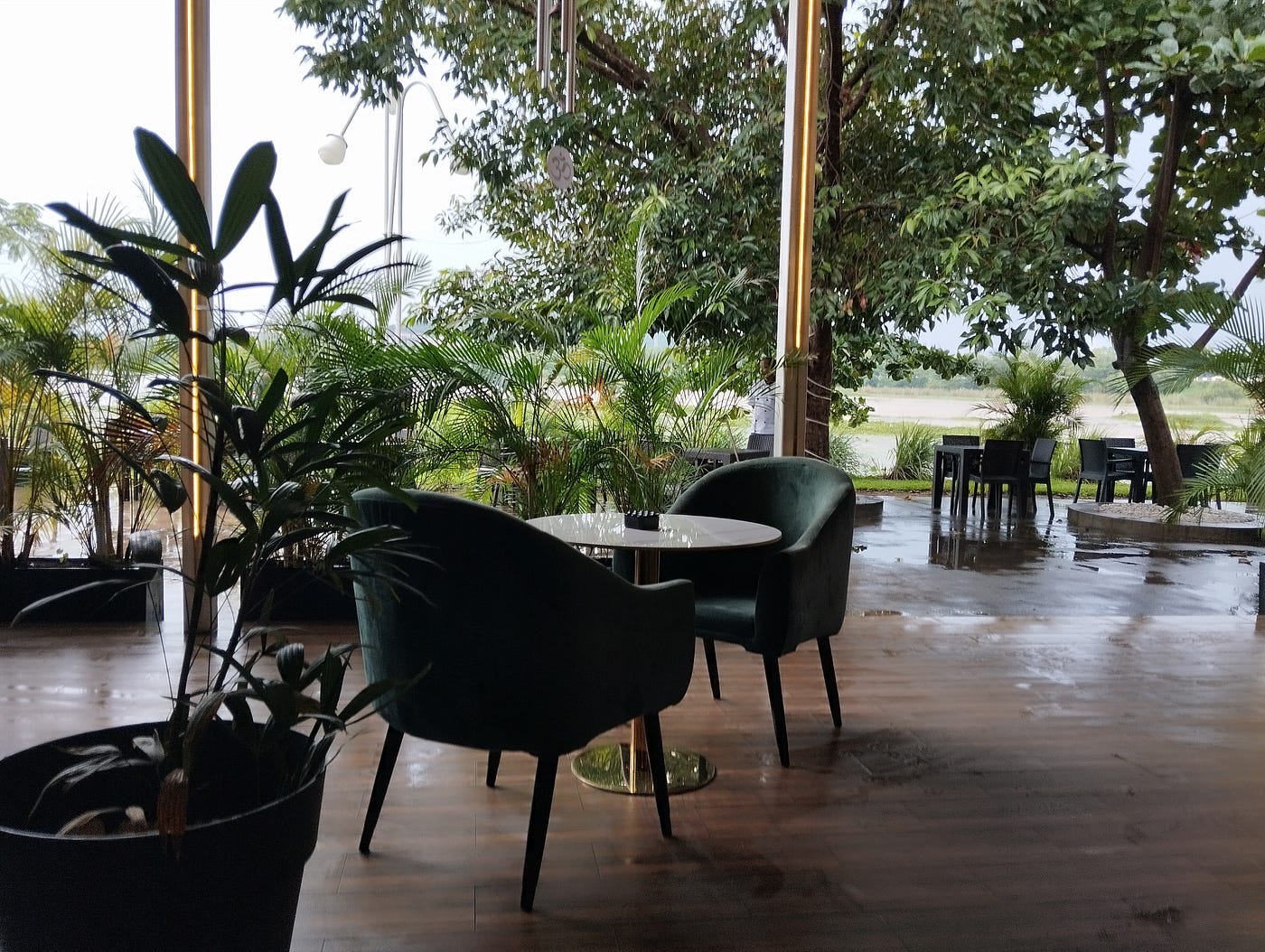
I took this photograph in November 2023 in the early morning, past 12 am, at New Castle Lounge, Makurdi; surely on one of those night crawling days. I cannot recall if the object is plastic or ceramic. But it is a convenience used to place in serviettes. I assume now, writing about it three years later, and I remember, I think, that I took the photograph because I thought of the object as a canal or a passage or sort, which I wanted the image’s subject to be about, even as it is obviously nightlife.
An image can communicate to us in very odd ways, especially beyond its literal composition, and also because we are able to impress our own experience and history on it. And when we are unlucky, maybe due to a lack of pre-exposure to its subject, it might estrange us; this estrangement still an odd way of the photograph’s communication, so that the eye, which is a master of itself, suddenly finds itself a slave in unravelling meaning. It is perhaps in this act, in our refusal to be estranged, that we assign, sometimes, the first thing that comes to mind as the meaning of an image. Maybe. Maybe not.
For me and this image, I could only think of the Suez Canal. And my meaning here was because the image transported me to the first time I read of the canal in a very fat world history book; it was the first time I would also know that man created artificial waterways to cut sailing costs. The image resurrected a pleasurable reading experience I once had.
The Corinth Canal is only 25m wide and cannot support the larger-built ships of today. The canal is now an artefact of sorts, and tourist attraction, yet it remains a beautiful memory of man’s irrepressibility.++
PS. I began writing #Nontransparentthings, a photography writing project, last year. It is now a unique hashtag you can Google to find out all the posts, stories, and reviews about it. I didn’t cover as much as I expected I would last year; only 16 photographs. There are over 30 more images to round off. If you want to catch up, here is a link to entries 1–10. You can read the last entry no. 16 here, or the introductory essay here. Last year also, I published my first photobook Glory to the Sky, accompanied by short personal essays like the one you read above. It has been described as a “metaphysical inquiry into how the act of looking sanctifies the ordinary.” You can purchase an e-copy HERE. Today, my recommended reading is this essay by Namwali Serpell, on what she calls “the New Literalism.” After reading it, I decided to stop using subtitles to watch my movies. But it is much more than this: it is a critique of the erasure of nuance in art in a postmodern and post/late capitalist age.
메타데이터
- post_id
- b4d3a227a0d9
- slug
- suez-canal-b4d3a227a0d9
- url
- https://medium.com/@carlterver/suez-canal-b4d3a227a0d9
- canonical_url
- https://medium.com/@carlterver/suez-canal-b4d3a227a0d9
- author_url
- https://medium.com/@carlterver
- status
- ok
- fetched_at
- 2026-06-23 03:48:11