The Kindness That Comes After
He went from army officer to the Situation Room on 9/11 to CIO of the Pentagon. The hardest thing he had to learn was how to lead.
The Kindness That Comes After
He went from army officer to the Situation Room on 9/11 to CIO of the Pentagon. The hardest thing he had to learn was how to lead.
John Sherman posted something on LinkedIn nine months before we talked.
*Coming out of college, I was beyond intense, often aggressive, and ready to conquer the world.*
I read it the day he posted it. I read it again the morning before we recorded. It’s a strange thing to say out loud, or to write publicly, when you’ve become one of the most genuinely kind leaders in American national security. Not kind in the way people mean when they’re being polite about someone. Kind in the way that costs something. The kind built on understanding that letting someone flounder because you don’t want an awkward moment isn’t mercy. It’s negligence.
I wanted to start there. Before the accolades. Before the career. Before the story I knew was coming about September 11th.
I wanted to know what changed.

John Sherman, Dean of the Bush School of Government and Public Service
The Lieutenant Who Had to Learn
John grew up in rural South Texas, three hours south of College Station. Graduated from a high school of 60 seniors. Football captain. Class president. Friday night lights, petrochemical plants, and classmates who were probably out on a John Deere tractor right now, as he put it.
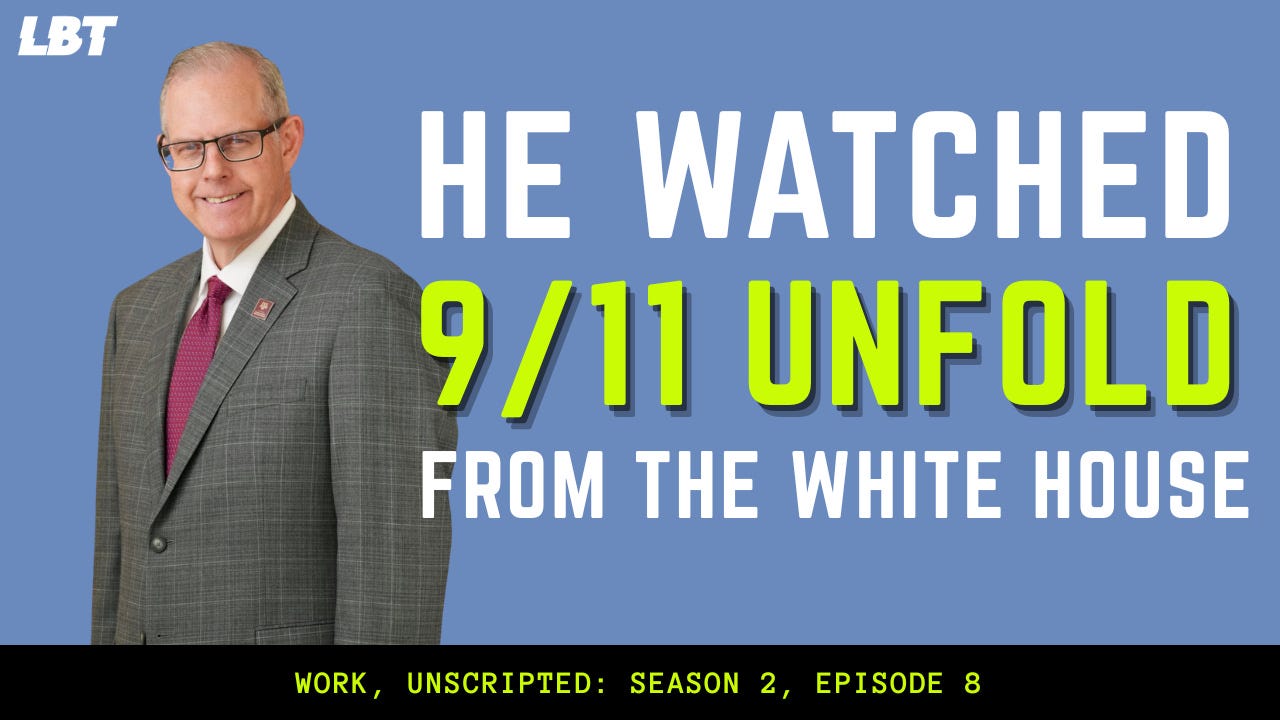
Watch the full interview on Youtube
He came to Texas A&M, went through the Corps of Cadets, commissioned as an army officer, and came out with what he called a "go take the hill" sort of charge.
Which was maybe appropriate for a lieutenant.
But as you move up in the military, in civilian agencies, in any organization, the charge has to give way to something else. Influence. Empathy. The ability to rally people not through direction but through trust.
John with his son, Brad
The shift didn’t happen in a single moment. It happened over accumulated years. Thirty-one direct reports at the National Geospatial Intelligence Agency. Senior executive roles at NGA and then CIA. The Pentagon. Eventually the role of CIO of the Department of Defense and now Dean of the Bush School of Government and Public Service at Texas A&M.
Somewhere in there, a new chief of staff told him he was being a little too “knife-hand" in a memo. John stopped. Thought about it. Said, "You're right."
He told me he still checks himself on it.
That’s the whole arc, really. Not a single revelation. Just a person who stayed open to being corrected, even after he’d earned the right to stop listening.
The Situation Room
John Sherman was the CIA duty officer in the White House Situation Room on September 11, 2001.
He’d been assigned there since August of 2000, part of a tight team of three duty officers, one NSA analyst, and a senior enlisted communicator running 12-hour shifts supporting the president and the national security team. During the summer before the attacks, all the intelligence traffic pointed overseas. An embassy somewhere in the Middle East. That was the assumption.

Sherman Family, 1990s
On quiet Saturdays, they ran drills. An embassy in the Middle East has just been bombed. Go. What do we do? How long did that take? Three minutes. Good. Again.
None of those drills involved planes.
What John remembers about the day itself is the plasma screens. The FAA on a line with NORAD, saying Flight 93 is down. The military responding that they had landed. The FAA is saying no. They’re down.
“I get misty just thinking about it,” he told me.
He also remembers his wife, Liz. She was a CIA officer at a building across the city. Her boss walked in that morning and told the room: the Twin Towers have been hit, the Pentagon has been hit, and the White House has been hit. His wife’s boss forgot, in that moment, that Liz’s husband was at the White House.
She fell to the ground.
Their kids, who are now 31 and 28, had to be taken home by their preschool teacher, who drove them to her house in Manassas because neither John nor his wife could get out of the city.
Every Day Is September 12th
John left the White House at 6:30 that evening. The city was cleared out. No traffic. No noise. Just a Park Service helicopter near the Washington Monument and tactical teams on the roof he’d just walked out from under. He held his badge above his head as he crossed the ellipse and got in his truck.
Didn’t see another car until Falls Church.
Then he crossed the Roosevelt Bridge, and there it was. Black smoke rising from the Pentagon across the water. He stopped in the middle of the empty road. No one else around. He looked out the driver’s side window and thought, My God. I’m looking at Pearl Harbor. This is December 7th, 1941. I’m looking at Battleship Row right now. Everything is about to change.
But the thing he came back to, the thing that stuck, wasn’t the horror of that day. It was the sign that hung for years afterward at CIA’s Counterterrorism Center.
Every day is September 12th.
The day after. The day when bureaucratic red tape vanished. When contracting officers moved without waiting to be asked. When the organs of national security that normally move in slow, competing directions all pointed the same way at once.
John and Liz
“It was a glimpse,” John said, “of what we can do as a nation when we come together.”
He’s spent years since trying to pass that glimpse on. He recently gathered a roundtable at the Bush School for incoming freshmen, students born in 2007 who have no memory of the attacks and don’t even remember when Bin Laden was killed. He wanted them to understand not just what happened but also what it revealed about what’s possible.
What Gets You Hired. What Keeps You There.
John is now Dean of a school tasked with producing the next generation of public servants. He thinks about character the way most administrators think about curriculum: as the foundation everything else is built on.
"Skills will have to be renewed constantly," he told me. Look at what’s changed in the last few years with generative AI. Look at where quantum computing is heading. What you know today has a shelf life.
Sherman Family, 2025
What doesn’t expire is who you are.
“What’s going to get them hired and keep them on the job is their character,” he said. “Can they be trusted? Do they have integrity? Are they going to be good leaders and good followers?”
He’s watched the kiss-up, kick-down employee pattern his whole career. The person who manages up brilliantly and treats everyone below them terribly. The one who takes credit for the team’s work. The one who looks great to the boss and is quietly burning through everyone around them.
“It’s easy to be wooed,” he said, “if you’re not careful.”
What he looks for, in the end, are two things together: character and competence. Neither one alone is enough. A great person who can’t do the job is a liability. A brilliant performer with no integrity is a liability waiting to happen.
He also said this, and I keep coming back to it: your North Star shouldn’t change, but your personality will. Be honest. Be a good person. But stay open. Stay curious. The path will take you places you didn’t plan for, and that’s not a problem. That’s the point.
Be joyous when it happens.
The last question I ask every guest is some version of "What do you want the next generation to take away?"
John didn’t hesitate.
Life is a journey. Be a lifelong learner. Do something bigger than yourself.
He said he tells every student he meets, the international affairs majors, the future diplomats, and the policy wonks, that he’s going to run into them in thirty years and they’re going to be hospital administrators in Chicago. Or a healthcare CEO who got there because they gave a briefing and a governor liked it and one thing led to another.
“And I want them to be joyous when that happens,” he said.
Sherman Family, 2022
Not just accepting of it. Not just resilient. Joyous.
John Sherman went from army lieutenant to imagery analyst to Situation Room duty officer to CIO of the Department of Defense to university dean. At each stop, he had to learn things he couldn’t have anticipated when he left central Texas at 22 with a go-take-the-hill sort of charge.
The title kept changing. The North Star held fast.
That’s the show. That’s the whole thesis, really.
*John Sherman is the Dean of the Bush School of Government and Public Service at Texas A&M University. He previously served as the 19th CIO of the U.S. Department of Defense.*
Support LBT
Listen to Work Unscripted
📺 YouTube · 🟢 Spotify · 🍎 Apple Podcasts · 🎵 Amazon Music
Join the Community
📝 Substack · 📸 Instagram · 💼 LinkedIn
Partner with LBT
💰 Become a Sponsor · 🙋 Nominate a Guest
*This article is originally published on my Substack on May 14th, 2026*
메타데이터
- post_id
- b4fd50068d4c
- slug
- the-kindness-that-comes-after-b4fd50068d4c
- url
- https://medium.com/write-your-world/the-kindness-that-comes-after-b4fd50068d4c
- canonical_url
- https://medium.com/write-your-world/the-kindness-that-comes-after-b4fd50068d4c
- author_url
- https://medium.com/@savank
- status
- ok
- fetched_at
- 2026-06-09 15:37:30