MEP Clean Agent vs. Sprinkler: Which Fire Protection System Wins?
Compare Clean Agent and Sprinkler fire protection systems to choose the right solution. Expert insights from MEP Consultant Noida for safer…
MEP Clean Agent vs. Sprinkler: Which Fire Protection System Wins?
Compare Clean Agent and Sprinkler fire protection systems to choose the right solution. Expert insights from MEP Consultant Noida for safer buildings.
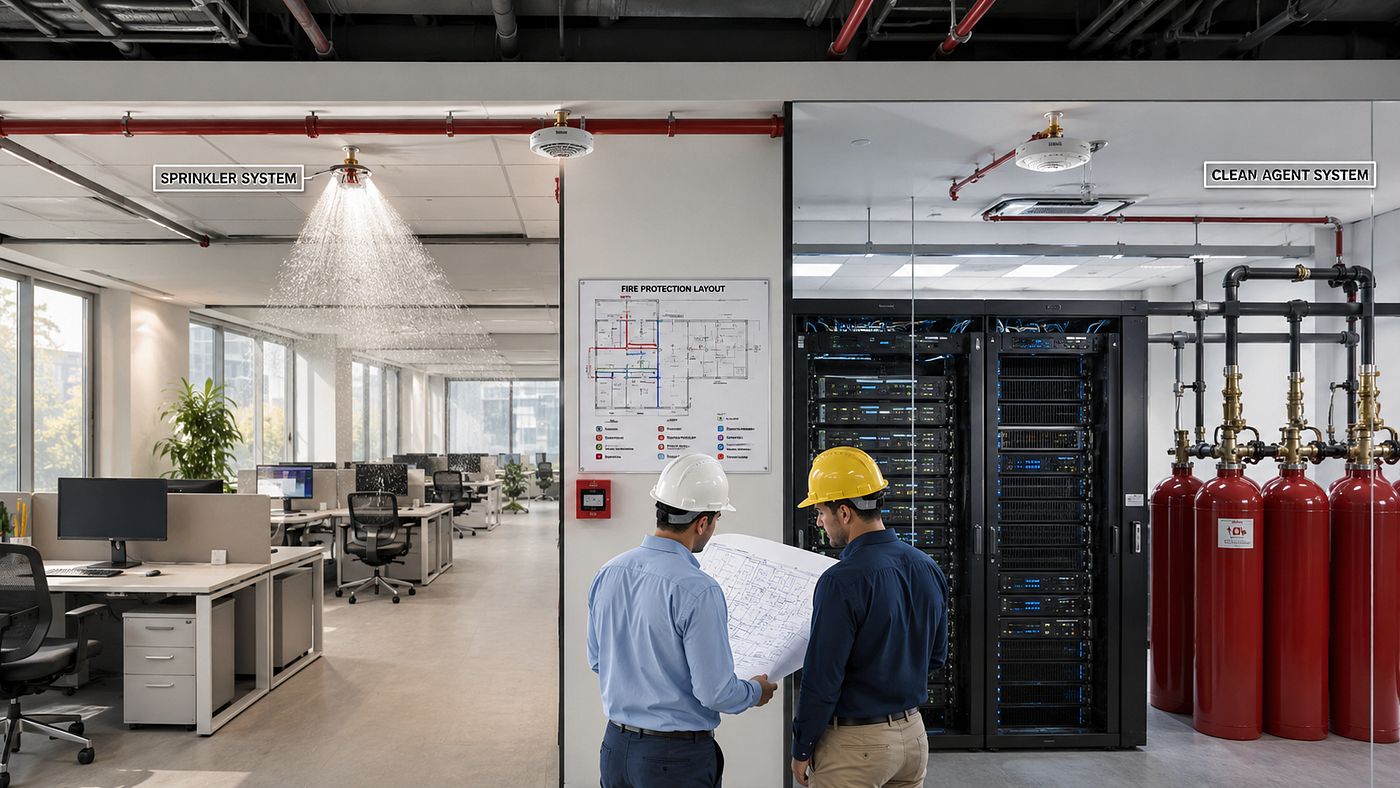
A modern commercial building showcasing two integrated fire protection zones, with a clean agent system protecting a server room and a sprinkler system safeguarding office and public areas. Engineers review coordinated fire safety layouts and building service plans during project execution.
Clean Agent Vs. Sprinkler: Choosing the Right System
Selecting the right fire protection system is a strategic decision that directly affects business continuity, asset protection, compliance, and occupant safety. While traditional sprinkler systems remain the standard for many commercial and residential buildings, clean agent systems have become the preferred solution for environments containing mission-critical equipment and sensitive assets.
The right choice depends on far more than installation costs; it requires evaluating operational risks, downtime tolerance, maintenance expectations, and the value of protected assets. Organizations investing in long-term infrastructure should understand the strengths and limitations of each technology before making a decision. With guidance from an experienced **MEP Consultant Noida**, businesses can design a fire protection strategy that aligns with building usage, regulatory requirements, and future operational needs while minimizing unnecessary risks and expenses.
Understanding the Difference Beyond Fire Suppression
The biggest misconception is that both systems serve identical purposes. In reality, they are designed to protect different environments and priorities.
Sprinkler systems suppress fire using water, making them highly effective in controlling flames across large occupied spaces. Clean agent systems extinguish fires using gaseous agents that leave no residue and cause no damage to electronic equipment.
Choosing between them is less about replacing one with another and more about selecting the technology that matches the operational profile of a facility.
Facilities such as hospitals, corporate offices, manufacturing plants, museums, laboratories, and data centres often require specialized fire protection that balances life safety with asset preservation.
When Water Can Become the Bigger Risk
For many organizations, fire is only one part of the potential loss.
Water discharged from sprinklers may successfully control flames, but it can simultaneously destroy servers, electrical panels, communication equipment, archives, artwork, laboratory instruments, or expensive manufacturing machinery.
This secondary damage often exceeds the original fire loss.
That is why modern infrastructure projects increasingly involve **MEP Consultants Noida** during the design phase to evaluate areas where clean agent protection delivers greater long-term value.
Where Clean Agent Systems Deliver the Greatest Advantage
Clean agent systems are designed for spaces where business continuity matters as much as fire suppression.
Their biggest strengths include:
- No residue after discharge, eliminating lengthy cleanup.
- Rapid fire suppression with minimal interruption to operations.
- Safe protection for electronic equipment, control rooms, and mission-critical facilities.
For businesses operating around the clock, avoiding days of downtime can justify the higher installation cost.
Why Sprinkler Systems Continue to Lead in Conventional Buildings
Despite technological advancements, sprinkler systems remain indispensable.
Warehouses, retail spaces, educational institutions, residential towers, hotels, parking structures, and industrial facilities often benefit from water-based suppression because of their extensive coverage and proven reliability.
Sprinkler systems also offer:
- Lower installation costs for large areas.
- Strong regulatory acceptance across building categories.
- Long operational history supported by standardized maintenance practices.
Rather than viewing sprinklers as outdated, industry professionals recognize them as the right solution for environments where water damage presents limited financial consequences.
Cost Should Never Be the Only Decision Factor
Many organizations compare only initial installation costs.
That approach frequently results in expensive mistakes.
A clean agent system generally requires greater upfront investment due to specialized cylinders, detection systems, room integrity requirements, and commissioning.
However, replacing damaged IT infrastructure, production equipment, or confidential records after sprinkler discharge can cost significantly more.
The true financial comparison should include:
- Downtime
- Equipment replacement
- Insurance implications
- Business interruption
- Recovery timelines
This broader evaluation enables decision-makers to invest wisely instead of simply spending less.
Compliance Demands More Than Equipment Selection
Fire protection systems must satisfy applicable fire codes, occupancy classifications, insurance requirements, and local authority approvals.
A professionally engineered solution considers:
Building occupancy
Fire load
Ventilation characteristics
Escape planning
Equipment sensitivity
Future expansion
Experienced **MEP Consultants Gurgaon** understand that compliance is achieved through integrated engineering rather than selecting individual products independently.
This holistic approach improves both safety and long-term operational efficiency.
Hybrid Protection Is Becoming the Preferred Strategy
Many modern commercial developments no longer choose one system exclusively.
Instead, they combine both technologies.
For example:
A corporate headquarters may use sprinkler protection throughout office floors while installing clean agent systems inside server rooms, electrical rooms, and network operation centres.
Similarly, manufacturing facilities often protect production areas with sprinklers while safeguarding automation control rooms using gaseous suppression.
Hybrid strategies optimize protection while maintaining cost efficiency.
Long-Term Maintenance Matters More Than Installation
Fire protection is only effective when systems remain operational years after installation.
Routine inspections, testing, cylinder monitoring, detector calibration, valve servicing, and compliance audits are equally important as the original design.
Organizations that neglect preventive maintenance often discover failures during emergencies rather than inspections.
Working with qualified **MEP Consultants Gurgaon** helps establish maintenance strategies that preserve system reliability throughout the building lifecycle while ensuring ongoing regulatory compliance.
Making the Right Investment
Every building presents unique operational risks.
A financial institution values uninterrupted digital services.
A pharmaceutical laboratory protects research.
A museum safeguards irreplaceable collections.
A warehouse prioritizes rapid suppression across large storage areas.
No universal solution exists.
Instead of asking which technology is better, decision-makers should determine which system better protects their specific assets, operational priorities, and future business objectives.
The right investment is one that minimizes total risk, not merely installation cost.
Conclusion
Choosing between clean agent and sprinkler systems requires balancing fire suppression performance, asset protection, compliance, maintenance, and business continuity. While sprinkler systems remain the practical choice for many conventional buildings, clean agent technology provides unmatched protection for environments where sensitive equipment and operational uptime are critical.
Many organizations now achieve the best outcomes through carefully engineered hybrid solutions that leverage the strengths of both systems. Consulting experienced fire protection engineers early in project planning ensures every investment supports safety, resilience, and long-term operational success.
FAQs
1. Is a clean agent system better than a sprinkler system?
Not necessarily. Clean agent systems are better for protecting sensitive equipment, while sprinkler systems are more suitable for general occupancy buildings. The right choice depends on building usage, asset value, and operational priorities rather than one system being universally superior.
2. Can both systems be installed in the same building?
Yes. Many commercial facilities combine clean agent and sprinkler systems to protect different risk zones. This approach provides efficient fire suppression while reducing potential damage to critical infrastructure and valuable equipment.
3. Which system requires more maintenance?
Clean agent systems generally require specialized inspections, cylinder monitoring, and room integrity testing. Sprinkler systems also need regular inspections and testing, but maintenance procedures are usually more familiar and widely standardized across facilities.
4. Which fire protection system is more cost-effective?
Sprinkler systems usually have lower installation costs. However, clean agent systems may deliver better long-term value by preventing expensive equipment damage, reducing downtime, and protecting business-critical operations after a fire incident.
5. Should fire protection decisions be made during building design?
Yes. Planning fire protection during the design stage allows better coordination with mechanical, electrical, and architectural systems. Early engineering also improves compliance, reduces future modifications, and optimizes overall project costs.
Protect smarter with **Sanelac**. Get expert fire protection solutions designed for safety, compliance, and long-term reliability.
메타데이터
- post_id
- b514b963f690
- slug
- mep-clean-agent-vs-sprinkler-which-fire-protection-system-wins-b514b963f690
- url
- https://medium.com/@sanelac.india/mep-clean-agent-vs-sprinkler-which-fire-protection-system-wins-b514b963f690
- canonical_url
- https://medium.com/@sanelac.india/mep-clean-agent-vs-sprinkler-which-fire-protection-system-wins-b514b963f690
- author_url
- https://medium.com/@sanelac.india
- status
- ok
- fetched_at
- 2026-07-09 15:12:33