🚀 HTML Attribute Injection: Breaking Out of the Tag
Target Application: https://github.com/Yavuzlar/VulnLab/tree/main
🚀 HTML Attribute Injection: Breaking Out of the Tag
Target Application: https://github.com/Yavuzlar/VulnLab/tree/main
Day 4 of breaking web applications on purpose.
Yesterday, we attacked JavaScript logic.
Today?
We don’t attack <script> tags.
We attack HTML attributes themselves.
And that’s where things get interesting.
🧠 The Dangerous Assumption
Developers often think:
“We blocked <script>. We’re safe.”
But what if I told you…
You don’t need <script> to execute JavaScript?
What if you could inject code using just:
- A quote
- A space
- And an event handler
Let’s break it.
🎯 The Setup
The application has a simple feature:
You enter your name. It generates a link like this:
<a href=”ticket.php?name=USER_INPUT”>See your ticket</a>
Looks harmless.
But here’s the problem:
Your input goes directly inside the href attribute.
No proper escaping. No strict encoding of quotes.
Now ask yourself:
👉 What happens if I close the attribute early?
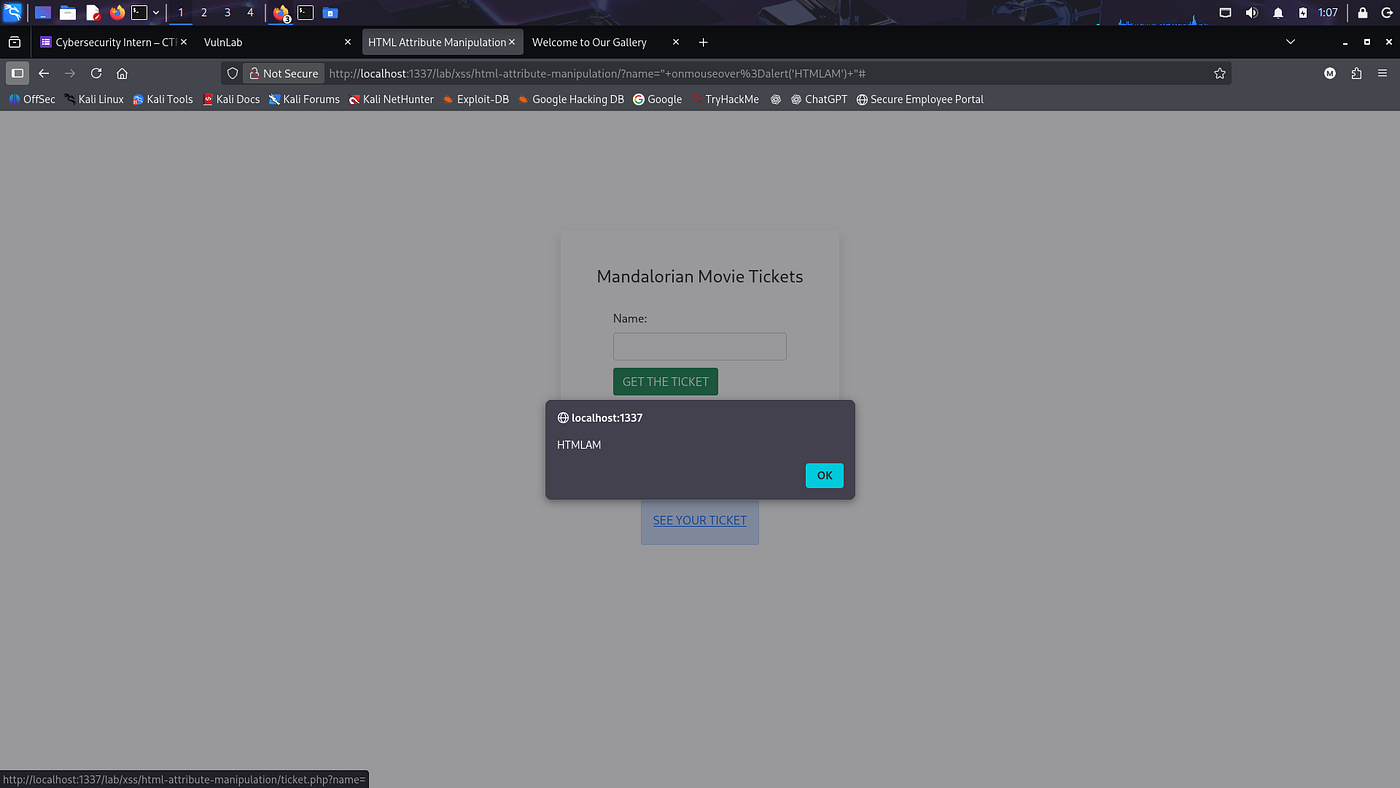
💣 The Payload
Instead of a normal name, inject:
“ onmouseover=”alert(‘attr’)”
Now the rendered HTML becomes:
<a href=”ticket.php?name=” onmouseover=”alert(‘attr’)””>See your ticket</a>
You didn’t inject a <script> tag.
You injected a new attribute.
And that attribute executes JavaScript.
⚡ Why This Works
Because HTML works like this:
- Attributes are separated by spaces.
- Quotes define attribute boundaries.
When you inject:
“
You close the original attribute.
Everything after that becomes a new attribute.
The browser parses it normally.
And onmouseover is a valid event handler.
Hover the mouse?
JavaScript runs.
No <script> needed.
🧠 Real-Life Analogy
Imagine a security guard checking for knives.
So you bring explosives instead.
They only blocked <script>.
You used onmouseover.
Same result. Different path.
That’s how attackers think.
💥 What Makes This Dangerous?
You can:
- 🍪 Steal cookies
- 🔓 Hijack sessions
- 🎭 Trigger actions silently
- 🧾 Inject phishing popups
- 👑 Target admin users specifically
And the worst part?
Many developers only filter < and >.
They forget about quotes.
And quotes are powerful.
🧨 The Bigger Question
How many applications:
- Dynamically generate <a href> links?
- Build image tags with user input?
- Inject values inside src, href, or value?
And how many properly escape quotes?
This is not a lab-only problem.
This is everywhere.
🛡️ How To Fix It Properly
✅ Escape Quotes Too
In PHP, for example:
htmlspecialchars($value, ENT_QUOTES, ‘UTF-8’);
ENT_QUOTES is critical.
Without it? You’re still vulnerable.
✅ Validate Expected Input
If name should only contain letters:
Reject anything else.
Strict allowlists beat weak filters.
✅ Use Content Security Policy
Block inline scripts and event handlers:
Content-Security-Policy: script-src ‘self’;
Defense in depth matters.
🧠 The Mindset Shift
XSS is not about <script>.
It’s about context.
HTML context. Attribute context. JavaScript context. URL context.
If you don’t understand context…
You don’t understand XSS.
And that’s where real attackers win.
🎯 Day 4 Takeaway
You don’t always break the page with <script>.
Sometimes…
You just break the quote.
And that’s enough.
By Day 10, you’ll start seeing vulnerabilities in normal websites automatically.
And that’s when the mindset changes.
LESSGO 🔥
Ready to build Day 5 next? 😈메타데이터
- post_id
- b52069572c01
- slug
- html-attribute-injection-breaking-out-of-the-tag-b52069572c01
- url
- https://medium.com/@issanpanda/html-attribute-injection-breaking-out-of-the-tag-b52069572c01
- canonical_url
- https://medium.com/@issanpanda/html-attribute-injection-breaking-out-of-the-tag-b52069572c01
- author_url
- https://medium.com/@issanpanda
- status
- ok
- fetched_at
- 2026-06-20 20:29:01