Urban Futures and Visioning Activities in Sweden
Over the past two decades, Sweden has experienced significant urban growth, with the urban population increasing from approximately 84% in…
Urban Futures and Visioning Activities in Sweden
Over the past two decades, Sweden has experienced significant urban growth, with the urban population increasing from approximately 84% in 2003 to around 88.7% in 2023 (Statista, 2024). This urban expansion is particularly evident in cities like Malmö, which has grown by almost 40% since the early 2000s, making it Sweden’s fastest-growing large city (Malmö Stad, 2024). Similarly, Växjö has seen a population increase of around 9.5% between 2005 and 2010, positioning it as the second fastest-growing city after Stockholm during that period (Statista, 2024). Rapid urbanization presents both opportunities and challenges, underscoring the need for city leadership to adopt a forward-thinking approach to urban development (Guy and Marvin, 1999). Foresight and speculative methods are invaluable tools in this context, enabling municipalities to anticipate future trends, address potential challenges, and create inclusive, sustainable environments that benefit all residents
With a focus on sustainability, inclusion, and aesthetic form, Sweden is often seen as an innovator in matters of urban design and planning. As urban areas face various challenges, it is interesting to see how some Swedish municipalities make use of foresight, visioning methods, and speculative activities to address questions and ideas about urban development.
The use of such futuring and visioning activities is intriguing. How can we work towards more sustainable cities if we cannot imagine what that entails? Such futuring and visioning activities are important and greatly valuable but remain understudied. To better understand these efforts, we conducted an inventory to identify and describe futuring, foresight, visioning, and speculative activities undertaken in Sweden over the past years. We were particularly interested in identifying those that involved community participation.

By the end of summer 2024, we had mapped a total of 62 such activities. These activities, spanning from 1995 to 2024, reveal some interesting insights into Sweden’s approach to urban futures:
A Growing Focus on Sustainability: Approximately 70% of the projects in the inventory prioritized sustainability, integrating goals like green infrastructure, energy efficiency, and climate resilience. This focus underscores commitments to aligning urban development with environmental imperatives and the United Nations’ Sustainable Development Goals (SDGs).
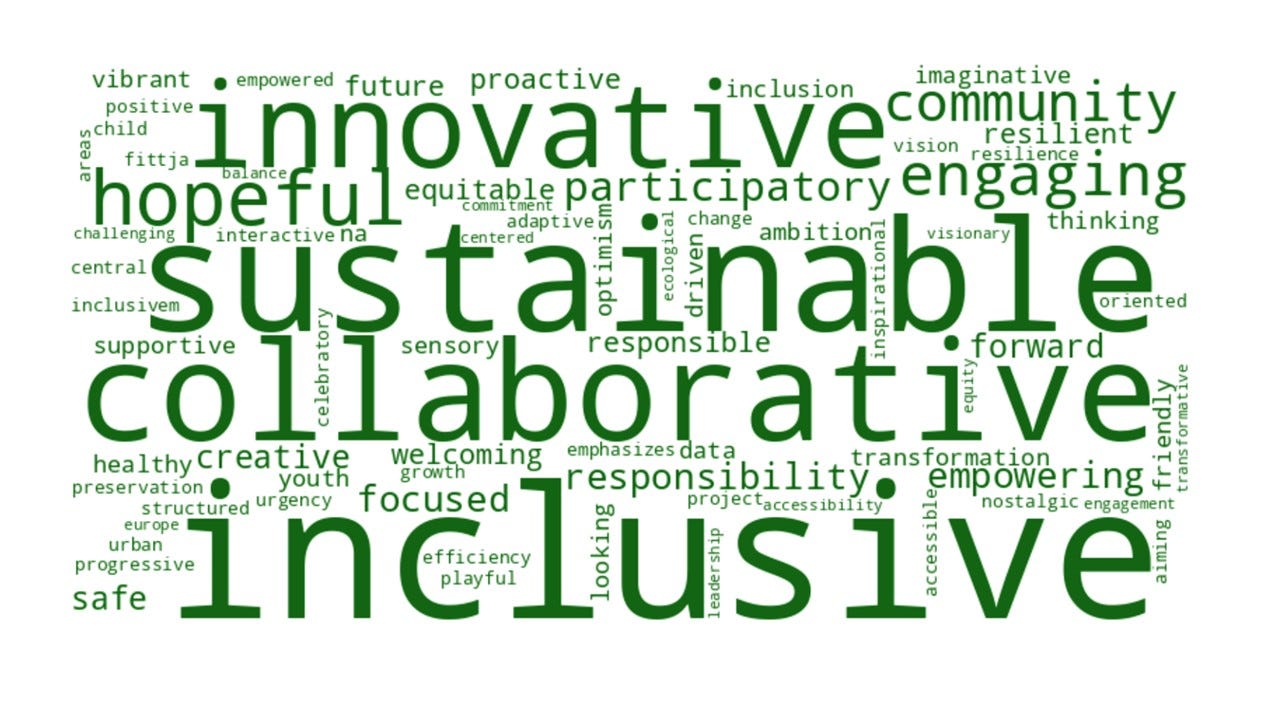
Word cloud of project descriptions of the envisioned futures as translated from Swedish to English (Visual by Shilan Hast)
Youth Engagement and Social Inclusion: we found that about 32% of the activities identified have included some structured forms of youth participation in their futuring activities. Some even had a very clear and specific focus on young people such as is for instance the project titled: “Youth Up North”. The importance of engaging younger generations in shaping urban futures is known and discussed in the country. However, if we acknowledge that youth is not a homogenous category we might as well suggest that less is known about how such activities are able to capture this diversity and deal with the challenges that come with that.
Regional Disparities: our work also revealed that there are differences in the total count and type of activities across the country. The South of Sweden emerged as a front-runner in such activities, accounting for 52% of all of the recorded in our database. In contrast, Northern Sweden, despite recent growth in initiatives, remains somehow still behind.
As urban areas globally grapple with sustainability and inclusivity challenges, Sweden’s experiences with futuring, foresight, and speculation of urban futures offer some valuable insight and material for other cities. We invite you to read more about our work in this **REPORT** and stay tuned for updates as we continue with the analysis of this data and seek to learn more about how to advance urban futures in their contexts.
Acknowledgement:
This activity received a seed grant from the EcoJust Research Platform at Södertörn University. Romina Rodela’s time has been funded under the grant ID 2019–01886 (FORMAS). The contribution of Shilan Hast to the development of the database and the drafting of the activity report is acknowledged.
References
Frantzeskaki, N., Hölscher, K., Bach, M., & Avelino, F. (2018). Co-creating sustainable urban futures. A primer on applying transition management in cities, Future City, 11.
Guy, S., & Marvin, S. (1999). Understanding sustainable cities: competing urban futures. European Urban and Regional Studies, 6(3), 268–275.
Khakee, A., & Dahlgren, L. (1986). Values in futures studies and long-term planning: Two Swedish case studies. Futures, 18(1), 52–67.
Malmö Stad 2024, https://malmo.se/Facts-and-statistics/Population.html
Statista 2024. Sweden: Urbanization from 2013 to 2023. https://www.statista.com/statistics/455935/urbanization-in-sweden/
Trygg, K., & Wenander, H. (2022). Strategic spatial planning for sustainable development–Swedish planners’ institutional capacity. European Planning Studies, 30(10)
메타데이터
- post_id
- b53244cbdfd1
- slug
- urban-futures-and-visioning-activities-in-sweden-b53244cbdfd1
- url
- https://medium.com/youth-plan/urban-futures-and-visioning-activities-in-sweden-b53244cbdfd1
- canonical_url
- https://medium.com/youth-plan/urban-futures-and-visioning-activities-in-sweden-b53244cbdfd1
- author_url
- https://medium.com/@rominarodela
- status
- ok
- fetched_at
- 2026-07-26 04:48:36