Managing Multiple Depop Shops Without Account Association in 2026
Etsy paid $1.625 billion for Depop in 2021, and the platform now counts more than 35 million registered users, with roughly nine out of ten…
Managing Multiple Depop Shops Without Account Association in 2026
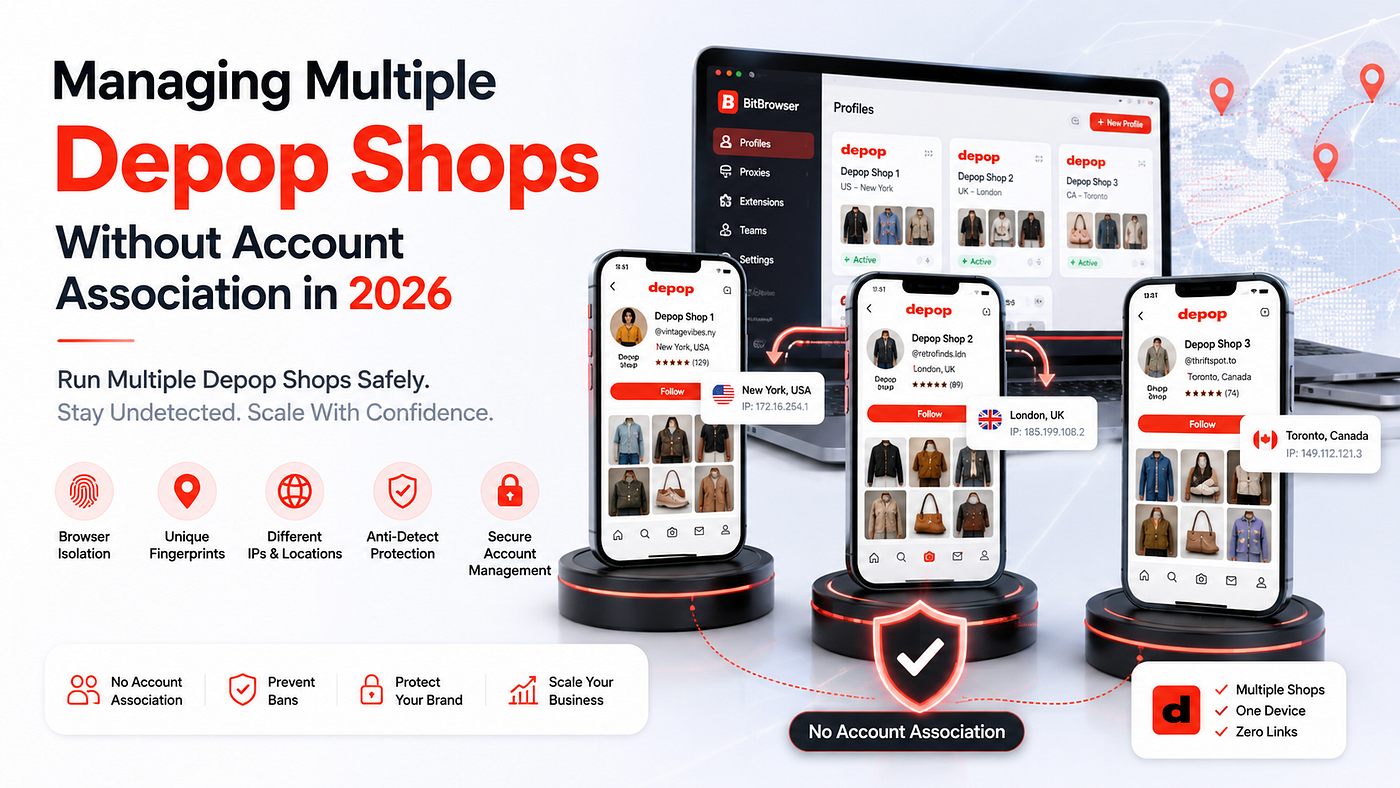
Etsy paid $1.625 billion for Depop in 2021, and the platform now counts more than 35 million registered users, with roughly nine out of ten sessions coming from a mobile device. That mobile-heavy base is exactly why running more than one shop on Depop is harder than most sellers expect. Log into two shops from the same iPhone on the same home Wi-Fi and the platform will link them, sometimes within hours.
Plenty of sellers have legitimate reasons to run multiple shops: a vintage seller splitting menswear and womenswear into separate storefronts, a reseller opening a second shop for a partner, or an agency managing catalogs for several small brands. Depop’s policy allows separate accounts for genuinely distinct businesses, but the platform’s detection systems flag any two accounts that share enough signals, whether the connection is real or accidental.
This guide walks through the technical setup that keeps multiple Depop shops fully separated in 2026.
Why Depop Links Accounts (Even Ones You Never Connected)
Depop inherits a lot of its trust and safety infrastructure from Etsy, which has one of the strongest account-association engines in e-commerce. When two shops share signals the platform considers suspicious, they get grouped together in an internal graph, and enforcement action taken against one usually cascades to the other.
The signals that trigger association fall into three groups:
Device and browser signals. Canvas fingerprint, WebGL renderer, installed fonts, screen resolution, timezone, audio context hash, and the user agent string. Two browsers with matching canvas hashes and matching WebGL renderers are almost certainly the same physical device. Depop reads all of these on every session.
Network signals. Your public IP, the ASN behind it, DNS resolver, and WebRTC-exposed local IPs. Two accounts sharing a residential IP from the same ISP subnet get flagged fast, especially if login times overlap.
Behavioral and identity signals. Payment method (same PayPal or Stripe account across shops is an instant link), shipping address, phone number, email recovery patterns, and even mouse movement or scroll rhythm on newer detection layers. Depop follows the same behavioral fingerprinting direction the wider industry moved to in 2026.
For a deeper look at how the same fingerprint signals cause cascading suspensions across social platforms, the Instagram AI ban wave breakdown covers the isolation playbook agencies now use across every mobile-first platform, including Depop.
What “Account Association” Actually Costs a Depop Seller
A single shop suspension hurts, but the real damage comes from the cascade. When Depop’s trust and safety team links two accounts, enforcement typically applies to both. A ban on shop A pulls shop B down with it, along with the PayPal account tied to either, sometimes even the shipping address on file. Sellers with 500-item inventories lose months of listing work overnight.
Recovery is slow. Depop reinstatement requests go through Etsy’s shared support pipeline, response times often stretch past three weeks, and the reinstatement rate for linked accounts sits well below the rate for isolated single-account appeals. Prevention is the only reliable path.
The Three-Layer Isolation Setup That Actually Works
Sellers who successfully manage multiple Depop shops long-term rely on the same architecture used across other mobile-first marketplaces: an antidetect browser for desktop management, cloud Android phones for scaled posting, and cloud iOS phones for shops that need to look exactly like the iPhone-native buyer base Depop is built around. Each layer solves a problem the others cannot.
Layer 1: BitBrowser for Desktop Management

Depop’s seller dashboard runs in a browser, and this is where BitBrowser sits at the center of a clean multi-shop workflow. Each Depop shop lives inside its own BitBrowser profile, and each profile carries its own persistent fingerprint: a unique Canvas hash, WebGL renderer, screen resolution, font stack, and timezone. Profiles remain fully isolated at the cookie, localStorage, and IndexedDB level, so nothing from shop A ever bleeds into shop B.
Two features matter most for Depop work:
- Per-profile proxy binding. Every shop can be tied to its own residential or mobile proxy, so the IP that logs in matches the geographic identity of the shop (a London-based vintage shop keeps a UK residential IP, a Los Angeles reseller keeps a US one). BitBrowser supports HTTP, SOCKS5, and SSH proxies natively, and the assignment is per-profile rather than per-launch.
- Team access without linkage. Multiple team members can log into the same profile from different physical locations without triggering association, because the profile itself carries the identity, not the operator’s machine.
For the technical details on how to test each profile for fingerprint leaks before going live, this fingerprint test tools reference covers the seven checks every multi-account operator should run weekly.
Layer 2: BitCloudPhone for Scaled Mobile Posting

Depop is a mobile-first platform. Around 90% of listings are uploaded from the mobile app, and the app has features (story-style posts, in-app camera edits, DM flows) that the desktop web version does not expose. If you run more than two or three shops, you need real mobile devices.
This is where BitCloudPhone fits in. It gives each Depop shop a dedicated cloud Android phone with its own IMEI, GPS coordinates, device model, carrier, timezone, and SIM data. The devices run 24/7 in a data center, carry unique hardware parameters that Depop’s app-level detection treats as distinct physical phones, and each one can be bound to its own mobile proxy so the network identity matches the device identity.
For sellers running 10 to 50 shops, the economics are clear: a fleet of cloud Android phones costs a fraction of a rack of physical devices, the devices never sleep, and the built-in RPA layer handles bulk listing uploads, message replies, and re-list cycles without a human watching each device.
Layer 3: BitCloudPhone-iOS for Shops That Need a Real iPhone

Depop’s core demographic is Gen Z, and Depop’s Gen Z base is heavily on iOS. In the US and UK markets, iPhone accounts for well over half of Depop’s mobile sessions. For shops targeting those markets specifically, or for shops that need to look exactly like a native iOS user (matching iOS-specific fingerprints, App Store install patterns, and iCloud presence), an Android cloud phone is not always enough.
BitCloudPhone-iOS is the current answer. It is the only cloud iPhone service on the market in 2026, launched as a separate product line alongside the Android version. Each cloud iPhone carries its own device model (iPhone 14, 15, or 16 profile), iOS version, carrier profile, and network stack, and supports bulk operations across Depop, Poshmark, TikTok, Instagram, and Snapchat from a single dashboard.
For any Depop shop that needs to interact with the app on the same iOS version and carrier profile as its buyers, this is currently the only realistic setup at scale. The parallel Etsy multi-shop isolation guide on Paragraph covers the same architecture for Etsy shops managed under Depop’s parent company.
Operational Rules That Keep the Setup Working
The tools handle the technical isolation. The human side of the workflow is what breaks the isolation if you get it wrong.
One payment method per shop. Never share a PayPal, Stripe, or bank account across two shops. This is the single fastest way to trigger association, and no browser or cloud phone will save you from it. Register a fresh payment method for every shop.
One shipping address per shop where possible. If two shops must ship from the same warehouse, use different sender names. Depop pulls shipping metadata from label services and cross-references it.
Warm up new shops slowly. A shop that lists 50 items on day one gets flagged for automated behavior. Real sellers list three to five items in their first week and gradually build activity. Match that pattern.
Stagger login times across shops. Two shops that always log in within the same minute look like the same operator switching accounts. Space the sessions out with the scheduling tools inside BitCloudPhone.
Rotate proxies on a schedule that matches real life. Use sticky sessions of a few hours to a few days, not permanent bindings.
Quick Answers to Common Questions
Does Depop officially allow multiple shops? Yes, for genuinely distinct businesses. The platform’s terms permit separate accounts for separate ventures. The isolation setup described here prevents false-positive linkage of legitimate separate businesses.
Can I just use incognito mode? No. Incognito clears cookies but leaves every other fingerprint signal intact, and Depop links accounts on fingerprint far more than on cookies.
Do I need both a cloud Android phone and a cloud iPhone? Only if you run shops targeting different device demographics. iOS-heavy markets like the US and UK favor the cloud iPhone.
How many shops can I realistically manage? With the three-layer setup, teams of two to three people manage 20 to 50 Depop shops without a pattern of suspensions.
The Setup at a Glance
Multiple Depop shops in 2026 stay separate when every shop has four things: its own browser profile with a unique fingerprint, its own mobile device with unique hardware parameters, its own IP address matching its geographic identity, and its own payment and shipping identity. Miss any one and the association engine will eventually connect the dots.
The tooling stack that delivers all four cleanly is BitBrowser on desktop, BitCloudPhone for scaled Android posting, and BitCloudPhone-iOS for shops that need to look like a real iPhone user. That is the setup professional resellers are running in 2026, and it is the setup that keeps a growing catalog of shops out of Depop’s association graph.
메타데이터
- post_id
- b53aa23f837f
- slug
- managing-multiple-depop-shops-without-account-association-in-2026-b53aa23f837f
- url
- https://medium.com/@amigoseo/managing-multiple-depop-shops-without-account-association-in-2026-b53aa23f837f
- canonical_url
- https://medium.com/@amigoseo/managing-multiple-depop-shops-without-account-association-in-2026-b53aa23f837f
- author_url
- https://medium.com/@amigoseo
- status
- ok
- fetched_at
- 2026-08-21 14:20:37



