Is the Turing Test Still Relevant in the Age of Modern AI?
The Turing Test, originally called the Imitation Game, proposed by Alan Turing in 1950, was a groundbreaking concept in the world of…
Is the Turing Test Still Relevant in the Age of Modern AI? Do We Need a New Approach to Measure Consciousness?
The Turing Test, originally called the Imitation Game, proposed by Alan Turing in 1950, was a groundbreaking concept in the world of artificial intelligence. Turing suggested that if a machine could engage in a conversation that was indistinguishable from that of a human, it can be considered to possess “intelligence”. The test has been the gold standard for measuring AI’s human-like capabilities for decades. But in today’s rapidly evolving landscape of advanced machine learning models and large language models (LLMs), the question arises: Is the Turing Test still relevant?
In its simplest form, the Turing Test involves an evaluator engaging in a text-based conversation with both a human and a machine. If the evaluator cannot reliably tell which is which, the machine has passed the test.
Modern AI and the Turing Test
Today, we have AI models like DeepSeek, ChatGPT, and other Large Language Models (LLMs) that generate remarkably human-like text. These models have access to vast datasets and can simulate sophisticated conversations, making them capable of passing the Turing Test in some scenarios. In fact, many AI systems can engage in deep and meaningful conversations with users that feel quite natural.
However, while these models may appear intelligent, they do not possess true consciousness or understanding. Their responses are based on patterns and statistical probabilities, not on internal awareness or subjective experience. These intelligent agents don’t “know” what they’re saying — they simply predict what words or phrases should come next based on their training.
Are They Beating the Turing Test?
In some ways, modern LLMs can and do pass the Turing Test — at least in specific, narrow contexts. A casual conversation with ChatGPT might make it hard for some people to distinguish between a human and AI. But in more complex or abstract scenarios, where understanding and reasoning beyond mere pattern recognition are required, modern AI falls short.
For instance, AI models still struggle with common-sense reasoning, empathy, and understanding context in deep or nuanced conversations. They might generate plausible-sounding responses, but they lack true understanding or an internal model of the world. This highlights a significant limitation of the Turing Test as a measure of “true” intelligence.
In the age of deep learning and neural networks, the Turing Test seems increasingly outdated as it focuses mainly on mimicry rather than understanding. Modern AI research is shifting towards more comprehensive approaches that evaluate:
- Reasoning and Problem-Solving: Can AI truly reason and solve problems in creative ways, or is it merely mimicking human-like responses?
- Consciousness and Self-Awareness: Are we closer to understanding AI’s potential for consciousness, or is this still a distant goal? Current AI models are far from being self-aware; they don’t have an internal experience or understanding.
- Ethical Considerations: As AI grows more capable, we must also consider the ethical implications of machines that can convincingly mimic human behaviour. How do we ensure responsible use and prevent manipulation?
Alternative Approaches to Assess AI’s “Intelligence”
As AI continues to evolve, it’s becoming clear that the Turing Test alone may not be enough to gauge a machine’s true cognitive abilities. Instead, we need new methods to better understand and measure AI’s intelligence, reasoning, and potential for consciousness. Here are some of the approaches gaining traction:
- Cognitive Modelling: This approach focuses on developing AI systems that mimic human-like thinking processes. It goes beyond simply reacting to stimuli and aims to replicate how humans reason, learn, and solve problems. By creating models that simulate human cognition, we can better assess whether AI systems can think and reason like we do.
- Theory of Mind: This test evaluates whether AI systems can understand and predict the mental states of others. Can AI recognise emotions, beliefs, or intentions in humans? A system with a “theory of mind” could anticipate how others might react or think, a key feature of human intelligence that AI has yet to fully replicate.
- Ethical and Social Responsibility Testing: As AI becomes more integrated into society, it’s essential to assess whether these systems behave ethically. This approach would measure an AI’s decision-making processes for fairness, transparency, and moral reasoning. Can AI systems make ethical choices in complex, real-world situations?
- Consciousness and Self-Awareness Testing: Though still far from reality, testing for AI consciousness would involve evaluating whether a system can demonstrate self-awareness — understanding its existence, actions, and place in the world. This approach goes beyond mimicry and tests for deeper, more fundamental cognitive abilities.
By shifting focus to these more comprehensive approaches, we could gain a clearer picture of whether AI is truly intelligent, not just convincingly human.
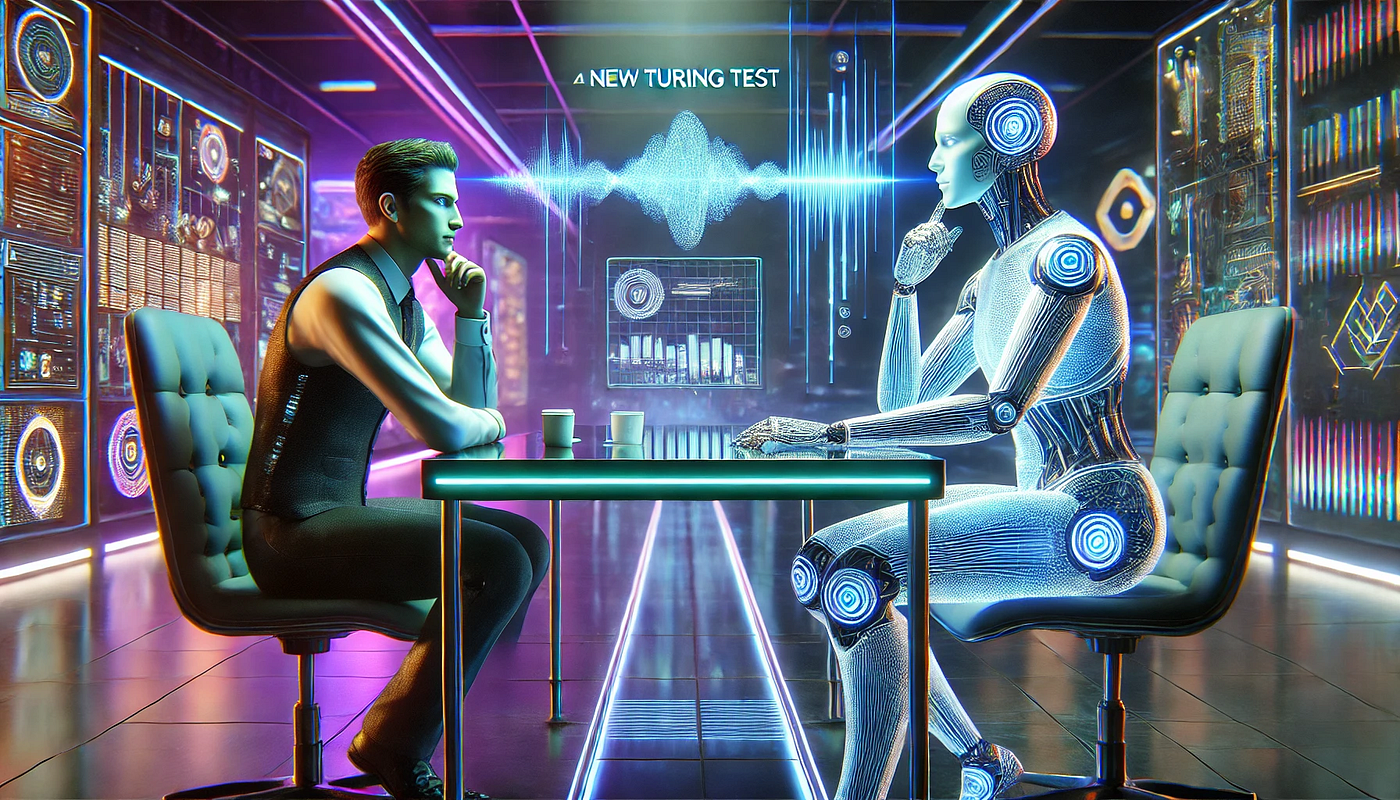
An creative illustration generated through LLMs.
With Love,
Arun
메타데이터
- post_id
- b548dd6a85bc
- slug
- is-the-turing-test-still-relevant-in-the-age-of-modern-ai-b548dd6a85bc
- url
- https://medium.com/analytics-vidhya/is-the-turing-test-still-relevant-in-the-age-of-modern-ai-b548dd6a85bc
- canonical_url
- https://medium.com/analytics-vidhya/is-the-turing-test-still-relevant-in-the-age-of-modern-ai-b548dd6a85bc
- author_url
- https://medium.com/@arunprasadmohan
- status
- ok
- fetched_at
- 2026-06-13 07:35:29