10 Crimes Oromumma Committed Against Amharas in Addis Ababa
🔴 1. Demolishing and Evicting Amharas from Their Homes
10 Crimes Oromumma Committed Against Amharas in Addis Ababa
🔴 1. Demolishing and Evicting Amharas from Their Homes
In and around Addis Ababa, more than one hundred thousand people, the vast majority of them Amharas, have been ethnically cleansed or forcibly evicted by Oromumma officials. These evictions systematically target Amhara neighborhoods, where homes are demolished without compensation or access to legal recourse.
In a recent wave of operations, over nine thousand three hundred homes belonging to non-Oromo residents, predominantly Amharas, were destroyed in kebeles such as Jemo, Terara Medihanialem, Fanuel Church, Haji Anba, and Lideta. Entire families were forced into makeshift tarp shelters or pushed into substandard rentals on the city’s periphery. Eviction notices often arrive just hours or days before demolition, offering no time for appeal or relocation. These practices directly violate international standards on forced evictions.
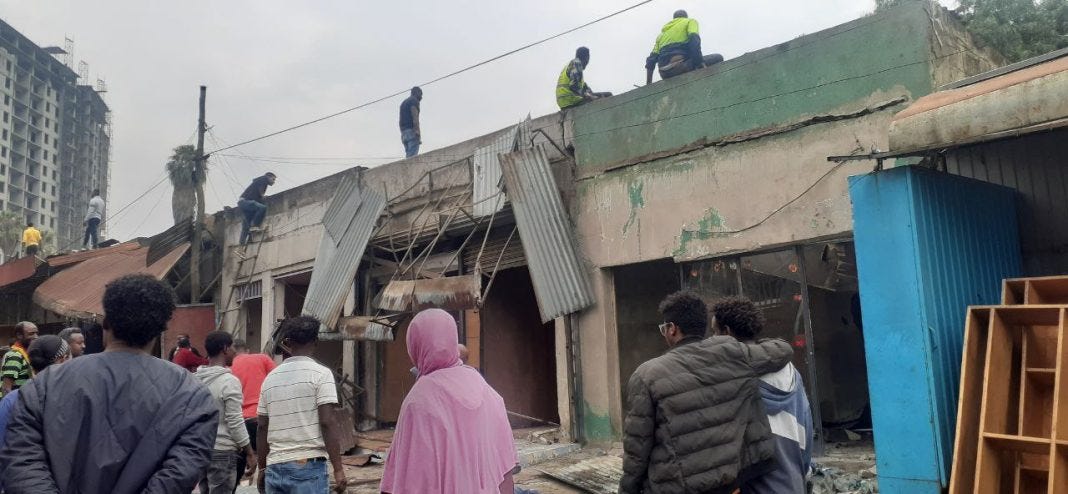
Meanwhile, homes owned by Oromo residents in the same areas are spared. This selective targeting reveals an ethnic strategy designed to shift the demographic balance of the capital. The city’s Corridor Development Project, marketed as urban beautification and modernization, has disproportionately uprooted Amhara families, entrepreneurs, and long-standing communities. Behind the official language of development lies a calculated effort to dispossess and erase Amharas from Addis Ababa.

🔴 2. Economic War on Amhara-Owned Businesses
Opening and operating a business as an Amhara in Addis Ababa has become nearly impossible. From the very first steps, Amhara entrepreneurs face deliberately obstructive barriers including endless licensing delays, repeated rejections, and unexplained bureaucratic hurdles. Even when approvals are granted, arbitrary audits and selective enforcement of regulations follow, targeting Amhara-owned businesses with intense scrutiny.
In many instances, officials have pressured Amhara business owners to bank exclusively with Oromia-based financial institutions and threatened to deny registration if they refuse. Local tax inspectors and health and safety officers frequently conduct unannounced raids, imposing excessive fines for minor or fabricated infractions. At the same time, identical violations at Oromo-owned businesses are ignored, exposing a clear double standard driven by ethnic favoritism.
At least thirty Amhara-owned businesses have been shut down without cause in the past year. These are not isolated incidents. Each closure is part of a broader strategy to strip Amharas of economic power, drain them of capital, and transfer wealth to a new Oromo elite. This campaign is not about regulation or red tape. It is a systematic effort to marginalize Amharas, eliminate their presence in the city’s economic life, and ensure Oromo dominance in Addis Ababa’s future.
🔴 3. Attacking Orthodox Christianity and Amhara Clergy
Orthodox Tewahdo Christianity is treated as an existential threat by Oromumma because of its deep connection to Amhara identity. This targeting has become systematic and violent. At least twelve priests and deacons have been arrested, beaten, or killed for defending displaced victims, and security forces have disrupted Easter and Timkat services in major cathedrals by sealing entrances and harassing worshippers. In one monastery, more than twenty precious icons were destroyed and religious relics looted, reflecting the regime’s disregard for sacred heritage.
The attack on the Church extends beyond physical violence. Church lands and schools have been confiscated and handed over to state-controlled religious bureaus, cutting off vital income streams and weakening the Church’s institutional foundation. Seminary curricula have been rewritten to erase Amhara saints and replace them with Oromo nationalist doctrine, eroding the Church’s theological lineage. Bishops have been appointed without the consent of the Synod, violating centuries-old church canons and undermining religious self-governance. These appointments ignore Ethiopia’s constitutional promise of religious freedom and instead reflect an authoritarian attempt to control the Church’s leadership.
International religious organizations have condemned these actions, recognizing them as part of a larger effort to dismantle the historic authority of the Orthodox Church, strip it of spiritual influence, and replace it with a politicized structure that answers to Oromumma.
🔴 4. Oromumma Weaponizing and Politicizing Education to Target Amhara Students
The education system in Addis Ababa is being used as a political weapon to humiliate Amhara students and force their submission to Oromumma ideology. Dozens of teachers and hundreds of students have been detained and beaten by security forces after refusing to sing the Oromia regional anthem in schools. These actions reflect a broader agenda of Oromization, where students are forced to learn Afaan Oromo and comply with Oromo nationalist symbols, even in private institutions.
Amhara students face systemic academic discrimination. In many schools, exams and administrative instructions are increasingly delivered in Afaan Oromo, a language not native to most Amhara students, placing them at a deliberate disadvantage. National exit exams for grades eight and twelve are frequently leaked to Oromo students in advance, while Amhara students are left unprepared and unsupported. In several instances, Amhara students were denied re-exams or appeals, even when identical allowances were quietly granted to Oromo students in the same locations.
Afaan Oromo is being made compulsory in Addis Ababa schools, while Amharic, the official federal language, there is an attempt to treat it as being optional and sidelined. Schools in Amhara-populated neighborhoods receive fewer resources, older textbooks, and underqualified teachers, while schools in Oromo districts enjoy better funding and full institutional support. Amhara students are also penalized for celebrating their culture or faith. Student clubs that promote Orthodox identity or Amhara history are banned, while Oromo cultural organizations operate freely with school approval.
Teachers who resist or speak out are punished. Amhara educators who raise concerns about bias in curriculum or language policy are demoted, reassigned, or removed entirely. At the same time, Oromo administrators who enforce these policies face no consequences. Amhara students are also pressured to participate in Oromumma political rallies and propaganda events under threat of academic penalties, while refusal can lead to exclusion from scholarships and student opportunities.
This is not education. It is organized indoctrination, resource manipulation, and linguistic warfare designed to replace Ethiopian national identity with Oromo supremacy and to marginalize Amhara students both culturally and academically within state-controlled schools.
🔴 5. Erasing Amhara History and Culture
Addis Ababa is increasingly being portrayed as an exclusively Oromo city, with a political campaign underway to formally incorporate it into the Oromia Region. As part of this effort, symbols of Ethiopia’s shared history under Amhara leadership are being systematically erased. References to Emperor Menelik II and the 1896 victory at Adwa are gradually replaced with a revisionist Oromo narrative in textbooks, public ceremonies, and street signage, deliberately downplaying Amhara contributions to the nation’s history.
Adwa celebrations have been banned, and during recent commemorations, images and T-shirts featuring Menelik II were prohibited while gatherings around his statue were blocked by security forces. In some cases, his imagery has been replaced with that of contemporary leaders like Abiy Ahmed in an attempt to shift the historical focus toward modern political symbolism. Historical buildings and homes are also being deliberately demolished to erase the identity and cultural memory of the city, which is increasingly portrayed as an Amhara legacy incompatible with the Oromumma narrative. This systematic destruction targets landmarks, architecture, and neighborhoods that reflect Addis Ababa’s multiethnic and imperial past, replacing them with developments designed to assert a new ethnic and political order.
In Harar, under government orders, Oromo youth toppled and destroyed the statue of Ras Mekonnen, an act that was met with celebration by Oromo extremists who viewed it as a victory for Amhara erasure.


These efforts form part of a deliberate and coordinated campaign to rewrite the capital’s historical narrative, eliminate Amhara contributions from Ethiopia’s national memory, and reconstruct Addis Ababa’s identity as exclusively Oromo.
🔴 6. Ethnic Profiling of Amharas
Security forces in Addis Ababa routinely target Amharas based on their name, accent, religion, and region of origin. Individuals are stopped and interrogated for speaking Amharic with a northern dialect, for having names associated with Gondar, Gojjam, or Wollo, or for wearing Orthodox crosses and traditional clothing. Public symbols such as the plain green-yellow-red flag or images of Menelik II, Atse Tewodros, or Haile Selassie are treated as acts of defiance. Those displaying them are harassed, detained, or labeled as threats under vague accusations of anti-government activity.
Once in custody, many Amharas are falsely accused of being affiliated with Fano, often without any evidence or due process. Phones are searched without a warrant, and simple photos of Orthodox religious events, historical figures, or Amhara resistance are used as justification for prolonged detention. These detentions are not grounded in public safety but are part of a calculated effort to criminalize Amhara identity.
This profiling is widespread and systematic. Security forces use ethnic cues to identify and isolate Amharas for humiliation, intimidation, and incarceration. The goal is not simply to monitor dissent, but to erase public expressions of Amhara culture and to send a warning that their presence in the capital is unwelcome. What is happening in Addis Ababa is not random policing. It is targeted repression carried out with the intent to suppress and eliminate Amhara identity from public life.
🔴 7. Blocking Amharas from Government Jobs
Amharas are routinely excluded from civil service and public employment through loyalty filters and ethnic bias. A selective language requirement is enforced where Amharas are disqualified for not speaking Afaan Oromo, while Oromo hires are placed in federal roles without needing to speak Amharic, the official federal language. Applicants are screened out if their names or accents mark them as from Amhara-majority regions, regardless of merit or qualifications. Even top graduates are rejected because they are amhara and if they are perceived as unsupportive of Oromumma ideology.
This exclusion extends into the security sector as well. Amhara Addis Ababa police officers and security personnel are being systematically removed from positions of power, fired without cause, and replaced with Oromo police officers from surrounding cities . These replacements are not about qualifications or performance but about consolidating institutional control. At the Ethiopian Broadcasting Corporation, Amharas have been purged from key roles to ensure Oromo dominance in national media. Similar purges have been reported across education, health, administrative, and municipal departments. This is not isolated discrimination. It is a coordinated effort to transfer institutional power into the hands of Oromumma loyalists and eliminate Amhara representation from the public sphere.
🔴 8. Organized Oromo Mobs Attack Amharas in Addis Ababa While Police Stand Down
Amhara civilians in Addis Ababa have been hunted, beaten, and killed by organized Oromo mobs during politically charged periods, often with the full knowledge and silent approval of the authorities. These mobs rampage through neighborhoods, burning homes, destroying businesses, and chanting ethnic slurs as they target anyone who appears Amhara, speaks Amharic, or wears symbols tied to Amhara identity. Security forces are frequently withdrawn before the violence begins or remain idle as it unfolds, refusing to intervene even as lives are lost and communities are shattered.

These attacks are not isolated incidents. They have occurred during events such as the Burayu massacre, the unrest following the death of Hachalu Hundessa, and the aftermath of Jawar Mohammed’s arrest. In each instance, the perpetrators act with impunity while survivors are left with no justice, no protection, and no compensation. The total absence of investigation or accountability is not accidental. It reveals a calculated strategy: this is not spontaneous mob violence. It is state-enabled ethnic cleansing and massacre carried out in plain sight within the capital.
🔴 9. Political Crackdowns To Silence Amharas and the Criminalization of Amhara Civil Society
Security crackdowns in Addis Ababa overwhelmingly target Amharas under the false pretense of national security and anti-extremism. Amhara politicians, activists, civil servants, students, and clergy have all been arrested without due process, often without formal charges or access to legal representation. Entire sweeps are carried out in neighborhoods suspected of being Amhara, with people detained for nothing more than attending church, posting on social media, or speaking out against state abuses. While Amharas are dragged from their homes and jailed, Oromo political actors openly mobilize with full state protection.
This campaign of repression extends beyond individuals. Amhara-led civil society organizations, NGOs, and advocacy groups are treated as threats to state authority. Licenses are suspended without explanation, public events are blocked, and members are harassed, detained, or forced into hiding. Legal aid networks and human rights monitors that document abuses by Oromumma-aligned forces are raided and shut down, with records confiscated and staff targeted. Independent Amhara media outlets such as Fithi Radio and Ethio Press Services have been shut down under vague accusations of incitement. Journalists reporting on Orthodox Church repression, Fano resistance, or government abuses face arrest or exile, with many fleeing to countries like Uganda to avoid persecution. Social media pages and websites run by Amhara advocacy groups are routinely blocked and erased under broad emergency laws.
The objective is clear. It is a coordinated strategy to eliminate not only the political voice of Amharas but also the institutional structures that give them visibility, protection, and the ability to document their own persecution. By dismantling civil society and silencing public expression, the state seeks to erase Amharas from the civic and political life of the capital entirely.
🔴 10. Coordinated Hate Speech and State-Sanctioned Incitement on Amhara people
Oromo nationalist politicians, state media, and affiliated influencers openly promote hatred against Amharas, echoing Prime Minister Abiy Ahmed’s rhetoric that labels Amhara critics as enemies of the state and accuses anyone who challenges Oromumma policies of inciting terrorism. In televised debates and official speeches, Amharas are portrayed as extremists who oppose federalism and as traitors to the national project. Prominent anchors frame any defense of Amhara rights as a security threat, often inviting guests who equate Amhara cultural festivals with secessionist agendas. Influencers with large followings circulate videos accusing Amharas of benefiting from national instability and encourage so-called patriots to push them out of public life.
Amhara religious leaders who defend their congregations or speak out about repression are branded as terrorists or collaborators and are targeted in coordinated social media campaigns. Hashtags like Stop the Fifth Column accompany manipulated video clips demanding their arrest, while official government channels amplify these messages with calls for zero tolerance against what they label as religious dissent. This climate of incitement has fueled widespread vigilantism. In multiple cities, mobs have attacked Amhara-owned businesses and pedestrians accused of spreading hatred.
By flooding the media and online platforms with dehumanizing language and conspiracy theories, Oromumma elites have normalized anti-Amhara bigotry and created the conditions for escalating repression and violence. What begins as state-sanctioned hate speech ultimately results in real-world persecution, silencing, and bloodshed.
메타데이터
- post_id
- b55252bcbada
- slug
- 10-crimes-oromumma-committed-against-amharas-in-addis-ababa-b55252bcbada
- url
- https://medium.com/@johnmikael/10-crimes-oromumma-committed-against-amharas-in-addis-ababa-b55252bcbada
- canonical_url
- https://medium.com/@johnmikael/10-crimes-oromumma-committed-against-amharas-in-addis-ababa-b55252bcbada
- author_url
- https://medium.com/@johnmikael
- status
- ok
- fetched_at
- 2026-07-19 02:09:36