Many Children Struggle to Speak — But Does Anyone Notice?
(A new study asks what Bangladeshi university students know about a hidden language condition affecting millions of children)
Many Children Struggle to Speak — But Does Anyone Notice?
(A new study asks what Bangladeshi university students know about a hidden language condition affecting millions of children)
Imagine a child who goes to school every day, sits in class, listens carefully — but still cannot find the right words to answer a question or tell a story. Not because they are not smart. Not because they are not trying. But because of a condition most people have never heard of.
That condition is called Developmental Language Disorder, or DLD. And according to a new research study from Bangladesh, the people around these children — the future teachers, parents, and professionals of the country — may not know nearly enough about it.
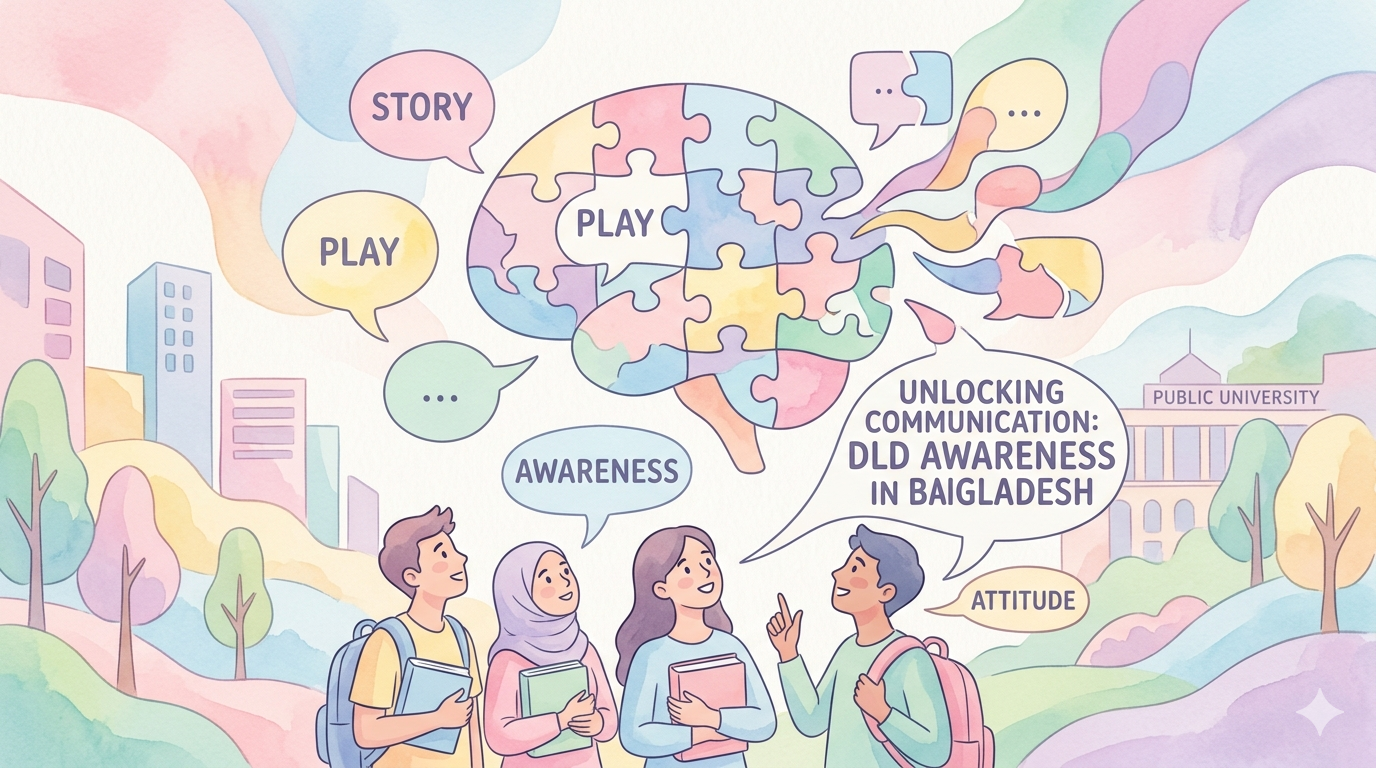
Image Created by Gemini
So, What is DLD?
Think of it this way. Most children learn to talk almost like magic. They hear words around them, and slowly — almost naturally — they start putting sentences together. But for some children, that magic does not quite happen in the usual way.
Children with DLD have difficulty understanding and using language. They might struggle to follow instructions, tell stories in order, find the right words, or understand what someone said to them — even though their hearing is perfectly fine and they are no less intelligent than their peers.
“DLD is not about intelligence or effort. It is a hidden condition that affects how the brain processes language — and it affects about 1 in 14 children worldwide.”
Because DLD does not have an obvious physical sign, it often gets missed. Children may be labelled as “slow,” “lazy,” or “not paying attention” when in reality they need specific support.
What Did the Researchers Study?
The researchers wanted to know: do young people in Bangladesh — university students who will soon become the teachers, doctors, social workers, and parents of tomorrow — actually know what DLD is?
They surveyed 167 students from public universities spread across all eight administrative divisions of Bangladesh. These were young adults between 18 and 30 years old. The researchers asked them three things:
- Awareness: Had they heard of DLD? How much did they think they understood it?
- Knowledge: What did they actually know — the facts — about DLD?
- Attitudes: How did they feel about children with DLD? Were they kind, supportive, accepting?
What Did They Find?
Here is where it gets interesting — and a little worrying.


In other words, students felt confident about DLD — but that confidence was not backed by real understanding. This is a concerning pattern, because someone who thinks they already know enough about something is less likely to seek out more information or training.
The Good News: People Have Kind Hearts
Despite the knowledge gap, the study found something genuinely encouraging. Students showed positive and supportive attitudes toward children with DLD. They were not dismissive or unkind. They were open-minded and willing to support such children.
This matters more than it might seem. The study found that attitude — how people feelabout DLD — actually had a stronger influence on awareness than factual knowledge did. In other words, if someone cares and has a good heart, they are more likely to want to learn and help. That is a powerful starting point.
Good attitudes can open the door to better knowledge. The warmth is already there — it just needs to be paired with the right information.
Who Knew More — and Who Knew Less?
The study also looked at differences between groups:
- Female studentsscored higher than male students in awareness, knowledge, and attitudes across every area measured.
- Students from Dhakaknew more and had better attitudes compared to students from other parts of the country — likely because Dhaka has more hospitals, schools, and resources where DLD might be discussed.
- Students from more remote or peripheral areashad less exposure to DLD — meaning the knowledge gap is especially large outside of major cities.
This tells us that where you grow up and study shapes what you know. Children with DLD in smaller cities and rural areas may be even less likely to be noticed and helped, because the adults around them simply have not heard of the condition.
Why Does Any of This Matter?
You might wonder: why does it matter whether a university student knows about DLD?
It matters because today’s university students are tomorrow’s teachers, parents, healthcare workers, and community leaders. If a teacher does not recognise DLD, they may punish or ignore a child who is actually struggling with a language disorder. If a parent has never heard of it, they may feel ashamed of their child instead of getting them the help they need.
Early identification and support for DLD can change a child’s entire life. Children who get the right help at the right time can learn to cope, communicate, and thrive. But that only happens when someone around them knows what to look for.

What Should We Do with This Information?
The researchers are clear: good intentions are not enough. Positive attitudes must be combined with real knowledge and education. Here is what they recommend:
- University curricula should include sessions on DLD and other language disorders, especially in education, psychology, and health-related departments.
- Awareness programs should reach all corners of Bangladesh, not just major cities.
- Special attention should be given to training male students and students from underserved areas, who showed the most significant knowledge gaps.
- The media, community centres, and mosques can all play a role in spreading simple, correct information about DLD.
FINALLY
Somewhere in Bangladesh right now, there is a child struggling to find their words. Their classmates might laugh. Their teacher might be puzzled. Their parents might be worried but confused. None of them may know the name “Developmental Language Disorder.”
This study is a small but important step toward changing that. By shining a light on how much — and how little — we know, it reminds us that awareness is a gift we can give to children who cannot yet speak up for themselves.
The hearts are in the right place. Now it is time to fill them with the right knowledge.

메타데이터
- post_id
- b556dfdd426b
- slug
- many-children-struggle-to-speak-but-does-anyone-notice-b556dfdd426b
- url
- https://medium.com/@shahriar.k.fahim/many-children-struggle-to-speak-but-does-anyone-notice-b556dfdd426b
- canonical_url
- https://medium.com/@shahriar.k.fahim/many-children-struggle-to-speak-but-does-anyone-notice-b556dfdd426b
- author_url
- https://medium.com/@shahriar.k.fahim
- status
- ok
- fetched_at
- 2026-06-24 16:30:55





