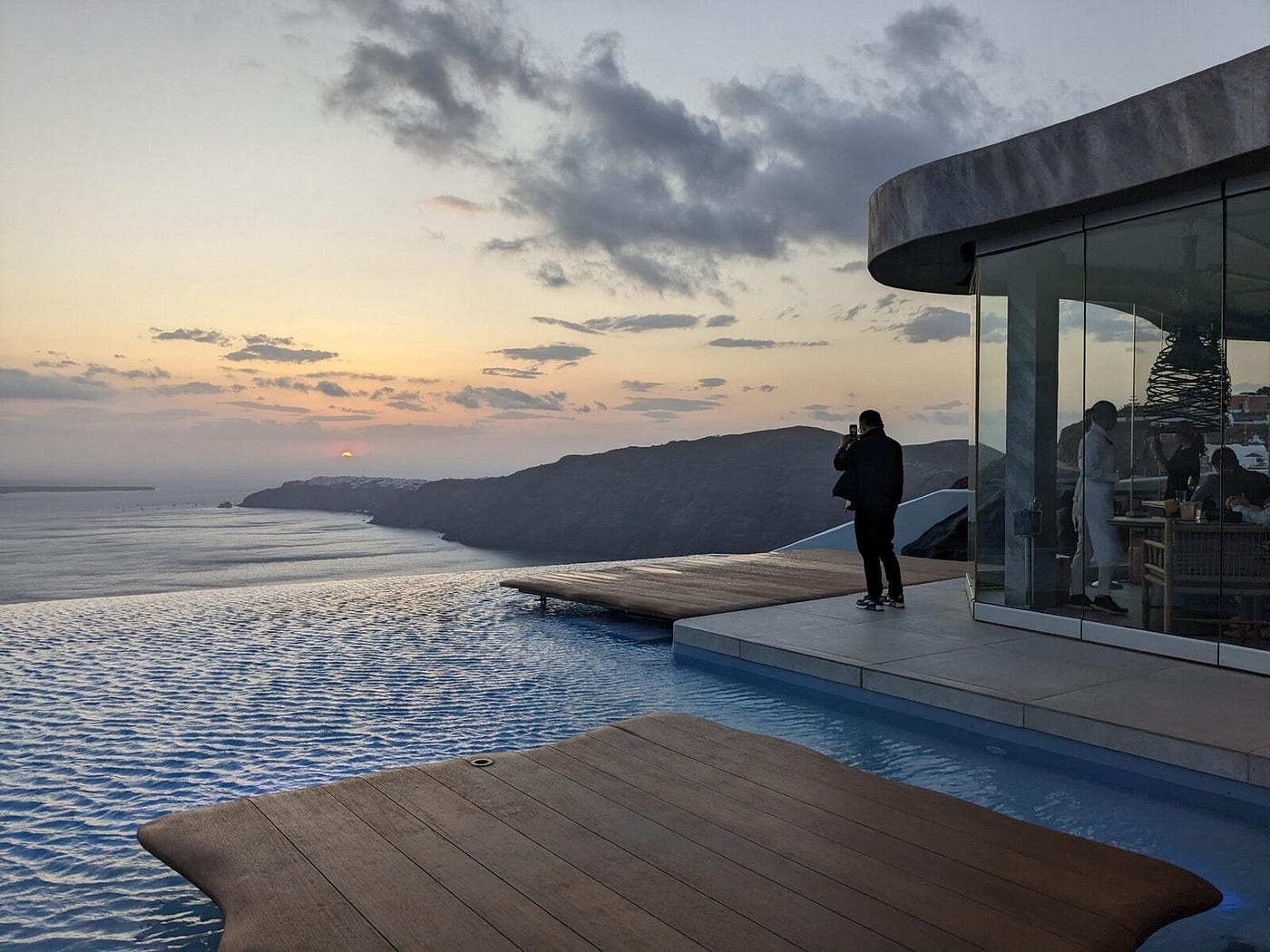
Silicon Valley, June 2018: My Week at Google, Singularity University and Waymo
A personal account of a June 2018 week in Mountain View as a Google guest: Singularity University, the Googleplex, GBikes, Napa wineries…
Silicon Valley, June 2018: My Week at Google, Singularity University and Waymo
A personal account of a June 2018 week in Mountain View as a Google guest: Singularity University, the Googleplex, GBikes, Napa wineries and a first ride in a Waymo self-driving car. Eight years on, what I keep.
In June 2018, I landed in San Francisco with a Google invitation in my pocket and a single obsession: to understand, from the inside, what Silicon Valley was building for the next ten years. Eight years later, much of what I saw — self-driving cars, the Google bikes, the campus-as-manifesto — has become daily life. A personal account.
An invitation you don’t decline
When Google invites you to spend a week in Mountain View to talk innovation, future of work and mobility, you don’t ask twice. At the time, I was running a digital business in Belgium and the brief was a single line: experience California, learn fast, come back changed. I left exactly like that — slightly shaken, infinitely more curious.
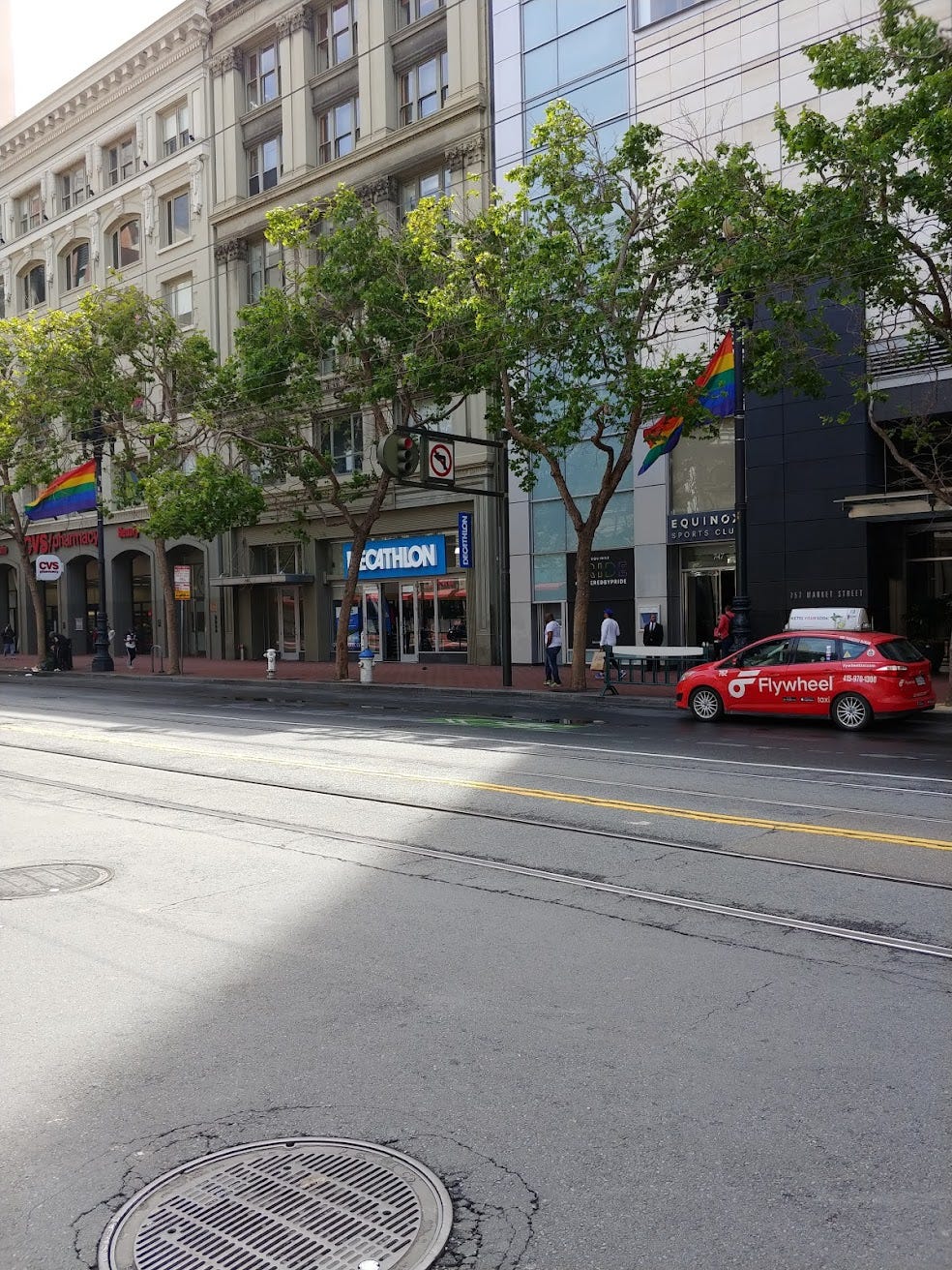
The arrival is through San Francisco. First shock: Market Street, its squealing streetcars, the rainbow flags up for the imminent Pride, and already that mosaic of worlds the city somehow holds together — a brand-new Decathlon next to an Equinox sportsclub, a CVS Pharmacy a stone’s throw from an encampment.
San Francisco from above: the skyline of a utopia
That same evening, view from the 30th floor. Downtown stretches to Twin Peaks, the City Hall dome catches the last light, and below you can guess SoMa, its warehouses turned into startup HQs. It’s that view that made me understand: Silicon Valley is not a geography — it’s a state of mind that irrigates the entire Bay.

Singularity University: learning to think exponentially
The core of the trip was Singularity University, then housed at NASA Ames Research Park. The course is short, dense, disrespectful of disciplines: from generative AI (before it had that name on the street) to biotech, from neuroprosthetics to decentralised energy, from algorithmic ethics to soft robotics.
What I took home wasn’t a syllabus — it was a grammar. Learning to think exponentially rather than linearly. Asking, in front of an emerging technology, not “how long until it works?” but “how long until it doubles, again, and again, and again?”. Eight years on, generative AI proves me right — and wrong, in equal parts.
The rule of the “6 Ds”
Singularity coaches hammered home the six Ds of exponential progress: Digitized, Deceptive, Disruptive, Dematerialized, Demonetized, Democratized. A grid which, applied to cars, books or medicine, predicts pretty well what has happened since. I still use it today when writing about premium mobility or slow travel.
Vineyard detour: Carneros, Napa, and the California that takes its time
Mid-week, an off-programme moment: heading to Napa Valley and the cooler Carneros area, open to San Pablo Bay. Silicon Valley loves to talk wine the way it talks code — by vintage, varietal, terroir. Except here, the tempo turns agricultural again.


The parallel with our Belgian family estates hits me: same care for the soil, same patience — but scale changes everything. We’re talking sensor-driven drip irrigation, algorithm-tuned harvests, degree-precise cellars. Technology in service of taste, not the other way round.
The Googleplex: campus as manifesto
The next day, back to Mountain View for the Googleplex. You enter through the Visitor Center, named badge, and walk across the campus — or rather, you cycle. The real surprise isn’t the architecture (low, modular, very 2000s); it’s the famous GBikes, those four-coloured shared bicycles that run the alleys non-stop.

Any employee can grab one, cross the campus, drop it in front of the next building. At the time, Google managed over 1,100 bikes in the internal scheme — a system so effective that the city of Mountain View regularly fished them out of ditches. What I read in it: a campus first thinks its human flows.
Campus culture, for real
Free canteens, micro-kitchens every fifty metres, nap rooms, prayer rooms, music rooms. You can mock it — I smiled too — but the core idea holds: reduce daily friction to free the brain. That’s exactly what I write today in The New Snobbery: Why “Zero Friction” Replaced “Look at Me” — the intuition germinated there, in June 2018, between two salads.
Waymo: getting into a driverless car, in 2018
The pivot moment of the trip. We were driven — the word matters — to a Mountain View parking lot where the white Chrysler Pacifica Waymo cars were waiting, already crowned with their roof LIDAR dome. For the record, a safety driver remained at the wheel; but the vehicle drove itself, braked itself, swerved by itself.

Eight years later, Waymo One operates commercially in San Francisco, Phoenix, Los Angeles and Austin, with more than 200,000 paid trips a week. What I experienced as a VIP demo is now urban infrastructure. That’s exactly the grammar of the exponential: what looks like a gadget in June 2018 becomes a utility by 2026.
Palo Alto on foot: Stanford Theatre, Oren’s Hummus and Palo Alto Bicycles
To close, I wanted to walk Palo Alto, slowly. University Avenue, its trees, its low storefronts. The Stanford Theatre was screening Singin’ in the Rain and The Adventures of Robin Hood on 35 mm film — a tender anachronism in the capital of scale.


Curiously, it’s those small shops — a rep cinema, a hummus shop, a hundred-year-old bike store — that seemed to hold the soul of the place. The Valley doesn’t live against its small streets; it lives with them. And that’s perhaps what our European cities — Brussels, Antwerp, Liège — should keep defending: the coexistence of the Stanford Theatre and the Googleplex.
What I keep, 8 years on
- Exponential isn’t a metaphor. The self-driving car of 2018 drives in 2026. The grammar works.
- The campus is a manifesto. Reducing daily friction frees thought — a principle I still apply to my travels.
- Silicon Valley needs Napa. The best engineers I met there were the ones who took their Sunday in the vineyards.
- Europe, keep your small streets. It’s what sets us apart — and what, paradoxically, will fuel our next innovation wave.
Frequently asked — Silicon Valley, Google & Singularity University
What is Singularity University and how do you take a course there?
Singularity University is an executive programme founded in 2008 on the NASA Ames campus, focused on exponential technologies (AI, biotech, robotics, energy). Access is via short Executive Programs (4 to 7 days) or the annual Global Solutions Program; registration runs through su.org, and cohorts mix executives, founders and researchers from around the world.
Can you visit the Googleplex in Mountain View as a tourist in 2026?
The Googleplex itself is not open to the public: building access is strictly invitation-and-badge. However, the Visitor Center, the Android Garden and the giant Android statue are freely accessible from the outside — a chance to watch the famous GBikes rolling along Charleston Road.
How can you ride a Waymo self-driving car today?
Waymo One operates commercially in Phoenix, San Francisco, Los Angeles and Austin. Just download the Waymo app, create an account and book a ride like a standard rideshare. The service has run without a safety driver since 2020 in Phoenix and since 2023 in San Francisco.
What is a good one-week itinerary to visit Silicon Valley?
A balanced route combines two nights in San Francisco (Mission, SoMa, Ferry Building), two nights in Palo Alto (Stanford, University Avenue, Oren’s Hummus), a day in Mountain View for Google’s Visitor Center and the Computer History Museum, and half a day in Napa or Carneros — a reminder that the Valley stops exactly where the vineyards begin.
Why does Silicon Valley still matter for a European leader?
Beyond the folklore, Silicon Valley is still the place where the grammar of the exponential — thinking in doublings rather than percentages — is transmitted most efficiently. For a European leader, a week there is less about contacts than about mental recalibration: seeing, for real, what ten years of doubling actually produces.
메타데이터
- post_id
- b55adc310bd9
- slug
- silicon-valley-june-2018-my-week-at-google-singularity-university-and-waymo-b55adc310bd9
- url
- https://medium.com/@gabsous/silicon-valley-june-2018-my-week-at-google-singularity-university-and-waymo-b55adc310bd9
- canonical_url
- https://medium.com/@gabsous/silicon-valley-june-2018-my-week-at-google-singularity-university-and-waymo-b55adc310bd9
- author_url
- https://medium.com/@gabsous
- status
- ok
- fetched_at
- 2026-06-21 07:44:09