Service Tiering: Prioritizing Critical Workloads in Large-Scale Microservice Architectures
Building distributed systems is one thing. Operating them under strict SLAs and highly variable traffic patterns is another with strict…
Service Tiering: Prioritizing Critical Workloads in Large-Scale Microservice Architectures
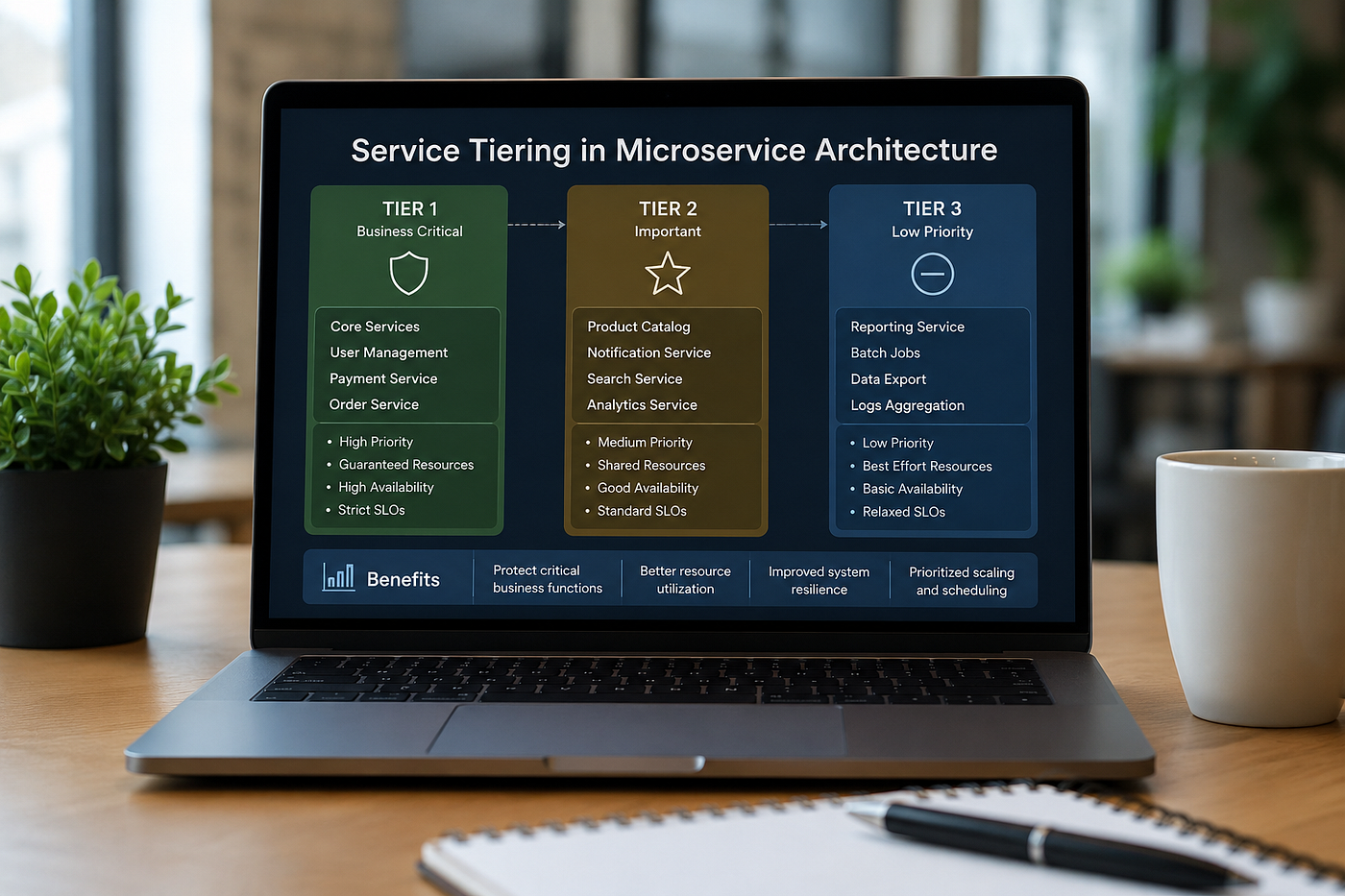
Designing for failure means deciding what must survive. Service tiering provides a structured approach to prioritize critical business functions under resource pressure.
Building distributed systems is one thing. Operating them under strict SLAs and highly variable traffic patterns is another with strict resources
- Millions of meters continuously sending telemetry
- Predictable traffic spikes at specific times of the day
- Massive monthly billing data ingestion
- Strict customer commitments with SLAs such as 99% data availability within T+12 hours
In such systems, a CPU bottleneck or memory saturation is not just a technical issue — it directly impacts business commitments and customer trust. This is where Service Tiering becomes a critical architectural and operational strategy.
The Problem: Not All Traffic Is Equal
A smart meter platform typically handles multiple workloads simultaneously:
Continuous Workloads
- Meter reads
- Instantaneous profiles
- Event ingestion
- Commands and acknowledgements
Burst Workloads
- Monthly billing data
- On-demand synchronization
- Firmware upgrades
- Large-scale device reconnects
Traffic patterns are rarely uniform.
For example:
- Daily peaks occur during meter communication windows.
- Monthly peaks occur when billing data is generated across the fleet.
- Unexpected peaks happen during recovery after communication outages.
During these periods:
- CPU utilization can increase rapidly
- Memory pressure can trigger excessive garbage collection
- Database connections become constrained
- Queue backlogs begin to grow
Without proper prioritization, non-critical workloads can consume resources required by critical business operations
Why Service Tiering Matters
Rather than treating every microservice equally, we categorized services based on business criticality.
Tier 1 — Revenue and SLA-Critical Services
Examples:
- Command Services (CommandExecutor, CommandAggregator, CommandOrchestrator)
- RawdataCollection, MeterDataCollection
- NetworkDataCollection, NetworkDataParser
- ViewerAPI, CommandAPI
These services directly impact contractual SLAs.
If billing data misses the T+12 hour processing window, the business impact is immediate.
Characteristics:
- Highest availability targets
- Dedicated resource allocation
- Aggressive monitoring
- Priority during incident response
Tier 2 — Operational Processing Services
Examples:
- Event Receiver Service
- Network Management Service
- BulkCommandAddition
These services support operational workflows but temporary degradation is often manageable.
Characteristics:
- Moderate availability targets
- Shared infrastructure
- Elastic scaling
Tier 3 — Supporting Services
Examples:
- FieldApi, FieldWorker, FieldUI
- Reporting Services
- Analytics Dashboards
These services provide visibility and insights but are not typically involved in meeting core SLA commitments.
Characteristics:
- Lower restoration priority
- Flexible scaling requirements
- Can tolerate delayed processing
Resource Contention: The Real Enemy

How Service Tiering protects business outcomes: during billing-cycle traffic spikes, resources are shifted away from supporting workloads and reserved for SLA-critical services, ensuring billing and command-processing pipelines continue to meet contractual commitments
In large smart meter deployments, the biggest challenge is often not traffic volume itself.
The challenge is resource contention.
Imagine a billing cycle day:
- Billing data starts arriving from millions of devices.
- Aggregation jobs begin processing.
- Reporting systems generate customer reports.
- Field teams continue sending commands.
If every workload competes equally for:
- CPU
- Memory
- Database connections
- Kafka consumers
- Thread pools
critical services can become starved.
The result:
- Growing queues
- Missed SLAs
- Delayed billing availability
Service tiering provides the framework to ensure business-critical workloads always receive priority access to resources.
Operationalizing Tiering Through DevOps Automation
The real value comes when service tiers are enforced automatically.
Infrastructure Scaling
Tier 1 services can be configured with:
- Higher minimum replica counts
- Faster autoscaling thresholds
- Reserved compute capacity
While Tier 3 services scale opportunistically.
Deployment Prioritization
CI/CD pipelines can enforce deployment order:
- Tier 1 services
- Tier 2 services
- Tier 3 services
This minimizes risk during releases.
Resource Protection
Kubernetes makes this particularly effective.
Examples include:
- Resource Requests and Limits
- Priority Classes
- Pod Disruption Budgets
- Node Affinity Rules
During resource shortages:
- Tier 1 workloads remain protected.
- Lower-tier services absorb the impact.
Automated Scaling Based on Business Events
One interesting optimization is event-driven scaling.
For example:
- Billing cycle approaching?
- Increase Tier 1 consumer capacity.
- Expected communication window?
- Pre-scale ingestion services.
- Firmware rollout planned?
- Allocate additional processing capacity.
Instead of reacting to CPU alarms, infrastructure is prepared proactively.
Monitoring Through a Tier Lens
Traditional monitoring asks:
Is the service healthy?
Tier-based monitoring asks:
Is the business SLA at risk?
For smart metering systems, the important metrics become:
- Billing data processed within T+12 hours
- Queue lag
- Consumer backlog
- Meter communication success rate
- Command execution latency
This shifts operational focus from infrastructure metrics to business outcomes.
The Outcome
By combining Service Tiering with DevOps automation, teams can:
- Protect SLA-critical workloads during traffic spikes
- Handle monthly billing surges predictably
- Reduce incident impact
- Improve infrastructure utilization
- Scale proactively instead of reactively
Most importantly, the platform continues to meet business commitments even when traffic patterns become highly unpredictable.
Final Thoughts
In high-scale smart metering platforms, success is not determined by how many microservices exist. It is determined by whether the system can consistently deliver critical data within agreed SLA windows.
Service Tiering provides the mechanism to align architecture, infrastructure, and operations around that goal.
When millions of devices, monthly billing cycles, and strict T+12-hour SLAs are involved, protecting the right services at the right time becomes essential — and with the right DevOps automation, much of that protection can be enforced automatically rather than relying on manual intervention.
메타데이터
- post_id
- b56f462c69e7
- slug
- service-tiering-prioritizing-critical-workloads-in-large-scale-microservice-architectures-b56f462c69e7
- url
- https://medium.com/@amitpundeer039/service-tiering-prioritizing-critical-workloads-in-large-scale-microservice-architectures-b56f462c69e7
- canonical_url
- https://medium.com/@amitpundeer039/service-tiering-prioritizing-critical-workloads-in-large-scale-microservice-architectures-b56f462c69e7
- author_url
- https://medium.com/@amitpundeer039
- status
- ok
- fetched_at
- 2026-06-10 08:17:25