What Happened to the 117 Settlers Who Disappeared from Roanoke Island?
The mystery that has puzzled historians, researchers, and curious minds for more than four centuries
What Happened to the 117 Settlers Who Disappeared from Roanoke Island?
The mystery that has puzzled historians, researchers, and curious minds for more than four centuries
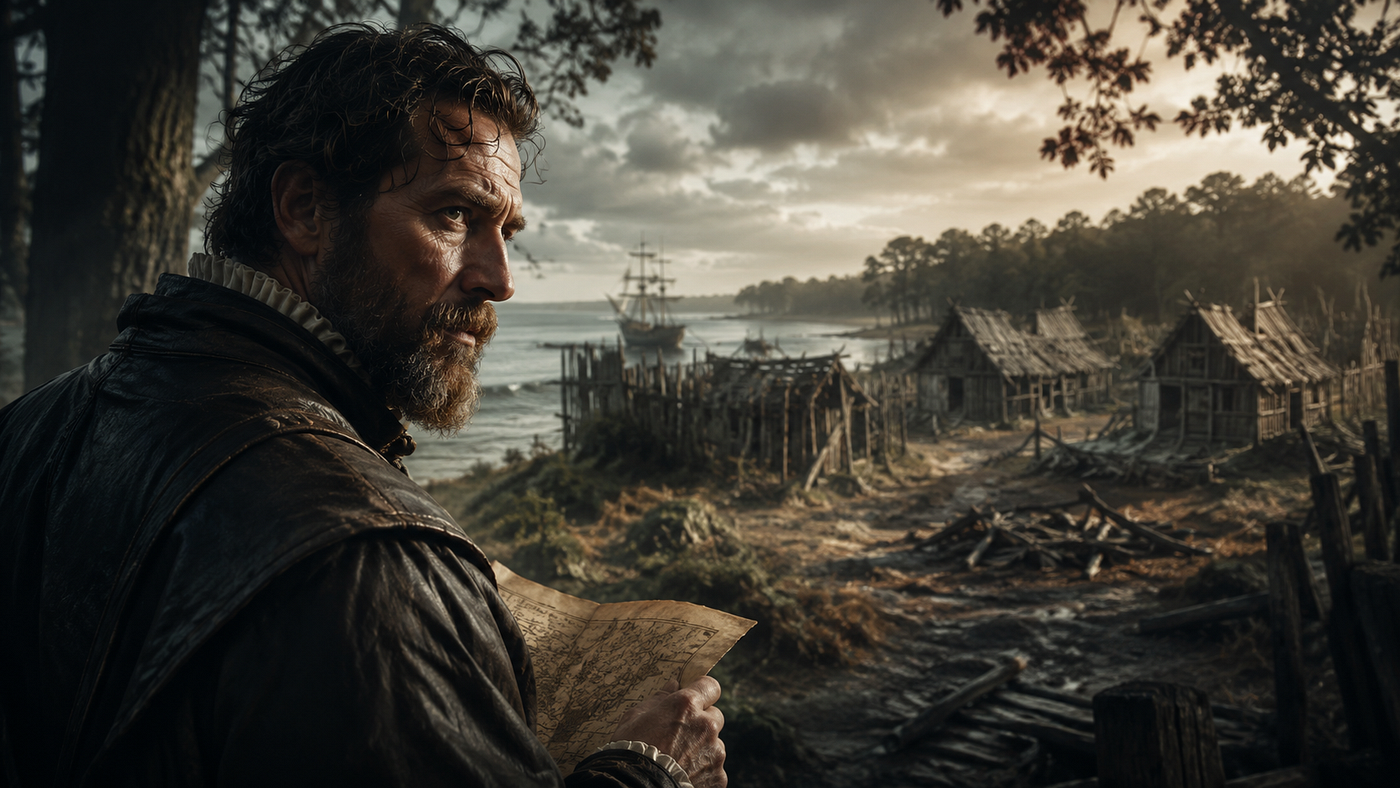
Few stories in American history are as haunting as the disappearance of the Roanoke colonists. More than 400 years after they vanished, historians still debate what became of the 117 men, women, and children who settled on Roanoke Island and seemingly disappeared without a trace.
Known today as the Lost Colony of Roanoke, the event remains one of the most famous unsolved historical mysteries in the United States. Despite decades of archaeological research and historical investigation, no single explanation has gained universal acceptance.
The story began in 1587 when a group of English colonists arrived on Roanoke Island, located in what is now North Carolina. England hoped to establish a permanent settlement in North America during a period of growing competition among European powers seeking new trade routes, resources, and territory.
The colony was led by John White, an artist, mapmaker, and governor. Among the settlers was White’s daughter, Eleanor Dare, who gave birth to Virginia Dare. She became the first English child known to have been born in an English settlement in the Americas.
Life in the New World proved difficult. Colonists faced limited supplies, unfamiliar conditions, and uncertain relationships with neighboring Indigenous communities. As food shortages became a concern, the settlers asked White to return to England for additional supplies.
White left reluctantly, expecting to return within a relatively short time.
Events in Europe changed those plans.
England was preparing for a potential invasion by Spain, culminating in the famous conflict involving the Spanish Armada in 1588. Ships that might have helped White return were redirected for military purposes. Historical records indicate that these events delayed his voyage back to Roanoke for nearly three years.
When White finally arrived in 1590, he discovered a scene that would become legendary.
The settlement was deserted.
The houses were gone, and no settlers could be found. White reported that the word “CROATOAN” had been carved into a wooden post. The letters “CRO” also appeared elsewhere at the site. Importantly, there were no obvious signs of a violent struggle.
This clue remains central to the mystery.
According to White’s own account, the colonists had previously agreed to leave a message indicating where they had gone if they relocated. Because no distress signal appeared at the site, some historians believe the settlers may have left voluntarily rather than fleeing an immediate attack.
That observation, however, does not reveal where they ultimately ended up.
Several theories have emerged over the centuries.
One of the most widely discussed possibilities suggests that some colonists joined the Croatoan people, a Native American community associated with nearby Hatteras Island. Historians consider this theory plausible because cooperation with an established community could have increased the settlers’ chances of survival.
Archaeologists have discovered certain English-made artifacts in areas connected to Indigenous settlements. While these findings suggest contact between English colonists and Native American groups, they do not conclusively prove what happened to the entire colony.
Another theory proposes that some settlers relocated inland. Researchers have examined archaeological sites in mainland North Carolina that contain artifacts dating to the late sixteenth century. These discoveries have generated debate among historians, though evidence remains incomplete.
Other scholars have explored the possibility that disease, famine, environmental hardship, or conflict contributed to the colony’s disappearance. Tree-ring studies have suggested that the region experienced severe drought conditions during parts of the colony’s existence. Limited food supplies could have made survival far more challenging.
What makes the Roanoke mystery remarkable is not only the disappearance itself but also the lack of definitive evidence. Many historical events leave behind written records, eyewitness accounts, or physical remains. Roanoke offers only scattered clues.
This uncertainty has fueled generations of research.
Historians analyze colonial documents. Archaeologists continue excavations. Researchers compare maps, artifacts, and environmental evidence. Each new discovery contributes valuable information, yet none has fully solved the mystery.
The story also highlights an important lesson about historical investigation.
History is not always a collection of clear answers. Researchers often work with incomplete evidence and competing interpretations. The Roanoke mystery demonstrates how scholars build theories from available facts while remaining open to new discoveries.
That distinction matters. A theory may be reasonable and supported by some evidence, but it does not become a proven fact until stronger evidence emerges.
Today, the Lost Colony of Roanoke continues to capture public interest through books, documentaries, academic studies, and museum exhibits. Its enduring appeal comes from a combination of real history, human drama, and unanswered questions.
More than four centuries later, the fate of the Roanoke Island settlers remains unknown. Based on current evidence, historians generally agree that the colonists likely did not simply vanish. They may have relocated, integrated with neighboring communities, split into smaller groups, or experienced a combination of hardships that left little trace in the historical record.
Until new evidence is uncovered, the mystery remains open.
That uncertainty has transformed Roanoke from a colonial settlement into one of the most enduring mysteries in early American history, a reminder that even after centuries of research, the past can still hold secrets waiting to be discovered.
메타데이터
- post_id
- b571559bb363
- slug
- what-happened-to-the-117-settlers-who-disappeared-from-roanoke-island-b571559bb363
- url
- https://medium.com/@wilmer.salvatierra0624/what-happened-to-the-117-settlers-who-disappeared-from-roanoke-island-b571559bb363
- canonical_url
- https://medium.com/@wilmer.salvatierra0624/what-happened-to-the-117-settlers-who-disappeared-from-roanoke-island-b571559bb363
- author_url
- https://medium.com/@wilmer.salvatierra0624
- status
- ok
- fetched_at
- 2026-06-20 20:29:01