The $80 Billion Paradox: 5 Surprising Facts from the Front Lines of the June 2026 AI Boom
The Big AI Disconnect
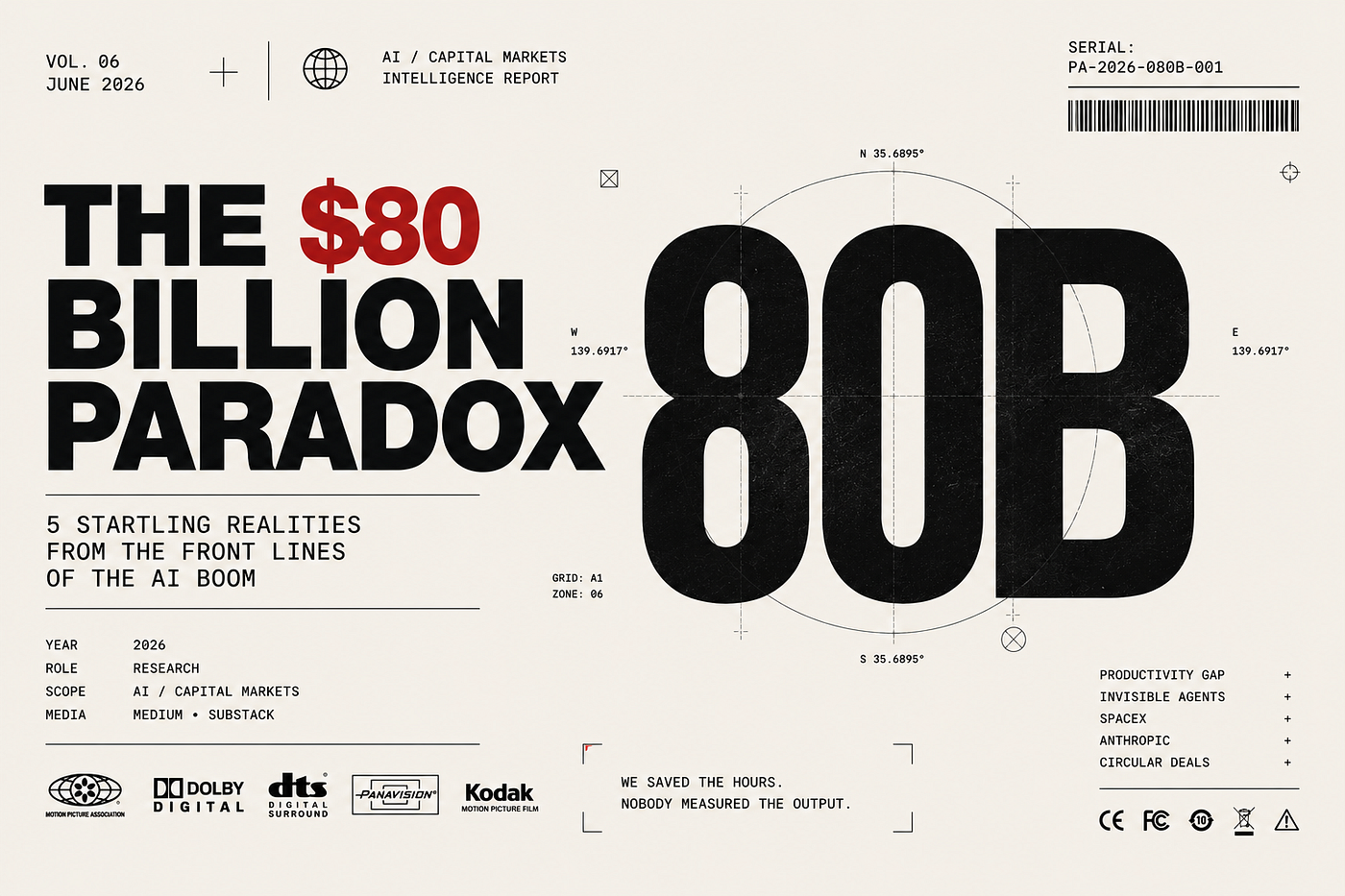
The $80 Billion Paradox: 5 Surprising Facts from the Front Lines of the June 2026 AI Boom
The Big AI Disconnect
June 2026 might be the moment when the artificial intelligence industry started to get really serious.
On one hand people are putting a lot of money into AI. We are talking about funding rounds, record-breaking IPOs and really big valuation projections that are all over the news. On the hand the people in charge the investors and the operators are seeing a different story.
AI is being used more and more. It is not always clear if it is making a big difference in business.
This is the problem right now. Companies are buying a lot of AI tools. They are struggling to make them work in a way that really helps the business. This is what we can call the Big AI Disconnect. The gap between how excited people’re to invest in AI and how well it actually works.
The next stage of the AI boom will not be about who can build the model. It will be about who can show that AI is really worth the money.
1. The Productivity Problem: Saving Time, Not Making Money
One of the most talked about findings in AI research is the productivity problem.
A lot of companies are saying that AI is helping them get things done faster. Employees can write reports faster analyze data quicker and tasks that used to take a long time.
When you look at how well the company is doing financially it does not always show that AI is making a big difference.
The reason for this is pretty simple: saving time is not the same as making money.
A lot of companies are just adding AI to their ways of doing things instead of changing how they work to really use AI. So the time they save just gets lost in the system of being used to make more money create better products or reduce costs.
Investors are starting to question the claims about how efficient AI is.
The question is no longer:
”How time does AI save?”
It is now:
”Where is the return on investment?”
The companies that can answer that question will likely do better than the rest.
2. The Rise of the AI Economy
While everyone is talking about the big AI companies, something else is happening under the surface.
Developers are building AI systems that can work on their own searching the internet gathering information and putting it together.
Projects like OpenClaw, ECC, Agent-Reach and MemPalace are part of a trend that we can call the Hidden AI Economy.
These systems can:
Search sources of information on their own.
Remember things for a time.
Do research without someone watching.
Reduce the need for tools that only a few people can use.
This is a deal.
In the past you needed a lot of money to access AI systems. Now individual developers, startups and small companies can use powerful AI tools.
If AI becomes cheap and easy to use the companies that win will be the ones that can use it the best.
This might be why big tech companies are still investing a lot in infrastructure. When software becomes common it is more important to have the scale and distribution to make it work.
The battle is no longer about who has the best AI model.
It is about who has the ecosystem, the most computing power, the best data and the best way to get it to people.
3. SpaceX and the Future of AI Infrastructure
The AI race is not about data centers anymore.
Investors are starting to think that things like communication infrastructure, satellite networks and launch capabilities are important for the future of AI.
This is why SpaceX is becoming a part of the conversation about AI infrastructure.
The companys ability to launch satellites build internet networks. Do advanced engineering makes it really unique. If AI systems need to be connected and work together the infrastructure in space could become really valuable.
Some analysts think that AI could bring in a lot of money over the decade.
The main point is that the AI economy is not just about software companies anymore.
It is also about energy systems, computer chips, telecommunications networks and space infrastructure.
The companies that win in the future might not look like the software companies we know today.
4. The End of the Secret Era
For a time AI development was happening behind closed doors.
Research labs would get funding release their results and grow without a lot of public attention.
That time is ending.
The industry is entering a phase where:
A lot of money is being raised publicly.
Big IPOs are being prepared.
Infrastructure is being financed on a scale.
Investors are watching closely.
Companies can no longer just show off their technology to get funding.
Public markets want to see results.
How much money is being made how many customers are staying, how profitable the company is and how well the AI is being used are all becoming really important.
The competition is changing from a race to a financial one.
The challenge is no longer building the best AI model.
It is getting money to stay ahead and showing that the investment is paying off.
5. The Circular Deal Problem
As more money is being invested in AI people are looking closer at how the money’s being made.
One problem that is growing is what analysts call circular capital flows.
Here is how it works:
- A big tech company invests in an AI startup.
- The startup uses a lot of that money to buy services from the investor.
- The investor makes money from the sale.
- The growth looks good. It might not be because of real demand.
Not all partnerships work this way.
Investors are starting to look closer at whether the growth is real or just because of the money being passed around.
This matters because the value of a company depends on whether it’s making money from real customers or just from the money being invested.
As the AI market grows up people will be looking closer at these relationships.
The Harvest Era Begins
The AI industry is moving from a time of speculation to what we can call the Harvest Era.
The early years were about what could be.
The next phase is about what works.
Investors are no longer impressed by seeing what AI can do. They want to see that it can make money increase productivity create markets and bring in cash.
The spending on infrastructure is still growing. Custom AI chips, accelerators, energy investments and big computing networks are becoming really important.
The opportunity is still huge.
But the big question remains:
Is the gap between how much money’s being spent on AI and how well it is working just a temporary problem or is it a sign of a deeper issue, with how companies are using AI?
The answer will determine which companies will be the winners of the AI decade and which will be remembered as the ones that did not make it.
메타데이터
- post_id
- b575e35ba97b
- slug
- the-80-billion-paradox-5-surprising-facts-from-the-front-lines-of-the-june-2026-ai-boom-b575e35ba97b
- url
- https://medium.com/@akmalabhinu/the-80-billion-paradox-5-surprising-facts-from-the-front-lines-of-the-june-2026-ai-boom-b575e35ba97b
- canonical_url
- https://medium.com/@akmalabhinu/the-80-billion-paradox-5-surprising-facts-from-the-front-lines-of-the-june-2026-ai-boom-b575e35ba97b
- author_url
- https://medium.com/@akmalabhinu
- status
- ok
- fetched_at
- 2026-07-11 12:10:32