I Work at One of the Agencies on This List. Here’s How I’d Actually Compare Them.
A field guide to eight SaaS demand gen agencies — written with the conflict of interest stated upfront, because anything else would be…
I Work at One of the Agencies on This List. Here’s How I’d Actually Compare Them.
A field guide to eight SaaS demand gen agencies — written with the conflict of interest stated upfront, because anything else would be dishonest.
A few months ago, a Head of Growth I’d been talking to for a while finally asked the question she’d been circling: “If you weren’t working at Scalerrs, which of these would you actually recommend?”
She had a shortlist of eight agencies. She’d spent six weeks talking to four of them. The decks all looked similar. The case studies all promised pipeline. Every founder she’d met had a story about why their model was different from everyone else’s, and she’d reached the point in the process where the conversations were starting to blur into each other.
What she wanted was someone who knew the landscape and didn’t have a horse in the race.
I had a horse in the race. So I said the only useful thing I could say, which is what this piece is: here’s how I’d actually think about each of these agencies, including the one I work at, with the bias declared upfront so you can discount accordingly.
I’ll be honest about where Scalerrs is the wrong fit. There are several agencies on this list I’d recommend over us for specific situations, and I’ll name them. If that’s not what you’d expect from a comparison written by an insider, that’s the point.
Before getting into the eight, one piece of context that’s shaping all of this. According to the 2025 Buyer Experience Report, B2B buyers often choose a favored vendor before first contact, and that early favorite wins roughly 80% of deals.
So, by the time someone fills out a demo form, they’ve usually already decided who they want to work with. That changes what demand gen has to do. It has to show up in the surfaces where buyers do their pre-decision research, which now includes Google, AI search, Reddit, review sites, and comparison content.
1. Scalerrs — for organic demand gen across Google, AI search, and Reddit
Let me start with the agency I work at, since the honest version is the most useful one.
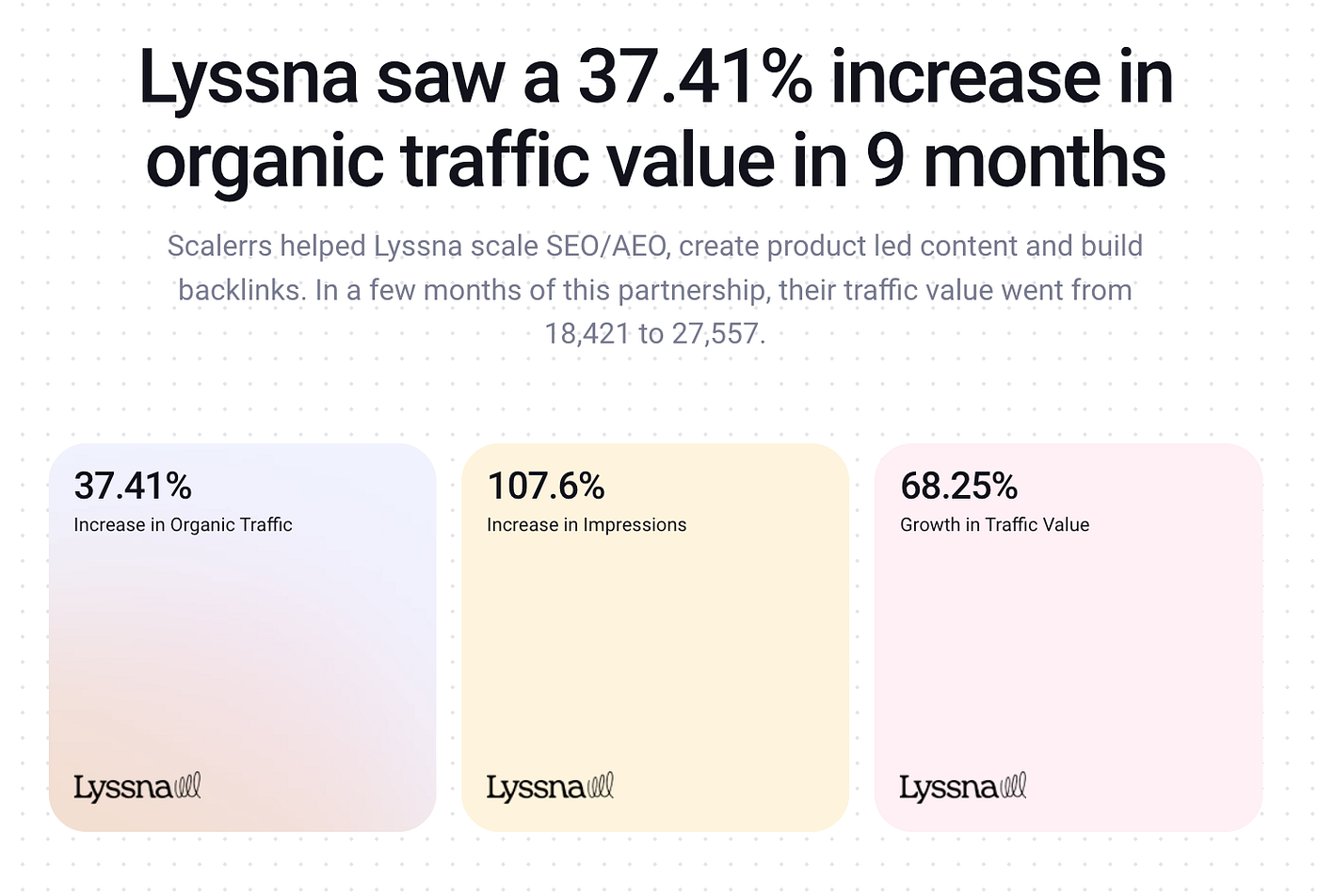
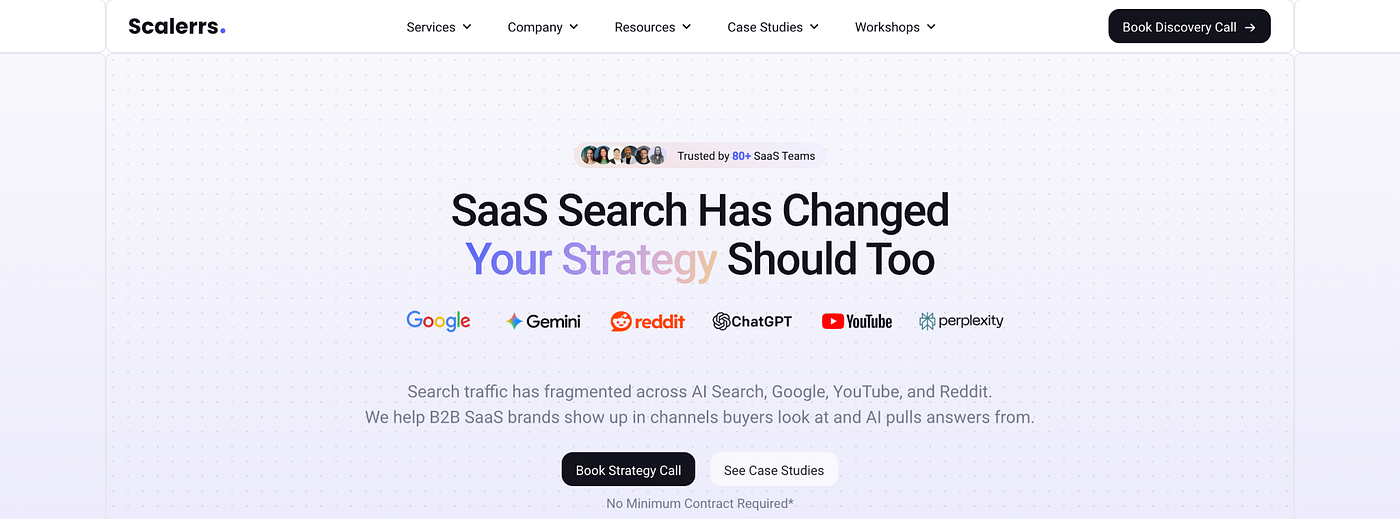
Scalerrs is built for B2B SaaS teams whose growth depends on showing up organically in the places buyers research software before they ever book a demo. That means Google, but also ChatGPT, Perplexity, Gemini, Claude, Google AI Overviews, Reddit, YouTube, third-party listicles, and comparison content. We work only with SaaS, the contracts are month-to-month with no minimum commitment, and pricing is custom.
If your main goal is scaling paid acquisition, this isn’t the right fit — keep reading, Hey Digital handles that better. If you’re not SaaS, also not the right fit. The narrowness is the point.
The two customer reviews I’d want a prospect to read before deciding both speak to the AI-search piece, which is the part of the offer that’s been moving fastest:
“With the help of Scalerrs, we got cited in Google AI Overviews for our most important terms. Seems unreal, especially cause we compete with big players like Square, Shopify, and Lightspeed.” — Michael Calberg, CMO at Korona POS
“I can confidently say about 30% of our pipeline comes from AEO/SEO and AI search. In the last month we got over $300K in pipeline just from AEO/SEO for really no additional work.” — Stan Rymkiewicz, Head of Growth at Default
That’s the case for the lane. Now let me make the case for everyone else on the list, because for a meaningful chunk of buyers reading this, one of them is the better answer.
2. Hey Digital — for paid demand gen

If you have budget, a working funnel, and the part of demand gen that’s actually holding you back is paid acquisition at scale, Hey Digital is the cleanest SaaS-specific option I’d point to.
They describe themselves as full-funnel across paid media, content, and signal-based outbound, but the spine of the offer is paid performance marketing built for SaaS — paid search, paid social, creative iteration, campaign strategy tied to ICP and funnel stage. The reporting is framed around qualified opportunities and revenue rather than lead volume, which is the right framing for the category.
The proof is reasonable. One published case study reports a 52% reduction in ad spend and a 159% increase in deal value. Their Clutch rating sits at 4.6/5, with reviews mentioning CPA efficiency, signup growth, and communication quality. Minimum project size starts around $5,000+ per Clutch, with custom pricing beyond that.
The pattern I’d watch for: this only works if you’re already past the point where ICP and product-market fit need debate. Paid scales what’s working; it doesn’t fix what isn’t.
3. Refine Labs — for strategy-led demand gen at the mid-market and enterprise end

Refine Labs is the agency I’d point a CMO toward if their actual problem isn’t “we need better channel execution” but “our whole demand gen model is broken and leadership is starting to notice.”
The thesis is the shift from older lead-gen approaches to brand, demand, and expansion thinking. Their paid media work spans LinkedIn, Google, YouTube, Meta, CTV, and Reddit, but the strategic layer is what they sell — change management around how a marketing org thinks about buyer behavior, attribution, and what counts as a win.
The pricing tells you who it’s for: a Marketing Strategy & Digital Media Assessment runs $35,000 for 6–8 weeks. Full-Service Management starts at $31,000/month. Paid Media & Creative Strategy starts at $20,000/month. That puts it firmly out of reach for early-stage SaaS and squarely in the lane of mid-market and enterprise teams that need a GTM reset.
The proof: a 46% increase in hand raisers and 59% growth in HIRO pipeline for one client. Another client described the work as helping them “reverse the decline and rebuild demand in a way that directly impacted revenue.”
If you’re a Series A SaaS company spending six figures a year on marketing in total, this isn’t your move. If you’re a Series C+ team and your CMO is rebuilding the function, it’s a credible option.
4. frontBrick — for ABM-led pipeline generation

The most ABM-specific agency on this list. Worth a look if your growth model genuinely depends on landing named accounts rather than building broad category visibility.
The motion is coordinated outbound across email, LinkedIn outreach, LinkedIn Ads, ICP analysis, competitive research, and landing-page support — with Clay-based workflows handling list building, scoring, routing, and personalization. Pricing is custom, with a $1,000+ minimum project size per Clutch.
The proof points are strong for the ABM lane. frontBrick holds a 5.0/5 Clutch rating, claims to have helped 50+ businesses generate 20+ qualified meetings per month, and has a published case study showing $700K in pipeline, 35 qualified opportunities, and a 25.4% positive response rate in 2.5 months.
The thing I’d flag: ABM is a different bet than organic demand gen. It’s narrower, more sales-coordinated, and works best when you have a defined, finite list of accounts that would actually buy. If you’re trying to build broad category presence, ABM isn’t the lever.
5. Powered by Search — for full-funnel B2B pipeline growth

The broadest offer on this list. Worth considering if you want one partner running paid, SEO, content, ABM, and lifecycle email rather than coordinating between specialists.
The strategic layer is genuinely substantive — customer avatar work, message-market-fit research, editorial planning, and prioritized roadmaps. The reporting language stays close to demos, trials, MRR, CAC reduction, and ARR impact, which is the right framing for SaaS.
Pricing is tiered and transparent: $6,000/month at the Startup tier, $14,400/month at Scale Up, and $21,600/month at Enterprise. Neil DuPaul, Senior Director of Demand Gen at ThreatX, captured the value well: “One of the things that can help you is an established framework like Powered by Search has about what B2B buyers prioritize and when they prioritize them.”
The honest tradeoff is breadth versus depth. A full-funnel partner is harder to beat on coordination and easier to beat on any single channel.
6. Kalungi — for early-stage SaaS needing an outsourced marketing team

A different shape entirely. Kalungi isn’t really a demand gen agency in the channel-specialist sense — it’s an outsourced SaaS marketing team that can fill the gap when you don’t have a full internal marketing function yet.
That makes it a credible option for earlier-stage SaaS companies that need strategic direction plus hands-on execution across more functions than a typical demand gen agency provides. Pricing is custom, with a retainer base and a pay-for-performance component layered on top.
I’d recommend Kalungi over a specialist when the buyer’s situation is “we’re scaling and we don’t have a marketing leader yet” rather than “our marketing function is in place but this one channel needs help.”
7. Directive — for larger tech brands focused on qualified pipeline

Directive runs what it calls Customer Generation, a model built around pipeline impact, revenue alignment, LTV-to-CAC clarity, and closed-loop attribution rather than MQL volume. The work spans content, paid media, ABM, CRO, marketing automation, and revenue operations — designed for coordination across a mature GTM team.
The honest read: this is more than most smaller SaaS teams need. If you’re running a lean marketing function and your problem is “we need help with one or two channels,” Directive’s coordination machinery is overkill. If you’re a larger B2B tech brand with longer sales cycles and a CMO who needs revenue-aligned reporting that ties marketing back to RevOps, it’s a credible fit.
8. Blend — for strategy-first full-service B2B demand gen

The widest “create, capture, convert” framing on the list, covering positioning, campaign strategy, content, paid media, ABM, and conversion support. Pricing is the most transparent I came across: Demand Gen Strategy engagements start at £10,000, and ongoing Demand Gen Retainers start at £6,000/month.
The fit is for B2B teams that want a broader strategic partner across the full funnel rather than a specialist in any single lane. The tradeoff, like Powered by Search, is depth in any particular channel.
How I’d actually run the decision
Five questions, in order.
First, channel fit. If your growth model depends on organic across Google, AI search, Reddit, and content, that narrows the list quickly. If you’re scaling paid, it narrows differently. If you need ABM, narrower still. Most teams skip this step and end up in conversations with agencies that aren’t built for their actual problem.
Second, SaaS specialization. Longer sales cycles, more stakeholders, heavier comparison behavior, more education before conversion — that changes what content needs to do and how success should be measured. Not every demand gen agency is built for the category, even the ones that say they are.
Third, pipeline focus. Plenty of agencies still report in traffic, leads, or MQL volume. The ones worth shortlisting connect work to demos, signups, SQLs, pipeline, or revenue influence. Otherwise the spend is hard to defend internally — which is the conversation your CMO will eventually have to have with the board.
Fourth, AI search readiness. If an agency can’t clearly explain how it tracks and improves your visibility in ChatGPT, Perplexity, and Google AI Overviews, it’s behind on a shift that’s already happening. This was a “nice-to-have” twelve months ago. It’s a baseline competency now.
Fifth (and this is the one most buyers underweight), who you actually work with after the deal closes. Many agencies sell with senior strategists and hand the account to layers of account management. Ask, on the sales call, who will run the work in month three. That answer determines whether the relationship feels like an extension of your team or a transactional vendor.
Coming back to the original question
The Head of Growth who started this piece eventually picked an agency. I won’t say which one — that’s her call to share. What I’ll say is that the conversation got useful the moment we stopped pretending all eight options were equivalent and started naming which problem each one actually solved.
That’s the part of agency comparison that I think most listicles miss. The honest answer isn’t “here are eight options ranked from best to worst.” It’s: these eight agencies are all good at different things, and the one that’s right for you depends on which problem is currently the biggest constraint on your pipeline.
If your problem is paid acquisition at scale, the answer probably isn’t an organic specialist no matter how strong the case studies are. If your problem is that buyers can’t find you in the surfaces where they’re now doing research, the answer probably isn’t a paid agency no matter how good their reporting is. The decision gets easier when you clearly define the problem first.
메타데이터
- post_id
- b57d867f2bc0
- slug
- i-work-at-one-of-the-agencies-on-this-list-heres-how-i-d-actually-compare-them-b57d867f2bc0
- url
- https://medium.com/@hey_scalerrs/i-work-at-one-of-the-agencies-on-this-list-heres-how-i-d-actually-compare-them-b57d867f2bc0
- canonical_url
- https://medium.com/@hey_scalerrs/i-work-at-one-of-the-agencies-on-this-list-heres-how-i-d-actually-compare-them-b57d867f2bc0
- author_url
- https://medium.com/@hey_scalerrs
- status
- ok
- fetched_at
- 2026-06-14 11:28:49