Is a car alive?
Is a car alive?
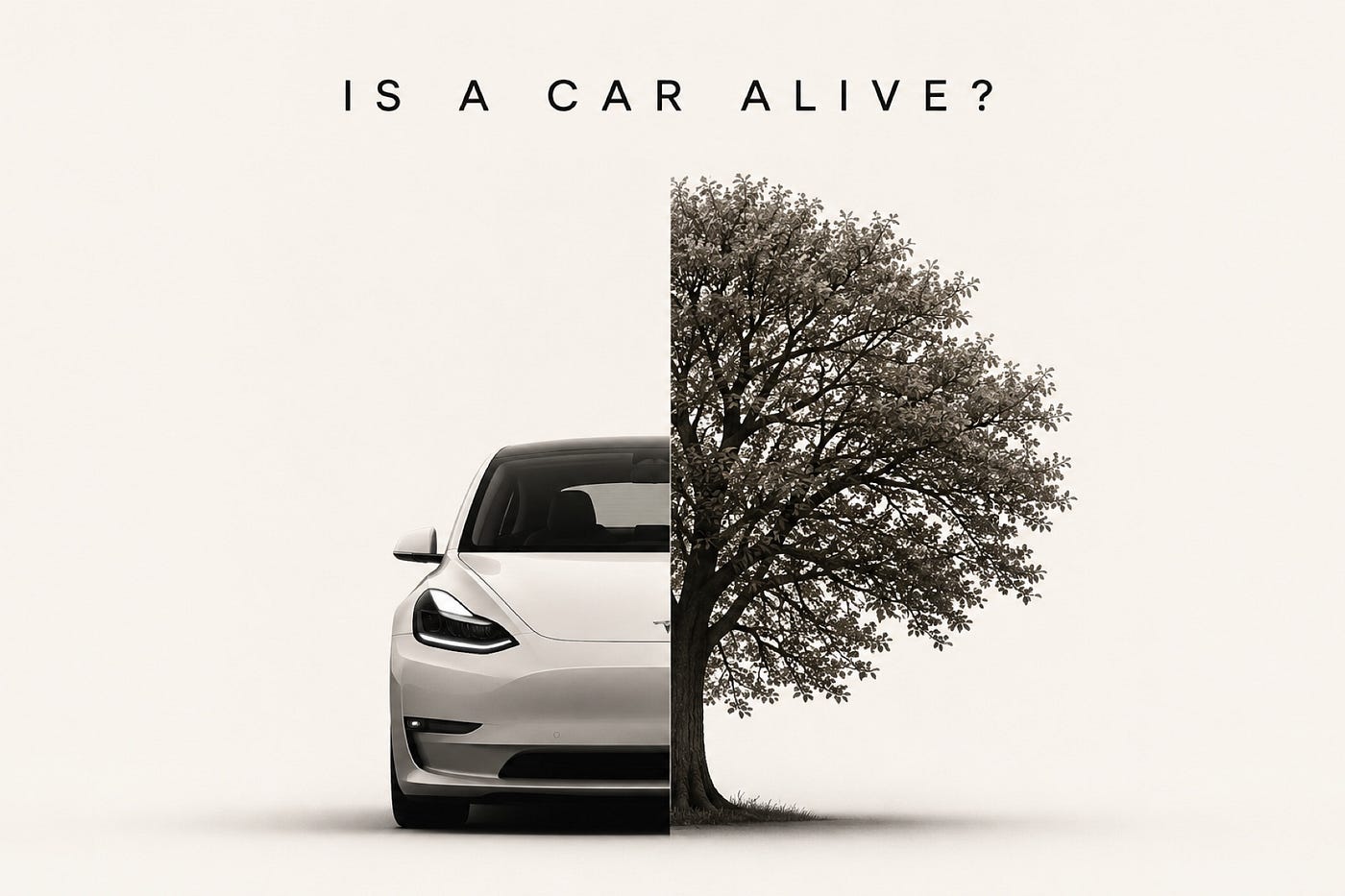
Is a Car Alive? Maybe We’ve Been Asking the Wrong Question.
Most people would laugh if you asked them whether a car is alive.
Of course it isn’t.
It doesn’t breathe. It doesn’t have a heartbeat. It doesn’t grow like a tree or reproduce like an animal. It is a machine, built by humans for a purpose. End of discussion.
But is it really that simple?
The more I think about life, the less obvious the definition becomes. We tend to separate the world into two neat categories: living and non-living. Humans, animals, plants – alive. Cars, televisions, computers, rocks – not alive.
Yet the line between those categories may not be as clear as we assume.
What Makes Something Alive?
Ask someone why humans are alive and they will usually mention a few characteristics.
We move.
We consume energy.
We communicate internally.
We react to our environment.
We make decisions.
We grow.
We age.
We eventually die.
On the surface, these seem like reasonable criteria.
But then something interesting happens when we compare ourselves to a modern car.
A car consumes energy. Instead of proteins, fats, and carbohydrates, it consumes gasoline, diesel, electricity, or a combination of them.
A car has internal communication. Instead of nerves and neurons, it has wires, sensors, processors, and electronic control units constantly exchanging information.
A car reacts to its environment. Rain sensors activate windshield wipers. Cameras detect obstacles. Radar systems measure distance. Temperature sensors regulate climate control.
A car ages. Components wear down. Materials degrade. Performance changes over time.
A car gets sick.
We simply use different words.
When a human develops a disease, we call it illness.
When a car develops faulty software, we call it a bug.
When a human has organ failure, we call a doctor.
When a car has component failure, we call a mechanic.
When a human undergoes surgery, parts of the body may be repaired or even replaced.
When a car undergoes repair, parts are repaired or replaced.
The parallels are surprisingly difficult to ignore.
Of course, similarities alone do not prove that something is alive. But they raise an interesting question.
How many characteristics can something share with living organisms before we stop calling it merely a machine?
The deeper we look, the more similar the structures become.
The human body is not a single decision-maker. It is a massive network of systems constantly communicating with one another.
Your brain receives information from your eyes, ears, skin, muscles, hormones, and organs. Trillions of chemical and electrical signals move throughout the body every second.
You are not consciously controlling most of this.
Your heart beats automatically.
Your lungs adjust automatically.
Your immune system responds automatically.
Your hormones regulate automatically.
Most of what keeps you alive happens without your awareness.
Modern vehicles function in a surprisingly similar way.
The engine control unit communicates with sensors throughout the vehicle.
Fuel injection systems constantly adjust based on incoming data.
Climate control systems monitor internal and external temperatures.
Safety systems observe road conditions and vehicle behavior.
Navigation systems process information and suggest actions.
Hundreds of decisions occur every second without the driver’s direct involvement.
Both systems are networks.
Both process information.
Both respond to changing conditions.
The primary difference is complexity and biological material.
But should the material matter more than the behavior?
If a process is fundamentally similar, does it become less significant simply because one system is made of carbon and the other of steel and silicon?
At this point, most people will present what seems like the strongest counterargument.
Cars cannot reproduce.
Living organisms create more living organisms.
Cars do not.
Case closed.
Or is it?
A car cannot build another car by itself.
That much is true.
But neither can many organisms reproduce independently.
A flower depends on pollinators.
Bees depend on flowers.
Trees depend on fungi in the soil.
Predators depend on prey.
Entire ecosystems exist through interdependence.
Remove enough bees from an environment and entire plant populations begin to collapse.
Remove enough plants and herbivores suffer.
Remove herbivores and predators suffer.
Life is not an isolated process.
Life is a network.
Every participant depends on countless others.
Now consider cars.
Cars depend on humans.
Factories build them.
Mechanics maintain them.
Fuel stations provide energy.
Road networks support movement.
Without humans, the automotive ecosystem would largely disappear.
Same the other way around.
Without cars, mobility would not simply become slower. In many regions, it would collapse almost entirely. Cities are designed around them. Workforces rely on them. Emergency services depend on them. Entire logistics networks are built on the assumption that goods can move quickly and continuously across long distances.
Now extend that dependency further.
Food does not magically appear in stores. It is transported.
Medicine does not distribute itself. It moves through supply chains.
Construction materials, fuel, consumer goods – almost everything in a modern economy relies on transportation systems that are heavily car-based.
Remove cars from the system overnight and the effect would not be subtle. It would ripple through every layer of society. Production slows. Distribution breaks. Markets destabilize. Infrastructure struggles to adapt.
It would not mean human extinction. But it would mean a severe structural shock to how civilization functions.
Does that count as them being part of the food chain?
Cars Are Becoming Increasingly Autonomous
The traditional image of a car is simple.
A passive machine waiting for human commands.
But that description becomes less accurate every year.
Modern vehicles can park themselves.
Maintain lane position.
Adjust speed automatically.
Monitor their own health.
Diagnose faults.
Update software over the internet.
Avoid collisions.
Navigate complex environments.
In some cases, they can travel significant distances with minimal human intervention.
The gap between machine and organism is shrinking.
Imagine describing a modern vehicle to someone from two hundred years ago.
You would tell them that it can perceive its surroundings, process information, adapt its behavior, diagnose internal problems, and improve itself through software updates.
Many of those descriptions sound surprisingly biological.
Not because the car is secretly an animal.
But because information processing itself may be more fundamental than biology.
Another common objection is that cars do not possess free will.
They simply follow programming.
Humans, on the other hand, make choices.
At least that is what we like to believe.
But do we truly possess free will?
Every decision you make is influenced by factors beyond your control.
Your genetics.
Your childhood.
Your culture.
Your education.
Your experiences.
Your hormonal state.
The food you ate yesterday.
The amount of sleep you got last night.
The virus currently affecting your body.
The thousands of environmental factors you are not consciously aware of.
Your brain constantly processes information and produces outputs.
A car’s processor does something remarkably similar.
Sensors gather information.
Software evaluates that information.
Commands are generated.
Actions occur.
The scale and complexity are vastly different, but the underlying principle remains recognizable.
Input.
Processing.
Output.
We often dismiss machines because they follow programming.
Yet humans may also be following programming – just an extraordinarily sophisticated form written by evolution instead of engineers.
If every decision emerges from prior causes, where exactly does free will begin?
And if we cannot clearly answer that question for ourselves, can we confidently use it to separate life from machinery?
Maybe Life Is Not a Category
Perhaps the biggest mistake we make is assuming that life is binary.
Alive.
Not alive.
One or the other.
Reality may be far messier.
Consider a rock.
Almost everyone agrees it is not alive.
Now consider a virus.
The debate becomes complicated.
Viruses reproduce and evolve, but only by using living cells.
Some scientists consider them alive.
Others do not.
Already the boundary begins to blur.
Then come bacteria, plants, insects, animals, humans, and increasingly intelligent machines.
What if life is not a category at all?
What if it is a spectrum?
A gradual progression of complexity, information processing, adaptation, self-maintenance, and autonomy.
Under that framework, a rock sits near one end.
Humans sit further along.
And machines occupy a position somewhere in between, steadily moving toward greater complexity with each generation.
The question is no longer whether a car is alive.
The question becomes where it belongs on the spectrum.
The Real Question
I am not arguing that your family sedan is secretly conscious.
I am not claiming that your television has feelings.
What I am suggesting is something far more interesting.
Perhaps our definitions are outdated.
Perhaps life is not defined by flesh, blood, or DNA.
Perhaps life is a pattern.
A process.
A self-organizing flow of matter, energy, and information.
If that is true, then the boundary between biological organisms and technological systems may be far thinner than we imagine.
A car may not be alive in the same way a human is alive.
But it may also not be as fundamentally different as we have always assumed.
And maybe, centuries from now, people will look back at our machines the same way we look back at the first primitive cells.
Not yet fully alive.
But no longer entirely lifeless.
When that day comes, the question “Is a car alive?” may sound far less ridiculous than it does today.
메타데이터
- post_id
- b59a7278403d
- slug
- is-a-car-alive-b59a7278403d
- url
- https://medium.com/@richard.mig/is-a-car-alive-b59a7278403d
- canonical_url
- https://medium.com/@richard.mig/is-a-car-alive-b59a7278403d
- author_url
- https://medium.com/@richard.mig
- status
- ok
- fetched_at
- 2026-06-22 12:55:45