Why “Subjective Experience” is a Misnomer
The Illusion of Subjective Experience and the Homunculus Fallacy
Why “Subjective Experience” is a Misnomer

The Illusion of Subjective Experience and the Homunculus Fallacy
In the study of the philosophy of mind, the hard problem of consciousness — a term coined by philosopher David Chalmers — refers to the difficulty of explaining subjective experience: what it is like to feel, perceive, and be aware. However, this so-called problem is a red herring, diverting attention from the real issue: the antiquated notion of a “ghost in the machine.”
The Persistence of the Homunculus
Philosopher Daniel Dennett has long argued that the idea of a homunculus — a “little person” inside the mind observing and controlling thoughts — continues to plague theories of consciousness, often in disguised forms. In Consciousness Explained (1991), he critiques models that implicitly rely on a Cartesian Theater, where a central self “watches” mental events unfold. This framework fails because it presupposes an internal observer, leading to an infinite regress (who watches the watcher?).
Instead, Dennett proposes the Multiple Drafts Model, where consciousness arises from parallel and distributed processes in the brain, rather than from a single, unified experiencer. He critiques many theories of mind — including those that reject dualism — for still smuggling in a homunculus by positing a “central processor,” a “self,” or a “mental observer” without truly explaining how consciousness emerges.
The “Hard Problem” as a Fake Problem
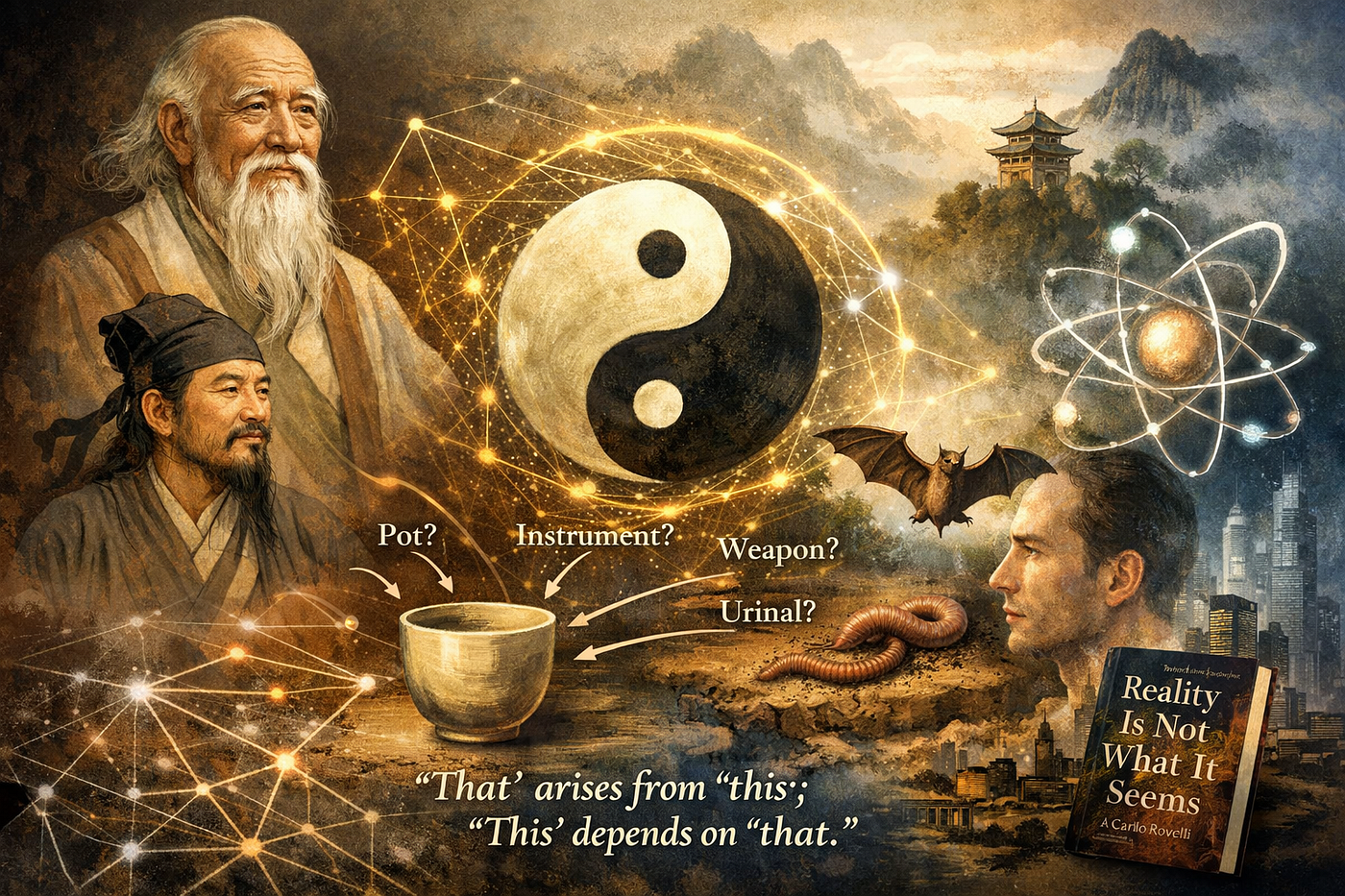
I argue that the hard problem of consciousness is a fake problem because it assumes the necessity of an inner observer — a self that “experiences” reality. But this is an unwarranted assumption. The Buddhist philosopher Buddhaghosa challenged this notion centuries ago in The Path of Purification:
There is no doer of a deed, Or one who reaps the deed’s result; Phenomena alone flow on — No other view than this is right.
Similarly, he wrote:
For there is suffering, but none who suffers; Doing exists although there is no doer. Extinction is, but no extinguished person; Although there is a path, there is no goer.
These insights align with both neuroscience and philosophical reasoning, which suggest that what we perceive as a coherent “self” is an emergent narrative, not an intrinsic reality.
The Illusion of a Unified Self
Neuroscientific findings reveal that the brain operates through distributed, parallel processes without a central controller:
- Split-Brain Studies: When the corpus callosum is severed, each hemisphere functions independently, leading to conflicting behaviors (e.g., one hand buttoning a shirt while the other unbuttons it). This suggests no singular “self” in charge.
- Modular Processing: Different cognitive functions (e.g., vision, emotion, decision-making) are handled by distinct brain regions (e.g., visual cortex, amygdala, prefrontal cortex). These processes run asynchronously, and the brain integrates them post-hoc into a coherent story.
Thus, the “unified self” is a constructed narrative, much like a film edited together from disparate footage. There is no central experiencer — only the brain’s attempt to make sense of its fragmented operations.
The Homunculus Fallacy
The concept of subjective experience often assumes an internal observer, leading to an infinite regress: if a homunculus exists inside the brain, who observes its observations? Neuroscience resolves this issue:
- No Center of Consciousness: fMRI studies show that consciousness arises from dynamic interactions across brain networks (e.g., default mode network, frontoparietal cortex), not from a single locus.
- Global Workspace Theory (GWT): Consciousness emerges when information is broadcast globally for integration, rather than residing in a privileged “self” region.
Evidence of Constructed Reality
The brain fabricates coherent narratives to mask its disunity:
- Blindsight: Patients with damaged visual cortices can navigate obstacles without conscious awareness, proving that perception occurs without subjective experience.
- Inattentional Blindness: People often fail to notice obvious stimuli when focused elsewhere, revealing that perception is selective and constructed.
- Post-Hoc Rationalization: Experiments like Libet’s readiness potential show that decisions occur subconsciously before we “feel” agency, implying that the “self” justifies actions retroactively.
Alternative Frameworks
Theories like Integrated Information Theory (IIT) and Predictive Processing explain consciousness without invoking a self:
- IIT: Consciousness corresponds to the degree of information integration in a system, rather than the presence of a homunculus.
- Predictive Coding: The brain constructs best-guess models of reality, with “subjective experience” being a simulation constantly updated by sensory input.
Conclusion
The “subjective experience” is an illusion, crafted by the brain to simplify its distributed operations. Believing in a true inner self commits the homunculus fallacy and ignores neuroscientific evidence. Instead, humans are ecosystems of competing processes, unified only by the brain’s storytelling machinery — a useful fiction for survival, not an ontological truth.
메타데이터
- post_id
- b5b83d45e658
- slug
- why-subjective-experience-is-a-misnomer-b5b83d45e658
- url
- https://medium.com/@kleong54/why-subjective-experience-is-a-misnomer-b5b83d45e658
- canonical_url
- https://medium.com/@kleong54/why-subjective-experience-is-a-misnomer-b5b83d45e658
- author_url
- https://medium.com/@kleong54
- status
- ok
- fetched_at
- 2026-08-03 08:47:48