ECMAScript 2026: 5 Features That Finally Fix JavaScript’s Worst Problems
Not hype. Not “watch this space.” These features are shipping and a few of them have been nine years in the making.

Photo by Author
ECMAScript 2026: 5 Features That Finally Fix JavaScript’s Worst Problems
Not hype. Not “watch this space.” These features are shipping and a few of them have been nine years in the making.
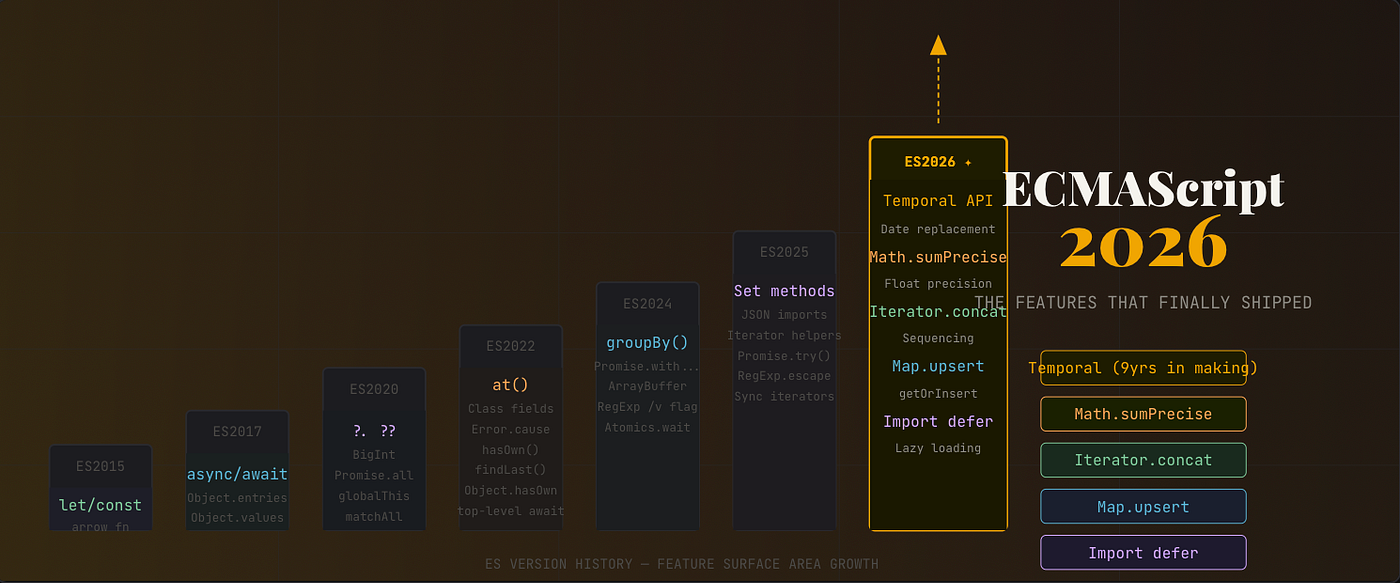
Let’s stop pretending ECMAScript releases are all equal. Most years, TC39 ships a handful of syntax niceties and everyone writes the obligatory “new features” post. ES2026 is different.
This year, features that have been languishing in committee for nearly a decade finally crossed the Stage 4 finish line. The Temporal API alone represents roughly nine years of work by engineers at Bloomberg, Igalia, Google, and Microsoft. That’s not an API that’s a treaty negotiation.
But rather than gush about the spec text, let me tell you what these features mean for your actual code and why you should already be testing them in Node 22+ and modern browsers today.
Temporal API — Date Is Finally Dead
The JavaScript Date object was copy-pasted from Java in 1995. Java deprecated the equivalent APIs in 1997. We used them for thirty years. That sentence alone should make you uncomfortable.
Date is mutable, has insane zero-indexing for months (January is 0, December is 11 nobody has ever found this intuitive), has no real timezone support, and arithmetic with it involves mental gymnastics around milliseconds. Every serious project I've worked on has had date-fns or luxon in its package.jsonpurely to work around these failures.
“The limitations of the existing Date API have historically forced developers to rely on large third-party libraries.”
— Rob Palmer, TC39 co-chair
The Temporal namespace replaces all of that with immutable, timezone-aware primitives. Here's what the surface area looks like:
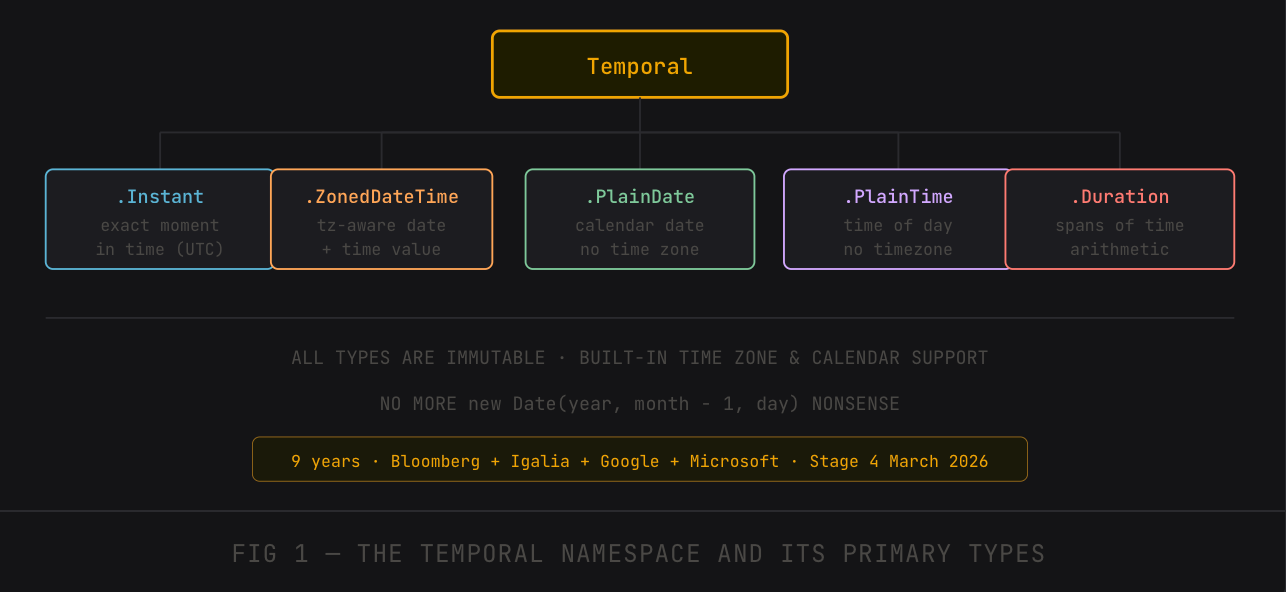
Here’s real code. Compare the old way vs. the new way to add 2 months to a date:
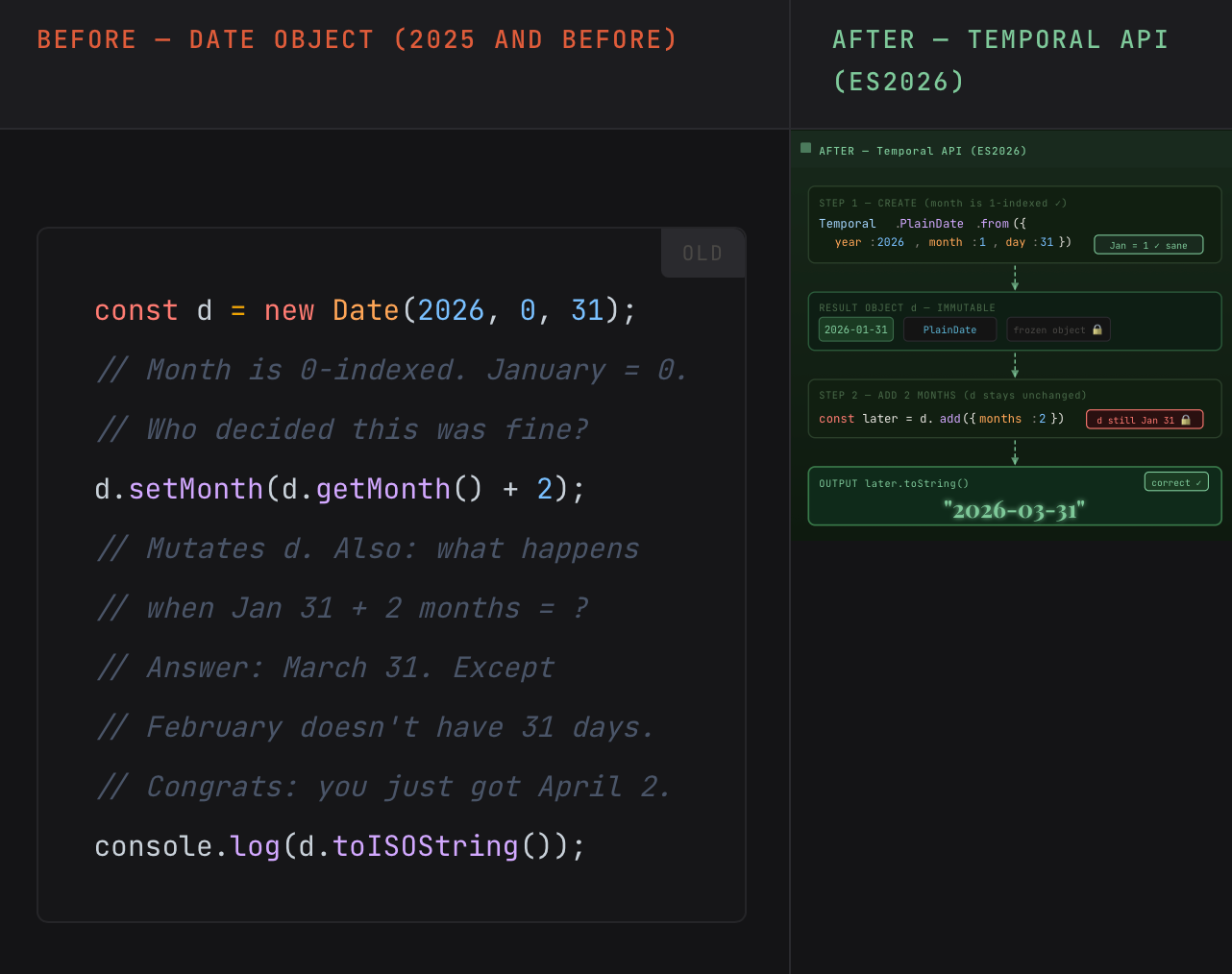
Browser support as of April 2026: Temporal is available in Chrome 131+, Firefox 134+, and Node.js 22.x. Safari has shipped it behind a flag. You can polyfill today with @js-temporal/polyfill.
Math.sumPrecise — Because Floating-Point Lies
Type 0.1 + 0.2 into any JavaScript console. You don't get 0.3. You get 0.30000000000000004. This is not a JavaScript bug it's IEEE 754 floating-point arithmetic working exactly as specified. But "working as specified" and "working as humans expect" are different things.
The real danger isn’t adding two numbers. It’s summing an array of floats where each tiny rounding error compounds. Financial calculations. Scientific data pipelines. Any situation where precision loss across many operations is unacceptable.

// Before — every JS developer's nightmare
[0.1, 0.2, 0.3].reduce((a, b) => a + b);
// → 0.6000000000000001

// After — Math.sumPrecise accepts any iterable
Math.sumPrecise([0.1, 0.2, 0.3]);
// → 0.6

// Works with generators too
function* prices() {
  yield 19.99;
  yield  4.50;
  yield  0.01;
}
Math.sumPrecise(prices());
// → 24.5  (not 24.499999999999996)
This isn’t just convenience. If you’re building any kind of financial calculation, tax summary, or scientific aggregation in JavaScript without reaching for a precision library, you’ve probably shipped bugs that were invisible in testing and only surfaced at scale. Math.sumPrecise closes that gap natively.
Iterator.concat — Sequence Without Spreading
ES2025 gave us iterator helpers — .map(), .filter(), .take() — but left a glaring gap: you couldn't sequence two iterators together without materializing them into arrays first. That kind of defeats the purpose of lazy evaluation.
// ES2025 — the painful workaround
function* concat(...iterables) {
  for (const it of iterables) yield* it;
}

// ES2026 — Iterator.concat is built-in
const first = [1, 2, 3].values();
const second = [4, 5, 6].values();
const third = generateFromDB(); // any iterator

const all = Iterator.concat(first, second, third);

// Fully lazy — nothing is evaluated until you iterate
for (const item of all.filter(x => x % 2 === 0).take(3)) {
  console.log(item); // 2, 4, 6
}
The mental model shift here is subtle but important. Iterator.concat returns an iterator not an array — so the entire pipeline remains lazy. You can chain .map(), .filter(), .take() on top without ever allocating intermediate arrays. This is the kind of thing that matters at scale: processing paginated API responses, streaming records from a database, or lazily consuming a large dataset without loading it all into memory.
Map.prototype.getOrInsert — The upsert Pattern, Finally
This one is the most embarrassingly overdue. Every JavaScript developer has written the following pattern dozens of times:
// The pattern you've written 10,000 times
if (!map.has(key)) {
  map.set(key, defaultValue);
}
const val = map.get(key);

// Or the slightly worse version
const val = map.get(key) ?? (() => {
  const v = createDefault();
  map.set(key, v);
  return v;
})();
// getOrInsert — value already exists, return it
const val = map.getOrInsert(key, defaultValue);
// getOrInsertComputed — compute default lazily
// (only called if key is absent — no wasted allocations)
const val = map.getOrInsertComputed(key, (k) => new Set());
// Real-world: grouping without a helper library
const byCategory = new Map();
for (const item of items) {
byCategory
.getOrInsertComputed(item.category, () => [])
.push(item);
}Two methods shipped: getOrInsert(key, value) for when you have a cheap default value ready, and getOrInsertComputed(key, fn) for when constructing the default is expensive and you only want it called on a cache miss. This is a small API but it will touch virtually every JavaScript codebase that uses Mapfor grouping, caching, or memoization.
Import Defer — Pay Only for What You Use
Normal ES module imports are eager: the moment you write import { something } from './module.js', the entire module graph is loaded and evaluated before your code runs. For small apps this is fine. For large codebases with deep module graphs that can take hundreds of milliseconds to resolve, it's a silent performance tax you're paying on every startup.

// Normal import — everything evaluates at startup
import { heavyProcess } from './heavy-lib.js';

// import defer — module is FETCHED but not EVALUATED
// until the first time you access a property on it
import defer * as heavyLib from './heavy-lib.js';

// ... app initializes quickly ...

// Only when you actually USE the module does it evaluate
if (userClickedExportButton) {
  heavyLib.exportToPDF(data); // evaluates here
}
Important nuance:
import defer is not import() (dynamic import). Dynamic imports return Promises. Deferred imports are synchronous once triggered — you're just delaying when the module evaluates, not whether it's available. This means no async/await gymnastics, no loading states for something that should feel synchronous.
The Honest Take
I’ve seen enough ES20XX announcement posts to know most of them read like release notes. So let me give you the opinionated version: ES2026 is a foundational release, not an incremental one.
Temporal alone retires four popular npm packages for most projects (date-fns, luxon, moment, and dayjs all exist primarily because Date is terrible). Math.sumPrecise fixes a class of numeric bugs that nobody talks about because they're hard to notice until your accounting software is off by two cents. Iterator.concat completes the iterator helpers story that ES2025 started. Map.getOrInsert removes a pattern that you've had to write from scratch literally hundreds of times.
And import defer is the pragmatic middle ground between "load everything eagerly" and "manage a pile of dynamic import Promises." It's the feature that large enterprise front-end teams have been waiting for without knowing it had a name.
Start using Temporal in new projects today. The polyfill is production-ready. The API is stable. The nine years of committee time are finally worth it.
You don’t need to wait for Ecma’s July ratification to start experimenting. Most of these APIs are already in recent versions of V8, SpiderMonkey, and Node.js. Run node --version, check you're on 22.x, and start breaking your old date-fns code today.
SOURCES & REFERENCES
- TC39 Proposals Repository — github.com/tc39/proposals
- TC39 Advances Temporal to Stage 4 — socket.dev · March 2026
- ES2026 Solves JavaScript Headaches With Dates, Math and Modules — The New Stack · Dec 2025
- ECMAScript® 2027 Language Specification (Intro section, ES2026 changelog) — tc39.es
- TC39 Finished Proposals — github.com/tc39/proposals/finished-proposals.md
- The TC39 Process — tc39.es/process-document
메타데이터
- post_id
- b5bf7f86555d
- slug
- ecmascript-2026-5-features-that-finally-fix-javascripts-worst-problems-b5bf7f86555d
- url
- https://javascript.plainenglish.io/ecmascript-2026-5-features-that-finally-fix-javascripts-worst-problems-b5bf7f86555d
- canonical_url
- https://javascript.plainenglish.io/ecmascript-2026-5-features-that-finally-fix-javascripts-worst-problems-b5bf7f86555d
- author_url
- https://medium.com/@faisalhaque226
- status
- ok
- fetched_at
- 2026-07-10 23:21:07