The Science Behind AI-Based English Proficiency Scoring
AI English proficiency scoring uses automatic speech recognition and natural language processing to measure spoken English across five…
The Science Behind AI-Based English Proficiency Scoring
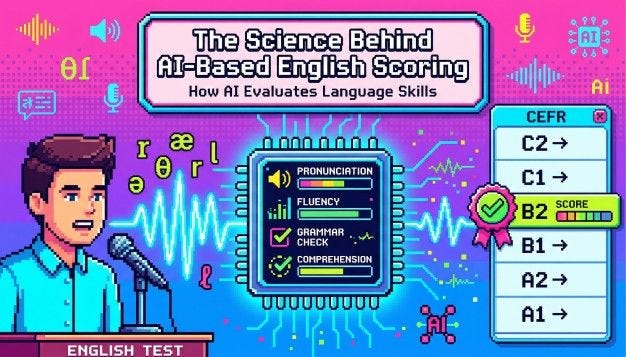
Illustration of AI-based English scoring system evaluating pronunciation, fluency, grammar, and comprehension with CEFR levels
TL;DR
AI English proficiency evaluation uses speech recognition and language processing to score spoken English in five areas: fluency, vocabulary, grammar, pronunciation, and the effect of the native language. The scores follow the CEFR scale, which is known worldwide by schools and companies. Hyring’s English Proficiency Test uses this AI evaluation in hiring, making the language test more scientific, accurate, and fair for all candidates.

AI English speaking assessment dashboard showing pronunciation analysis, fluency, grammar accuracy, and CEFR score.
One problem interview panels often ignore is that two interviewers may judge the same candidate’s English skills differently. One may see a fluent speaker, while the other may have doubts. Both evaluations are valid; they just reflect personal opinions. An AI scoring system was created to fix this issue. It does not replace the interviewer but gives a common standard for their evaluations.
What AI English Proficiency Scoring Actually Does
It is more than just a speech recognition tool. While regular speech-to-text software only records what is said, an AI system also looks at how words are spoken, the speed of speech, pauses, clarity, and rhythm. It also considers vocabulary and grammar.

Comparison of basic speech-to-text vs AI proficiency scoring system with acoustic analysis, fluency metrics, and final proficiency score
What is important? Speaking correctly does not mean the candidate will be easy to understand in a real conversation. Grammar and other language features do not always show this.
How the Technology Works Under the Hood
There is a specific order of steps, with each one building on the last.
Automatic speech recognition (ASR) is the first step. It does more than just create a transcript; it records speech at the level of sounds, considering timing, stress, and intonation.
Next, Natural language processing (NLP) models analyze the text. These models learn to recognize skill levels by studying many rated samples. They do not just follow grammar rules but find language skills based on patterns.
Finally, scoring algorithms take features from both steps and convert them to a standard scale.
The Five Dimensions That Build the Score
Hyring’s EPT does not give one overall score but scores five specific areas based on real work performance:
- Fluency: How smoothly someone communicates, how often they pause to correct themselves, and if they speak easily or with effort.
- Vocabulary: The range and appropriateness of words used.
- Grammar: The correctness and complexity of language. A few small mistakes in a long answer are less impactful than repeated mistakes.
- Pronunciation: Evaluated in a work setting. It is not about having a perfect accent but being clear enough to understand without extra effort.
- Mother Tongue Influence: It is okay for the native language to affect English skills. The system checks if this influence impacts communication.

Three-stage AI speech evaluation process showing ASR speech input, NLP linguistic analysis, and CEFR-based scoring algorithm
Together, these five criteria show hidden issues that one score might miss. An applicant might speak well but have bad pronunciation. Or they could be great at grammar and reading but struggle with vocabulary.
Why CEFR Gives the Score Real Meaning
The Common European Framework of Reference for Languages (CEFR) is a system that rates language skills from A1 (Beginner) to C2 (Proficient). Each level has clear descriptions of what a person can and cannot do.
A score of 74 out of 100 means little without a conversion chart. But a B2 on the CEFR scale tells hiring managers that the person can hold professional conversations, answer unexpected questions, and communicate without constant prompts. A C1 level shows even more skill: taking part in complex discussions and negotiations.
CEFR is used by the British Council and big companies as a standard. The EPT test from Hyring matches well with CEFR, so scores are consistent. A B2 in Manila means the same as a B2 in Warsaw.

A chart comparing candidate English proficiency with metrics like fluency, vocabulary, grammar, pronunciation, and filler words
AI vs. Human Scoring: What the Evidence Shows
Raters can get tired. A recruiter judging the fifteenth call of the day may not focus as much as on the first. This is just human nature.
There’s also bias against accents in language tests. Non-native speakers often get lower scores based on how familiar their accent is, even if they communicate well. This is hard to change in humans.
AI does not have these issues. Candidate 200 is judged the same way as Candidate 1 using the same criteria. Studies show that AI scoring is as reliable as two experienced raters judging the same samples.
However, some things, like background noise or technical issues, can affect results. Still, when accurate assessments are needed, AI often does better than human-only evaluations.
How This Changes the Hiring Process
Setting a language level requirement is easy. But applying it to 300 candidates is much harder.
If you have a team hiring for jobs needing client interaction, you can filter out candidates with B2 level skills and above before interviews. This way, tired recruiters won’t let less qualified candidates through.
Hyring’s English Proficiency Test fits into the hiring process. Language tests are combined with resume screening and video interviews, giving recruiters a full picture instead of separate test results. In some cases, the language assessment happens during an AI-led interview, so candidates are judged while they communicate, not just on a separate test.
This is important because how someone performs on a test may not match how they do in a real interview.
Key Takeaways
- An AI English score checks speech using sound and language at the same time. It looks at five areas: fluency, vocabulary, grammar, pronunciation, and the effect of the first language.
- This helps show issues that one score might hide. Scores linked to CEFR levels are useful in real life for many fields. No conversion is needed for B2 or C1 levels.
- The main benefit of AI scoring is not being perfect but being consistent. AI does not get tired and is not biased by accents. Hyring uses this assessment in hiring, making the process more consistent.
Frequently Asked Questions
1. What does AI English proficiency scoring actually measure?
It looks at five main parts of spoken English: fluency, vocabulary, grammar, pronunciation, and how much a person’s first language affects their speech. It uses sound and language rules to create the score.
2. What is CEFR, and why does it matter for hiring?
CEFR stands for the Common European Framework of Reference for Languages. It is a six-level scale made by the Council of Europe. Each level describes how well someone can communicate, making scores easy to understand and compare.
3. Is AI scoring fair to non-native English speakers?
It may be less biased than human scoring in some cases. Human raters can favor familiar accents. AI scoring focuses on how clear the speech is, not the accent. The data used to train the AI is also very important.
4. How is this different from IELTS or TOEFL?
IELTS and TOEFL are tests for school and immigration, not for hiring. They take hours to complete and give results in days. AI-based workplace assessments like Hyring’s EPT provide instant CEFR-based results during the hiring process.
5. Can a recruiter interpret proficiency scores without a linguistics background?
Yes. CEFR levels are explained simply. A recruiter just needs to know that B2 means ‘clear and confident in most work situations,’ and C1 means ‘fluent in discussing complex topics.’
메타데이터
- post_id
- b5d600db2e91
- slug
- the-science-behind-ai-based-english-proficiency-scoring-b5d600db2e91
- url
- https://medium.com/@adithyan_rk/the-science-behind-ai-based-english-proficiency-scoring-b5d600db2e91
- canonical_url
- https://medium.com/@adithyan_rk/the-science-behind-ai-based-english-proficiency-scoring-b5d600db2e91
- author_url
- https://medium.com/@adithyan_rk
- status
- ok
- fetched_at
- 2026-07-11 21:05:18