Kelp! I Need Somebody
Pardon the Beatles song analogy, but KELP needs all the HELP it can get.
Kelp! I Need Somebody
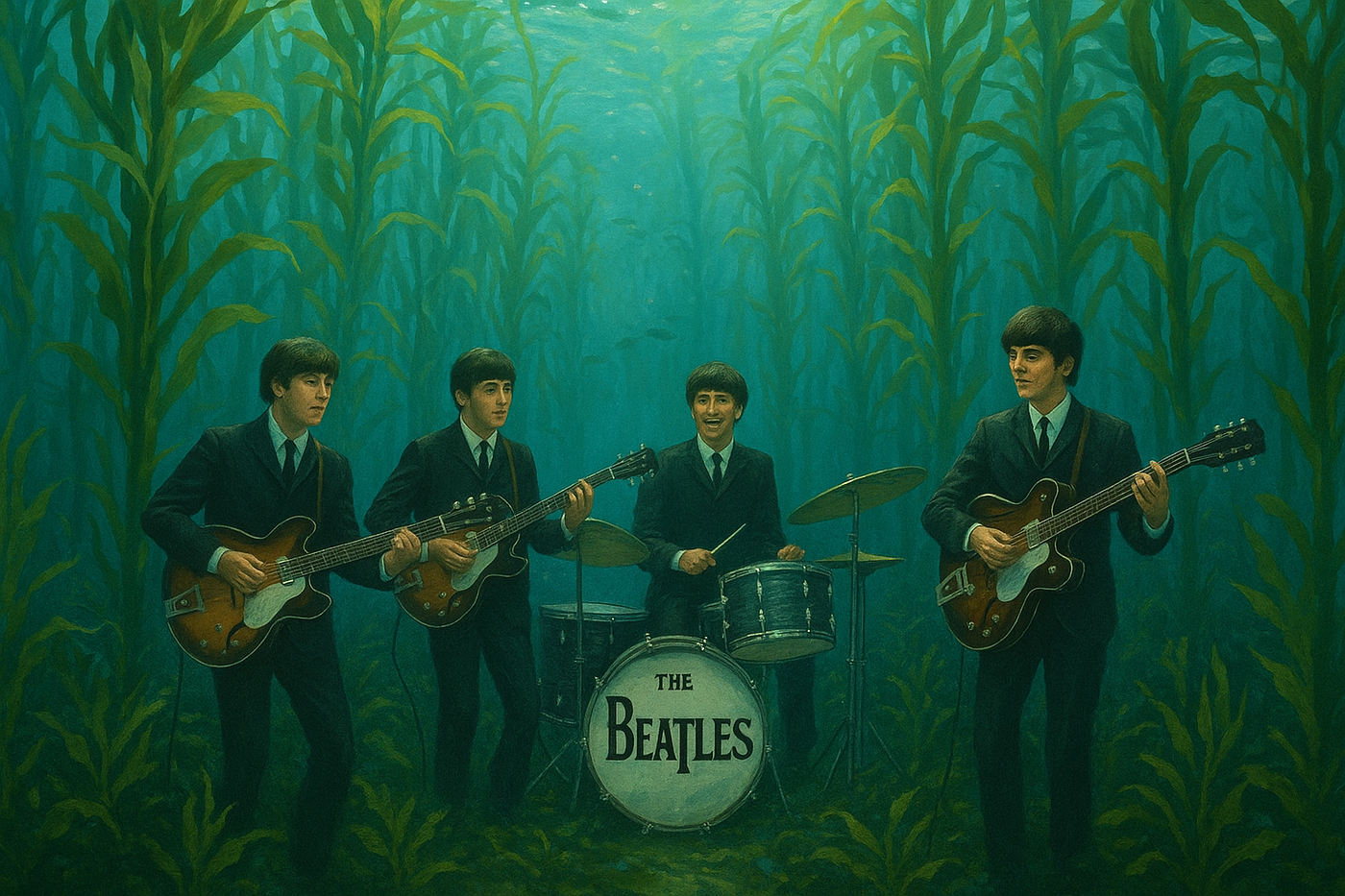
Underwater kelp forest scene with The Beatles — AI-generated using ChatGPT (OpenAI)
Pardon the Beatles song analogy, but KELP needs all the HELP it can get.
“When I was younger, so much younger than Today,
Never [gave a second thought to kelp] in any way.
But now [with climate change,] in oh so many ways,
[These sea kelp forests may just] vanish in the haze.”
— with apologies to the ghost of John Lennon and to Paul McCartney.
Many of you may already be asking, “What is kelp?” or even, “What if a few pieces of smelly seaweed disappear?”
Well, let me enlighten you by pointing you in the direction of Sir David Attenborough and Colin Butfield’s “Ocean” (Ref 1), and perhaps, along with some appropriately borrowed material from various other references, we can have a few laughs along the way? After all:
“Kelp forests, to those who know them and love them, are some of the most majestic places on Earth. But for many others, these magnificent ecosystems remain unknown, out of sight and out of mind beneath the waves.” Mission Blue’s “Kelp 101” (Ref 2).
1. What is Kelp?
Kelp, believe it or not, is a type of seaweed that, when grouped together as a giant kelp species, forms a kelp forest, a magnificent aquatic phenomenon that, unlike any terrestrial timber forest, is completely resistant to forest fire in its natural environment. This may be why kelp forests don’t spark our interest and, what’s more, why so few of us have a burning passion for kelp. 😂
Kelp, like all seaweeds, is not a plant, but belongs to the protists set of organisms (Ref 2).
“Methinks the [kelp] doth [protist] too much.” Apologies to William Shakespeare’s and ‘Hamlet’.
But, unlike Hamlet, kelp needs all the protistors it can summons in order to guard against the many threats to its species (see 5 below).
Back then to the kelp species which has several unique, plant-like and, coincidentally, plant-dissimilar features (refer Fig 1 below).

Fig 1: Kelp Anatomy (from surfscience.org, Ref 3)
The more discerning of you may be instantly drawn to the ‘gas bladder’ features, which are buoyancy aids, and not ornaments capable of discharging smelly hydrogen sulphide (and other natural gasses) aimed at scaring away vegetarian predators, should they choose to masticate the kelp fronds. 😂

Fig 2: Funky fart cloud — generated using ChatGPT (OpenAI)
Then there’s the ‘holdfast’ root-dissimilar base which fastens the kelp onto its foundation and will be referred further below.
2. Where can I find Kelp?
Kelp only needs cool clear saltwater full of nutrients, a hard base in which it can anchor its stalked stump-like ‘holdfast’, sunlight, and lots and lots of carbon (Ref 4). It can therefore be reportedly found in 25% to 30% of our planet’s temperate to polar, clear coastal waters (lower range from Ref 4, upper range from Ref 1). Because kelp draws its nutrients from sunlight and water, and cannot extract these from the soil, rock, oyster beds, or other hard base on which its ‘holdfast’ (stalked stump) is anchored, it fully depends upon photosynthesis to maintain its rapid growth of reportedly between 50cm (1.5ft) and 60cm (2ft) per day (lower range from Ref 4, upper range from Ref 1). It is thus prone to damage from light-reducing pollution in the water, among other injurious factors.
Like land-based trees, kelp in marine forests can grow to significant heights (or depths, depending upon your point of reference), reportedly maxing out between 30m (100ft) and 45m (150ft) (Ref 1, 4 and 5).
Incidentally:
“The answer to, ‘Does my bum look big in this?’ depends upon the respondent’s point of reference, ie from the back, side or front of the questioner, and whether or not the respondent is married to (and wishes to stay married to) the questioner.”Dreamed up by the author, during an epiphany while writing this post.😂
3. Why is Kelp so Important to the Planet?
“Kelp forests are considered ‘foundation species’ or ‘ecosystem engineers’ because they create complex habitats that provide food, shelter, and nursery grounds for thousands of marine species …” — The famous Dr Google’s “Kelp in Australia” (Ref 5).
Being a retired engineer myself, I assume that kelp (the ecosystem engineer) has never been subjected to the pressure of being ‘on time’ and ‘on budget’, never been criticised for not following ‘standard procedures’, and has never been struck off client lists for not meeting quality control requirements. 😂

Fig 3: The author undertaking a quality control inspection, prior to retirement.
Getting back to the importance of kelp forests, it happens that their lengthy fronds feed and/or shelter such diverse species as lingcod, sheepshead, rockfish, seahorses, abalone, rock lobster, finfish, snails, urchins, octopus, jellyfish, rays, sea otters, seals and other marine mammals, both those that are locally residing and those passing through during migration (Ref 1,2 and 5). Indeed, some of these species are endemic to the kelp forests and the reefs on which some kelp anchor their ‘holdfasts’.
Then there’s the shoreline ‘protection services’ they provide (without having to pay Big Vinnie in advance 😂). Kelp forests, not unlike their mangrove coastal buddies, dissipate wave energy from storm surges, thus reducing potential for shoreline erosion.
Since kelp derives its nutrients and carbon requirements from the water and air (see 2 above) and not from a root system, in order to sustain its rapid growth, it works as an unpaid 24/7 marine swimming pool cleaner, “absorbing nutrients from agricultural runoff pollution,” and, “drawing down significant amounts of carbon” as it grows (Ref 2). As a consequence, it reduces the risk of toxic algae blooms (Ref 4).
4. Why is Kelp so Important to us?
The benefits of Kelp stretch beyond the ocean, providing advantages and aids to humans, and to the land, as outlined below:
- Cooking — Kelp is harvested for use in the kitchen, to enhance the flavour of food and as a salt substitute in the form of dried granules and powders (Ref 5 and 6). Being rich in nutrients, it is also used in the health food industry and in food supplements (Ref 6). [Here the emphasis is on ‘enhancing’ our food. Can’t really see me sitting down to a main course of kelp, as yet — see Fig 4 below. 😂 ]

Fig 4: Kelp pasta? Looks delicious — NOT! (photo from Ref 8)
- Pharmaceuticals — Kelp is used in cosmetics and reportedly in some medicines (Ref 6), although with respect to the latter, I could only find reference to its research development for possible use in anti-coagulants, immune-related disorders, anti-aging products, and to inhibit growth of cancer cells (Ref 8). Furthermore, it was clearly stated that “more research is needed to fully understand its potential in cancer treatment.” As for the cosmetics, I guess that kelp mask beauty is in the eye of the beholder? 😂

Fig 5: Kelp mask for Halloween anyone? (AI generated using ChatGPT, OpenAI)
- Plastic Alternative — The polysaccharides in kelp have ‘film forming abilities’ so that a plastic replacement for packaging (especially food packaging) can be made from kelp and other seaweeds (Ref 7). The cost of such bio-plastics is still relatively high, however, compared to petroleum based plastics, although scientists are continuing to work on ways to improve bio-plastic affordability.
- Agriculture — Kelp extract is reportedly increasing in popularity for improving plant growth (Ref 8). Plants can be treated either with a foliage spray or using kelp to fertilise the soil. This has resulted in improved growth, yield and resistance to ‘pests and diseases’. Apparently, some vegetables have increased in size and quality after being treated with kelp extract powder during crop growth. [Just take care! That kelp extract’s powerful stuff. Too much and the veggies will want a bigger celery … and a stock option. Also, you don’t want them turning into Bruce Leek. 😂]
5. What are the Threats to Kelp?
“… we can say that kelp forests have declined around the world over the last hundred years and are still declining.” Attenborough and Butfield (Ref 1).
All is not, however, as clear as it might seem, particularly since the changes to kelp forests are complex and the ecosystems associated with them are “extremely dynamic”.
The various threats to Kelp forests have been well documented over the years and are outlined below (Ref 1, 2, 5, and 6):
- Climate Change — Kelp species only thrive in cooler waters and hence, as climate change heats our oceans and they experience regional marine heatwaves, kelp in many large areas is dying off.
“In Northern California and Southern Australia, marine heatwaves in the 2010s triggered a cascade of events that lead to the loss of over 90% of the kelp canopy cover in less than a decade … that have yet to recover” Mission Blue’s “Kelp 101” (Ref 2).
- On the other hand, however, it appears that, as the oceans heat up in our cool to moderate coastal areas and the ice starts to melt in our polar regions, some kelp species may be succeeding in spreading to colder latitudes. Scientists warn, however, that this may come at the expense of other species that cannot exist in a warming climate. Furthermore, the increase in frequency and intensity of storms results in more kelp being uplifted from their ‘holdfast’ bases to be either deposited along shorelines or to drift out to sea.
“But research does appear to show that, overall, kelp forests in Western Australia, New South wales and parts of New Zealand are declining, as they are certainly doing in Maine and the wider north-eastern United States coast. By contrast, many in Greenland, Southern Chile and parts of Norway are stable or even increasing.” Attenborough and Butfield (Ref 1).
- Pollution and Turbidity — Water turbidity (ie its cloudiness or murkiness) can lead to algae blooms that inhibit growth. Such turbidity can arise from excess storm run-off across bare soil, into rivers and hence our shores. Excessive nutrient levels can also arise from uncontrolled sewage discharge, and from agricultural fertilisers in run-off. Illegal industrial pollution and sediment dumping (eg from onshore earthworks and from marine dredging) has also damaged kelp forests in some areas.
- Although kelp, in a well-balanced environment, can provide much clarification and filtration of water (refer 3 above) by its need to draw in carbon and nutrients through its fronds, there appear to be limits to the amount of nutrients and turbidity it can handle without severely impeding its growth and presence.
- Overgrazing and Overfishing — Species such as long-spined sea urchins, that graze on kelp, can lead to large kelp devoid barren areas when predators to urchins, such as rock lobsters and wrasse, are removed by overfishing. This emphasises the sensitivity of our oceans to natural balance and how easy it can be to create destruction through man-made imbalance.
- As fish stock are diminished, the commercial fishing industry has developed larger and more powerful trawlers, whereby weighted nets and chains are dragged along the seabed. These methods can not only destroy growing kelp forests but also destroy muscle and oyster beds, and sea grasses which had become the spawning and feeding grounds for many fish and other species, thus propogating the overfishing problem. A well documented example of such overfishing damage has been documented at Shoreham-by-Sea, Sussex, England (Ref 1) and will be discussed more in 6 below.
6. How can we Help Kelp?
There are many organisations aware of the plight of the kelp forest and who are working to “protect, conserve and restore” these magnificent wonders (Ref 2). Some of these organisations and projects are listed below:
- Mission Blue, supporting projects in Northern Island, Humboldt Archipelago in Chile, False Bay in South Africa;
- Operation Crayweed in NSW, Australia;
- Tasmanian Giant Kelp Restoration Project, Tasmania, Australia;
- A ‘marine gardening’ restoration project in South Korea (which has reportedly restored more area of kelp than any other country, Ref 2);
- Smaller scale projects in Chile, Northern California, and in Wellington, New Zealand.
In addition to the above examples, Attenborough and Butfield (Ref 1) describe how a severe 1 in 200 year storm in 1987 uprooted some 14km of kelp forest and deposited huge kelp piles on beaches near Shoreham-by-Sea, Sussex, England. Subsequently, the trawl nets of large commercial fishing boats scraped across the beds on which the kelp had anchored and, together with sediment dumping, had a devastating effect on the the kelp and its associated ecosystem.
Luckily through the foresight of Eric Smith (a local freediver), Dr Sean Ashworth (Sussex Inshore Fisheries and Conservation Authority), and Sarah Cunliffe (award-winning wild-life filmmaker), the spotlight was shone on this problem over a prolonged period of time. Eventually new laws were passed in 2021 establishing a ‘no-trawl’ zone in the area. The result is that kelp is slowly returning, along with its reliant species, and both the local community and the broader UK community are not only more eco-savvy but are assisting with monitoring as part of the “Help Our Kelp” campaign.
Here it’s worth quoting Attenborough and Butfield’s summary of the situation at Sussex, as a lesson for others:
“Sean notes that the most vociferous opposition came from big trawling businesses based far away. Nevertheless there were enough in the fishing community who could see the writing on the wall. Fish stocks were too low. More and more effort was going into catching less and less. From scientific research around the world it is now widely understood both that kelp forests function as critical marine nursery grounds and that the density with which kelp grows buffers the energy of the waves so that egg cases which are laid on the kelp are not dislodged and washed away. Not only could there be no fishereis without fish; there could be few fish without kelp.” Attenborough and Butfield (Ref 1).
“The solutions aren’t simple — but they are growing quickly, just like the kelp. And whether it’s through policy, research, restoration, or simply spreading the word, there’s a role for all of us to help the kelp.” Mission Blue’s “Kelp 101” (Ref 2).
So let me just close with a little more Help from The Beatles (apologies again to John and Paul for the edits):
Help [kelp] if you can, [it’s being knocked] down,
And I would appreciate you being round,
Help [kelp] get its [roots] back on the ground,
Won’t you please, please, help [kelp],
Help [kelp], help [ke-e-elp], ooh?
References
-
Attenborough, D and Butfield, C (2025), Ocean: Earth’s Last Wilderness, John Murray (Publishers).
-
https://missionblue.org/2025/05/kelp-101-what-are-kelp-forests-and-why-do-they-matter/
-
https://www.plantextractwholesale.com/blog3/kelp-extract-powder-composition-and-characteristics/

When not researching the weird or the wonderful, the comical or the cultured, the sinful or the serious, I chase my creative side, the results of which can be seen as selected photographs of my travels on my website at:
***http://ken-boddie.squarespace.com***
The author of the above, Ken Boddie, besides being a sometime poet and occasional writer, is an enthusiastic photographer, rarely leisure-travelling without his Canon, and loves to interact with other like-minded people with diverse interests. A retired geotechnical engineer, he honed his knowledge of the English language during decades of labouring over formal reports, with an ever conscious awareness of the need for clarity and precision in an increasingly litigious world. More recently, he has engaged in various post graduate English language and grammar studies, leading to his volunteering as an English tutor to adult migrants who have chosen to come to the ‘lucky country’ of Australia.
메타데이터
- post_id
- b5d6f69c5e39
- slug
- kelp-i-need-somebody-b5d6f69c5e39
- url
- https://medium.com/the-environment/kelp-i-need-somebody-b5d6f69c5e39
- canonical_url
- https://medium.com/the-environment/kelp-i-need-somebody-b5d6f69c5e39
- author_url
- https://medium.com/@kenboddie
- status
- ok
- fetched_at
- 2026-06-18 00:10:23